
Yes – you can form a U.S. LLC from India without a U.S. visa, SSN, or flight to the U.S. The basic path is simple: pick a state, file the LLC, get an EIN from the IRS, open a U.S. bank account, and keep up with tax and state filing deadlines.
Here’s the short version:
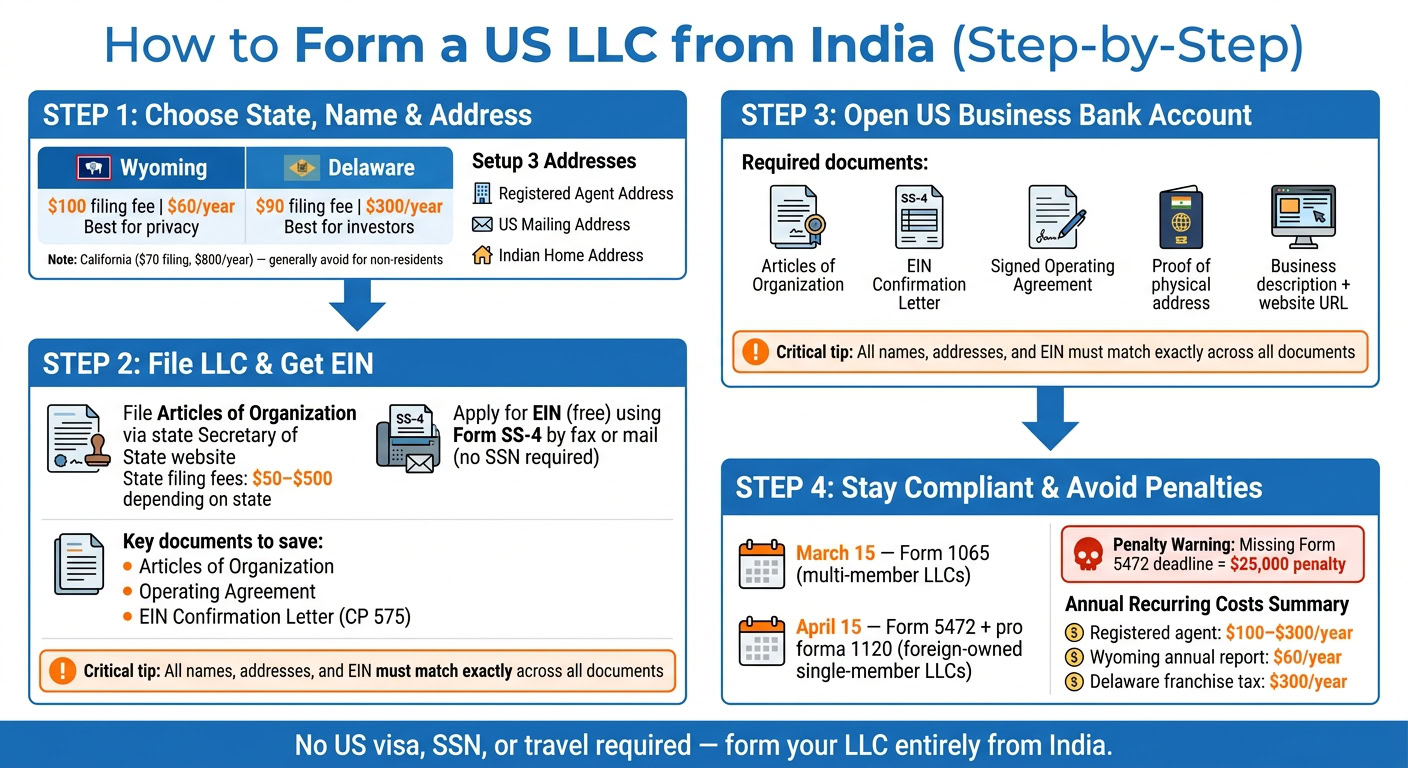
- Wyoming is often the low-cost pick, with a $100 filing fee and $60/year state fee.
- Delaware is often chosen when you may want investors later, with a $110 filing fee and $400/year franchise tax.
- You can get an EIN for free, but if you don’t have an SSN or ITIN, you usually apply with Form SS-4 by fax or mail.
- Banks often ask for three different addresses: your registered agent address, a U.S. mailing address, and your Indian home address as your physical address.
- Missing IRS filing deadlines can get expensive fast: Form 5472 penalties can start at $25,000.
Before I move into the full guide, here’s what matters most:
- Pick the right state
- Keep your name, address, and EIN records identical across documents
- Save your Articles, Operating Agreement, and EIN letter in one folder
- Track key tax dates like March 15 and April 15
If I were starting from India, I’d focus less on setup hype and more on document match, bank prep, and compliance after formation. That’s where most problems start.
Step 1: Choose a state, pick an LLC name, and set up an address
Choose the best state for a non-US owner
For most Indian founders, the choice usually comes down to Wyoming or Delaware. Why those two? Cost, privacy, and future fundraising tend to drive the decision.
| State | Formation Fee | Annual/Ongoing Fee | Key Notes |
|---|---|---|---|
| Wyoming | $100 | $60 | Best for privacy; member names not required in public filings; no state income tax |
| Delaware | $110 | $400 | Preferred by investors; well-developed business courts; no sales tax |
| California | $70 | $800 | Generally avoided by non-residents; $800 minimum franchise tax applies even with zero income |
In plain English, Wyoming is often the lower-cost and more private option. Delaware tends to make more sense if you expect investor interest later. California is usually a poor fit for non-residents because the $800 minimum franchise tax applies even if the business makes $0.
Pick a compliant LLC name and check availability
Once you’ve picked the state, make sure your LLC name is open before filing. The name has to include a designator such as “LLC” or “Limited Liability Company”, and it must be different from other business names already registered in that state. Some terms are restricted and may need state approval.
Before filing, do three checks:
- Search the name on the official state filing portal
- Run it through the USPTO trademark database
- See if the .com domain is still open
It also helps to keep a backup name ready. That way, if your first pick gets rejected, you can move without losing time.
Set up a registered agent and a business mailing address
Every LLC needs a registered agent with a physical street address in the state where the LLC is formed. That person or service receives legal papers and state notices. If you’re based in India, you’ll usually hire a registered agent service in that state.
This part trips people up: a registered agent address is not the same thing as a business mailing address.
U.S. banks often ask for three separate addresses:
- Registered agent address
- U.S. mailing address
- Physical residence address
A virtual mailbox is for day-to-day mail, like bank cards or IRS notices. The registered agent is there for legal and compliance mail. Those are two different jobs, and banks often treat them that way. It’s smart to keep all three addresses clearly separated in your records before you file.
“A registered agent address or a virtual mailbox CANNOT be used as the physical address [for banking]. Your non-US residential address is acceptable with most banks.” – BusinessAnywhere
Once the state, name, and address are in place, the next step is filing the LLC and applying for an EIN.
sbb-itb-ba0a4be
Step 2: File the LLC and get an EIN
Once your state, business name, and address are set, the next move is simple: file the LLC and get your EIN.
File the Articles of Organization with the state
To legally form the LLC, you need to file the Articles of Organization.
If you live outside the U.S., you’ll usually do this through the state’s official Secretary of State website. You can also use a formation service like BusinessAnywhere, which offers $0 formation plus state fees.
You’ll usually need:
- Your LLC name
- Your registered agent’s name and address
- A mailing address for state notices
- Your management structure
- The organizer’s name and signature
State filing fees usually range from $50 to $500, depending on the state.
Create an Operating Agreement and save your formation records
An Operating Agreement is an internal document that explains how your LLC is owned and run.
Most states don’t ask you to file it publicly. Even so, it matters a lot for banking and for setting clear internal rules. Think of it as the rulebook for your company. If questions come up later, this document helps avoid confusion.
At a minimum, your Operating Agreement should explain:
- Member ownership percentages
- Management roles
- How profits are split
- What happens if a member leaves
After everyone signs it, save the signed Operating Agreement in one digital folder with your certified Articles of Organization and EIN confirmation letter.
Banks often ask for these documents next.
| Document | Purpose | Storage Format |
|---|---|---|
| Articles of Organization | Official proof of LLC existence | Digital + certified copy |
| Operating Agreement | Internal governance and banking support | Digital, signed by all members |
| EIN Confirmation (CP 575) | Tax ID for banking and IRS filings | Digital, keep with your formation records |
Apply for an EIN without a US Social Security number
An EIN (Employer Identification Number) is your LLC’s federal tax ID. The IRS issues it for free, and Indian founders can get one even without a U.S. Social Security number.
Here’s the catch: the IRS online EIN application is only open to applicants with a Social Security number or ITIN. If you’re a non-U.S. resident, you’ll need to apply by fax or mail using Form SS-4. Fax is usually faster than mail.
On Form SS-4, you’ll enter your:
- LLC name
- State of formation
- U.S. mailing address
- Entity type
- Reason for applying
- Responsible party’s name and Indian address
Once the EIN is issued, the IRS sends a CP 575 confirmation letter. Save that with your Articles of Organization and Operating Agreement. If you ever lose it, the IRS can send a 147C letter as a replacement.
After the EIN comes through, you’re ready for bank verification.
Step 3: Open a US business bank account and prepare for verification
Once your EIN is issued, the bank will check your LLC against the state formation records. At that point, you can move ahead with a U.S. business bank account.
Most hold-ups don’t come from the bank itself. They usually happen when details don’t match across your paperwork.
Prepare the documents banks typically request
Banks check three things: your LLC, your identity, and what your business does. If you pull everything together before you apply, you’ll cut down on a lot of back-and-forth.
| Category | Required Documents |
|---|---|
| Entity Proof | Approved Articles of Organization |
| Tax ID | EIN Confirmation Letter (CP 575 or 147C) |
| Internal Governance | Signed Operating Agreement |
| Personal ID | Valid Indian Passport |
| Address Proof | Proof of physical address (utility bill or bank statement) |
| Business Activity | Brief business description and website URL |
Make sure your address, phone, and records match across all applications
The biggest banking problem is consistency.
Banks want three separate addresses during verification:
- Registered agent address – the state filing address for legal notices
- Mailing address – where the bank sends your debit card and statements; one of the best virtual mailbox services with a real U.S. street address works here
- Operating address – where the business actually runs
Use your Indian home address as the operating address. A lot of applications get flagged or denied when people enter a registered agent address or virtual mailbox in that field.
Your LLC name and EIN should match exactly across your Articles of Organization, your CP 575 or 147C letter, and the bank application. Even a small mismatch can trigger a compliance review.
Use a U.S. phone number for bank calls and two-factor authentication codes. Also make sure the business description on your bank application matches what you put on Form SS-4 and in your Operating Agreement. If those descriptions don’t line up, that’s another common verification flag.
Keep scanned copies of your Articles, EIN letter, and Operating Agreement in one folder.
After the account is open, stay on top of state filings and federal reporting.
Step 4: Stay compliant, understand your taxes, and avoid common mistakes
Track annual state filings, registered agent renewals, and federal reporting
Formation is a one-time task. Compliance is the part that keeps going.
Most states require an annual report or franchise tax filing to keep your LLC active. If you miss one, you could face fees, lose good standing, or even have the state dissolve the LLC. Your registered agent also needs to stay active at all times, and that service usually renews each year for about $100 to $300 per year.
On the federal side, foreign-owned single-member LLCs usually file Form 5472 with a pro forma Form 1120 by April 15. Miss that deadline, and the penalty can be $25,000. Multi-member LLCs usually file Form 1065 by March 15 and send Schedule K-1s to each member. Late filing penalties can reach $210 per member, per month. These filings still matter even if the LLC owes no U.S. income tax.
A simple system helps a lot here. Keep your formation papers, bank records, and tax documents in one folder. Set calendar reminders for March 15 and April 15 so those dates don’t slip past you. If your address changes, update your state records, IRS records, and bank records right away. It also helps to keep all LLC money in one bank account and save the statements with your tax files.
Understand the main costs and tax considerations for Indian founders
Once you know the filing rules, the next piece is cost.
Here are the recurring expenses most founders should expect:
| Cost Category | Estimated Amount |
|---|---|
| State formation fee | $50–$500 (varies by state) |
| Registered agent (annual) | $100–$300/year |
| Wyoming annual report | $60/year |
| Delaware franchise tax | $400/year |
| California annual franchise tax | $800/year |
Wyoming is usually the lowest-cost option. Delaware costs more, but many investor-backed companies still use it. California is usually the most expensive pick for remote founders because of its $800 minimum tax.
Conclusion: A clear start-to-finish roadmap from India
With filings and costs mapped out, the last part is keeping the LLC in good standing.
The sequence is simple: choose a state, file the LLC, get the EIN, open the bank account, and stay current on filings.
The most common post-formation mistakes are missed deadlines, mismatched addresses, and letting the registered agent expire. Forming a U.S. LLC from India is completely doable, but it goes much more smoothly when your documents, addresses, and deadlines are handled in the right order from day one.
FAQs
Do I need an ITIN to form a U.S. LLC from India?
No. You do not need an ITIN to form or run a U.S. LLC from India.
You can get an EIN from the IRS without an SSN or ITIN. On Form SS-4, leave the SSN/ITIN fields blank or enter “foreign” or “N/A” as instructed.
An ITIN usually comes up later, and only if you have personal U.S. tax filing duties. For most founders, that means you can set up the LLC first and deal with an ITIN only if your own tax situation calls for it.
Can I open a U.S. bank account without visiting the U.S.?
Yes. You may be able to open a U.S. business bank account remotely, especially with fintech or digital banking platforms. Many old-line banks still ask you to visit a branch in person.
In most cases, you’ll need your LLC formation documents, EIN, a valid passport, and proof of your home address in India. Banks also ask for a physical address in the U.S., and it can’t be a registered agent address or a virtual mailbox.
What taxes does a foreign-owned U.S. LLC usually have to file?
Foreign-owned U.S. LLCs can still have federal filing duties even when they make $0 in income. That’s the part many people miss.
If you have a single-member LLC with 25% or more foreign ownership, you usually need to file Form 5472 along with a pro forma Form 1120 by April 15.
If the LLC has more than one member, it will usually file Form 1065 by March 15.
Nonresidents may also need to file Form 1040-NR if the LLC has effectively connected income in the U.S. On top of that, some states charge franchise taxes or annual report fees.
Miss a required filing, and the penalties can be steep.
Related Blog Posts
- How to register an LLC in the US from India
- How to register an LLC in the US from Pakistan
- How to Open a US LLC as a Non-US Resident in 2026 (Complete Step-by-Step Guide)
- US LLC for Indian Founders: The Complete 2026 Guide to Forming a US Business