

Short answer: yes, but most people should not use one. If I want to start a charity in the U.S., I would usually form a nonprofit corporation, not an LLC.
Here’s the simple version:
- An LLC and tax-exempt status are not the same thing
- A mission-driven LLC is usually still taxable
- A 501(c)(3) LLC can exist, but only under tight IRS rules
- In most cases, all LLC members must be other 501(c)(3) groups or government units
- If I’m an individual founder who wants tax-deductible donations, grants, and charity status, a nonprofit corporation is the standard path
A big source of confusion is that people use “nonprofit LLC” to describe three different setups:
- A normal LLC with a social mission
- An LLC owned by an existing nonprofit
- An LLC trying to get its own 501(c)(3) status
That difference matters. An LLC can pass money to members by default. A charity cannot. So even if an LLC says it wants to do good, that alone does not make it tax-exempt.
There’s also a hard ownership rule. Under IRS guidance, a 501(c)(3) LLC is usually limited to members that are already 501(c)(3) organizations or government units. That means individuals cannot directly own it in the usual stand-alone charity setup.
Quick comparison
| Setup | Who owns it | Tax-deductible donations? | Best fit |
|---|---|---|---|
| Nonprofit corporation | No owners; board-run | Yes, if IRS approves 501(c)(3) | New charities |
| LLC owned by a nonprofit | Parent 501(c)(3) | Usually through the parent | Property holding, liability separation |
| Mission-driven LLC | Individuals or investors | No, in most cases | Social enterprise |
| 501(c)(3) LLC | Only exempt groups or government units | Yes, if IRS approves | Joint projects, nonprofit subsidiaries |
One more point: the IRS does not treat this as a shortcut. A qualifying LLC must use Form 1023, not Form 1023-EZ, and its documents must block private profit, limit its purpose to exempt work, and send assets to charity if it shuts down.
So if you’re asking, “Can I form a nonprofit LLC?” the better question is: Am I starting a nonprofit or an LLC, or am I starting a mission-driven business? That answer usually tells me which entity to pick.
sbb-itb-ba0a4be
Nonprofit LLC vs. Nonprofit Corporation: What Is the Difference?
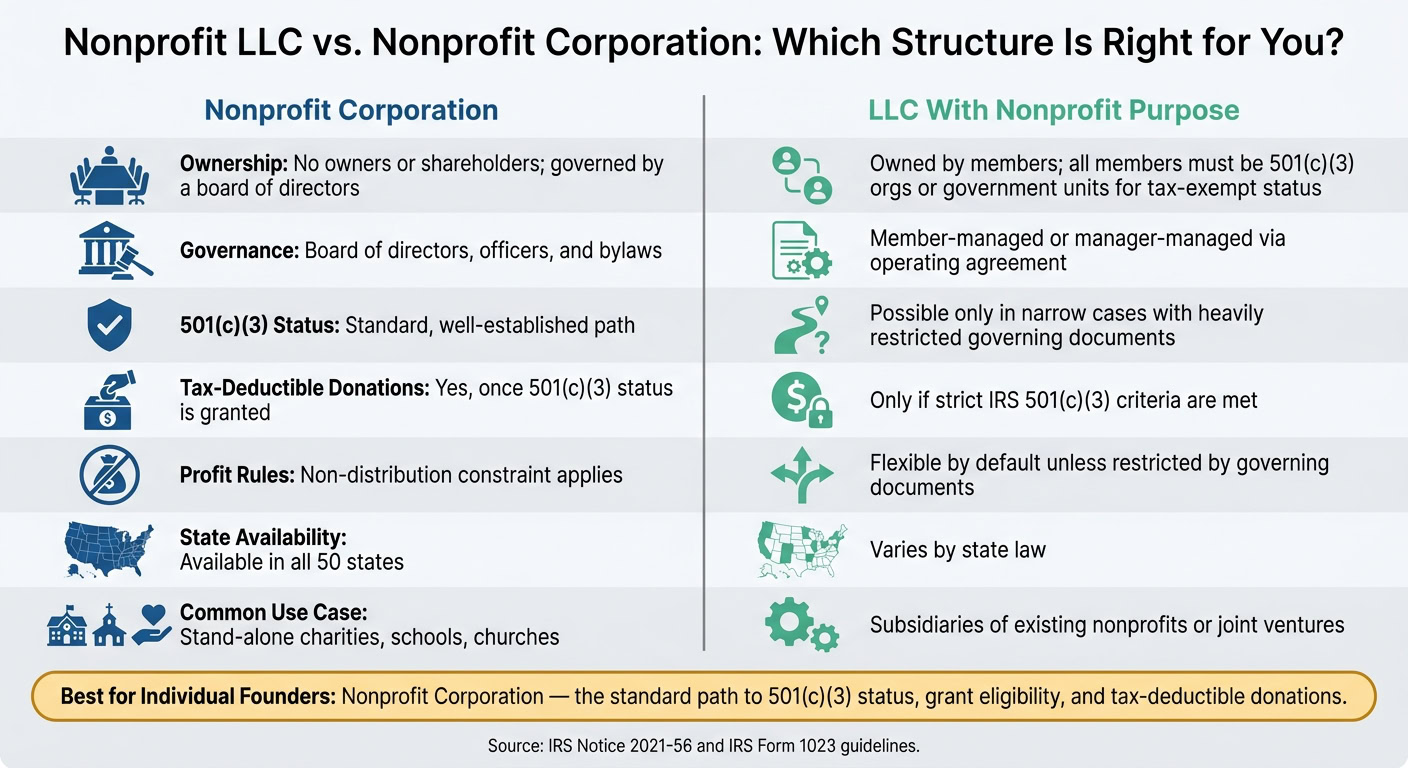
Nonprofit LLC vs. Nonprofit Corporation: Which Structure Is Right for You?
A nonprofit corporation is a state-law entity built around a mission, not owner profit. A standard LLC, on the other hand, is member-owned and usually set up to distribute profit. That’s why LLCs are much harder to use for charitable work.
How Ownership, Governance, and Profit Rules Differ
The biggest difference comes down to governance and where the money can go. A nonprofit corporation has no owners or shareholders. Instead, it is governed by a board of directors, and that board has fiduciary duties to the organization’s mission, not to private owners.
An LLC works in a very different way. It is owned by members, who can run the business themselves or appoint a manager. The operating agreement sets the rules, including how profit is allocated.
That leads straight to the non-distribution constraint, which is the core rule for nonprofit entities. A nonprofit corporation can bring in revenue, but it cannot pass surplus funds to private individuals as profits or dividends. Any surplus has to go back into the mission.
A standard LLC doesn’t come with that rule built in. Its members can divide and distribute profit however the operating agreement permits. And that’s the exact point of friction with 501(c)(3) rules.
For an LLC to meet IRS standards, it needs custom provisions. These usually include a charitable purpose clause, a ban on private profit distributions, limits on who can be a member, and dissolution terms that follow nonprofit rules. The IRS laid out these requirements in Notice 2021-56.
Here’s the practical side-by-side view that affects both formation and IRS treatment.
Comparison Table: Nonprofit Corporation vs. LLC With Nonprofit Purpose
| Feature | Nonprofit Corporation | LLC With Nonprofit Purpose |
|---|---|---|
| Ownership | No owners or shareholders; governed by a board of directors | Owned by members; for 501(c)(3) treatment, all members must be 501(c)(3) organizations or governmental units |
| Governance | Board of directors, officers, and bylaws | Member-managed or manager-managed via an operating agreement |
| State Availability | Available in all 50 states | Availability varies by state law |
| 501(c)(3) Status | Standard, well-established path | Possible only in narrow cases with heavily restricted governing documents |
| Tax-Deductible Donations | Yes, once 501(c)(3) status is granted | Only if strict IRS 501(c)(3) criteria are met |
| Profit Rules | Non-distribution constraint applies | Flexible by default unless restricted by governing documents |
| Common Use Case | Stand-alone charities, schools, and churches | Subsidiaries of existing nonprofits or joint ventures |
Those rules decide whether an LLC can qualify at all, which the next section explains.
Can You Form a Nonprofit LLC in the U.S.?
Yes, but only in a small set of situations. A nonprofit LLC has to clear two separate hurdles: state formation law and IRS tax rules.
Here’s the key point: a state might let you form an LLC for charitable purposes, but that doesn’t mean the IRS will treat it as tax-exempt. State approval is the first step. IRS approval is the tougher one.
State-Law Nonprofit LLCs and Why Availability Varies by State
State rules are all over the map. Some states clearly allow LLCs formed for charitable purposes. Others treat LLCs as for-profit entities unless a law says otherwise. And some states push charities toward a nonprofit corporation or LLC instead.
Before you file anything, check your state’s LLC statute or your Secretary of State’s guidance. If your state allows this path, the next issue is whether the LLC can meet IRS rules.
When an LLC May Qualify for 501(c)(3) Status
The IRS has issued guidance on when an LLC may be recognized as a 501(c)(3) organization. The rules are strict, and there’s not much wiggle room.
Every member of the LLC must be either a 501(c)(3) organization or a governmental unit. That means individual founders can’t directly own a 501(c)(3) LLC. On top of that, the LLC’s governing documents must do a few specific things:
- Limit the LLC to exempt purposes
- Bar private distributions
- Dedicate assets to charity if the LLC dissolves
- Block transfers to non-exempt parties
- Include a backup rule in case a member loses exempt status
The LLC also has to file Form 1023, not the shorter Form 1023-EZ. And it must follow the same operating limits that apply to a nonprofit corporation: no private inurement, no substantial lobbying, and no political campaign activity.
The IRS taxes the LLC as a corporation, not a partnership. That’s a big reason nonprofit LLCs usually show up as ownership vehicles rather than stand-alone charities.
In day-to-day use, that means nonprofit LLCs tend to work best as subsidiaries or joint ventures, not as charities owned by founders.
How LLCs Are Actually Used for Nonprofit Purposes
Once the formation rules are clear, the next step is seeing how these LLCs work in day-to-day use.
Single-Member LLC Owned by an Existing 501(c)(3)
When a 501(c)(3) owns a single-member LLC, the LLC is usually ignored for tax purposes and reported through the parent nonprofit. The parent reports the LLC’s activity on its own return, and the LLC usually doesn’t need a separate exemption filing.
This setup works well when a nonprofit wants one part of its work in a separate legal entity without changing the tax result. A common use is holding real estate, isolating liability, or running a specific program. Say a charity creates an LLC to own and operate a community center. The LLC can sign leases and hire staff, but the activity is still treated as part of the parent nonprofit. That means donor deductibility stays with the parent, and the LLC has to follow the parent’s 501(c)(3) limits.
The same setup can also be used for shared charitable projects.
Joint LLCs Owned by Nonprofits or Government Units
Two or more exempt organizations, or an exempt organization and a government unit, can form a joint LLC for a shared charitable project. You’ll often see this in collaborative health initiatives, shared community facilities, and multi-agency grant-funded programs. Each owner may put in funding, staff, or property, and the LLC serves as the operating vehicle while each member reports its share of the activity under the tax rules that apply to it.
If a joint LLC wants to qualify on its own, every member must be an exempt organization or a government unit. On top of that, the operating agreement has to lock in charitable-purpose and asset-dedication rules. The table below shows how these setups differ in practice.
Comparison Table: Nonprofit Corporation + LLC Subsidiary vs. 501(c)(3) LLC vs. Mission-Driven LLC
| Feature | Nonprofit Corp + LLC Subsidiary | 501(c)(3) LLC | Mission-Driven LLC |
|---|---|---|---|
| Ownership | Parent 501(c)(3) owns the LLC | All members must be 501(c)(3)s or government units | Individuals or investors |
| Tax Treatment | LLC is often disregarded; activity is reported by the parent | Can be tax-exempt if the IRS approves Form 1023 and the governing documents satisfy IRS rules | Taxable |
| Donation Deductibility | Donations go to the parent 501(c)(3) | Potentially deductible if the LLC is recognized as exempt | Generally not tax-deductible |
| Profit Distribution | Not allowed; surplus supports the mission | Not allowed; no private inurement | Allowed, subject to the operating agreement |
| Typical Use Cases | Real estate holding, liability isolation, specific programs | Joint charitable projects, public-private collaborations | Social enterprise, impact investing |
A mission-driven LLC is still taxable and is not a charity substitute.
Which Entity Should You Choose for a Charitable or Mission-Driven Business?
Best Choice for Individual Founders Seeking 501(c)(3) Status
If you’re deciding between a charity setup and a mission-driven LLC, here’s the simple rule: if you want to run a charity, accept tax-deductible donations, and apply for grants, form a nonprofit corporation – not an LLC.
Why? Because Form 1023 is the standard IRS application for 501(c)(3) recognition, and a nonprofit corporation is the usual structure for founders going after that status. Most states and grantmakers treat it the same way: as the standard charity vehicle.
That path comes with limits. You should expect rules around private benefit, compensation, lobbying, campaign activity, filings, and asset dedication. Those guardrails exist to protect charitable assets and keep them tied to the public good. In return, you can get tax-exempt status, grant eligibility, and donor trust.
If your business is mostly built to earn revenue but also has a social mission – say, a product company or a fee-for-service social enterprise – an LLC is often the better fit. It gives you profit distributions and flexible ownership. But in most cases, it does not give you charitable tax status.
How BusinessAnywhere Can Help With Formation and Compliance
Once you’ve picked the structure, the next step is filing and staying compliant. BusinessAnywhere can help with state filings, registered agent designation, and EIN acquisition through its LLC and corporation formation, registered agent service, EIN application service, and existing company maintenance offerings.
That means less time dealing with paperwork and more time spent on the mission.
Conclusion: The Short Answer on Nonprofit LLCs
A "nonprofit LLC" is not the default charitable entity in the U.S. Nonprofit corporations are the standard path for founders who want 501(c)(3) status, grant eligibility, and tax-deductible donations.
LLCs can still be used for nonprofit purposes. For example, they may work as subsidiaries owned by existing 501(c)(3) organizations or as joint ventures among exempt entities. But those setups depend on strict ownership rules, and they are not a match for an individual starting a stand-alone charity.
For individual founders, a nonprofit corporation is the default choice. LLCs fit only narrow nonprofit ownership structures.
FAQs
Can I personally own a 501(c)(3) LLC?
No. A 501(c)(3) LLC can’t be personally owned.
To qualify for 501(c)(3) tax-exempt status, the LLC must be owned only by a tax-exempt organization, such as another 501(c)(3) nonprofit or a governmental unit.
If your goal is a charitable mission, a nonprofit corporation is usually the standard setup. It has no owners and is run by a board of directors.
Why would a nonprofit use an LLC subsidiary?
A nonprofit can set up an LLC subsidiary to bring in revenue without pulling focus from its main charitable mission. In plain English, it gives the organization a separate lane for business activity that might otherwise muddy its tax-exempt purpose or eat up too much time and attention.
It can also place higher-risk or more commercial work outside the nonprofit’s main operation. That separation adds another layer of liability protection while still helping the organization support its long-term goals.
What happens if a mission-driven LLC accepts donations?
If a standard mission-driven LLC accepts donations, those contributions usually aren’t tax-deductible for the donor. That’s the big difference from a 501(c)(3) nonprofit corporation. A standard LLC is still not tax-exempt.
There’s another catch too: the business may need to follow state charitable fundraising registration rules. So even if the company has a social mission at its core, the LLC is still a for-profit entity. In most cases, that means the money is treated as taxable revenue, not tax-exempt donations.