


If you want a mission-first business that can still earn money, an L3C may fit. But it works only in 7 states as of August 9, 2026, and it does not give you tax-exempt status.
I’d sum it up like this: an L3C is a for-profit LLC with a public-purpose mission written into its legal setup. You can still distribute some profit to members, but profit cannot be the main point. If you want tax-deductible donations, I’d look at a nonprofit instead. If you want max return and broad investor appeal, I’d look at a standard LLC.
Here’s the short answer:
- Best for: mission-led businesses with modest return goals
- Not best for: VC-style growth or donor-funded models
- Federal tax status: usually pass-through, not 501(c)(3)
- State access: only Illinois, Louisiana, Maine, Rhode Island, Utah, Vermont, Wyoming
- Main tradeoff: more mission protection, fewer funding paths
A few facts matter most here:
- An L3C is formed under state LLC law
- It must put a charitable or educational purpose first
- It cannot be formed mainly for profit, lobbying, or campaign activity
- It can still operate across state lines, but that often means more filings and fees
- Foundation money is possible, but not promised
If I were choosing, I’d ask just three questions:
- Is the mission first on paper and in practice?
- Are members fine with lower returns?
- Will the business operate in a state that recognizes L3Cs?
If the answer to any of those is no, another entity type will usually make more sense.
| Entity | Main goal | Tax-exempt? | Can pay profits to owners? | Best fit |
|---|---|---|---|---|
| Standard LLC | Profit | No | Yes | Growth-focused business |
| L3C | Public purpose first | No | Yes, with limits tied to mission | Mission-led revenue business |
| Nonprofit | Public mission | Yes, if approved by IRS | No | Donation- and grant-led group |
So in plain English: an L3C sits between a standard LLC and a nonprofit. It gives you ownership and revenue options, but not nonprofit tax perks. For the right founder, that trade can work well. For many others, it adds limits without enough upside.
How an L3C Works Legally
An L3C is set up under state LLC law, not under a separate nonprofit law. That means you file articles of organization and an operating agreement just as you would for an LLC, but those documents need to spell out the L3C’s public-benefit purpose. That purpose matters at the state level. It does not change how the entity is treated for federal taxes.
What to include in formation documents
The articles should state the company’s charitable, educational, or similar public-benefit purpose. The operating agreement should also say, in plain terms, that making money comes second to that mission.
Those formation documents should also show that:
- Profit is not a major purpose of the entity
- The company is not formed to influence legislation
- The company is not formed to take part in political campaigning
Before you file, check your state’s naming rules too. Some states require the legal name to include "L3C" or "low-profit limited liability company."
Tax treatment and what an L3C is not
This is where people often get tripped up: an L3C is not a 501(c)(3). So it is not tax-exempt, and gifts to it are not tax-deductible. Even with a social mission, it is still a for-profit LLC under state law, and the IRS treats it that way.
For federal tax purposes, a single-member L3C is usually disregarded, while a multi-member L3C is usually taxed as a partnership. That only changes if the founders make a separate federal tax election. In other words, putting a social mission into the formation documents does not, by itself, change the federal tax classification.
For founders, the big point is simple: L3C rules affect state formation, not federal charity status. If your main goal is to receive tax-deductible donations, a nonprofit corporation with 501(c)(3) status is the structure built for that job.
sbb-itb-ba0a4be
L3C vs LLC vs Nonprofit: A Side-by-Side Look
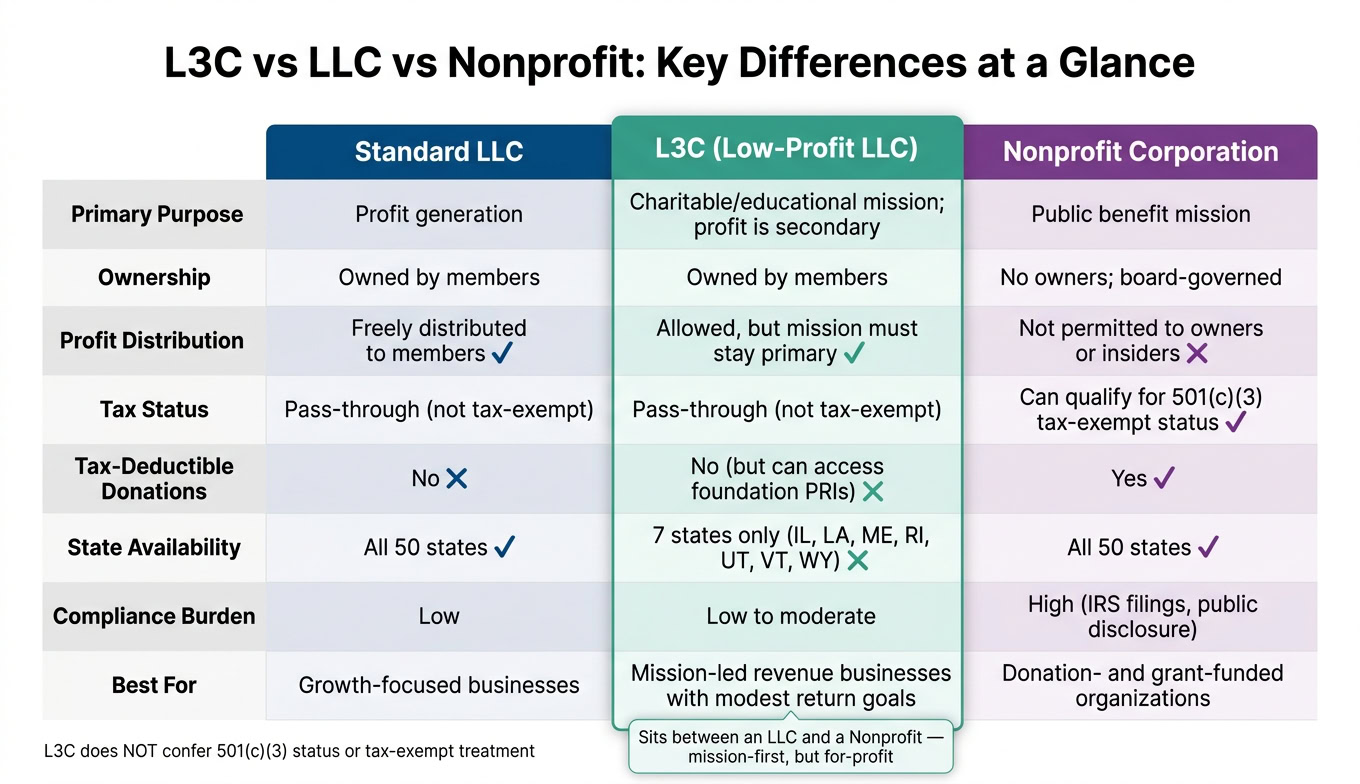
Here’s a side-by-side view of where an L3C fits. For mission-driven founders, structure choice isn’t just paperwork. It shapes control, funding options, taxes, and how clearly your mission shows up on paper.
| Feature | Standard LLC | L3C (Low-Profit LLC) | Nonprofit Corporation |
|---|---|---|---|
| Primary Purpose | Profit generation | Charitable, educational, or socially beneficial mission; profit is secondary | Charitable, educational, religious, or similar public benefit mission |
| Ownership | Owned by members | Owned by members | No owners; governed by a board of directors |
| Profit Distribution | Profits can be distributed to members | Profits can be distributed, but the mission must remain primary | Net earnings can’t be distributed to owners or insiders |
| Tax Status | Pass-through by default | Pass-through; not tax-exempt | Can qualify for 501(c)(3) status |
| Donations & Grants | Contributions are not tax-deductible | Contributions are not tax-deductible; can better fit foundation PRIs | Can receive tax-deductible donations and many government and foundation grants |
| Governance | Flexible; member- or manager-managed | Flexible; member- or manager-managed | Board-led, with bylaws and formal governance requirements |
| Compliance | Lower ongoing compliance; annual or periodic reports | Similar to an LLC, with the added requirement of maintaining its stated mission | Higher compliance; IRS filings, state registrations, and public disclosure |
| State Availability | All 50 states | Available only in states that recognize the form | All 50 states |
How an L3C differs from a standard LLC
Both structures give you limited liability protection and flexible management through an operating agreement.
The main split shows up in the governing documents. A standard LLC usually has a broad profit-focused purpose. An L3C, by contrast, must say in its articles of organization and operating agreement that its main purpose is charitable, educational, or socially beneficial, and that making income is not a major purpose.
That built-in mission can send a clear message to impact investors and foundations: this company puts purpose first and profit second. But there’s an important catch. An L3C does not get tax-exempt status just because it has that mission language.
How an L3C differs from a nonprofit corporation
The biggest gap between an L3C and a nonprofit comes down to ownership and control. A nonprofit has no owners. It is governed by a board of directors, and over time, founders may have to answer to that board. An L3C works more like a standard LLC. It has members with ownership interests, and those members can keep control through the operating agreement.
The money rules are also very different. A nonprofit can’t distribute profits to founders, directors, or other insiders. Any surplus stays inside the organization and supports the mission. An L3C can distribute some earnings to members, as long as its social mission stays in the top spot.
That tradeoff matters. A nonprofit with 501(c)(3) status can accept tax-deductible donations and is often in a stronger position for grants. An L3C doesn’t offer that. Contributions to an L3C are investments, not charitable donations.
These tradeoffs lead straight to the next issue: who an L3C makes sense for.
Who Should Use an L3C and the Main Tradeoffs
Good use cases for mission-driven founders
Once you see how an L3C differs from an LLC and a nonprofit, the big issue is simple: does your funding model line up with the structure?
L3Cs make sense for ventures like community health training, affordable housing, and subsidized arts programs. These are businesses that bring in revenue, but keep profit limits in place to protect a public mission. In plain English, they’re built for founders who care about impact first and can live with lower returns.
That setup tends to work best when a business:
- accepts modest returns
- depends on mission-focused capital
- can explain its public mission during foundation due diligence
Of course, that same setup can make the business less appealing to many investors. That leads to the next call: do those limits match the way you want to grow?
When another structure may make more sense
If your main goal is growth, scale, or strong investor returns, an L3C will often get in the way. The low-profit label tells investors that mission comes first. For many conventional equity investors and venture capital firms, that’s a hard sell. A standard LLC usually gives you more room to operate without capping your profit path or tying you to the small number of states that recognize L3Cs.
If your model depends on broad donor fundraising or tax-deductible contributions, a nonprofit corporation with 501(c)(3) status is usually the better choice. Many grant-making programs are open only to nonprofit organizations, and an L3C does not qualify for those programs.
If the structure still looks like a match, the next step is to review the essential business formation documents and your state’s rules before you move ahead.
Formation Steps and Final Decision Points
What to review before filing
Before you file, make sure both your formation state and any states where you plan to operate recognize L3Cs. If you form in one state and do business in others, plan for extra filings, registered agents, and more compliance work. If the structure still makes sense after that check, move on to your filing documents and funding plan.
Once state availability is clear, use this checklist to make sure an L3C fits before you file:
- Funding sources: Find a foundation or impact investor that accepts the structure, and get written confirmation that funding is still on the table. An L3C does not guarantee PRI funding.
- Member return expectations: Members need to be comfortable with limited returns. If someone expects standard equity-style returns, a mission-first setup can create friction.
- Tax treatment: Review tax treatment with a CPA and decide whether a corporate election makes sense for your plan.
- Operating agreement language: Spell out the mission, limit distributions, and require a supermajority to change the core purpose. Add mission-protection rules so the entity keeps its charitable or educational focus intact.
After that, file the articles with the required low-profit language. Then get an EIN, register for state taxes, and open a business bank account.
Key takeaway for founders
At that point, the choice is pretty simple.
Use an L3C only when three things line up: a mission-first purpose, limited return expectations, and states that recognize the L3C structure. If any of those pieces are missing, another entity type will usually be a better fit.
FAQs
Can I convert my LLC or nonprofit into an L3C?
Usually, no. An LLC can sometimes convert to an L3C, but only in states that recognize L3Cs.
A nonprofit usually can’t convert to an L3C and keep tax-exempt status, because L3Cs are not tax-exempt. If you’re thinking about this route, talk with a legal professional about your state’s rules and conversion requirements.
Can an L3C raise money from both investors and foundations?
An L3C can raise money from investors because it’s a type of LLC. But at its core, it’s still a for-profit business and does not qualify for 501(c)(3) tax-exempt status.
That matters for funding. In most cases, an L3C can’t accept tax-deductible donations or get the kinds of grants that nonprofits and foundations usually reserve for tax-exempt organizations.
What if my state does not recognize L3Cs?
L3Cs are only available in a handful of states, including Illinois, Louisiana, Maine, Rhode Island, Utah, Vermont, and Wyoming. If your state doesn’t recognize the L3C structure, you can’t form one there.
Some states may let a foreign L3C register to do business there. But the company still has to be formed in a state that officially allows L3Cs.