
Closing a business is not the same as walking away. If you do not file the right state forms and close tax accounts, your company can stay on the books and still rack up reports, taxes, fees, and penalties.
Here’s the short version:
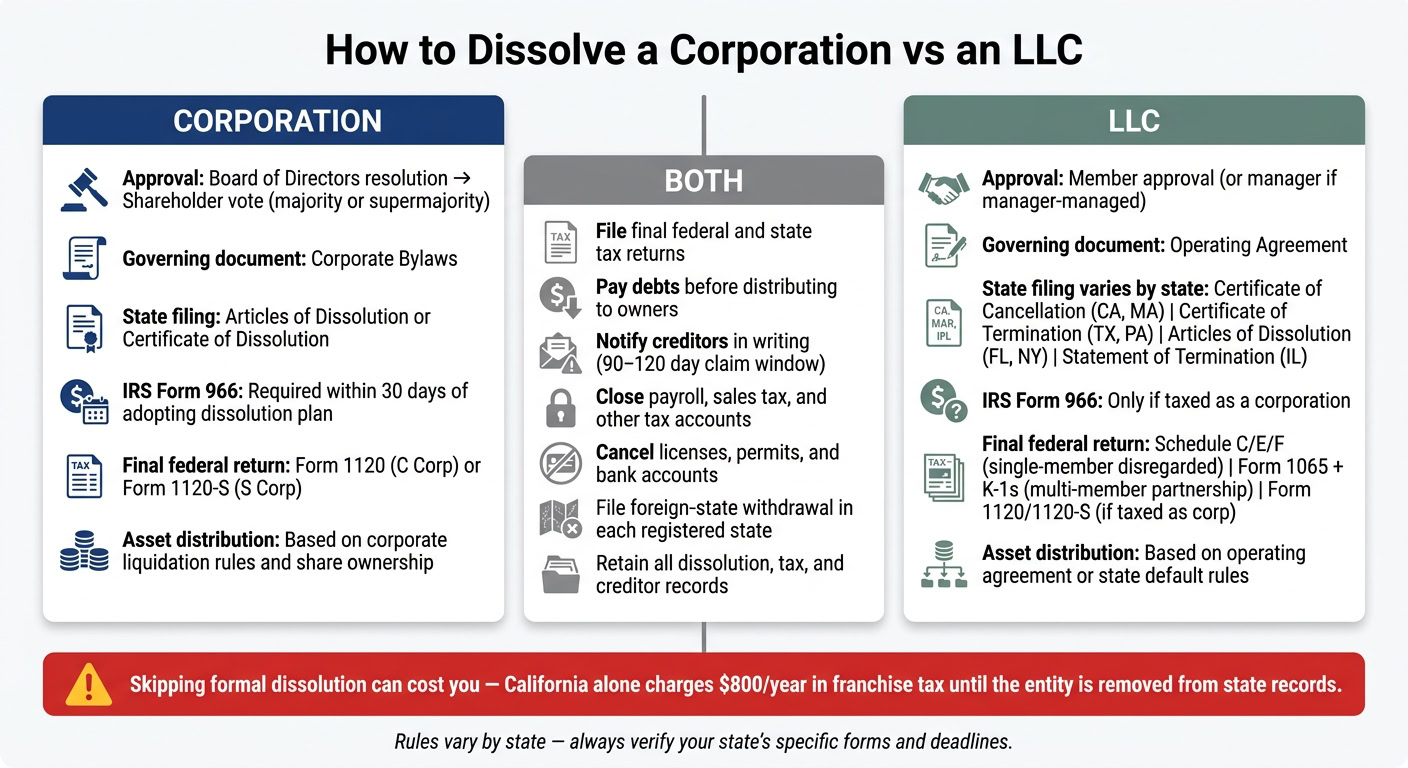
- If you run a corporation, I need board approval, shareholder approval, state dissolution forms, and in many cases IRS Form 966 within 30 days.
- If you run an LLC, I usually follow the operating agreement, get member approval, and file the state’s cancellation or termination form.
- In both cases, I still need to:
- file final federal and state tax returns,
- pay debts before owners get paid,
- notify creditors,
- close payroll, sales tax, and other tax accounts,
- cancel licenses, permits, and foreign registrations.
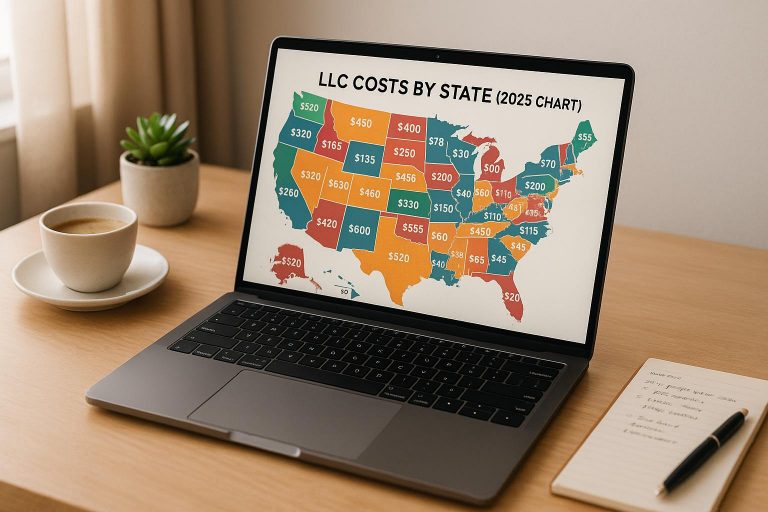
One missed step can cost money. For example, in California, many corporations and LLCs generally owe $800 per year while they remain on state records.
The big difference: corporations usually need a board + shareholder vote, while LLCs usually need member approval under the operating agreement.
For the LLC side of this comparison in full detail, read our guide on how to dissolve an LLC.
Quick Comparison
| Topic | Corporation | LLC |
|---|---|---|
| Approval | Board and shareholders | Members or managers |
| Main internal rulebook | Bylaws | Operating agreement |
| Common state filing | Articles/Certificate of Dissolution | Cancellation, Termination, or Dissolution form |
| IRS Form 966 | Usually yes for corporate tax treatment | Only if taxed as a corporation |
| Final federal return | Form 1120 or 1120-S | Schedule C, Form 1065, or Form 1120/1120-S |
| Asset payouts | Based on corporate liquidation rules and shares | Based on operating agreement or state default rules |
| Foreign-state exit | Separate withdrawal filings | Separate withdrawal filings |
If I want a clean shutdown, the path is simple: approve it, file it, pay what is owed, close tax accounts, and keep records. If you need professional assistance, consider using a company dissolution service to ensure every step is handled correctly.
sbb-itb-ba0a4be
Approvals and state filings: the first legal steps
Dissolution starts on the inside. The business has to approve the move before it files anything with the state. That approval gives the wind-up process legal backing and helps cut down on later fights over who had the power to act.
Corporation: board resolution, shareholder vote, and Articles of Dissolution
For a corporation, the usual path starts with a board resolution and then moves to a shareholder vote. Once approval is in place, the corporation files Articles of Dissolution or a Certificate of Dissolution with the Secretary of State.
These filings often include:
- The corporation’s legal name
- The date dissolution was approved
- Vote details
- A statement about whether debts and liabilities have been handled
Indiana adds a bit more. Its statute says the filing must list the votes entitled to be cast, along with the votes for and against dissolution.
Some states also tack on extra steps. That can mean a wind-up election filing or tax clearance before the state will accept the dissolution.
Hold on to the board minutes, shareholder consents, and dissolution filings in the minute book. A state may not ask for those papers when you file, but they can matter later if a creditor dispute or audit shows up.
LLC: member approval, operating agreement rules, and cancellation forms
For an LLC, the operating agreement runs the show. It sets the vote threshold, whether that’s a majority, supermajority, or unanimous consent. If the agreement doesn’t say, state default rules step in. For a single-member LLC, the owner’s written consent is often enough before filing.
After approval, the LLC files the state form needed to end the entity. The name of that form changes from state to state. California and Massachusetts use a Certificate of Cancellation. Texas and Pennsylvania use a Certificate of Termination. Florida and New York use Articles of Dissolution. Illinois uses a Statement of Termination.
In some states, dissolution and cancellation are two separate steps. In others, they’re rolled into one filing.
Just like with corporations, the paper trail matters. Record member approval in a written consent or signed minutes so there’s a clear record that the dissolution was properly approved.
Comparison table: approval rules and state filing names
| Corporation | LLC | |
|---|---|---|
| Who approves | Board of directors, then shareholders | Members (or managers if manager-managed) |
| Vote threshold | Set by state statute and bylaws; often majority or two-thirds | Set by operating agreement; state default applies if silent |
| Governing document | Corporate bylaws | Operating agreement |
| Internal record to keep | Board resolution + shareholder meeting minutes or written consent | Member resolution or written consent |
| Common state filing name | Articles of Dissolution; Certificate of Dissolution | Certificate of Cancellation; Certificate of Termination; Articles of Dissolution; Statement of Termination |
| Foreign-state registration | Separate withdrawal filing required in each state where registered | Separate withdrawal or cancellation required in each state where registered |
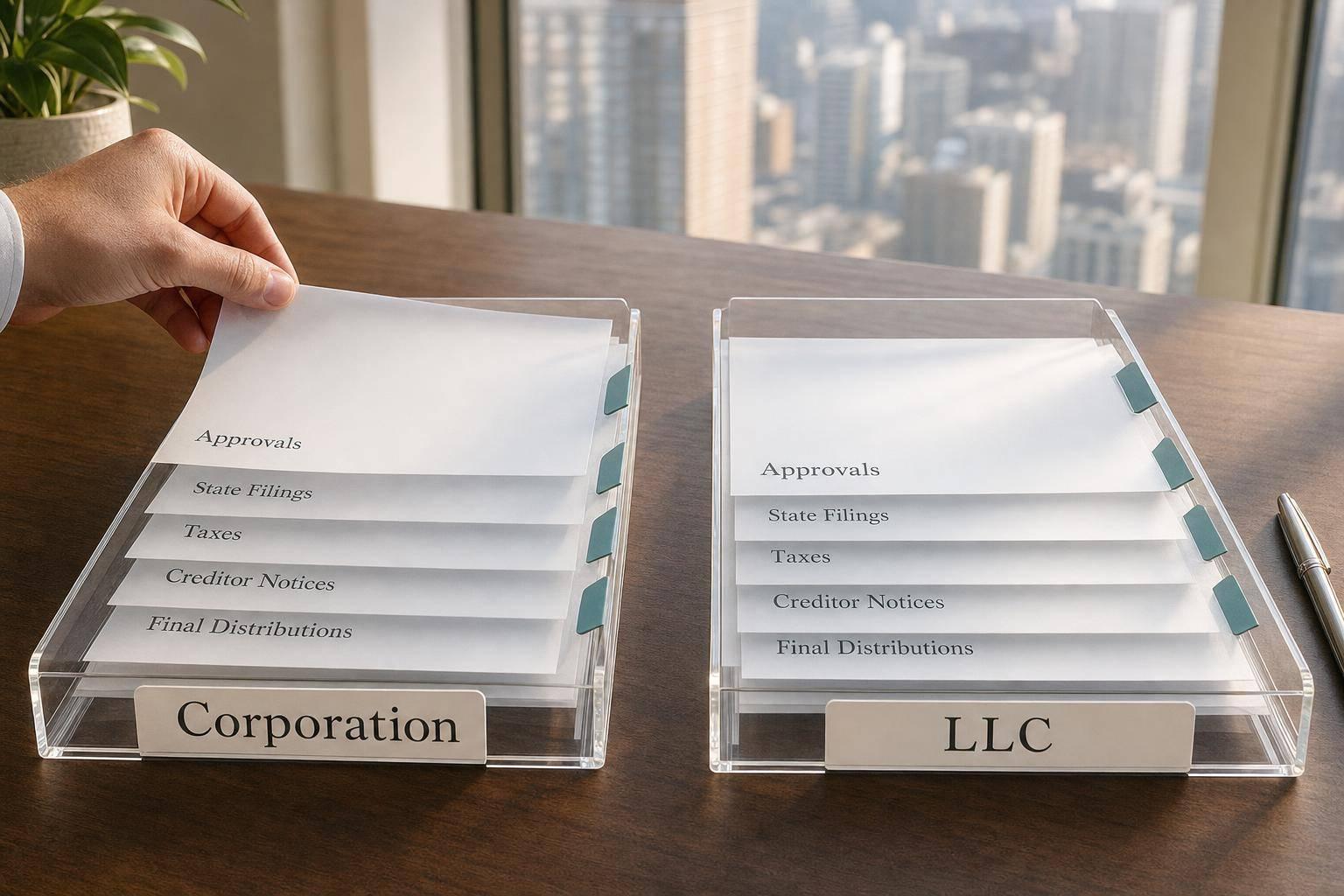
After approval and filing, the process moves into tax closure, creditor notices, and final distributions.
Taxes, debts, and winding up before closing
After the state filing, the business still needs to finish the wind-up process: close tax accounts, pay debts, and distribute assets. If you skip these steps or rush through them, you can leave behind unpaid taxes, open claims, or penalties. Corporations and LLCs handle the same basic wind-up tasks, but their final tax filings are not always the same.
Federal and state tax closure steps
Once dissolution is approved, the business should limit its activity to winding up. That usually means collecting receivables, selling assets, and paying debts.
For corporations, the IRS generally requires Form 966 (Corporate Dissolution or Liquidation) within 30 days of adopting the dissolution plan. Form 966 is only a notice. It is not the final return. If the plan is later amended, another Form 966 must be filed within 30 days of that amendment.
The final corporate income tax return – Form 1120 for C corporations or Form 1120-S for S corporations – must be marked "Final return." A C corporation’s final return is generally due by the 15th day of the fourth month after it stops doing business. An S corporation’s final return is generally due by the 15th day of the third month after termination.
LLCs follow the same basic wind-up approach, but the final return depends on how the LLC is taxed. A single-member LLC treated as a disregarded entity reports on the owner’s return using the applicable final Schedule C, E, or F. A multi-member LLC taxed as a partnership files a final Form 1065, marks it "Final return," and issues final Schedule K-1s. An LLC taxed as a corporation follows the same final return rules as a C or S corporation.
At the state level, close every tax account tied to the business, including income, franchise, sales tax, withholding, and unemployment. Some states want tax clearance before they will accept dissolution paperwork.
If the business had employees, file final Forms 941/944 and 940, mark the form to show no more wages will be paid, and issue all W-2/W-3 and 1099/1096 forms.
If employees are losing their jobs because the business is dissolving, give any notice required under federal, state, or local law.
After tax accounts are closed, or at least in motion, move on to creditors, payroll, and final distributions.
Paying creditors, notifying employees, and distributing assets
Once the tax filings are underway, settle debts and notify creditors before sending anything to owners. That sequence matters. Debts, taxes, and wind-up costs should be paid first, or money should be set aside for them, before assets are distributed.
Notify all known creditors in writing. The notice should say the entity is dissolving, give a mailing address for claims, explain what documents are required, and set a claim deadline – usually 90 to 120 days out. Many states let businesses cut off future creditor claims if proper written notice is sent and the deadline passes. Some states also allow newspaper notice to limit unknown creditor claims after a set period.
Pay final wages without delay. In some states, accrued PTO must be paid out too, depending on company policy and state law. File all final payroll returns and reconcile withholding and unemployment tax accounts before closing them.
Also cancel business licenses, permits, bank accounts, credit lines, and insurance policies. Let landlords, vendors, and contract parties know what’s happening. Keep copies of all dissolution records in a safe place.
After debts, taxes, and wind-up costs are covered, remaining assets are usually distributed in this order:
- Administrative and wind-up costs
- Tax obligations (federal, state, local)
- Secured creditors
- Unsecured creditors
- Owner loans
- Return of capital contributions
- Remaining profits based on ownership percentages or the operating agreement
For corporations, distributions follow the corporate liquidation waterfall, and shareholders receive their share based on stock ownership. For LLCs, the operating agreement controls the distribution order. That may not match a simple ownership-percentage split. If the agreement says nothing, state default rules apply.
Comparison table: final tax filings for corporations vs LLCs
| Entity Type | Final Federal Return | Form 966 Required? | State Tax Clearance? |
|---|---|---|---|
| C Corporation | Form 1120 | Yes, within 30 days of adopting dissolution plan | Yes, especially for franchise and income tax |
| S Corporation | Form 1120-S | Yes, within 30 days of adopting dissolution plan | Yes, varies by state |
| Single-member LLC (disregarded) | Final Schedule C, E, or F on the owner’s return | No | Varies; close state tax accounts as needed |
| Multi-member LLC (partnership) | Final Form 1065 + final Schedule K-1s | No | Varies; close state tax accounts as needed |
| LLC taxed as C or S corporation | Form 1120 or Form 1120-S | Yes, same as corporation rules | Yes, same as corporation rules |
What happens if you skip formal dissolution
Stopping operations is not the same as closing the business. If you don’t file dissolution or cancellation paperwork, the entity can stay active in state records and keep generating compliance duties. That means the shutdown isn’t finished, whether you’re dealing with a corporation or an LLC. The practical move is simple: close the entity the formal way, then work through the wind-up checklist.
Until the state accepts the dissolution or cancellation, you may still owe annual reports, franchise taxes, and registered agent fees.
California is a good example. Corporations and LLCs there generally must pay a minimum $800 franchise tax each year as long as they remain on the state’s records. Other states use different fee schedules and penalty rules, but the basic pattern doesn’t change: a dormant entity can still cost you money.
Administrative dissolution doesn’t solve this problem either. If the state administratively dissolves the entity because you missed filings, that action does not wipe out past-due obligations. And if you want to bring the entity back later, most states require payment of outstanding balances plus a reinstatement fee. If the entity still legally exists, you may also need to check Beneficial Ownership Information reporting duties or confirm that the inactive-entity exemption applies.
The risks are almost the same for corporations and LLCs. So is the cost of leaving either one open: ongoing compliance. Here’s a quick side-by-side look.
Comparison table: risks of leaving a corporation or LLC open
| Risk | Corporation | LLC | Practical impact |
|---|---|---|---|
| Annual report obligation | Continues until dissolution is accepted | Continues until cancellation is accepted | Triggers late fees and loss of good standing |
| Franchise / annual tax | Continues while the entity remains on state records | Continues while the entity remains on state records | Creates ongoing cost |
| Late penalties and interest | Can apply to unpaid franchise tax balances | Can apply to unpaid annual fees | Balances grow fast if notices are ignored |
| Registered agent cost | Still required while the entity exists | Still required while the entity exists | Ongoing cost with no business benefit |
| Federal tax filing | Final federal return still may be required | Final federal return still may be required | Failure to file can trigger penalties and interest |
| Loss of good standing | Can limit certificates of existence and other filings | Can limit certificates of existence and other filings | Can make reinstatement or later transactions harder |
| Administrative dissolution | State can administratively dissolve the entity for noncompliance | State can administratively dissolve the entity for noncompliance | Does not erase back obligations |
| Reinstatement burden | Must cure missed filings, taxes, and fees | Must cure missed filings, taxes, and fees | Makes reinstatement harder |
| BOI reporting exposure | May still owe a BOI filing or exemption review | May still owe a BOI filing or exemption review | Adds another compliance step for forgotten entities |
That’s why the final checklist matters. Formal dissolution closes the state record, but only after the filings, tax closures, and wind-up steps are done.
Dissolution checklists and final takeaways
Use the checklists below to turn the approval, filing, tax, and wind-up steps into a clear shutdown sequence.
Corporation dissolution checklist
- Review governing documents – Check your articles of incorporation, bylaws, and any shareholder agreements for dissolution procedures and voting thresholds.
- Adopt a board resolution – The board formally recommends dissolution and authorizes officers to move ahead with state filings.
- Obtain shareholder approval – Most states require a majority vote of outstanding shares, though some bylaws call for a supermajority.
- File Form 966 if required, and mark the final federal return.
- File Articles of Dissolution – Submit the right form to your state of incorporation, such as a Certificate of Dissolution in Delaware.
- Withdraw from foreign states – File an Application for Withdrawal or Certificate of Termination in each state where the corporation is registered as a foreign entity.
- Wind up operations.
- File final tax returns.
- Cancel licenses, permits, and bank accounts.
- Retain dissolution, tax, and creditor records.
LLCs follow much the same wind-up path, but the approval and filing rules depend on the operating agreement and the state form.
LLC dissolution checklist
- Review the operating agreement for approval rules and dissolution procedures; state defaults apply if it is silent.
- Approve dissolution by members – Record the decision with a written resolution or consent form.
- File the correct cancellation form – Submit Articles of Dissolution, a Certificate of Cancellation, or the equivalent form for your formation state.
- Settle debts and notify creditors – Pay outstanding liabilities before distributing assets to members; many state statutes give creditors 90 to 180 days to make claims.
- File the final return for your tax status – Schedule C, Form 1065 with K-1s, or Form 1120/1120-S.
- Close state tax accounts and cancel licenses – Shut down sales tax permits, payroll accounts, and any state or local business licenses.
- Withdraw from foreign states.
- Retain dissolution, tax, and distribution records.
Key differences to remember
The split is pretty simple:
- Corporations need board approval and shareholder approval.
- LLCs follow the operating agreement and member approval rules.
- Both need state dissolution filings, final tax returns, and foreign withdrawals where they apply.
Check your state’s forms, deadlines, and tax-clearance rules before filing.
FAQs
Can I dissolve my business myself?
Yes. You can dissolve your business on your own by getting the needed internal approvals, putting the decision into a written resolution, and filing the right dissolution forms with your state.
Accuracy matters here. Mistakes can lead to rejected filings, ongoing state fees, or lingering tax obligations, so it may make sense to talk with a legal professional.
What if my LLC is taxed as a corporation?
If your LLC elected corporate tax treatment, you have to deal with two separate things:
- ending the LLC with your Secretary of State
- wrapping up its federal tax filing
Even with corporate tax status, the LLC does not end on its own. You still need to file formal dissolution paperwork with your Secretary of State to end the LLC’s legal existence.
On the tax side, file a final federal return. Use Form 1120-S if the LLC was taxed as an S corporation, or Form 1120 if it was taxed as a C corporation. Be sure to check the "Final Return" box.
How long does business dissolution take?
Business dissolution usually takes 1 to 12 weeks. How long it takes depends on your state and how complex your business is.
Some states, such as Delaware and Wyoming, may process filings in about one week. Others can take longer. Check your state’s rules so you can meet legal requirements and avoid potential penalties.