

Starting an Ohio cooperative takes at least two individual incorporators – and Chapter 1729 governs the process. I recommend checking current state forms, appointing an Ohio statutory agent, and drafting articles and bylaws that spell out member rights before accepting member capital.
Here’s what I cover:
- Formation: Articles, agent requirements, startup records, and an EIN.
- Governance: Membership, voting, meetings, and board authority. The default board minimum is five member-directors, with an exception for smaller memberships.
- Equity and patronage: Stock, allocations, reserves, and redemption terms. Leaving the cooperative does not guarantee immediate repayment.
- Records and changes: Accounting, member inspection rights, amendments, and merger approvals.
- Compliance: Agent updates, state filings, and separate tax and business duties.
My starting rule: <u>keep state filings, internal approvals, and tax obligations separate</u>. Check current law and get legal and tax advice before issuing equity or changing member rights.
How to Form and File an Ohio Cooperative
Ohio Cooperative Formation: Chapter 1729 Checklist
Organizer, Name, and Articles Requirements
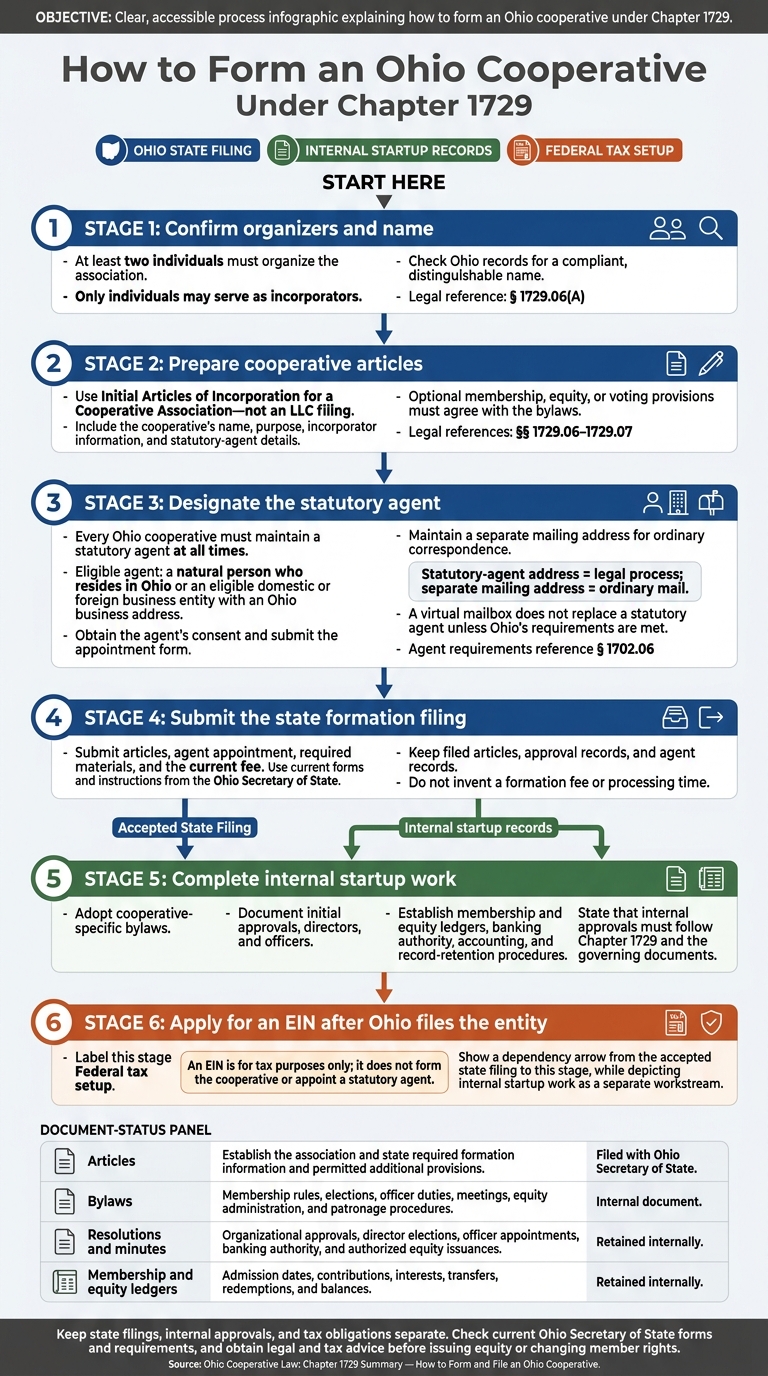
At least two individuals must organize the association under § 1729.06(A). Only individuals may serve as incorporators.
Check Ohio records for name availability. Then prepare the Initial Articles of Incorporation for a Cooperative Association – not an LLC filing. Include the cooperative’s name, purpose, incorporator information, and statutory-agent details. If you add optional membership, equity, or voting provisions, make sure they agree with the bylaws. Sections 1729.06 and 1729.07 govern these requirements.
Use the Ohio Secretary of State website for current forms and instructions.
Statutory Agent and Mailing Addresses
After preparing the articles, designate a statutory agent and a separate mailing address. Every Ohio cooperative must maintain a statutory agent at all times.
The agent may be a natural person who resides in Ohio or an eligible domestic or foreign business entity with an Ohio business address. Obtain the agent’s consent and submit the state appointment form, following the requirements referenced in § 1702.06.
The statutory-agent address receives legal process. The separate mailing address handles ordinary correspondence. A virtual mailbox can handle ordinary mail, but it does not replace a statutory agent unless Ohio’s requirements are met.
Articles, Bylaws, and Startup Records
Review standard corporate templates for cooperative-specific membership, voting, equity, and patronage rules. Record adoption and approvals using the procedures authorized by Chapter 1729 and the governing documents.
| Document | Purpose and subjects | Filing status |
|---|---|---|
| Articles | Establish the association; state required formation information and any permitted additional provisions | Filed with Ohio Secretary of State |
| Bylaws | Set membership rules, elections, officer duties, meetings, equity administration, and patronage procedures | Internal document |
| Resolutions and minutes | Record organizational approvals, director elections, officer appointments, banking authority, and authorized equity issuances | Retained internally |
| Membership and equity ledgers | Track admission dates, contributions, interests, transfers, redemptions, and balances | Retained internally |
Formation Checklist and EIN Application
Keep state filing tasks separate from internal startup work:
- [ ] Confirm two or more individual incorporators and a compliant, distinguishable name.
- [ ] Submit the articles, agent appointment, required materials, and current fee.
- [ ] Keep filed articles, approval records, and agent records.
- [ ] Adopt cooperative-specific bylaws and document initial approvals, directors, and officers.
- [ ] Establish membership and equity ledgers, banking authority, accounting, and record-retention procedures.
Apply for an EIN after Ohio files the entity. An EIN is for tax purposes only; it does not form the cooperative or appoint a statutory agent. BusinessAnywhere can assist with EIN filing.
Once filing is complete, define member rights, voting rules, and board authority in the bylaws. These provisions remain subject to Chapter 1729 and the articles.
sbb-itb-ba0a4be
Member Rights and Board Powers
Joining, Leaving, and Transferring Membership
Owning equity does not make someone a member. A member must qualify and be accepted into membership. The governing documents should set rules for eligibility, admission, capital contributions, voting, and patronage.
The bylaws should cover withdrawal notices, resignation, suspension or expulsion, and appeals. They should also explain when members can transfer membership stock and how assignments and transfers work.
Leaving does not mean automatic repayment. A departing member’s payout depends on the equity class, bylaws, articles, redemption terms, the cooperative’s financial condition, and any creditor or statutory limits.
Member Meetings, Notices, and Voting
The bylaws should explain how members act together once membership rules are in place.
Every association must hold an annual meeting. The board can call special meetings. Members holding at least 20% of the votes entitled to be cast can also request a special meeting, but they must identify the specific business to be considered.
Notice must state the meeting’s purpose and reach each voting member and any affected stockholder at least 10 days before the meeting. Publication can replace individual notice only when individual notice is impracticable and the bylaws allow it.
The bylaws determine quorum and can allow voting by proxy, in-person ballot, mail, electronic or telephonic transmission, or a mix of these methods. They should also explain whether members can participate remotely and how attendance is verified. Ballots and proxies count toward quorum only for the matters they cover.
Members do not necessarily have equal voting power. Chapter 1729 allows bylaws to provide for voting by members or delegates and to limit voting by particular classes or groups.
Directors, Officers, and Member Approval
Next, define who can run the cooperative and which decisions need member approval, similar to how you would choose a business structure for other entities.
Section 1729.22 generally requires at least five directors elected by and from the members. If the cooperative has fewer than five members, the board may have as many directors as there are members. The bylaws can allow district elections and appointed directors. Appointed directors cannot make up more than one-fifth of the entire board and do not have to be members.
Set rules for director qualifications, elections, terms, compensation, removal, and district boundaries. Unless the bylaws provide otherwise, the remaining directors fill midterm vacancies by majority vote. The board can instead call a special meeting of the affected district or group.
The board directs the association’s day-to-day operations unless the law or governing documents reserve authority to members or another party. It elects the president, secretary, and treasurer. A chair or vice chair must be a director. Define officers’ signing powers and duties, and retain the related notices, ballots, proxies, minutes, and resolutions.
This table shows who usually has authority over common decisions and where additional approval may be needed.
| Decision | Usual authority | Special approval or reservation of power |
|---|---|---|
| Borrowing and granting security interests | Board | Check the articles and bylaws for limits, reserved powers, or member approval requirements. |
| Issuing stock or other equity interests | Board | Member approval may be required if the issuance changes authorized classes, voting rights, or other protected rights. |
| Buying, selling, leasing, or encumbering property | Board | Check reserved member powers and any heightened approval rule before closing. |
| Amending or restating articles | Directors first, then members | The amendment generally requires two-thirds director approval and the applicable member approval threshold under Section 1729.08. |
| Merger or consolidation | Board proposes the transaction | One Chapter 1729 provision, for example, requires 60% of member votes cast and a simple majority of affected stockholder votes entitled to vote. |
The table is a quick reference – not a substitute for checking the statute, articles, bylaws, class rights, and financing documents before approving a transaction.
Shares, Patronage, and Cooperative Records
After governance, Chapter 1729 covers equity, patronage, and the records needed to track both.
Stock and Other Equity Interests
Chapter 1729 recognizes membership stock, patronage stock, and other equity interests. Spell out the rights attached to each class, including voting rights, patronage rights, and transfer limits.
For each issuance, document the class, quantity, value, price, eligibility, payment terms, and whether shares use certificates or are uncertificated. Certificates should identify the cooperative, holder, class, number of shares, and applicable restrictions.
Membership stock and patronage stock carry a continuing statutory security interest that secures debts owed to the cooperative. It takes priority over other perfected security interests. But members and patrons cannot automatically offset equity against a debt. The articles, bylaws, or a contract must allow it.
Capital Dividends and Patronage Allocations
Section 1729.13 permits dividends on capital stock. After required reserves, other net income from business conducted with or for members and eligible patrons must be distributed on a patronage basis under the bylaws or written agreements.
| Payment or allocation | Recipients | Governing authority |
|---|---|---|
| Capital-stock dividend | Holders of qualifying capital stock | Section 1729.13, articles, bylaws, and applicable resolutions |
| Retained reserve | The cooperative | Bylaws or written agreements, subject to required approvals |
| Patronage allocation | Members and eligible patrons | Section 1729.13 and the allocation plan |
An allocation does not always mean a cash payment. The cooperative may pay it in cash or retain it in a patron’s equity account. Put the patronage formula, reserve policy, allocation date, and cash-versus-equity treatment in writing.
Ohio law governs authority and procedures; federal tax rules determine tax consequences separately. Get cooperative tax advice before describing an allocation as deductible or immediately taxable.
Equity Repurchase and Redemption
Section 1729.13 allows a cooperative to buy back common stock at par or book value, as set by the board. It does not give a member an automatic right to immediate redemption after resignation, inactivity, or death.
Keep equity rights, allocations, and redemptions in connected records. These records also support later approvals, disputes, and filings.
Accounting, Minutes, and Member Inspection
The cooperative’s books and minutes must reflect its equity decisions.
Section 1729.29 requires complete books, records, and minutes. The cooperative must also keep members’ and stockholders’ names, addresses, and ownership balances at its principal office.
Members and nonmember stockholders may inspect relevant records for a proper purpose with one week’s written notice. The board may deny a request if its purpose is both unrelated to the requester’s interest as a member or stockholder and harmful to the association.
The bylaws and ledgers used for patronage and redemption also support inspection requests. A written inspection procedure can help staff handle requests, but it must not narrow the statutory right.
Amending Articles and Approving Mergers
Amending and Restating Articles
Major changes require both internal approval and a state filing. Filed articles change only through statutory amendment and state filing. Under § 1729.08, amendments generally need director approval, then member approval. The articles may set a higher voting threshold or allow approval by a majority of all votes eligible to be cast. Notice of the regular or special meeting must include the proposed text or a general description. After adoption, file the amendment under § 1729.12. Updating bylaws or internal records does not replace that filing.
Unless the articles say otherwise, the board alone may approve only the limited amendments allowed by statute: principal office changes, authorized stock-series terms, share reductions within issued limits, reallocations among already authorized classes, and removal of obsolete merger or conversion language. These exceptions do not permit broader changes to member rights.
A restatement brings the existing articles and amendments into one document. The board may adopt it without another member vote if it includes only previously approved amendments. Any new changes must follow the normal amendment process. Label the filing “restated” or “restated and amended.”
Merger filings follow the same order: approval first, filing second.
Merger and Consolidation Approval Rules
When a cooperative changes form entirely, merger agreement rules take the place of amendment rules.
Section 1729.35 requires a written agreement approved by each constituent association’s board and members, along with any applicable stockholder approval. Check the statute, articles, bylaws, and transaction terms to determine the voting class and method. The agreement should identify the surviving or new entity, explain how memberships and stock will be treated, and set procedures for amendment or abandonment. For a consolidation, include the new association’s articles of incorporation.
After member approval, later amendments cannot change these protected matters:
- Membership rights or the amount or kind of consideration received, exchanged, or converted.
- The surviving or new association’s articles or bylaws as provided in the agreement.
- Provisions concerning member rights or voting.
If the agreement is amended or abandoned after the merger certificate is filed but before it takes effect, an authorized officer of each constituent association must sign and file a certificate of amendment or abandonment.
Transaction Filings and Record Updates
Under §§ 1729.37–1729.38, a merger or consolidation takes effect when the certificate is filed, unless the agreement specifies a later date. A consolidation generally requires the new association’s articles with the transaction filing. A merger may require amendments to the surviving association’s articles with the certificate.
Once the transaction takes effect, the legal entity changes. Update its records immediately. Keep evidence of filing, update agent and office records, and align governing documents. Close or combine membership and equity ledgers, update accounting, tax, and banking records, and preserve all approvals, certificates, and receipts.
State Compliance After Formation
Agent Updates and State Reports
Once the cooperative is formed, the work shifts from filing to maintenance. Keep the statutory agent record current.
If the agent changes, file the Ohio Secretary of State’s Statutory Agent Update, Form 521, within 30 days. The filing fee is $25, but check the current form and fee before submitting. An outdated agent record can lead to cancellation of the entity.
Ohio does not require a universal annual report for cooperatives. Instead, track filings triggered by specific events and any periodic reports tied to registrations, licenses, or activities. Use the Ohio Secretary of State Business Search to check the cooperative’s status and filing history. For each compliance task, record who owns it, its deadline, the approval needed, and where the accepted filing is stored.
State filings are only part of the job. Internal statutory records must also stay current, complete, and accessible. Use those records to support filings, approvals, and audits. Reconcile them regularly, document approved corrections, and investigate discrepancies rather than informally overwriting them.
Administrative Help and Professional Advice
BusinessAnywhere’s maintenance service can help with filings, calendar tracking, mail handling, and storage. Founders still remain responsible for accuracy and approvals. Before relying on the service, confirm that it supports Ohio cooperative filings, statutory-agent requirements, and transaction documents. Keep review authority and copies of every submitted and accepted filing.
Delegating admin tasks does not remove separate state and federal duties. Track obligations outside Chapter 1729 separately, including tax, payroll, sales tax, securities, employment, workers’ compensation, UCC, lender, and license requirements. Which requirements apply depends on the cooperative’s activities. Consult Ohio cooperative counsel before changing member rights, redeeming equity, or restructuring. Work with a qualified tax professional on patronage allocations, nonpatronage income, and tax classification.
Conclusion: Ohio Cooperative Founder Checklist
Use this checklist to turn Chapter 1729 into steps for filing, governance, equity, and compliance.
Start with the member-driven model. Identify whom the cooperative serves, what members contribute or use, and how their activity will drive the business. Chapter 1729 governs member-based ownership, governance, equity, and filings.
Decide whether to authorize capital stock before drafting the articles. Once the filing is accepted, confirm that the formation filing is complete and the bylaws match it. Keep the filed articles.
Before accepting member capital, put eligibility, voting, capital, transfer, patronage, and redemption rules in the bylaws. Define the authority of members, directors, and officers. The default board minimum is five member-directors, or fewer if membership is smaller.
Keep membership, equity, and governance records organized. Before an amendment or merger, check the required notices, votes, and certificates. Confirm that approvals and certificates are complete before filing. Keep those records aligned with any later amendment or merger filing.
Before filing, check current Ohio Secretary of State forms, fees, and registered agent requirements. Get legal and tax review of the articles, bylaws, capital terms, patronage rules, and tax status.
FAQs
Can I form an Ohio cooperative without issuing stock?
Yes, you can form an Ohio cooperative without issuing stock under Ohio Revised Code Chapter 1729. Cooperatives are member-owned, so ownership is tied to membership – not capital contributions.
They typically operate through membership fees or contributions that don’t give members extra voting power. The standard governance model is one member, one vote, regardless of how much capital each member contributes.
How can I protect my equity if I leave?
Put clear internal governance documents in place before you leave to protect your equity. Corporate bylaws should spell out buy-back rights, which let the company repurchase departing members’ shares, and transfer restrictions that prevent unwanted share transfers.
For LLCs, the operating agreement should set out exit terms, including how assets or ownership interests will be distributed. Without these agreements, default state laws may apply – and those rules may not match your financial goals.
How are patronage allocations taxed?
Many U.S. cooperatives qualify for Subchapter T treatment under the Internal Revenue Code. This lets them deduct patronage refunds paid to members. Profit from patron business is taxed once: at the cooperative level when retained, or at the member level when distributed as patronage refunds.
Non-patronage income, such as revenue from business with non-members, is taxed like standard corporate income.