

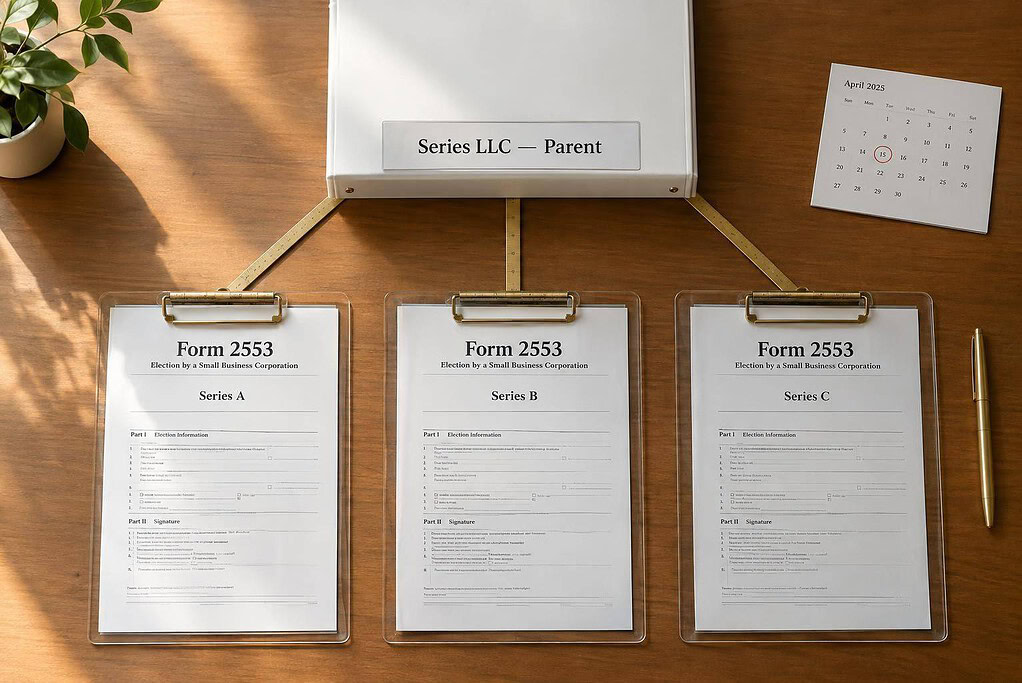
A Series LLC may qualify for S-corp status – but one election doesn’t automatically cover every protected series. I’d start by identifying the taxpayer seeking the election: the parent LLC or a specific series. Then I’d check its federal tax classification before filing Form 2553.
Here’s the checklist I’d use:
- Check ownership and stock rights. The taxpayer must be domestic, have no more than 100 shareholders, permit only eligible owners, and have one class of stock.
- Review each series separately. An EIN or state liability shield doesn’t settle federal tax treatment. The unresolved status of the 2010 proposed series rules calls for a taxpayer-specific review.
- Confirm consent and timing. Obtain all required shareholder consents. Form 2553 is generally due within 2 months and 15 days after the tax year begins; late-election relief may apply.
- Check state taxes and property risks. State filings may remain separate, and S-corp treatment can create tax costs when appreciated real estate is distributed.
- Keep the election valid. Track ownership changes, maintain separate records, and pay shareholder-employees reasonable compensation through payroll.
My starting rule: <u>confirm the taxpayer first, then choose the tax treatment</u>. Federal S-corp approval doesn’t replace state filings or payroll duties.
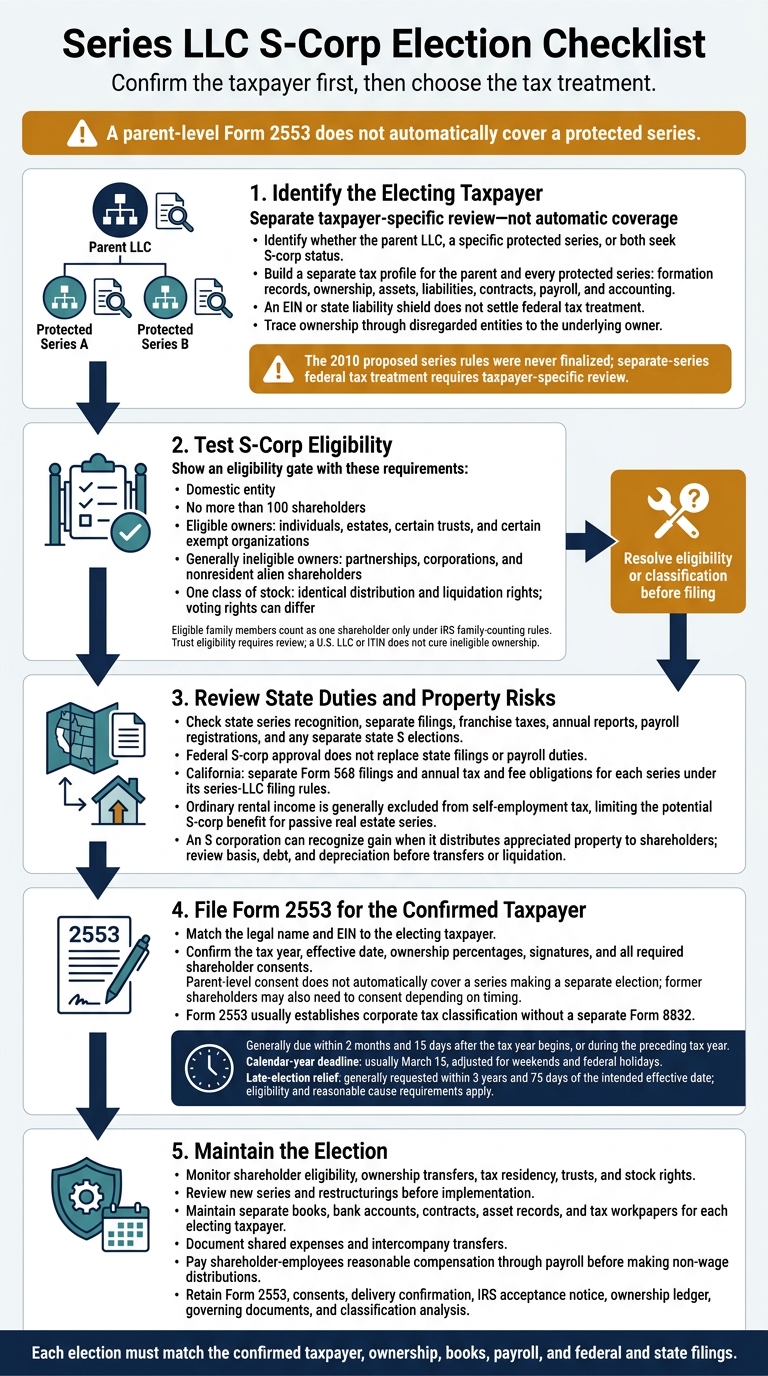
Series LLC S-Corp Election Checklist
Step 1: Check S-Corp Eligibility
Verify Domestic Status and Shareholder Eligibility
Use the IRS S corporation requirements as a checklist for each taxpayer seeking an election. First, confirm that the taxpayer is a domestic entity. Then create an ownership schedule with each owner’s name, ownership percentage, acquisition date, owner type, and tax residency.
An S corp can have no more than 100 shareholders. Eligible family members count as one shareholder only under the IRS family-counting rules. That rule doesn’t waive the need to check each owner’s eligibility and consent obligations. After checking the owner list, review whether the governing terms preserve one class of stock.
Permitted owners include individuals, estates, certain trusts, and certain exempt organizations. Partnerships, corporations, and nonresident alien shareholders generally aren’t allowed. For trust owners, review the trust instrument, beneficiaries, and eligibility as a permitted trust type, such as a QSST or ESBT. Don’t rely on the trust’s name alone. A U.S. LLC or ITIN does not cure ineligible ownership.
Review Stock Rights, Business Restrictions, and Consents
One class of stock means identical distribution and liquidation rights; voting rights can differ. Check the operating agreement and any series agreements for preferred returns, special allocations, guaranteed distributions, and liquidation priorities that could create a second class of stock. For a series structure, test the parent and each protected series together.
Obtain every required shareholder consent for Form 2553. Depending on the filing date, you may also need consent from shareholders who held interests earlier in the election year. Parent-level consent doesn’t automatically cover a protected series making a separate election. For trust-owned interests, use the Form 2553 instructions to identify the required signer.
Also check whether any business restrictions bar the entity from electing S-corp status. Confirm that it isn’t a financial institution, insurance company, or domestic international sales corporation barred from that status.
sbb-itb-ba0a4be
Step 2: Assess the Parent LLC and Each Protected Series
Once you’ve confirmed basic S-corp eligibility, determine whether the parent, each protected series, or both count as separate federal taxpayers.
Compare Parent and Protected-Series Tax Treatment
Build a separate tax profile for the parent and every protected series. Review formation records, ownership, assets, liabilities, contracts, payroll, and accounting when choosing a business structure. Pin down which entity owns each asset, signs each contract, employs each worker, and receives each payment. A parent-level Form 2553 does not automatically cover a protected series.
The IRS proposed rules in 2010 that would have treated each domestic series as a separate federal tax entity. Those rules were never finalized, leaving uncertainty about whether a protected series can make its own S-corp election.
The table below compares who files, who reports income, and which payroll rules apply.
| Structure | Classification | Eligible owners | Form 2553 requirements | Income-tax return | Employment-tax treatment | Key risk |
|---|---|---|---|---|---|---|
| Parent LLC seeking S status | LLC electing corporate and S status | Owners meeting S-corp rules | Parent files with required consents | Form 1120-S | Payroll and reasonable compensation rules for shareholder-employees | Election may not cover a series |
| Series treated as a separate federal taxpayer seeking S status | Series electing corporate and S status | Owners independently meeting S-corp rules | Own election and required consents | Form 1120-S | Separate payroll analysis | Must qualify independently |
| Disregarded series | Disregarded for income tax | Underlying owner controls | No separate election merely because parent elected | Owner’s return | May still have separate employment-tax obligations | Underlying ownership must be verified |
| Partnership-classified series | Partnership | Partnership ownership rules | Must elect corporate treatment to obtain S status | Form 1065 unless classification changes | Partnership rules apply | Partnership cannot be an S-corp shareholder |
Trace ownership through disregarded entities to the underlying owner. For a disregarded series, identify that owner before deciding whether an S election is possible. A partnership generally cannot own S-corp shares.
Review State Taxes and Real Estate Risks
Check every relevant state’s rules for series recognition, filings, franchise taxes, and annual reports. Liability recognition and tax treatment are separate questions. Confirm separate filing duties and any required state S elections, then assess payroll obligations separately. California treats each series as a separate LLC under its series-LLC filing rules, requiring separate Form 568 filings and annual tax and fee obligations.
Ordinary rental income is generally excluded from self-employment tax. That limits the tax benefit of S status for passive real estate series. Before transferring property or liquidating a corporate series, review basis, debt, and depreciation. An S corporation can recognize gain when it distributes appreciated property to shareholders.
Step 3: File Form 2553 and Keep S-Corp Status
Identify the eligible electing taxpayer before filing Form 2553. This form usually establishes corporate tax classification without a separate Form 8832. Keep records that support the election.
Confirm the EIN, Consents, and Filing Deadline
Make sure the legal name and EIN match the electing taxpayer. Check formation details, the tax year, effective date, ownership percentages, and required signatures. Get all required shareholder consents. If you file Form 2553 after the effective date, former shareholders who owned stock during the effective period may also need to consent.
File within 2 months and 15 days after the tax year begins, or during the preceding tax year. For calendar-year elections, the deadline is usually March 15, adjusted for weekends and federal holidays.
If you miss the deadline, late-election relief may be available if the entity was otherwise eligible and had reasonable cause for filing late. You generally must request relief within 3 years and 75 days of the intended effective date.
Keep the signed form, shareholder consents, delivery confirmation, IRS acceptance notice, ownership ledger, governing documents, and classification analysis.
Maintain Ownership, Payroll, and Series Records
After filing, monitor shareholder eligibility and stock rights. Before approving ownership changes, review transfers, shareholder tax residency, trusts, and economic rights. Also review new series and restructurings before putting them in place.
For each electing taxpayer, keep separate books, bank accounts, contracts, asset records, and tax workpapers to support continued S-corp status. Document shared expenses and intercompany transfers separately.
Pay shareholder-employees reasonable compensation through payroll before making non-wage distributions. Document their duties, hours, and comparable pay, along with payroll calculations, withholdings, deposits, Forms W-2, quarterly employment-tax returns, and year-end reporting.
Conclusion: Confirm Eligibility Before Filing
A parent LLC’s eligibility does not make every protected series eligible. Analyze the federal tax classification of the parent and each series separately. Identify the exact taxpayer seeking S-corp status, then test that taxpayer’s eligibility.
Check the S-corp requirements for that taxpayer: domestic status, eligible shareholders, one class of stock, and required consents.
If the taxpayer passes the federal test, review state rules next. Federal approval does not satisfy state filing requirements. Check the duties of the parent and each protected series, including annual reports, franchise taxes, payroll registrations, and any separate state election rules.
Begin filing only after both reviews are complete. Gather governing documents, EIN records, and the eligibility checklist. Document any tax advice related to foreign ownership or real estate. Make sure Form 2553, the books, payroll, and federal and state filings all match the confirmed tax treatment and election.
FAQs
Can different series use different tax classifications?
Yes. Under proposed IRS regulations, each series within a Series LLC is treated as a separate taxable entity. Each can obtain its own EIN, file its own tax returns, and make its own tax elections.
For example, one series may be taxed as a partnership while another elects S-corporation status, as long as it meets all eligibility requirements.
This flexibility allows different tax strategies while keeping the series legally separate.
What happens if one series loses S-corp eligibility?
If a series in a Series LLC stops meeting S-corp eligibility rules, its S-corp election can terminate. This can happen if it has an ineligible shareholder, more than 100 shareholders, or violates the one-class-of-stock requirement.
The series would generally then be taxed as a C corporation and lose its S-corp tax advantages. It would not automatically revert to partnership or sole proprietorship taxation; those classifications would depend on its ownership and a separate, permitted change in tax classification.
When are S-corp tax savings worth the added costs?
S-corp tax savings can outweigh the added costs when your owner-employment income is high enough. The savings come from splitting that income between a reasonable salary, which is subject to payroll taxes, and distributions, which aren’t subject to those taxes. That split needs to reduce your self-employment tax burden enough to justify the extra expense.
You’ll also need to handle payroll, reasonable compensation, annual filings, and records – and meet eligibility rules, including the cap of 100 U.S. shareholders and the limit of one stock class.