


If you’re a licensed professional, the short answer is this: a PC is the corporate form, and a PLLC is the LLC form. Both can help separate business debts from your personal assets, but neither one protects you from your own malpractice.
Before you choose, I’d focus on 4 things:
- State rules: some states allow both, some push you toward one, and only 29 U.S. jurisdictions, including D.C., specifically allow PLLCs
- Ownership setup: a PC uses shares, directors, and officers; a PLLC uses members and an operating agreement
- Taxes: a PC defaults to C corporation tax treatment; a PLLC defaults to pass-through tax treatment
- Paperwork: a PC usually has more records, meetings, and formal steps than a PLLC
Put simply: if your state allows a PLLC, many small practices like its simpler setup. If your state or board wants a PC, or you want a more formal share-based structure, a PC may fit better.
Quick Comparison
| Point | PC | PLLC |
|---|---|---|
| Legal form | Corporation | LLC |
| Owners | Shareholders | Members |
| Internal rules | Bylaws | Operating agreement |
| Management | Directors and officers | member-managed or manager-managed |
| Default federal tax | C corporation | Sole proprietorship or partnership |
| Malpractice shield for your own acts | No | No |
| Business debt shield | Yes, if kept in good standing | Yes, if kept in good standing |
| Paperwork level | More | Less |
I’d treat state law as the first filter, tax treatment as the second, and day-to-day administration as the third.
What Is a PC and What Is a PLLC?
A Professional Corporation (PC) and a Professional Limited Liability Company (PLLC) are state-law entities for licensed professionals. The main differences come down to ownership, governance, and management. It helps to start there, because those rules shape almost everything else.
Professional Corporation (PC): Shares, Directors, Officers, and Corporate Formalities
A PC is a corporation formed under state law to provide professional services through licensed owners. Ownership is divided into shares of stock. Shareholders elect a board of directors, and that board appoints officers – usually a president, secretary, and treasurer. In some states, one person in a solo practice can hold all of those roles.
A PC also comes with more corporate paperwork and structure. It usually requires bylaws, stock records, resolutions, minutes, and annual state filings. Those records help show that the business stands apart from its owners. For practices that want a clear chain of command and formal recordkeeping, that setup can feel like a good fit.
States also limit who can own or manage a PC, and those rules change by profession and by state.
A PLLC works differently and gives owners more room to set things up their own way.
Professional Limited Liability Company (PLLC): Members, Operating Agreement, and Management Options
A PLLC is an LLC authorized under state law to provide professional services. Instead of shares, it uses membership interests. And instead of bylaws and board minutes, it runs on an operating agreement. That agreement sets the rules for voting, profit splits, buyouts, and exits. For many practices, that means simpler internal control.
Management is also more flexible. A PLLC can be member-managed or manager-managed. A solo therapist might use a short agreement that confirms sole management. A multidisciplinary practice, on the other hand, may need more detail around voting, compensation, confidential information, and professional-license limits.
State law also limits ownership here, and those rules depend on both the profession and the type of entity.
The table below shows the main structural differences:
| Feature | PC | PLLC |
|---|---|---|
| Ownership unit | Shares of stock | Membership interests |
| Core governance document | Bylaws and corporate records | Operating agreement |
| Management structure | Board of directors and officers | Member-managed or manager-managed |
| Formality level | High – meetings, minutes, resolutions | Lower – more flexible internal rules |
sbb-itb-ba0a4be
PC vs. PLLC: Ownership, Liability, Management, and Taxes
Ownership, Liability, and Management: Side-by-Side
Choosing between a PC and a PLLC shapes more than the name on your formation papers. It affects how ownership can change hands, who stays in control, and what happens if an owner retires, leaves the firm, or loses a license.
At the practical level, the choice comes down to three things: who can own the business, how much control the owner keeps, and how the practice is taxed.
Liability is the same in both structures. The entity can shield the owners from business debts, but each licensed professional is still personally liable for their own malpractice. So if the practice has an unpaid office lease, vendor bill, or employee claim, the entity may help protect personal assets. But if a doctor, lawyer, or other licensed owner commits malpractice, that person is still on the hook. In plain English, a PC or PLLC can help with business-side risk, but it does not replace professional liability insurance.
The table below shows the differences that tend to matter most day to day.
| Factor | PC | PLLC |
|---|---|---|
| Ownership transfer | Governed by bylaws and shareholder agreements | Restricted by operating agreement; requires member approval |
| Protection from business debts | Yes, when properly maintained | Yes, when properly maintained |
| Protection from own malpractice | No | No |
| Continuity after owner exit | Generally continues | Depends on operating agreement and state law |
Tax Treatment and Administrative Workload
This is where many people get tripped up.
A PC or PLLC is a state-law business form. Tax treatment is a federal issue. Those are separate systems, and they don’t always line up the way people expect.
A PC defaults to C corporation taxation. That means the entity pays tax on its income, and shareholders can pay tax again on dividends. A PLLC defaults to pass-through taxation: it is a disregarded entity if it has one member, and a partnership if it has more than one member. A PLLC can also elect S corporation or C corporation tax treatment.
That split matters because a PLLC taxed as an S corporation and a PC taxed as an S corporation can work almost the same way for federal tax purposes, even though the legal structures underneath are different. The IRS does not treat "PLLC" as its own federal tax category.
If S corporation status is elected, there is one rule you can’t brush aside: shareholder-employees must be paid reasonable compensation through payroll before taking distributions. The IRS won’t let owners label all practice income as distributions just to cut employment taxes. Salary is subject to employment taxes. Properly handled distributions are not. For a profitable practice, that gap can mean real tax savings. The tradeoff is more payroll work and more bookkeeping than a default pass-through PLLC.
| Feature | PC | PLLC |
|---|---|---|
| Default federal tax | C corporation | Disregarded entity (single-member) or partnership (multi-member) |
| Pass-through option | S corporation election (Form 2553) | Default, or S corporation election (Form 2553) |
| Double taxation risk | Yes, under C corporation default | No, under default pass-through |
| Reasonable compensation required | Yes, if S corporation elected | Yes, if S corporation elected |
| Recordkeeping burden | Higher – stock records, bylaws, board approvals, minutes | Lower – operating agreement, member consents, financial records |
No matter which structure you use, the basics still matter: keep clean records and use the full legal business name consistently if you want to keep liability protection in place. And one more thing sits above all of this: state licensing rules decide whether your profession can use a PC, a PLLC, or both.
State Licensing Rules and How to Form the Right Entity
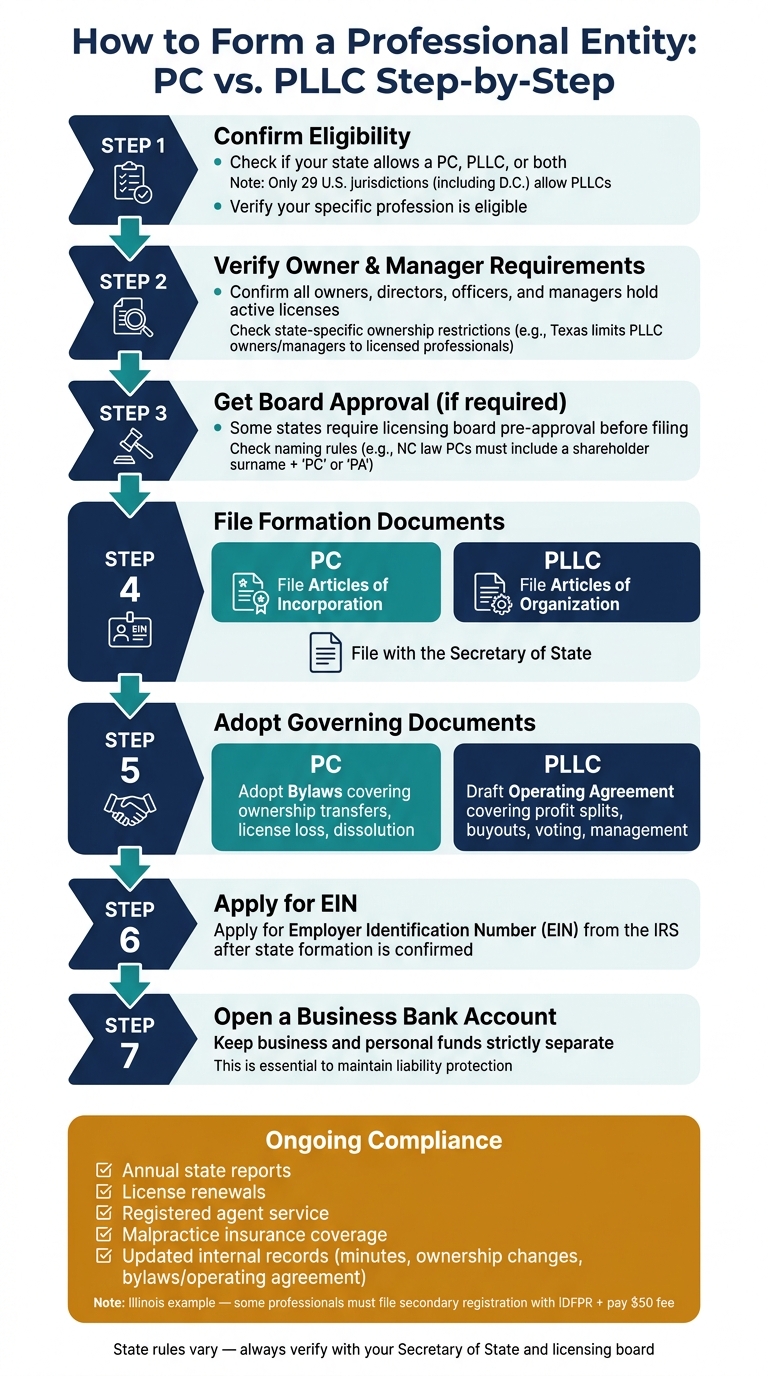
How to Choose Between a PC and PLLC: Step-by-Step Decision Guide
After you compare legal structure and taxes, state licensing rules usually make the final call on which entity you can use. And this is where a lot of people get tripped up.
A standard LLC or regular corporation often can’t offer regulated services like medicine, law, accounting, or architecture. In many cases, you need a professional entity instead. Only 29 U.S. jurisdictions, including Washington, D.C., specifically allow PLLC formation, so you need to confirm that both your state and your profession are on that list.
State Approval, Naming Rules, and Filing Steps
Start with two places: the Secretary of State and your licensing board. You need to confirm that the entity type is allowed and find out whether the owners and managers must hold active licenses.
Many states limit ownership to licensed people. Texas is a good example: it limits PLLC owners and managers to licensed professionals. New York takes a detailed approach too. A professional service PLLC there must list each member’s name, license number, and residence address in its articles of organization.
Naming rules can be stricter than people expect. In North Carolina, a law PC must use the surname of one or more shareholders and end with "Professional Association", "PA", "Professional Corporation", or "PC." So even if a name clears the Secretary of State database, the licensing board can still reject it.
Once you’ve confirmed the right entity type, move through the filing process in this order:
- Confirm that your profession and entity type are allowed in your state.
- Verify that owners, directors, officers, and managers meet state eligibility rules.
- Get any board approval required before filing.
- File articles of incorporation for a PC or articles of organization for a PLLC with the state.
- Adopt bylaws for a PC or an operating agreement for a PLLC that covers ownership transfers, loss of license, and dissolution.
- Apply for an EIN from the IRS after the state forms the entity.
- Open a business bank account and keep business and personal funds separate.
Ongoing Compliance for a Professional Practice
Forming the entity is only the start. Staying in good standing is what keeps the practice running lawfully.
A missed annual report or an expired professional license can push the entity into bad standing. And once that happens, the practice may not be allowed to operate.
That means you need to stay on top of annual reports by state, license renewals, registered agent service, malpractice coverage, and internal records like meeting minutes, ownership changes, and updated bylaws or operating agreements.
Illinois shows how state rules can add extra steps. Certain professionals there must file a secondary registration with the Illinois Department of Financial and Professional Regulation (IDFPR) and pay a $50 fee on top of Secretary of State filings.
Because costs and deadlines vary a lot by state and profession, a compliance calendar with your local filing and renewal dates isn’t just helpful. It’s the safest way to keep things from slipping through the cracks.
When to Choose a PC, When to Choose a PLLC, and the Final Takeaway
After looking at structure, liability, taxes, and state rules, the choice usually comes down to compliance and how you want the practice to run day to day.
When a PC May Be the Better Choice
A PC is often the better fit when your state or licensing board requires it, or when your practice needs a more formal corporate setup. In some states, professional entity rules are strict enough that a PC may be required. A PC can also make sense when ownership needs to be spelled out clearly, especially in a larger group practice.
Take a five-physician group. If the owners want clear equity shares, a board of directors, and a structure that hospitals or lenders already know well, a PC may be the better path. And if it qualifies, a PC can still elect S corporation tax treatment.
If you don’t need that level of formality, a PLLC is often the simpler route to set up an LLC.
When a PLLC May Be the Better Choice
A PLLC tends to work well when your state clearly allows it for your profession and you want fewer corporate formalities. For a two-attorney firm, a solo therapist, or a small accounting practice, that can be a good match.
Why? Because a PLLC lets you set many of the ground rules in the operating agreement. That can include profit splits, buyout terms, voting rights, and management roles. For smaller practices, that often means simpler administration and more direct control over ownership terms.
Conclusion: Choose Based on State Law, Tax Goals, and Governance Needs
The best choice usually isn’t one-size-fits-all. It depends on your state’s rules and the way your practice is set up. A PC and a PLLC can both help with business structure, but neither one protects you from your own malpractice.
Use a PC or PLLC only if your state allows it. From there, pick the one that matches your tax plan, governance style, and malpractice coverage needs.
FAQs
Can I switch from a PC to a PLLC later?
Yes. As your practice grows, you can switch your business structure later if another setup fits your goals, tax situation, or way of running the practice better.
Moving between a PC and a PLLC often means filing paperwork with the state, updating your licenses, and, in some cases, dealing with tax effects. That can get messy fast. A business attorney or tax professional can help you sort it out before small issues turn into bigger ones.
Does my profession affect whether I can form a PC or PLLC?
Yes. Your job can affect whether you need to form a PC or PLLC.
Many states require licensed professionals, such as doctors, lawyers, accountants, architects, and therapists, to use one of these business structures. The main reason is regulatory accountability.
In some states, licensed professionals can’t operate as a standard LLC at all. Since the rules change by state and by profession, check your state’s Secretary of State website or your licensing board before you file.
Which is easier for a solo practice to manage?
For a solo practice, a PLLC is usually easier to run than a PC. It gives you more flexibility and skips a lot of the formality that comes with a corporation.
In plain English: a PLLC does not require formal board meetings, corporate officers, or the same level of record-keeping.
That can mean less admin work day to day. It also lets solo practitioners make decisions on their own, without dealing with the more formal governance and compliance rules that PCs often bring.