

Yes – I can start a US LLC from Vietnam without a visa, SSN, or US address. But the setup is only half the job. I also need to pick the right state, get an EIN, open a bank account, and file on time to avoid penalties that can start at $25,000.
Here’s the short version:
- I can form the LLC online from Vietnam
- Wyoming is often the lower-cost choice; Delaware is more common for VC plans
- I need a registered agent with a physical address in the state
- I can get an EIN without an SSN or ITIN
- A US bank account is possible, but approval depends on bank checks
- A foreign-owned single-member LLC may owe $0 in US income tax and still need Form 5472
- In many cases, setup takes about 2 to 6 weeks
The main point: a US LLC can be remote-friendly, but missed filings, mixed funds, and weak records can turn a simple setup into an expensive mess.
If I want the short path, it looks like this: choose the state, file the LLC, get the EIN, open banking, then stay current with tax, BOI, and state filings.
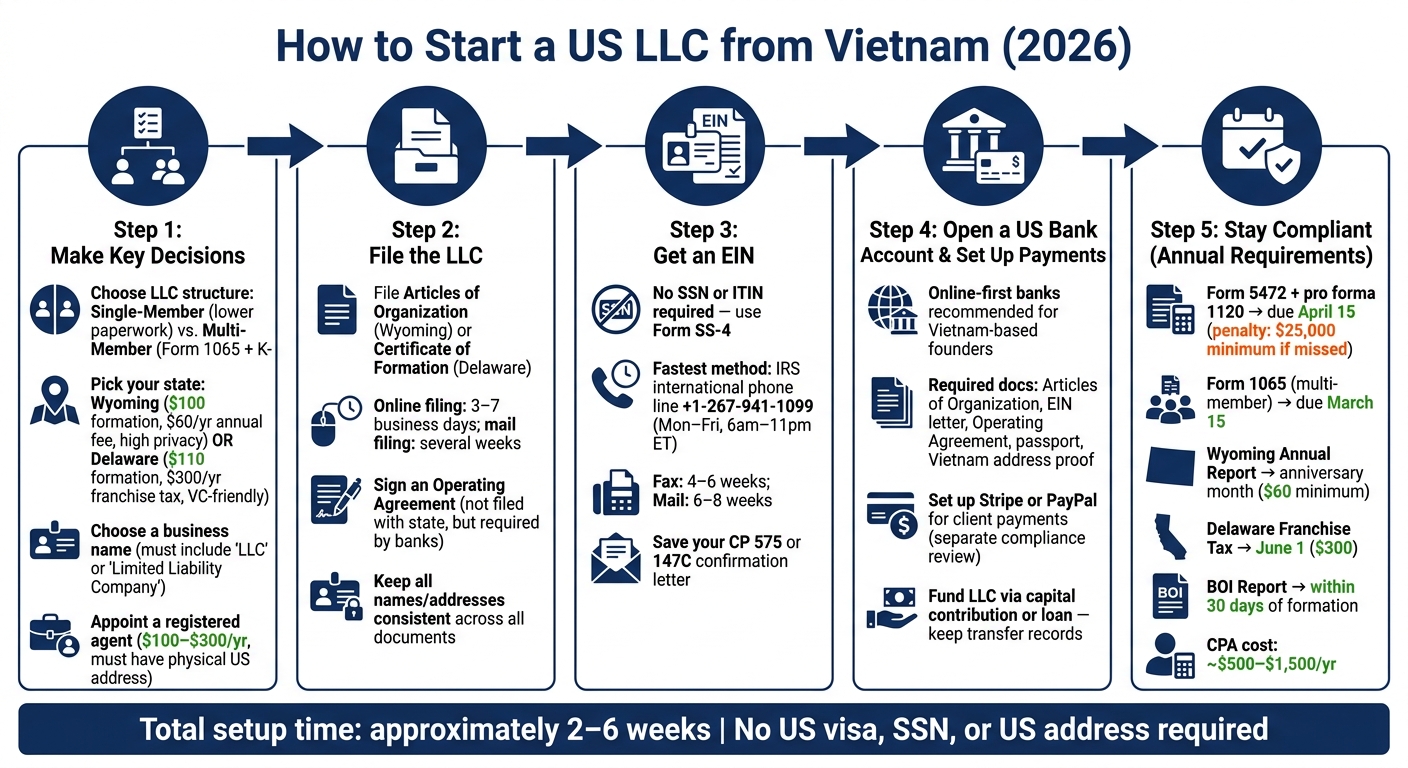
How to Start a US LLC from Vietnam: Step-by-Step Process (2026)
Step 1: Make Key Decisions Before You File
Before you file, make four calls first: your ownership setup, your state, your business name, and your registered agent. These choices shape what you’ll pay to form the LLC, how much admin work shows up later, and how smooth your banking process will be.
Choose the LLC Structure That Fits Your Ownership
A single-member LLC has one owner. A multi-member LLC has two or more. If you’re building from Vietnam, the big issue isn’t only who owns the company. It’s also how much filing work comes with that setup.
By default, the IRS disregards an SMLLC for federal tax purposes. That said, a foreign-owned SMLLC still has its own filing duties. An MMLLC is treated as a partnership by default and generally files Form 1065 each year.
Here’s the simpler side-by-side view:
| Feature | Single-Member LLC | Multi-Member LLC |
|---|---|---|
| Default IRS treatment | Disregarded entity | Partnership |
| Typical annual filing | Form 5472 + pro forma Form 1120 | Form 1065 + K-1s for each member |
| Paperwork complexity | Lower | Higher |
| Banking setup | EIN required to open a US business bank account | EIN required; ownership percentages must be clear for KYC |
| Control | Full control by one owner | Shared control under the operating agreement |
One point matters a lot here: foreign-owned SMLLCs must still file Form 5472 and pro forma Form 1120, even if there’s no U.S. income. Miss that filing, and the penalty is $25,000.
Once you know who owns the company, the next step is picking the state that matches your tax and filing profile.
Wyoming vs. Delaware: Which State Works Better for a Vietnam-Based Founder
For most founders based in Vietnam, Wyoming is the default pick. It costs $100 to form, has a minimum $60 annual report fee, charges no state income tax, and does not require member names on public filings. Delaware costs about $110 to form and comes with a $300 annual franchise tax.
Delaware can still make sense. If you plan to pitch U.S. venture capital firms or later convert the LLC into a C-Corp, Delaware tends to be the easier sell because U.S. investors know its Court of Chancery well.
| Feature | Wyoming LLC | Delaware LLC |
|---|---|---|
| Formation fee | $100 | ~$110 |
| Annual state fee | $60 minimum annual report fee | $300 franchise tax |
| Privacy | High – member names are not required on public filings | Moderate |
| Best fit | Remote operators prioritizing low cost and privacy | Startups seeking US venture capital |
A simple way to think about it: Wyoming is often the low-hassle, lower-cost path. Delaware is more about investor familiarity.
After that, lock down your business name and your registered agent before you submit the filing.
Pick a Business Name and Appoint a Registered Agent
Your LLC name must be different from other names already registered in your chosen state, and it must include a designator like "LLC" or "Limited Liability Company". Check state name availability first. Then run a USPTO trademark search so you don’t bump into an existing federal trademark.
Every state also requires a registered agent. This is a person or company with a physical street address in the state where you form the LLC, and they receive legal papers and state notices for the business. A P.O. Box or virtual mailbox does not work as the registered agent address.
If you’re running the company from Vietnam, this role matters more than it might seem. A solid registered agent helps keep legal notices and state mail from slipping through the cracks while you’re half a world away. Most professional registered agent services cost $100 to $300 per year. It’s smart to pick one that forwards documents online, so you can see time-sensitive notices fast.
With those basics set, you can move on to the formation documents.
sbb-itb-ba0a4be
Step 2: File the LLC and Prepare Internal Documents
File the Articles of Organization or Certificate of Formation
Now you make the LLC official.
Use the state, business name, and registered agent you picked earlier. Wyoming calls this filing the Articles of Organization. Delaware calls it a Certificate of Formation. In both states, you file with the Secretary of State, and that filing is what creates the LLC.
The form usually asks for:
- the LLC name
- the registered agent’s name and street address
- the principal business address
- the filer’s name and address
- whether the LLC is member-managed or manager-managed
If you’re based in Vietnam, online filing is usually the easiest remote option. Wyoming and Delaware both take online submissions, and online processing often takes 3–7 business days, while mail filing can take several weeks.
The big thing here is consistency. Your LLC name on the Articles should match your EIN application, Operating Agreement, and bank application exactly. That includes small details like LLC vs. L.L.C. If your EIN, bank, and payment processor records don’t line up, you can run into fraud alerts or delays.
| Detail | Must Match Exactly Across… |
|---|---|
| LLC Name | Articles, EIN (SS-4), bank application |
| Ownership % | Operating Agreement, Form 5472 |
| Business Address | EIN application, banking, payment processors |
Put the registered agent’s street address on the formation filing so your personal address does not end up on the public record. And use one mailing address across your EIN, bank, and payment forms.
Use the same legal name, ownership percentages, and address details in the Operating Agreement and EIN application too.
Sign an Operating Agreement and Keep Finances Separate
You do not file the Operating Agreement with the state. But banks will usually ask for a signed copy, and it needs to match the details in your state filing.
The agreement should spell out ownership percentages, management structure, capital contributions, profit and loss distributions, transfer rules if a member leaves, dissolution terms, and banking authority: who may open accounts and sign for the LLC.
For a single-member LLC, this document also helps show that the business is separate from you as a person. That matters for liability protection.
As soon as the LLC is formed, open a separate U.S. business bank account and run all business income and expenses through it. Don’t mix personal and company money. That’s where people get sloppy, and it can cause problems. Mixing funds can weaken the LLC’s liability protection, and banks may shut down accounts if they see personal transactions in a business account. Setting up QuickBooks or Xero early can make recordkeeping cleaner and tax filing much less of a headache later.
With the LLC filed and the Operating Agreement signed, move to the EIN application.
Step 3: Get an EIN, Open a Bank Account, and Set Up Payments
Apply for an EIN Without an SSN or ITIN
An EIN is the tax ID your LLC needs for banking and IRS filings. The IRS issues it for free.
If you don’t have an SSN or ITIN, use Form SS-4 and apply by phone, fax, or mail. The fastest route is usually the IRS international line at +1-267-941-1099, available Monday through Friday, 6:00 a.m. to 11:00 p.m. ET. Have your completed SS-4 ready and ask for the EIN during the call. Fax applications usually take 4 to 6 weeks. Mail usually takes 6 to 8 weeks.
On Form SS-4, list the responsible party. That’s the person who controls the LLC. Also, make sure the LLC name matches your Articles of Organization or Certificate of Formation exactly. Even a small mismatch can slow things down.
Once the IRS confirms your EIN, save the CP 575 or 147C letter. Banks will usually ask for one of these.
With the EIN confirmed, get your banking file ready before you start applying.
Build a Banking File and Apply for a US Business Account
Banks review both the LLC and the founder, so gather your company and personal documents at the same time. For founders in Vietnam, online-first US business banks are often the most practical place to start.
A solid application usually includes:
- Approved Articles of Organization or Certificate of Formation
- EIN confirmation letter, either CP 575 or 147C
- Signed Operating Agreement
- Valid passport
- Proof of your Vietnam address, such as a utility bill or bank statement
- A website or a short written business description
- Expected monthly transaction volume, customer locations, and proof of source of funds
Approval is never guaranteed. Each bank runs its own compliance review, and standards can vary a lot from one bank to another.
Do not use your registered agent address as proof of where the business operates. That address is there to receive legal notices, and most banks won’t accept it as your business address. You should also be ready to explain what your business does in plain English and show where your clients are located.
Traditional banks like Chase or Bank of America often have stricter in-person rules and may ask you to visit a US branch. If traveling to the US isn’t realistic, an online-first bank is usually the better starting point for a founder based in Vietnam.
Set Up Payment Processing and Fund the LLC Correctly
After your account is approved, run all client payments and owner funding through the LLC account only. Mixing personal and business money can create accounting and tax problems later.
For client payments, Stripe and PayPal are common options for US LLCs. But bank approval doesn’t mean payment processor approval. Each one runs a separate compliance review based on the business model and the founder.
If you send your own money from Vietnam to the LLC account, mark the first transfer as either a capital contribution or a loan. Keep the transfer record. You’ll want that paperwork later if you need support for Form 5472.
Before sending large wires from Vietnam, check local foreign-exchange and reporting rules.
Step 4: Meet Tax, BOI, and Annual Compliance Requirements
How the IRS Taxes a Foreign-Owned US LLC
Once your LLC starts receiving or sending money, the tax calendar matters just as much as the bank account. A foreign-owned U.S. LLC may owe no U.S. income tax and still have federal filing duties. Even if you manage the business entirely from Vietnam, the IRS still treats the LLC as a U.S. filing entity.
By default, a foreign-owned single-member LLC is treated as a disregarded entity. That means the IRS looks to the owner, not the LLC itself, for default federal tax treatment. U.S. income tax applies only to effectively connected income (ECI), which means income tied to a U.S. trade or business and services performed in the United States.
Here’s the part many founders miss: no tax due does not mean no filing due. If the LLC has reportable transactions with its foreign owner, you must file Form 5472 with a pro forma Form 1120 by April 15. A multi-member LLC files Form 1065, the partnership return, by March 15. Miss Form 5472, and the minimum penalty starts at $25,000.
Form 5472, BOI Reporting, and State Filing Deadlines
Federal tax filings are only one piece of the puzzle. You also need to stay on top of state annual filings and BOI reporting.
For BOI reporting, you must disclose each beneficial owner’s legal name, date of birth, home address, government ID number, and ID image. This report does not replace IRS or state filings. It sits alongside them. For LLCs formed in 2026, the BOI report is typically due within 30 days of formation.
Use this calendar as a quick reference:
| Requirement | Entity Type | Due Date | Cost / Penalty |
|---|---|---|---|
| Form 5472 + pro forma 1120 | Foreign-owned SMLLC | April 15 | $25,000 minimum penalty |
| Form 1065 | Multi-member LLC | March 15 | $210 per member/month |
| Wyoming Annual Report | All Wyoming LLCs | Anniversary month | $60 minimum; risk of administrative dissolution if missed |
| Delaware Franchise Tax | All Delaware LLCs | June 1 | $300; interest and penalties if late |
| BOI Report | Most LLCs | 30 days from formation | Civil and criminal penalties |
Keep your formation records, tax filings, bank statements, and ownership records for at least seven years. Banks and payment platforms may also ask for periodic KYC refreshes, so don’t be surprised if they want updated documents later on. And if you’re hiring a U.S. CPA who works with foreign-owned LLCs, plan for about $500 to $1,500 per year. These are informational filings, but they are still mandatory, and errors can get expensive fast.
Conclusion: The Clearest Path to Starting and Running a US LLC from Vietnam
The path is straightforward: form the LLC, get the EIN, open the bank account, and stay on top of annual filings.
For founders in Vietnam, three mistakes cause most of the trouble:
- Mixing personal and business funds, which can weaken liability protection and complicate Form 5472
- Assuming the LLC has no U.S. tax or reporting duties
- Ignoring annual reports, BOI filings, or Form 5472 until penalties start stacking up
Forming the LLC is usually the easy part. The hard part is staying current after setup. That’s where people slip. Remote ownership can work well, but only if you treat compliance like part of the business, not an afterthought. The cheapest option on day one can end up costing far more later if you can’t keep up with the filings year after year.
FAQs
Do I need a visa or SSN to start a US LLC from Vietnam?
No. You don’t need a visa or a Social Security Number (SSN) to start a US LLC from Vietnam.
US law doesn’t restrict LLC ownership based on citizenship or where you live. That means a non-US resident can form and own a US LLC without moving to the United States or getting US immigration status first.
If you need an EIN, you can still get one as a non-resident. The IRS online application asks for an SSN or ITIN, so that route usually won’t work. But there’s a simple workaround: apply with Form SS-4 by fax, mail, or by calling the IRS.
Which state should I choose for my LLC?
For a non-US founder, Wyoming is usually the best default pick. It has low fees, strong privacy, and no state income tax.
Delaware makes more sense if you plan to seek venture capital or set up a more complex investor structure. The trade-off is cost. It’s more expensive to keep each year, including a $300 franchise tax.
If your main goal is keeping recurring costs down, New Mexico can be the cheapest option for long-term maintenance. It has low filing fees and no annual report or franchise tax.
What filings can trigger penalties for a foreign-owned LLC?
Foreign-owned LLCs can get hit with steep penalties if they miss required filings.
If the LLC has 25% or more foreign ownership, you need to file Form 5472 and a pro-forma Form 1120 every year. Miss those filings, and the penalties can be severe: $25,000 and $10,000.
If the LLC is taxed as a partnership, Form 1065 is also required. The late penalty is $210 per member, per month.
State rules matter too. Missing annual reports or franchise tax payments can lead to extra fees or even administrative dissolution.