

Yes, you can start a U.S. LLC as a Canadian. But for many Canadian residents, it creates more tax and filing pain than it solves. In many cases, the IRS sees the LLC one way, while the CRA sees it another way. That split can lead to double tax risk, extra forms, and penalties as high as $25,000 for a missed Form 5472.
Here’s the short version:
- If you live in Canada and do service work from Canada, a U.S. LLC often does not lower your tax bill.
- If you want a U.S. LLC only for Stripe, PayPal, or USD banking, you may not need one at all.
- If you have U.S. inventory, a warehouse, employees, or U.S. investors, a U.S. entity may make sense.
- For many founders, a Canadian corporation is the simpler path.
- If you need a U.S. entity, a U.S. C corporation is often cleaner than an LLC for Canadian tax purposes.
Watch the costs: state fees can run from $60/year in Wyoming to $800+ in California, plus registered agent fees of about $100 to $300 per year. Using a professional registered agent ensures you never miss a legal notice or tax deadline. And even with $0 U.S. tax due, you may still need IRS filings.
Quick Comparison
| Option | Best fit | Main upside | Main risk |
|---|---|---|---|
| Canadian corporation | Remote services from Canada | Simpler Canadian tax reporting | May not solve U.S. banking or investor needs |
| U.S. LLC | U.S. inventory, warehouse, or local activity | Can help with U.S. banking and some U.S. setups | IRS/CRA mismatch, extra forms, double tax risk |
| U.S. C corporation | U.S. investors, U.S. contracts, scale in the U.S. | Both countries treat it as a corporation | More company-level tax and admin |
| No U.S. entity + multi-currency account | Low-volume USD payments | Lowest admin load | May not work for every platform or provider |
Bottom line: if your work is done from Canada and your main goal is just to get paid in U.S. dollars, I’d look at a Canadian setup first. A U.S. LLC tends to make sense only when there is a clear U.S. business reason behind it.
sbb-itb-ba0a4be
Why a U.S. LLC Can Be a Tax Trap for Canadians
IRS vs. CRA Classification Mismatch
A U.S. LLC can look simple on paper. For Canadians, it often isn’t.
The core issue is a classification mismatch. The IRS treats a single-member LLC as a disregarded entity, so the income flows straight to the owner’s return. The CRA treats that same LLC as a foreign corporation.
That split creates two headaches.
First, there’s a timing mismatch. The U.S. taxes the owner in the year the LLC earns the profit. Canada may not recognize that same income until the LLC actually pays out a distribution.
Second, the mismatch can hurt foreign tax credits. Why? Because the two countries may not see the same taxpayer. The U.S. taxes the individual owner, while Canada may treat the LLC itself as the taxpayer first, and then tax the owner later on dividends.
| Feature | IRS Treatment (U.S.) | CRA Treatment (Canada) |
|---|---|---|
| Entity Classification | Disregarded Entity | Foreign Corporation |
| Who Is Taxed | The individual owner | The entity (and the owner on dividends) |
| Timing of Taxation | When income is earned | When profits are distributed as dividends |
| Reporting Requirement | Form 5472, 1120, or 1065 | T1134 (Foreign Affiliate) |
| Main Risk | U.S. compliance penalties | Double taxation / denied foreign tax credits |
This is why having U.S. clients, by itself, usually does not make a U.S. LLC a smart move for most Canadian service businesses.
Why Having U.S. Clients Is Not Enough to Justify a U.S. LLC
Where your clients live isn’t the main issue. What matters more is where the work is done and whether you have U.S.-taxable business activity.
If you perform your services entirely from Canada, the income is often treated as foreign-source and is generally not subject to U.S. federal tax, as long as the work is done from Canada and no U.S.-taxable business activity exists.
There is one big exception: physical goods. If you sell products through Amazon FBA and keep inventory in a U.S. fulfillment center, that inventory in the U.S. can create U.S.-source income.
For most service businesses, a U.S. LLC tends to add paperwork and filing costs without lowering Canadian tax risk. And even when the U.S. tax case is weak, the filing burden usually stays in place.
The Real Compliance Burden: IRS Filings and State Obligations
No U.S. tax due does not mean no U.S. filing.
That’s the part many Canadian founders miss. You can owe $0 in U.S. tax and still have to file forms with the IRS and keep up with state-level rules.
Federal Filings Canadians Commonly Miss
A Canadian-owned single-member LLC will usually need to file Form 5472 and an informational Form 1120 every year, even if there’s no U.S. tax due.
And Form 5472 kicks in more often than people expect. It can be triggered by any payment or transfer between you and the LLC. That includes:
- Capital contributions
- Distributions
- Business expenses paid personally
- Loans
Even formation costs you paid out of pocket before the LLC had a bank account can count.
Miss these filings, and the penalties can get ugly fast. Missing Form 5472 can lead to a $25,000 penalty, plus another $25,000 after IRS notice. Missing the informational Form 1120 can trigger a $10,000 penalty per foreign owner.
Without a Social Security number, Canadians also need to get an EIN by filing Form SS-4 by fax or mail.
Federal forms are just the first layer. State fees, registrations, and yearly upkeep add a second stream of costs.
| Filing | Who Needs It | What Triggers It | Penalty for Missing |
|---|---|---|---|
| Form 5472 | Single-member LLCs owned by a non-U.S. person | Any payment or transfer between you and the LLC | $25,000 |
| Informational Form 1120 | Single-member LLCs owned by a non-U.S. person | Required as attachment to Form 5472 | $10,000 per foreign owner |
| Form 1065 | Multi-member LLCs | Having 2+ members | $210/member/month |
| EIN via Form SS-4 | All LLCs | Formation | Cannot open a bank account or file taxes without it |
| Form 1040-NR | Non-resident owners | Effectively Connected Income (ECI) | Varies based on tax owed |
State Fees, Registered Agents, and Nexus Issues
Federal filings are only half the picture. Every U.S. LLC also has state-level obligations.
Each LLC must keep a registered agent in the state where it was formed. This has to be a person or service with a physical street address who can accept legal papers for the company. If that lapses, the state can dissolve the LLC. Registered agent services usually cost $100–$300 per year.
Most states also require an annual report or franchise tax to keep the LLC in good standing. The price swings a lot depending on the state. Delaware charges $300 per year. Wyoming charges $60. California charges at least $800, even if the LLC didn’t earn a single dollar.
If your LLC does business in a state other than the one where it was formed, that state may also make you register to do business there. That’s a separate filing, with its own fees and annual requirements.
Things can get more complicated once the LLC has inventory, employees, or enough sales in a state. Physical presence, like inventory, staff, or warehouse use, including Amazon FBA storage, can create a sales tax duty. Sales-threshold nexus can also apply if your sales into a state pass a threshold, often around $100,000 a year, which can mean you need to register and collect sales tax there.
| State | Annual Fee | Registered Agent | Best For |
|---|---|---|---|
| Wyoming | $60 | Required | Online and service businesses |
| Delaware | $300 | Required | Startups seeking VC investment |
| California | $800+ | Required | Only if physically operating there |
New York adds another twist: newspaper publication. That can cost more than $1,000.
It helps to put every deadline on your calendar. Delaware’s annual deadline, for example, is June 1 each year. Miss it, and you may face late fees and lose good standing.
When a U.S. LLC Makes Sense and What May Work Better
Cases Where a U.S. LLC May Be Justified
Once you get past the filing headaches and tax traps, the next step is simple: does a U.S. entity solve an actual business problem?
For most Canadian founders, the answer is no. But there are a few cases where the extra paperwork may be worth it.
Physical U.S. operations are the clearest case. If you have a warehouse, office, or another fixed place of business in the U.S., or you hire U.S. workers there, a U.S. entity may be the cleaner way to handle local tax and compliance rules. The same goes for inventory stored in the U.S. That can create U.S.-source income and reporting duties.
U.S. investors or enterprise contracts are another solid reason. If you’re planning to raise venture capital or angel money from U.S.-based investors, many of them will expect a Delaware entity. That’s mostly because they’re used to it, and the legal system around it is well understood. A U.S. entity can also help when a large U.S. client wants to sign with a U.S. company instead of a Canadian one.
Banking and currency needs can matter too, especially for companies moving a lot of money in U.S. dollars. A U.S. entity can make U.S. dollar banking easier, and at higher volume, foreign exchange savings may justify it. If your USD volume is still low, a multi-currency account may do the job without the cost and admin of setting up a U.S. entity.
Better Options for Most Canadian Founders
For most Canadian-based founders, especially service providers, consultants, and SaaS operators, a Canadian corporation is the lower-friction path.
Why? It keeps you inside the normal Canadian filing system. It also avoids the IRS/CRA classification mismatch and cuts down on state filing issues. If you’re performing services remotely from Canada, that income is generally treated as foreign-source income, so U.S. federal income tax usually isn’t the main problem.
If you do need a U.S. entity for investors, contracts, or operations, a U.S. C corporation is often cleaner than an LLC for Canadians. The reason is pretty straightforward: both tax systems treat it as a corporation. In some cases, it may also make sense to discuss electing corporate tax treatment for an LLC through Form 8832 with a cross-border tax advisor.
Here’s a quick filter to make this easier:
| Business Need | Structure That Fits |
|---|---|
| Remote services from Canada | Canadian corporation |
| U.S. VC or angel investment | U.S. C corporation (Delaware) |
| Amazon FBA or U.S. warehouse inventory | U.S. LLC or C corporation |
| U.S. dollar banking at scale | U.S. LLC or C corporation |
| Low-volume USD payments | Multi-currency account – no U.S. entity needed |
| U.S. employees or office | U.S. LLC or C corporation |
The basic idea is pretty simple: use a U.S. entity when the U.S. need is concrete. If none of these apply, staying Canadian is usually the cleaner move, and it helps you sidestep extra U.S. filings.
A Safer Formation Path and Final Takeaway
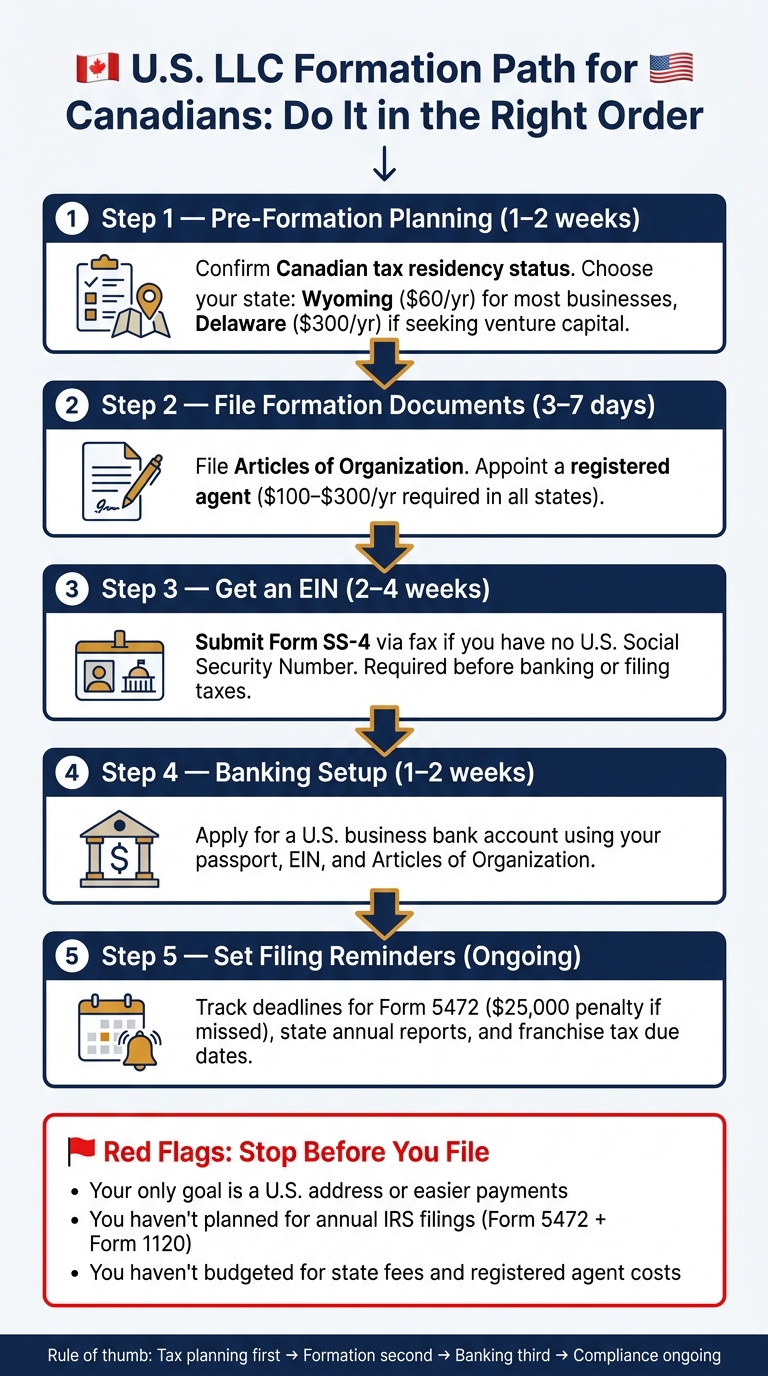
How to Form a U.S. LLC as a Canadian: Step-by-Step Compliance Checklist
Formation and Compliance Order
If a U.S. LLC still makes sense after the tax and compliance checks above, the safest move is to handle things in the right order. That helps you avoid expensive cleanup later.
Go in this sequence: tax first, then formation, then banking, then compliance.
| Step | Action | Timeline |
|---|---|---|
| 1 | Pre-Formation Planning: Confirm your Canadian tax residency status and choose your state (Wyoming for most; Delaware if you’re seeking venture capital). | 1–2 weeks |
| 2 | File formation documents: File Articles of Organization and appoint a registered agent. | 3–7 days |
| 3 | Get an EIN: Submit Form SS-4 via fax if you don’t have a U.S. SSN. | 2–4 weeks |
| 4 | Banking Setup: Apply for a U.S. business account with your passport, EIN, and Articles of Organization. | 1–2 weeks |
| 5 | Set filing reminders: Set deadlines for Form 5472 and state annual reports. | Ongoing |
Start with residency. Your Canadian tax status shapes how the rest of the filing and tax treatment works.
Also, plan for the cost of cross-border filing help, plus annual IRS and CRA reporting.
If you can’t get through the first two steps cleanly, stop before you file anything.
Red Flags: When You Should Not Form Yet
A U.S. LLC should come after the business case is clear and the filing workload is already mapped out.
Hold off if your only goal is getting a U.S. address or easier payment access. That still comes down to the provider’s review, so formation alone doesn’t guarantee approval.
You should also wait if any of these are still unsettled:
- You’re still a Canadian tax resident
- You haven’t planned for annual IRS filings
- You haven’t budgeted for state fees and registered-agent costs
If any of those apply, it’s usually safer to keep operating through your Canadian corporation until the U.S. need is concrete enough to justify the added filing load.
FAQs
Do I need a U.S. LLC to get paid in USD?
No. You do not need a U.S. LLC just to get paid in USD.
The main issue isn’t the currency. It’s where the income comes from and which country’s tax rules apply.
A U.S. LLC can make things easier on the banking side. For example, it may help you open a USD business account or get access to some payment processors. But in many cases, you can still send invoices in USD and receive USD payments without a U.S. LLC.
There’s also a tax filing point that trips people up. Even if your U.S. tax bill is $0, a foreign-owned single-member LLC may still need to file with the IRS. One common example is Form 5472.
Can a U.S. LLC cause double taxation for Canadians?
Yes. For Canadian tax residents, a U.S. LLC can lead to double taxation.
Here’s why: the CRA may view the LLC as a foreign corporation. When that happens, the same income can end up taxed in both the U.S. and Canada.
If the LLC is taxed as a corporation, there can be a second layer of tax when dividends are paid to the shareholder. Pass-through treatment may help avoid tax at the corporate level, but IRS filing and reporting can still apply even when no U.S. tax is due.
When is a U.S. C corporation better than an LLC?
A U.S. C corporation often makes more sense when the plan is to keep profits in the business and use that money to grow, instead of paying it out to owners.
Here’s the simple version: a C corporation pays a flat 21% federal corporate tax. If you want to reinvest earnings back into the company, that setup can work better than a pass-through entity.
It’s also a common pick for startups that want venture capital. Why? Because a C corporation can issue multiple classes of shares, which investors often want. It may also qualify for QSBS treatment if the stock is held for five years.