

Spending fewer than 183 days in a country does not guarantee you avoid tax residency. I start by checking local residency rules, travel dates, available homes, and family ties – not just counting days.
Here’s the checklist I use:
- Personal residency: Check how digital nomads pay tax and each country’s rules first, then any treaty rules if both countries treat you as a resident.
- U.S. taxes: U.S. citizens generally owe tax on worldwide income even with zero U.S. travel days. For many noncitizens, the U.S. day-count test looks at three years.
- Filing and tax relief: Review resident or nonresident returns, foreign tax credits, income exclusions, and foreign-account reporting separately.
- Business duties: A U.S. LLC, nomad visa, or mailing address does not settle your tax status. Work and management locations can create business, payroll, and state tax duties.
<u>Before moving, I gather travel logs, housing records, work locations, and entity documents for a cross-border tax review.</u> That helps me confirm where to file, which deadlines apply, and what relief I may qualify for.
How Residency Tests and Day Counts Work
Digital Nomad Tax Residency: Beyond the 183-Day Rule
Physical Presence, Homes, and Personal Ties
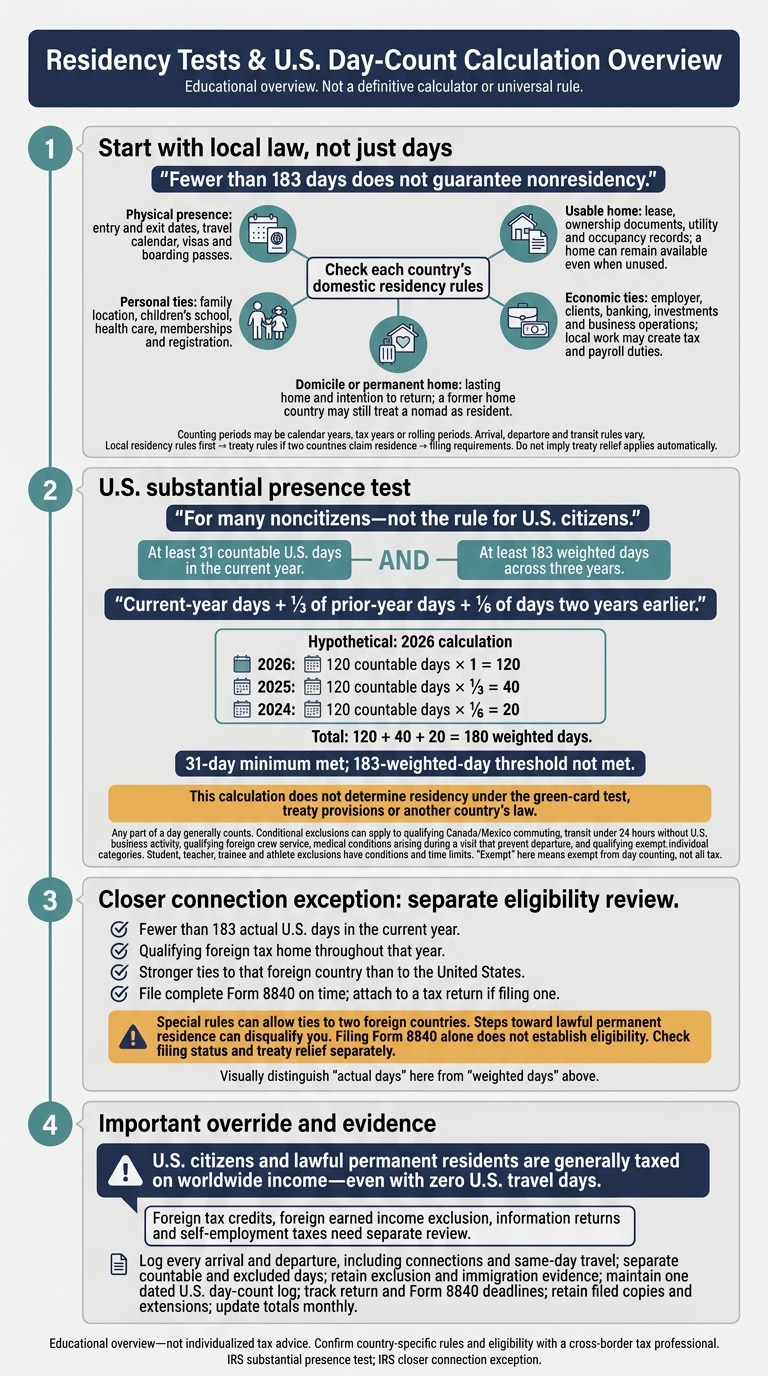
Local law determines residency first; treaty tie-breakers come later. Residency affects where you file, which income is taxed, and which business rules may apply. The full picture matters – not just your day count. Spending fewer than 183 days in a country does not rule out local tax or payroll duties. Once you’ve checked local residency, review treaty rules and filing requirements.
| Test or factor | Supporting evidence | Why it matters | Records to keep |
|---|---|---|---|
| Physical presence | Passport stamps, immigration records, flight bookings, lodging receipts | An accidental overstay or incorrect day count can affect residency | Entry and exit dates, visas, boarding passes, travel calendar |
| Usable home | Lease, deed, utility bills, insurance, property access | A home can remain available even when you don’t use it | Lease dates, ownership documents, utility and occupancy records |
| Personal ties | Spouse or partner’s location, children’s school, memberships, health care, local registration | Family and community ties can outweigh a low day count | School, registration, medical, membership, and family-location records |
| Economic ties | Employer, clients, bank accounts, investments, business operations | Local work may create tax and payroll duties | Contracts, invoices, bank statements, work-location logs, payroll records |
| Domicile or permanent home | Evidence of a lasting home and an intention to return | A nomad may unintentionally remain a resident of a former home country | Property records, relocation documents, voter or licensing records, correspondence |
Follow the country’s counting period: calendar year, tax year, or rolling period. Check whether arrival and departure days count, too. Transit exceptions vary by country.
U.S. Day-Count Test and Closer Connection Exception
The IRS substantial presence test requires at least 31 countable U.S. days in the current year and 183 weighted days. Add all current-year days, one-third of the prior year’s days, and one-sixth of the days from two years earlier.
Any part of a day generally counts. Specific exclusions may apply to qualifying Canada/Mexico commuting, transit lasting less than 24 hours between foreign locations without U.S. business activity, qualifying foreign crew service, medical conditions that arise during a visit and prevent departure, and qualifying exempt-individual categories. Student, teacher, trainee, and athlete exclusions have conditions and time limits. Here, “exempt” refers to day counting – not exemption from all tax.
The IRS closer connection exception requires fewer than 183 actual U.S. days in the current year, a qualifying foreign tax home throughout that year, and stronger ties to that foreign country than to the United States. Special rules allow ties to two foreign countries.
File a complete Form 8840 on time, attached to your tax return if you’re filing one. A pending green-card application or other steps toward lawful permanent residence can disqualify you. Filing the form does not, by itself, establish eligibility. You’ll also need to check filing status and treaty relief.
Travel Records and U.S. Worldwide-Income Tax Rules
U.S. citizens and lawful permanent residents are generally taxed on worldwide income – even with zero U.S. travel days. Foreign tax credits, the foreign earned income exclusion, information returns, and self-employment taxes each need a separate review.
Hypothetical – three-year calculation: With 120 countable U.S. days in each of 2024, 2025, and 2026, the 2026 calculation is 120 + 40 + 20 = 180 weighted days. The 31-day minimum is met, but the 183-day threshold is not. This calculation does not determine residency under the green-card test, treaty provisions, or another country’s law.
Keep records that support your filing status, ties, and day exclusions:
- Record every arrival and departure, including connections and same-day travel.
- Separate countable days from excluded days. Keep proof of each exclusion and your immigration status.
- Maintain one dated log for U.S. day-count evidence.
- Track tax return and Form 8840 deadlines. Keep filed copies and extensions, and update your totals monthly.
sbb-itb-ba0a4be
Tax Treaties and Personal Filing Duties
Treaty Tie-Breaker Rules for Dual Residents
If two countries treat you as a resident under their domestic laws, check the applicable treaty next.
Domestic residence, treaty residence, and income sourcing are separate tests. Start with each country’s domestic residence rules. If both treat you as a resident and an income-tax treaty applies, review its residence article. A typical tie-breaker follows this sequence: permanent home → closer personal and economic relations → habitual abode → nationality → competent-authority agreement. The treaty’s wording controls and can override a simple day count. Back up your position with leases, family-location records, travel logs, tax returns, and business-management records.
Keep a residency file for each tax year. If a payer or the other country requires a residency certificate, eligible U.S. taxpayers can request certification using Form 8802. Most U.S. treaties have a saving clause that preserves U.S. taxing rights for citizens, with limited exceptions. Treaty relief does not remove separate domestic filing duties. Green-card holders should seek specialist advice before claiming treaty nonresident treatment: the claim can affect Form 1040 filing, treaty disclosures, expatriation issues, and immigration status.
Filing as a Resident, Nonresident, or Dual Resident
Once you establish treaty residence, determine the correct filing status. Treaty residence affects how you report your status – not whether you have filing duties.
Dual residence and U.S. dual-status taxation are different. Dual residence means two countries treat you as a resident under their domestic laws. U.S. dual-status taxation means you were a resident for part of the year and a nonresident for the rest. Use IRS Publication 519 and IRS tax treaty guidance to check your return position, treaty provisions, and disclosure requirements.
| Status or position | Income commonly considered | Typical U.S. filing and reporting focus | Tax relief or coordination |
|---|---|---|---|
| U.S. resident under domestic law | Generally worldwide income | Form 1040; foreign-account reporting may apply | Foreign tax credit, foreign earned income exclusion (FEIE), and treaty provisions each require eligibility checks |
| U.S. nonresident alien | U.S.-source income and income effectively connected with a U.S. trade or business | Form 1040-NR; Form 8840 may support an eligible closer-connection exception | Treaty exemptions or reduced rates may apply; Form 8833 may be required |
| Dual resident under both countries’ domestic laws | Potentially worldwide income under both systems before treaty coordination | Often Form 1040-NR with Form 8833 when claiming treaty residence abroad; check applicable exceptions | Treaty tie-breakers, foreign tax credits, or other relief may reduce double taxation |
| Dual-status taxpayer within one tax year | Worldwide income during the resident period; generally limited U.S.-taxable income during the nonresident period | Dual-status Form 1040 or Form 1040-NR, with an accompanying statement, depending on year-end status | Resident and nonresident rules apply to different parts of the year |
Get a professional review when your residence involves multiple countries, entities, or treaty claims.
Form 8833 discloses a treaty-based position; Form 8840 does not establish treaty residence. Check FBAR and other international-reporting thresholds separately, even if you owe no income tax. The foreign tax credit generally covers qualifying foreign income taxes. The foreign earned income exclusion requires a foreign tax home plus either the bona fide residence test or the physical presence test. Neither benefit establishes nonresidency.
Income Sources, State Taxes, and Social Taxes
Services income is generally sourced where you perform the work – not where your client is located or where you receive payment. For nomads, moving between countries can change income sourcing even when clients stay the same. Interest, dividends, royalties, and rent follow separate sourcing rules.
Federal treaty residence does not end state tax obligations. States may consider domicile, homes, family, licenses, business activity, and intent to return. State sourcing rules also vary, so nonresidents may still owe state tax.
Check payroll, self-employment tax, and Social Security separately. Totalization agreements coordinate Social Security coverage, not income-tax residence. Before filing, gather workday logs, income-by-category records, foreign tax returns, evidence of state ties, and payroll or coverage records.
After establishing your personal residency, check how your entity is taxed and managed.
Business Tax Planning and Remote Compliance
Entity Tax Treatment and Management Abroad
U.S. formation, a registered agent, and a virtual mailbox help with administration. They do not determine personal tax residency.
IRS elections can affect whether an LLC is treated as a disregarded entity, a partnership, an S-corporation, or a C-corporation. A foreign country may treat that same entity differently for tax purposes. Before choosing S-corporation status, check that every shareholder is eligible. Nonresident aliens generally cannot be S-corporation shareholders.
Where business decisions happen matters – not just where the owner lives. Managing your business abroad can trigger local registration, payroll, or permanent-establishment issues, even if you spend fewer than 183 days there.
| Issue | Determining factors | Duties | Records |
|---|---|---|---|
| Personal residency | Presence, domicile, personal and economic ties | Resident or nonresident returns | Travel logs, residency certificates, housing records |
| Entity classification | Ownership, IRS elections, default treatment | Form 1065, Form 1120, or Form 5472 | Formation documents, operating agreement, EIN, election confirmations |
| Management location | Where decisions, operations, and contract activity occur | Foreign corporate tax, registration, permanent-establishment, and payroll obligations | Management records, contracts, invoices, payroll |
| State compliance | Formation state and activity in other states | Annual reports, franchise taxes, registered-agent maintenance | State filings, receipts, agent records |
Once you know the entity’s classification, map its federal and state filing duties separately.
Federal Tax Filings and State Requirements
No operating income does not mean no filing duties. Your entity’s classification determines its filing obligations, and federal, state, or ownership-reporting duties may still apply.
For example, a foreign-owned U.S. disregarded entity with reportable transactions may need to file Form 5472 with a pro forma Form 1120 – even without U.S. income. Federal filing tools help with administration, but they do not replace a review of entity-specific, state, or foreign filing requirements.
Track state reports and franchise-tax deadlines separately from federal returns. Keep registered agent services active and your contact records current so legal and state notices reach you. Check ownership-reporting rules for your entity type and filing year.
BusinessAnywhere Support and Recordkeeping
Admin tools and services can help you organize and maintain records. They do not change your tax status, and tax residency and filing duties need separate review.
Filing is only part of the job. You also need proof. A mailing address supports recordkeeping, but it does not establish management location or tax residency. Keep business and personal funds separate throughout the year, and maintain:
- Travel calendars and residency records: dates, locations, and supporting evidence.
- Contracts and invoices: services, payments, and work locations.
- Management records: who made key decisions, when, and where.
- Payroll and foreign filings: withholding, coverage, returns, and payments.
- Entity records: formation documents, elections, annual reports, and agent details.
Conclusion: Confirm Your Residency and Filing Duties
Apply each country’s domestic residency tests first. If two countries claim you as a resident, review the treaty rules. Double-check your day counts, then confirm which filings apply. Keep personal, business, state, and foreign-reporting filings separate, and organize supporting records by tax year and country.
Fewer than 183 days is not a universal exemption. The U.S. substantial presence test counts days across three years, so past visits can affect your current-year status. A U.S. LLC does not change your personal or business tax duties.
Get a cross-border tax review before you relocate or change your entity structure. Bring your travel calendar, details about your home-country ties, entity elections, and the locations where you make decisions. Before you act, ask the tax professional to confirm your residency status, required filings, deadlines, and available foreign-tax relief.
FAQs
Can I be a tax resident nowhere?
No. Tax residency depends on where you spend your time, keep a permanent home, or have financial and personal ties. You’ll typically be a tax resident in at least one jurisdiction.
U.S. citizens and green card holders are taxed on their worldwide income, no matter where they live. They remain U.S. tax residents regardless of their physical location.
How does moving midyear affect my tax filings?
Moving midyear can make you a dual-status alien, which means you must report income from both your resident and nonresident periods. You may need Form 1040 and Form 1040-NR, or a combined statement filed with your return.
Your residency depends on time spent in each country and your economic ties. A move may leave you with tax obligations in both the U.S. and your new country. A tax professional can help you work through the transition and avoid double taxation.
Can working abroad create tax duties for my U.S. LLC?
Yes. Your U.S. LLC may have tax obligations in both the United States and your country of residence.
Your country of residence may charge corporate income tax, VAT, or payroll taxes if your business activities create a permanent establishment. This could include a fixed office or a dependent agent who finalizes contracts locally.
U.S. states may also claim tax nexus based on physical presence or economic activity – even while you’re abroad. Tax planning can help you manage these obligations.