


If your side hustle is making consistent income or involves risks, it might be time to form an LLC. An LLC protects your personal assets, offers tax flexibility, and boosts professionalism. Here are five signs it’s time to make the switch:
- Steady Income: Earning over $1,000 monthly? You’re at risk without legal protection.
- Liability Risks: Handling client visits, costly equipment, or services prone to errors? An LLC shields you.
- Professional Growth: Larger clients and vendors often prefer working with LLCs.
- Financial Separation: Already tracking business finances separately? An LLC strengthens that boundary.
- Expansion Plans: Planning to hire or scale? Many lenders and investors require a formal structure.
Starting an LLC is straightforward and affordable. Services like BusinessAnywhere help you file for as little as $0 (plus state fees), making it easier to protect your business and personal assets while preparing for growth.
5 Signs It’s Time to Form an LLC
There are key moments when it becomes clear that your side hustle has outgrown its casual beginnings and needs to be formalized as an LLC. These indicators show that your business is ready for legal protection and professional development.
Consistent Monthly Revenue
If your business is bringing in over $1,000 a month on a regular basis, it’s time to think seriously about forming an LLC. At this income level, the risks of operating without proper protection outweigh the costs of setting up the structure. Plus, the IRS mandates that anyone earning more than $400 annually from self-employment file Schedule SE to cover Medicare and Social Security taxes.
Growing Liability Exposure
Does your work involve visiting client locations, using expensive equipment, or providing services where mistakes could lead to legal trouble? If so, your personal assets might be at risk. As Wise explains:
"If your side hustle involves any possibility of customer injury, property damage, or professional liability, an LLC provides crucial protection".
Need for Professional Credibility
As you start chasing larger contracts or collaborating with established companies, being seen as a professional entity becomes critical. Many corporations prefer working with a business that operates as an LLC rather than a sole proprietorship. Wise highlights this by stating:
"Listing your business as an LLC rather than a sole proprietorship gives you more credibility in the eyes of certain clients and vendors. It’s a sign that your side hustle has elevated to a formally recognized entity".
Financial Separation
If you’ve already taken the step to open a dedicated business bank account and are tracking your expenses separately, you’re laying the groundwork for forming an LLC. Separating personal and business finances not only streamlines your bookkeeping but also reinforces the legal protections that come with an LLC.
Expansion Plans
Thinking about hiring employees, applying for funding, or scaling your operations? An LLC becomes essential at this stage. Many lenders require a formal structure, and you’ll need an Employer Identification Number (EIN) to grow your business effectively.
sbb-itb-ba0a4be
Why Form an LLC with BusinessAnywhere
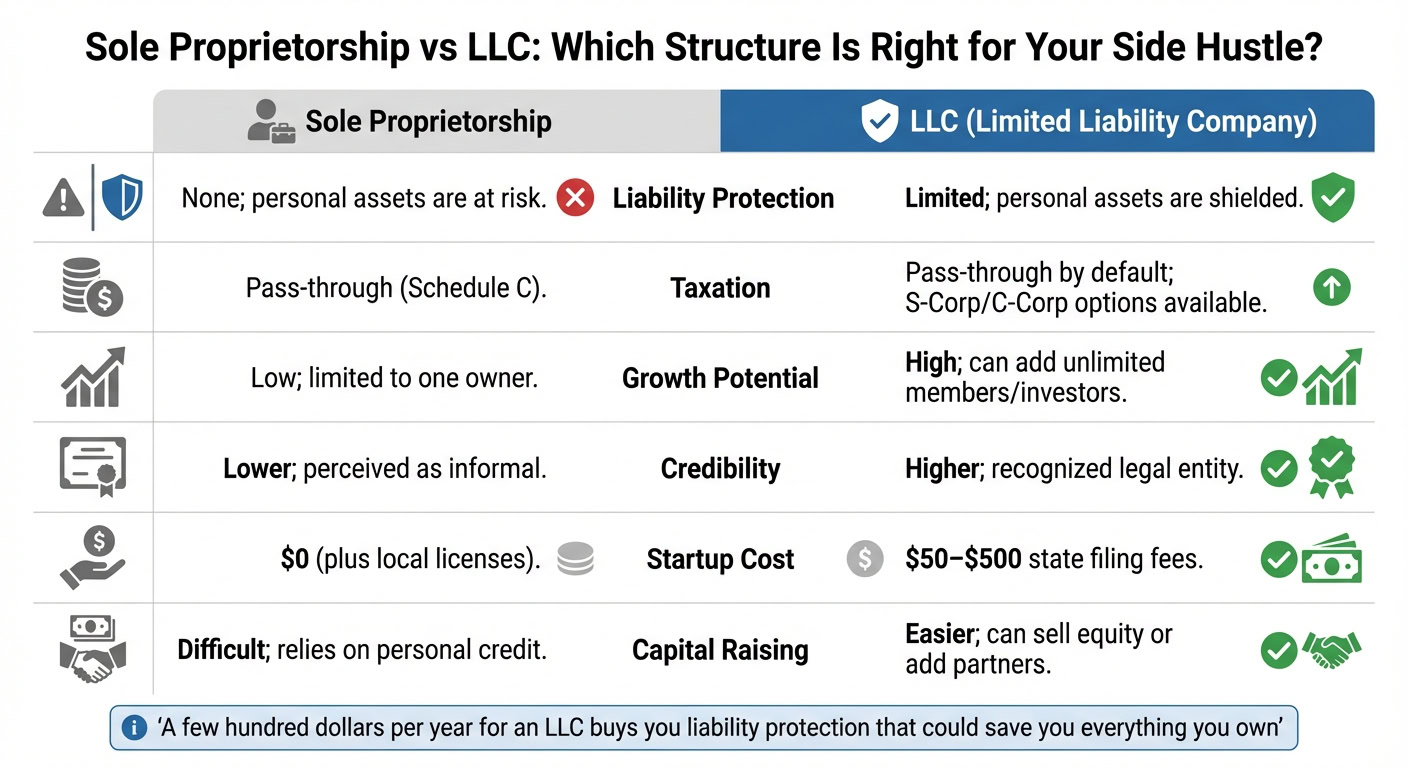
Sole Proprietorship vs LLC Comparison Chart
When your side hustle starts gaining traction, forming an LLC can be a smart next step. To understand why, here’s a quick comparison between sole proprietorships and LLCs:
| Feature | Sole Proprietorship | LLC |
|---|---|---|
| Liability Protection | None; personal assets are at risk | Limited; personal assets are shielded |
| Taxation | Pass-through (Schedule C) | Pass-through by default; S-Corp/C-Corp options |
| Growth Potential | Low; limited to one owner | High; can add unlimited members/investors |
| Credibility | Lower; perceived as informal | Higher; recognized legal entity |
| Startup Cost | $0 (plus local licenses) | $50–$500 state filing fees |
| Capital Raising | Difficult; relies on personal credit | Easier; can sell equity or add partners |
This comparison highlights the advantages of an LLC, especially when it comes to protecting your personal assets. As Rick Mak explains:
"A few hundred dollars per year for an LLC buys you liability protection that could save you everything you own".
With BusinessAnywhere, forming an LLC is straightforward and cost-effective. They offer a $0 formation option where you only pay state filing fees, which range from $50 to $500 depending on your state. Plus, your first year of registered agent service – normally priced at $147 – is included at no extra cost. After that, the service is just $147 per year. For entrepreneurs who work remotely or frequently travel, BusinessAnywhere also provides a remote online notary service for $37 per notarization, making the signing process hassle-free.
Beyond liability protection, an LLC offers tax advantages. Both LLCs and sole proprietorships use pass-through taxation, meaning you’ll pay a 15.3% self-employment tax on net earnings. However, once your LLC’s net income exceeds $50,000–$60,000, you can elect S-Corp status, potentially saving $5,000 to $8,000 for every $100,000 in profit. BusinessAnywhere even helps with S-Corp election filing for $97, giving you a cost-effective way to optimize your taxes without needing an accountant right away.
How to Form Your LLC in 4 Steps
Starting your LLC doesn’t have to be complicated. Here’s a straightforward guide to help you through the process:
Step 1: Choose a Business Name
Your LLC’s name needs to be unique within your state and must include a term like "LLC" or "Limited Liability Company." To avoid issues, check your Secretary of State’s online database to confirm the name you want isn’t already taken. Some states allow you to reserve a name for a fee, usually between $10 and $50.
Step 2: File Articles of Organization
This document – sometimes called a Certificate of Formation – officially registers your LLC with the state. It includes details like your business name, address, and registered agent. Filing fees vary widely, from $35 in Montana to $520 in Massachusetts, but most states charge around $100. Services like BusinessAnywhere can handle the filing for you, and many states process applications online in 1 to 10 business days. Once this step is complete, you’ll need to create an LLC operating agreement.
Step 3: Create an Operating Agreement
An operating agreement is an internal document that spells out how your LLC will operate. It covers things like ownership percentages, how profits are shared, and management roles. While only five states – California, Delaware, Maine, Missouri, and New York – legally require this document, having one is crucial. It helps maintain the legal separation between your personal and business assets. Corporate attorney Omaima Poonawala emphasizes its importance:
An effective operating agreement can prevent costly legal disputes.
Step 4: Obtain an EIN
Your Employer Identification Number (EIN) works like a Social Security number for your business. You’ll need it to open a business bank account, hire employees, and file federal taxes. You can apply for an EIN for free on the IRS website, and approval only takes about five minutes. If you’d rather have assistance, BusinessAnywhere offers an EIN application service for $97.
Once you’ve secured your EIN, open a separate business bank account to keep your finances organized and protect your personal liability. Use tools like the BusinessAnywhere dashboard to monitor filings, store documents, and stay on top of compliance. With these steps complete, your LLC is officially up and running!
Conclusion
Turning your side hustle into an LLC is a clear sign that your business has outgrown its informal beginnings. If you’re consistently pulling in over $1,000 a month, dealing with increasing liability risks, seeking more professional credibility, needing to separate finances, or preparing to hire employees, it’s time to consider formalizing your business.
Making this move comes with distinct benefits. An LLC provides flexibility in tax options and boosts your professional image, which can open doors to larger contracts or funding opportunities. As Sarah Jones from LegalZoom explains:
An LLC can significantly enhance your side hustle’s professionalism and make it easier to build business credit.
Platforms like BusinessAnywhere simplify the process. They offer $0 LLC formation (you only cover state fees), a free first-year registered agent service, and tools for managing EIN applications and compliance requirements. Their remote-friendly dashboard ensures you can handle everything without getting bogged down in paperwork, leaving you free to focus on growing your business.
FAQs
Will an LLC protect me if I’m personally at fault?
An LLC generally provides a layer of protection, shielding you from personal responsibility for business debts and claims. However, this safeguard isn’t absolute. If you engage in illegal activities, neglect necessary formalities, or act carelessly, that protection can vanish. To keep your liability shield intact, make sure your LLC adheres to all legal and operational rules.
What ongoing fees and filings will I have after I form an LLC?
After setting up an LLC, you’ll need to budget for recurring expenses like annual reports or franchise taxes. On average, these costs run about $91 per year in the U.S., though they can vary depending on your state. Some states may also tack on extra fees, so it’s important to review your state’s specific regulations to ensure you remain compliant.
When does it make sense to elect S-Corp status for my LLC?
If your LLC generates around $80,000 or more annually, choosing S-Corp status can be a smart move. This decision often helps lower self-employment taxes, potentially leading to considerable tax savings. However, it’s important to consult a tax professional to make sure this option fits your financial objectives and meets all compliance requirements.