

Starting a business with family or friends can be rewarding but comes with unique challenges. Personal relationships often blur professional boundaries, leading to misunderstandings, disputes, and even strained relationships. To avoid these pitfalls, focus on professionalism from the start. Here’s how:
- Define roles clearly: Assign responsibilities based on skills, not relationships, and document them to prevent overlaps or confusion.
- Draft formal agreements: Put ownership, profit-sharing, decision-making, and exit strategies in writing to avoid disputes.
- Use professional tools: Separate personal and business communication with tools like Slack or Asana, and manage tasks effectively.
- Plan for conflict resolution: Establish ground rules and consider third-party mediation for disputes.
- Track accountability: Schedule regular reviews and update roles as the business grows.
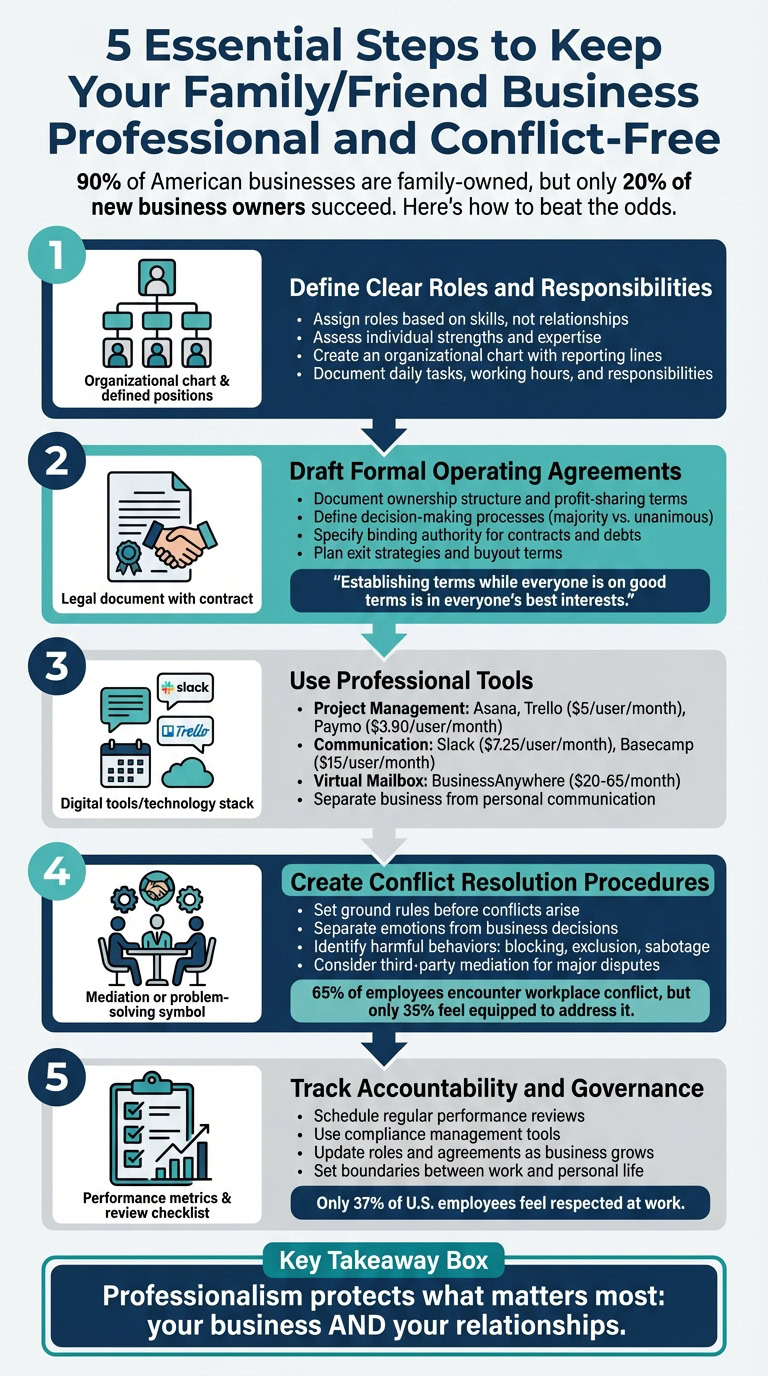
5 Essential Steps to Start a Professional Business with Family or Friends
Set Clear Roles and Responsibilities
Family and friend-run businesses often stumble when they assign roles based on personal relationships rather than the actual needs of the business. Jamie Johnson from the U.S. Chamber of Commerce points out that this tendency can lead to overlapping duties, unclear accountability, and even resentment – issues that harm both the business and personal relationships.
Start with your business needs, not your family tree. Begin by identifying every role your business requires. Think of positions like CEO, CFO, marketing manager, or operations lead, depending on your specific business model. Once you’ve outlined these roles, evaluate whether your family members or friends have the professional qualifications to fill them.
It’s also crucial to assess current skills rather than relying on past perceptions. For instance, a family member who used to be disorganized might have developed excellent project management abilities over time. To make this process more objective, consider bringing in a neutral third party, such as a business consultant, who can evaluate skills without personal bias.
Assess Individual Strengths and Skills
When assigning roles, focus on expertise and experience. If a friend has a background in marketing or a cousin is skilled in accounting, align their roles with those strengths. It’s important to determine whether someone’s abilities are better suited for executive roles (strategy and vision), managerial positions (overseeing departments), or operational tasks (daily execution).
Documenting these roles and responsibilities is key. Business coach Sai Blackbyrn recommends formalizing details such as daily tasks, working hours, vacation policies, and even office space allocations. This creates clarity, ensures accountability, and helps avoid feelings of micromanagement.
Once roles are assigned, create a clear visual structure to reinforce accountability and transparency.
Create an Organizational Chart
An organizational chart is a powerful tool for defining and visualizing accountability. By outlining reporting lines and responsibilities, it helps everyone understand their place within the business.
Start by categorizing roles: place executive leadership at the top, managers in the middle, and operational staff at the foundation. If applicable, include governance bodies like a board of directors or a family council to handle major decisions and maintain clear boundaries.
Updating this chart regularly is essential to keep it accurate and aligned with the business’s growth and changes. A well-maintained organizational chart ensures clarity and keeps everyone on the same page.
sbb-itb-ba0a4be
Draft Formal Operating Agreements
After assigning roles, it’s time to put everything in writing. A formal operating agreement not only protects your business but also safeguards personal relationships. Without a written agreement, your state’s default laws will dictate many aspects of your business, and those generic rules often fail to address the specific dynamics of partnerships involving family or friends.
"Establishing terms and conditions for your partnership at the beginning, while everyone is on good terms, is in everyone’s best interests." – Attorneys Bethany K. Laurence and Amanda Hayes
This document acts as a neutral guide when conflicts arise, helping partners focus on pre-agreed terms rather than personal emotions.
In the U.S., all states except Louisiana follow either the UPA or RUPA. While these frameworks provide basic guidelines, they rarely address the nuances of partnerships involving close personal relationships. By working with an attorney, you can create a customized agreement that overrides default laws and aligns with your specific needs.
Document Ownership Structure and Profit-Sharing Terms
Once your legal framework is in place, define each partner’s contributions clearly. Contributions might include cash, property, equipment, or specialized expertise – all of which determine ownership percentages. For instance, if one partner invests $50,000 while another provides valuable industry connections and full-time effort, their equity stakes should reflect these contributions.
Next, outline how profits and losses will be divided. Will you base this on ownership percentages, or use a different formula? Also, decide how often partners can take "draws" or distributions from the business. These details help avoid misunderstandings that could lead to resentment. For example, if one partner works full-time while another contributes part-time, a 50/50 split might feel unfair and could create tension later.
Define Decision-Making Processes
Your agreement should also establish clear rules for decision-making. Decide whether each partner will have an equal vote or if voting power will be tied to ownership percentages. Clarify which decisions require a simple majority and which demand unanimous consent. Minor daily decisions can often be handled by individual partners, but major actions – like incurring significant debt or entering new markets – should require unanimous agreement.
Additionally, specify which partners have binding authority. This means identifying who can legally sign contracts or take on debts for the business. Without these guidelines, one partner could unintentionally (or intentionally) commit the business to obligations without the others’ knowledge or approval. These rules help ensure smoother operations and prevent unnecessary conflicts.
Plan Exit Strategies
Planning for exits is just as important as planning for day-to-day operations. Your agreement should address scenarios like partner departures, retirement, incapacity, or death. Decide on a valuation method for a partner’s share while everyone is on good terms to avoid disputes during an emotionally charged exit.
Include buyout terms that allow the remaining partners to purchase the departing partner’s share, keeping the business intact. Additionally, outline situations that could lead to dissolving the business entirely and specify how remaining assets would be distributed. While these provisions might feel overly cautious, they are essential for avoiding the "horror stories" where business disputes fracture family relationships for years.
Use Tools to Improve Communication and Operations
Having formal agreements in place helps maintain clear professional boundaries, but to keep everything running smoothly, the right tools are just as important. One common pitfall in partnerships with family and friends is relying on personal text messages or casual verbal agreements for business matters. This can quickly lead to confusion, missed deadlines, and even tension when tasks and responsibilities aren’t clearly defined.
Use Project Management Software
Project management software is a game-changer for assigning and tracking responsibilities. Tools like Asana are great for non-technical teams, offering an intuitive interface and features like Timelines and Portfolios to assign tasks visually. With a performance rating of 88/100, it’s known for being easy to use.
For simpler workflows, Trello provides a drag-and-drop Kanban system, starting at just $5 per user/month. If your business involves billing clients or tracking hours, Paymo might be the better choice. Starting at $3.90 per user/month, it combines task management with built-in time tracking and invoicing features. This setup can eliminate awkward conversations about workload by clearly showing each partner’s contributions.
Set Up Virtual Mailbox Services
If your business operates out of a shared home, having a separate professional address is crucial. A virtual mailbox service like BusinessAnywhere offers unlimited mail scanning and global forwarding, all managed through a digital dashboard. Plans start at $20 per month for two recipients, with more comprehensive options available at $65 per month. This ensures your business correspondence stays organized and distinct from personal mail.
Choose Communication Platforms
Keeping business conversations out of personal group chats is another essential step. Platforms like Slack and Basecamp provide structured, professional environments for work discussions. Slack, starting at $7.25 per active user per month, integrates with over 2,200 apps, making it a hub for centralized workflows. Basecamp, at $15 per user/month, supports project-specific communication and offers helpful features like automated check-ins.
As Carol Tuttle, CEO of Live Your Truth, LLC, puts it:
"We have a family rule that when we are together for family time, the conversation of business needs to be checked at the door".
Using professional communication tools not only enforces these boundaries but also keeps your operations more organized. These tools are key to maintaining clarity and structure as your business evolves.
Create Conflict Resolution Procedures
Just like formal agreements and defined roles protect your business structure, having a plan for resolving conflicts safeguards your relationships. When running a business with family or friends, disagreements are bound to happen. The goal isn’t to avoid them altogether but to handle them in a way that’s professional and constructive. Without a clear process, even minor disputes can escalate, potentially harming both the business and personal bonds. In fact, over 65% of employees encounter workplace conflict, yet only 35% feel equipped to address it directly.
Set Ground Rules for Managing Conflicts
The first step in handling disagreements is setting clear guidelines before they arise. Start by acknowledging that conflicts are a natural part of business and shouldn’t be taken personally. This mindset can help prevent feelings of hurt when differences in strategy or opinion occur.
It’s also important to separate emotions from business decisions. Decisions should be driven by logic and profitability, not emotional attachments or overly ambitious goals.
Another key rule is to recognize and address harmful behaviors as they happen. Specific negative patterns like "blocking" (intentionally hindering progress), "exclusion" (keeping others out of the loop), and "sabotage" can derail collaboration. Doug Baumoel and Blair Trippe from Continuity Family Business Consulting explain:
"Naming the problem is often the first step in resolving it. Identifying behaviors such as blocking, excluding, and sabotaging can help family business stakeholders recognize destructive patterns in their conflicts."
Additionally, set boundaries to protect personal relationships. For instance, establish a rule that work-related topics are off-limits during family dinners or social events. This separation can prevent business stress from spilling into personal time.
When internal efforts aren’t enough, bringing in an impartial third party can help.
Consider Third-Party Mediation
If conflicts escalate beyond what internal measures can resolve, a neutral mediator can make a big difference. A mediator provides an unbiased perspective, helping to overcome common biases and find solutions.
It’s wise to identify a trusted mediator ahead of time. This person should have no prior connection to your family or social circle to ensure objectivity. As Entrepreneur.com advises:
"Find a neutral party that hasn’t been connected to you or your family members to step in and be an arbitrator. They can work out any differences based on what you’ve initially put in writing, and they can remind you that the most important thing in or out of business is the relationship."
A real-world example highlights the value of mediation. In June 2025, a family-owned sporting equipment manufacturer faced a major internal conflict. Older cousins used their banking ties to block loans for new facilities, while younger cousins retaliated by cutting them out of communications. The family sought help from Doug Baumoel and Blair Trippe, who facilitated neutral discussions. By addressing destructive behaviors and introducing independent board members, they created a governance plan that balanced growth with stability. This not only restored the company’s competitive edge but also repaired family relationships.
For smaller issues, regular check-ins can be an effective preventative measure. Scheduling monthly or quarterly meetings allows partners to discuss concerns before they grow into larger problems. Callie McGill, Content Manager at LendingTree, emphasizes:
"Checking in with each other frequently to provide updates on what each of you contributes to the company’s growth can often stop fights before they start."
Track Accountability and Governance
Having conflict resolution strategies is just the starting point. To keep a family or friend-run business running smoothly, you need systems that ensure accountability and adapt as the business evolves. Without regular check-ins and governance structures, even the most well-thought-out agreements can lose their effectiveness, leading to frustration or operational confusion.
Schedule Regular Performance Reviews
Performance reviews aren’t just for large corporations – they’re equally important in businesses involving family or friends. These structured evaluations help avoid micromanagement, counter outdated assumptions, and ensure everyone’s responsibilities are clearly defined and tracked.
Start by documenting baseline expectations in a formal contract or operations manual. This creates an objective point of reference, reducing the chance of disputes turning into "he-said, she-said" situations. As Entrepreneur advises:
"Don’t assume that because you’re working with family you don’t need a contract or operations manual – or that you’ll sail through any conflict."
Use these reviews to evaluate whether the business is hitting the financial and operational benchmarks outlined in your initial agreements. These discussions can guide decisions on scaling, pivoting strategies, or even planning for closure. Bringing in a neutral third party can also help minimize biases and prevent family dynamics from escalating into major issues. For instance, it could help avoid situations like prolonged estrangement between siblings. Pair these reviews with streamlined compliance processes to ensure long-term stability.
Use BusinessAnywhere for Compliance Management

Staying compliant with state and federal regulations can feel overwhelming, especially when personal relationships overlap with business responsibilities. BusinessAnywhere simplifies this process by offering a centralized platform for managing compliance tasks. It handles annual report filings, provides registered agent services (free for the first year, then $147 annually), and sends timely compliance alerts to prevent missed deadlines. The platform also assists with Beneficial Ownership Information Report (BOIR) filings for just $37, helping you stay aligned with FinCEN regulations.
By organizing documents, facilitating strategic planning, and tracking performance, BusinessAnywhere reduces the administrative burden on individual partners. It also creates a transparent audit trail, ensuring that everyone is on the same page.
Update Roles and Agreements as Needed
As your business grows, your roles, agreements, and systems need to grow with it. Job descriptions, delegation processes, and performance evaluations should all reflect the company’s current needs. When unclear roles lead to duplicated efforts or power struggles, revise your agreements to clarify ownership, compensation, and daily responsibilities. MSB Law highlights the importance of these boundaries:
"Establishing boundaries is not just important, it’s foundational."
Include precise "pivot points" in your agreements, defining the financial or operational conditions that would trigger strategy changes or scaling efforts. Regular, structured meetings help keep discussions focused on business goals. When major adjustments are required, neutral advisors or arbitrators can offer an unbiased perspective. These updates ensure your business maintains a professional framework, avoiding situations where personal relationships interfere with operational efficiency.
It’s worth noting that only 37% of U.S. employees feel respected at work. In family or friend-run businesses, this highlights the need for clear boundaries between work and personal life. For example, you might agree not to discuss business matters during family gatherings. This separation helps maintain professionalism while preserving personal relationships.
Conclusion
Starting a business with family or friends can be incredibly fulfilling, but it requires a solid professional framework from the very beginning. While 90% of American businesses are family-owned, long-term success depends on balancing personal bonds with professional discipline. Considering that only 20% of new business owners succeed, the ability to manage this balance often determines the outcome.
The strategies outlined – like defining roles, formalizing agreements, using professional tools, resolving conflicts effectively, and maintaining accountability – are essential for protecting both your business and your relationships. As attorney and author Mark J. Kohler highlights:
"I am constantly amazed at how many people will invest or loan hundreds of thousands of dollars to their neighbor or fellow church member without getting anything in writing … I just hear the constant excuse: ‘I didn’t want to hire a lawyer because it would have made the relationship uncomfortable, and I trusted them.’"
Professionalism is the safeguard for what matters most. It prevents business disagreements from spiraling into personal estrangements – like the siblings who didn’t speak for five years after a dispute over an undocumented agreement. It fosters honest feedback that drives growth and sets a standard of fairness and accountability, ensuring success is based on merit rather than favoritism.
Boundaries, as we’ve seen, are not obstacles – they’re protective measures. By separating work from personal life, documenting agreements, and promoting fairness, you’re laying the groundwork for a business that can thrive without jeopardizing the relationships at its core. With the right systems and a commitment to professionalism, your venture can flourish while preserving the bonds that inspired it. These safeguards ensure that your business can succeed and your relationships remain intact.
FAQs
What’s the best way to split ownership if we contribute different things?
To ensure a fair division of ownership, it’s crucial to draft formal agreements that spell out everyone’s contributions and ownership percentages. This approach promotes transparency, keeps everyone on the same page, and provides legal clarity, reducing the chances of disputes down the line.
Which decisions should require unanimous approval versus a majority vote?
When it comes to major decisions – like reshaping strategy, making large financial investments, or changing ownership structures – unanimous approval is usually required. These are high-stakes choices that demand the full agreement of all involved parties.
On the other hand, day-to-day operational decisions are often less complex and can typically be resolved with a majority vote. By clearly outlining which decisions fall into each category ahead of time, you can avoid confusion and keep the decision-making process running smoothly.
When should we bring in a mediator or neutral third party?
When conflicts escalate to a point where they’re unmanageable or start impacting relationships and business operations, it’s time to bring in a mediator or neutral third party. This approach can help prevent long-term harm to both family ties and the business itself. A mediator offers an unbiased perspective and creates a space for productive communication, making it easier to tackle the root causes of the disagreement.