

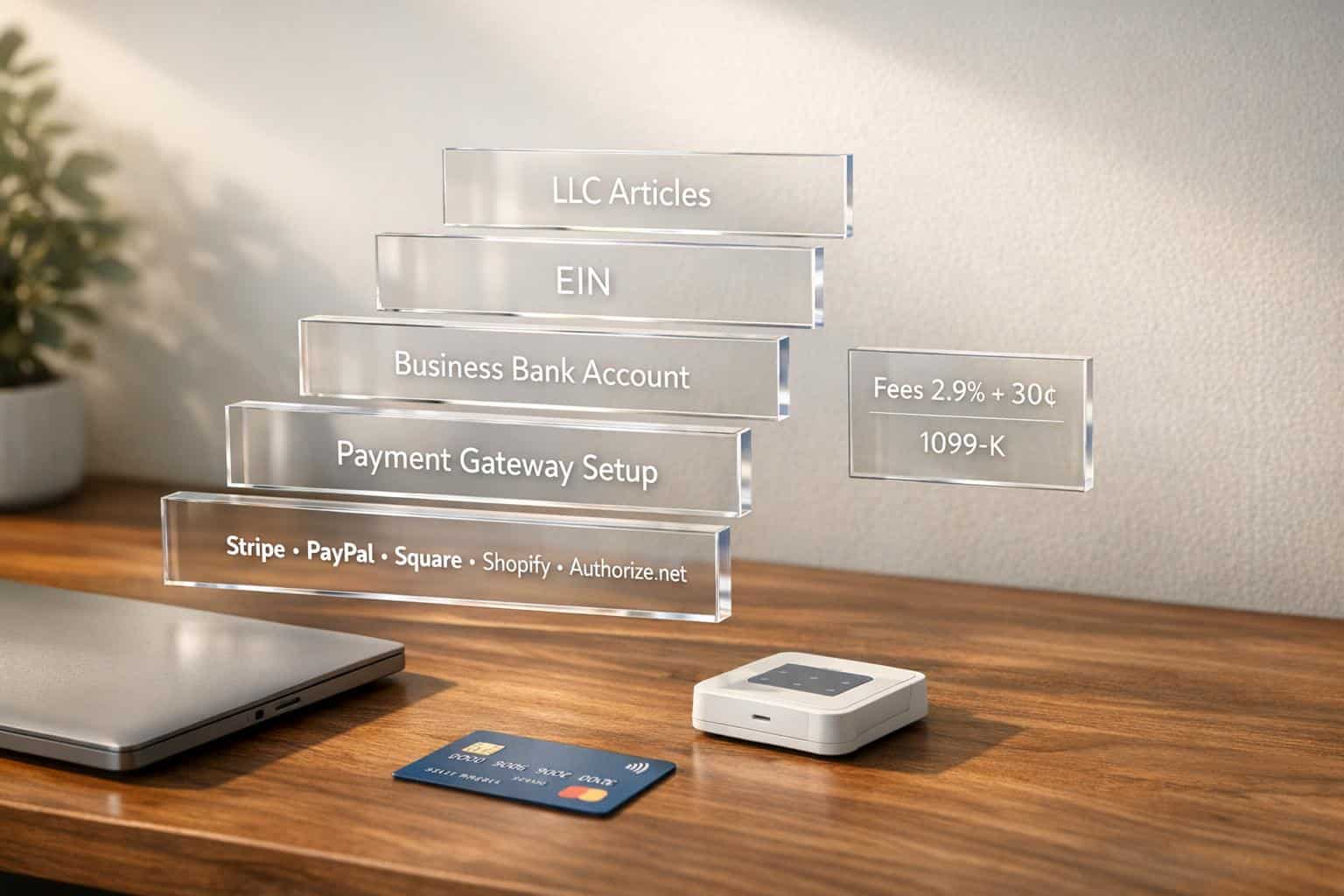
To accept online payments as a new LLC, you need to set up a payment processor that connects to your business bank account. Here’s a quick rundown of what you need and the best options:
What You Need:
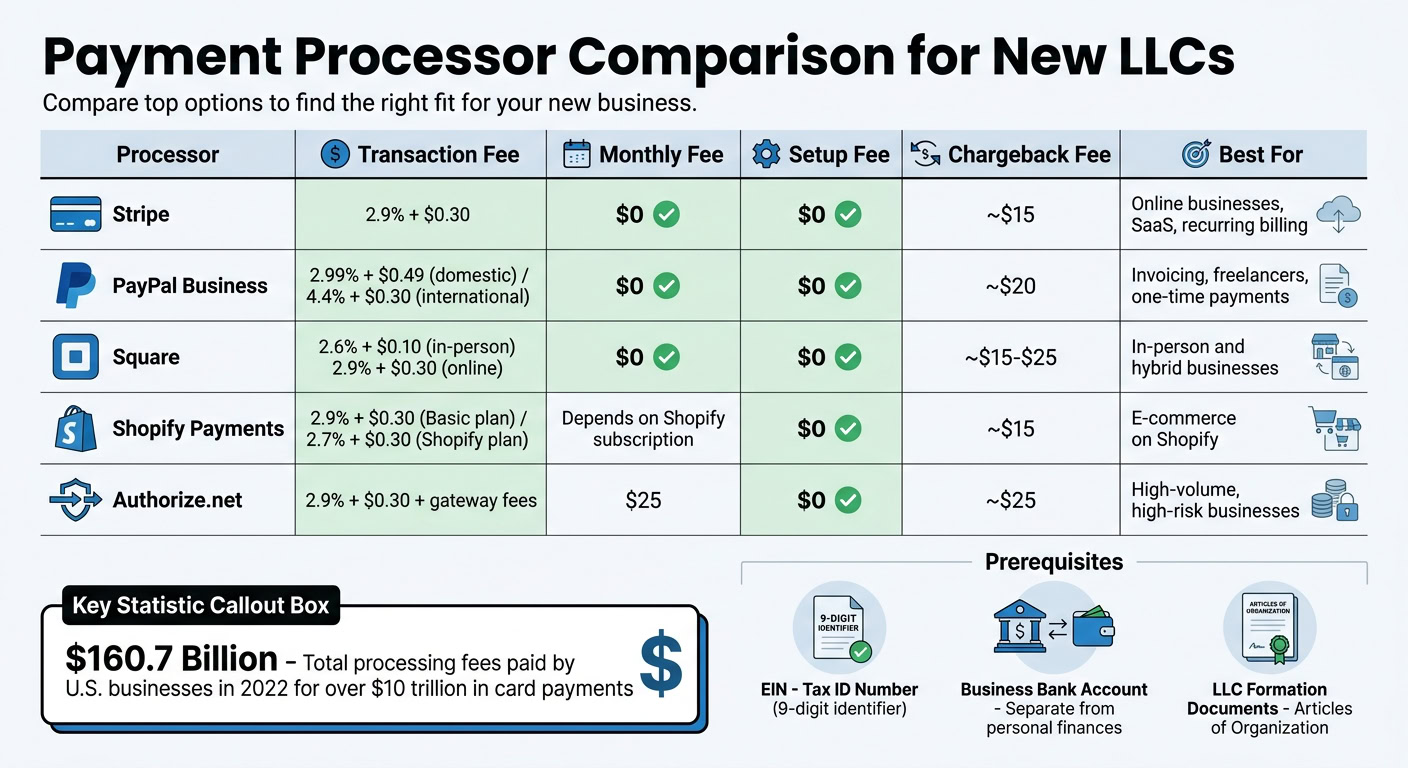
- EIN (Employer Identification Number): A unique tax ID for your LLC, required by most payment processors.
- Business Bank Account: Keeps your personal and business finances separate.
- LLC Formation Documents: Includes Articles of Organization and, if applicable, an Operating Agreement.
Best Payment Processors:
- Stripe: Ideal for online businesses with recurring billing or SaaS models. Charges 2.9% + $0.30 per transaction.
- PayPal Business: Great for invoicing and one-time payments. Fees are slightly higher at 2.99% + $0.49 per transaction.
- Square: Perfect for businesses combining online and in-person sales. In-person fees are 2.6% + $0.10.
- Shopify Payments: Best for Shopify e-commerce users. Fees start at 2.9% + $0.30 on the Basic plan.
- Authorize.net: Suited for high-volume or specialized industries. Includes a $25 monthly fee plus standard transaction rates.
Quick Comparison:
| Processor | Transaction Fee | Monthly Fee | Best For |
|---|---|---|---|
| Stripe | 2.9% + $0.30 | $0 | Online businesses, SaaS |
| PayPal Business | 2.99% + $0.49 | $0 | Invoicing, freelancers |
| Square | 2.6% + $0.10 (in-person) | $0 | In-person and hybrid businesses |
| Shopify Payments | 2.9% + $0.30 (Basic plan) | Shopify plan fee | Shopify e-commerce users |
| Authorize.net | 2.9% + $0.30 + $25 gateway | $25 | High-volume or niche industries |
Key Tax Note:
If your LLC processes $600 or more annually, you’ll receive a 1099-K form from your payment processor. This reports gross payment volume to the IRS, so ensure your EIN and business records are accurate.
Choose a payment processor based on your business type, transaction volume, and customer needs. For non-residents, services like Stripe Atlas can simplify the process of setting up a U.S. LLC and accessing payment systems.
What You Need Before Setting Up Payment Processing
To get your LLC approved by a payment processor, you’ll need three key items: an EIN, a business bank account, and your LLC formation documents. These essentials establish your business’s legitimacy and ensure compliance with federal Know Your Customer (KYC) regulations, which are designed to prevent fraud.
These documents confirm that your LLC is legally recognized. Without them, payment processors can’t verify your identity, deposit funds, or report income to the IRS. The good news? Obtaining these items is straightforward and often takes just a few days.
Let’s break down each requirement to ensure your LLC is ready for payment processing.
Get an EIN (Employer Identification Number)
An EIN is like a Social Security number for your business – a unique, nine-digit identifier issued by the IRS. Payment processors, such as Stripe, PayPal Business, and Square, use it to track and report your business’s tax obligations. In fact, most processors won’t approve your account without one.
"In order to pay taxes as an LLC, you’ll need to obtain a federal tax ID, known as an employer identification number (EIN). This is your business’s version of a Social Security number. You will use it to pay taxes, to open a business bank account, or to apply for loans." – Stripe
Applying for an EIN is free and easy. Head to the IRS website, and in less than 15 minutes, you can complete the process. Make sure you have your Articles of Organization handy, as you’ll need to provide your LLC’s legal name, formation date, and business address. If you’re a non-resident LLC owner, services like Stripe Atlas can assist with the EIN application as part of their $500 formation package.
Open a Business Bank Account
A business bank account is where your payment processor will deposit funds from customer transactions. It’s also essential for keeping your LLC’s finances separate from your personal accounts, which protects your personal assets. Without this separation, you risk "piercing the corporate veil", leaving your personal assets vulnerable to business liabilities.
"The first and highest-priority step is opening a business bank account to serve as the home base of your LLC’s financial operations." – Stripe
To open a business account, most banks require your EIN and Articles of Organization. Once your account is active, you’ll need the routing and account numbers to connect it to your payment processor. This account will handle deposits, refunds, and chargebacks.
Gather Your LLC Formation Documents
Payment processors will need to verify your LLC’s legitimacy, which means providing your formation documents. Typically, they’ll request your Articles of Organization to confirm your LLC’s legal status and your Operating Agreement to clarify ownership and management details.
Even if your state doesn’t require an Operating Agreement, many processors will still ask for one to confirm who is authorized to manage the business’s finances. If your LLC operates under a trade name (DBA), you may also need to provide proof of registration. Depending on your industry, additional licenses or permits may be required.
Keep digital copies of these documents in a secure location. You’ll need to upload them during the application process to finalize your payment processor setup. These documents are critical to ensuring smooth integration with your payment system.
Payment Processing Options for Your LLC
Once you’ve got your EIN, business bank account, and formation documents ready, the next step is choosing a payment processor. The right choice depends on how you plan to accept payments – online, in person, or both – and the number of transactions you anticipate.
Each payment processor caters to specific needs. Stripe is excellent for online businesses, especially those with recurring billing like SaaS companies. PayPal Business works well for freelancers and service providers who rely on invoicing. Square is ideal for businesses needing both online and in-person payment solutions, while Shopify Payments integrates seamlessly with Shopify e-commerce stores. For high-volume or specialized industries, Authorize.net is a strong option.
Keep in mind that most applications are approved within 24 to 48 hours, though some, like Authorize.net, might take longer due to additional vetting. Understanding fee structures is critical, as most processors charge about 2.9% + $0.30 per online transaction. However, fees for in-person sales, monthly charges, and costs for chargebacks or international transactions can vary. In 2022, U.S. businesses spent $160.7 billion in processing fees to handle over $10 trillion in card payments. Even minor differences in fees can significantly affect your bottom line.
Below, we break down each option, focusing on setup, fees, best use cases, and any limitations for non-residents.
Stripe: Best for Most LLCs
Stripe stands out for online businesses, especially those offering digital products, subscription services, or marketplaces. Its developer-friendly API allows for extensive customization, and it supports payments in over 135 countries with a wide range of local payment methods. If you’re running a SaaS platform or need recurring billing, Stripe’s built-in subscription tools make managing customer payments straightforward.
- Setup: The process is entirely online. Sign up on Stripe.com, input your LLC details, and verify your identity. This takes about 10–15 minutes, and most accounts are approved within one business day. Once approved, you’ll get API keys to integrate Stripe into your website using plugins or custom code.
- Fees: Stripe charges 2.9% + $0.30 per transaction with no monthly fees, making it a practical choice for startups and small businesses. Its advanced analytics tools also help track revenue and customer behavior.
- Non-Resident Limitations: Non-U.S. residents must use Stripe Atlas, which costs $500 upfront plus $100 annually for registered agent services after the first year. This service includes Delaware incorporation, EIN assistance, and help opening a U.S. business bank account.
Next up: PayPal Business, a great option for invoicing and one-time payments.
PayPal Business: Good for Invoicing and One-Time Payments
PayPal Business is a household name, making it a go-to for freelancers, consultants, and service providers who primarily handle invoices or one-time payments. Its user-friendly platform requires no technical expertise, and features like "One Touch" simplify mobile payments.
- Setup: Create a business account on PayPal.com, provide your LLC details, and upload any additional documents like Articles of Organization if requested. Once approved, you can start sending invoices, generating payment links, or adding PayPal buttons to your website.
- Fees: PayPal charges 2.99% + $0.49 per transaction, which is slightly higher than Stripe’s 2.9% + $0.30. For instance, on a $100 transaction, PayPal would charge $3.48 compared to $3.20 with Stripe. Over time, this difference can add up.
- Non-Resident Limitations: Non-U.S. residents need a U.S. business entity and bank account, often set up through services like Stripe Atlas, to meet PayPal’s requirements. While its reporting tools are less detailed than Stripe’s, PayPal’s simplicity and global recognition make it a solid choice for solo entrepreneurs.
For businesses requiring in-person payment solutions, Square is worth considering.
Square: Best for In-Person and Hybrid Businesses
Square is perfect for businesses that need to accept payments both online and in person. Whether you’re running a retail shop, restaurant, or service-based business, Square’s point-of-sale (POS) system and hardware simplify card payments, inventory tracking, and employee management.
- Setup: Download the Square app, input your LLC details, and order your free card reader. Square provides a basic magstripe reader for free, with options to upgrade to more advanced hardware like the Square Terminal or Square Register. Most accounts are approved within 24 hours.
- Fees: Square charges 2.6% + $0.10 for in-person transactions and 2.9% + $0.30 for online sales. For example, a $50 in-person sale would incur a fee of about $1.40, compared to $1.75 for an online transaction.
- Non-Resident Limitations: Square is only available to U.S.-based businesses with a U.S. address and either a Social Security Number (SSN) or Individual Taxpayer Identification Number (ITIN). Square also offers free tools for invoicing, online stores, and appointment scheduling, though its analytics and customization options are less robust than Stripe’s.
If you’re already using Shopify for e-commerce, Shopify Payments might be your best bet.
Shopify Payments: For E-Commerce LLCs
Shopify Payments is tailored for Shopify users, eliminating the need for a third-party payment gateway. If you’re running an e-commerce store on Shopify, this option streamlines payment processing.
- Setup: Activate Shopify Payments directly within your Shopify account. Enter your LLC details, and you’re ready to accept payments as soon as your store goes live.
- Fees: On the Basic Shopify plan ($39 per month), the transaction fee is 2.9% + $0.30. Higher-tier plans offer lower rates. If you use a third-party processor, Shopify adds a 2% fee, making Shopify Payments the more cost-effective option for Shopify users.
- Non-Resident Limitations: Shopify Payments supports businesses in the U.S., Canada, UK, Australia, and several European countries. Non-U.S. residents can use it if they have a U.S. business entity and bank account, though additional verification may be required.
For businesses with high transaction volumes or those in specialized industries, Authorize.net is worth exploring.
Authorize.net: For High-Volume or High-Risk Businesses
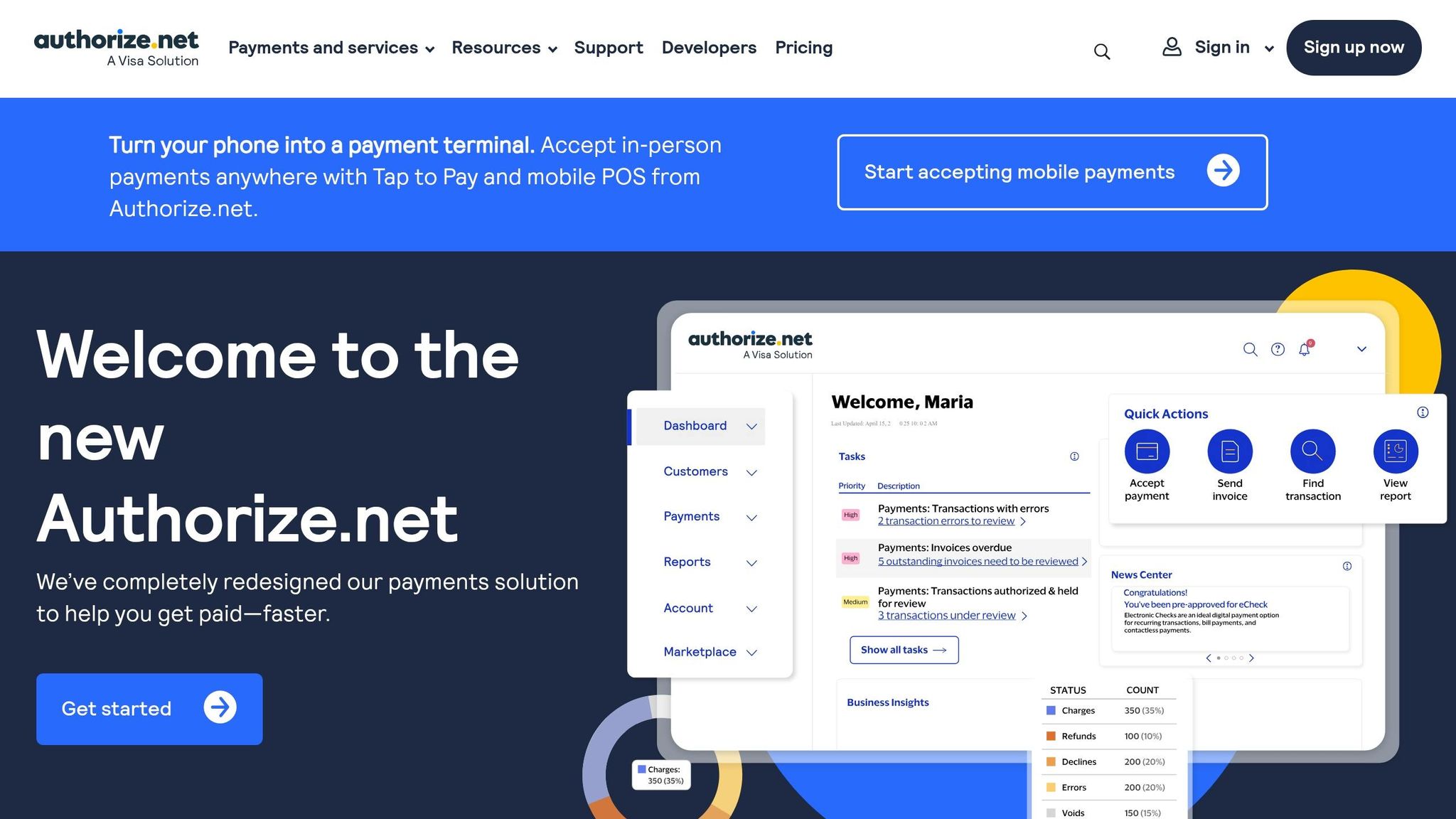
Authorize.net serves as a traditional payment gateway and merchant account provider, making it a better fit for businesses with high transaction volumes or those in higher-risk industries like travel, nutraceuticals, or subscription services.
- Fees: Authorize.net charges 2.9% + $0.30 per transaction, plus a $25 monthly gateway fee. This makes it less cost-effective for startups or low-volume businesses but a strong choice for established companies.
- Setup: The process requires additional documentation and takes longer than other processors, but it’s well-suited for businesses that need a more robust system.
Choosing the right payment processor is a critical step in setting up your LLC for success. Each option has its strengths, so weigh your business model and transaction needs carefully.
Payment Processing for Non-Resident LLC Owners
Setting up payment processing as a non-U.S. resident can feel like navigating a maze. Most processors insist on a U.S. address, EIN, and a U.S. business bank account – requirements that can be tough to meet from abroad. Thankfully, services like Stripe Atlas and a clear understanding of PayPal’s restrictions offer practical ways to overcome these challenges, ensuring you can start accepting payments without unnecessary delays.
Using Stripe Atlas as a Non-Resident
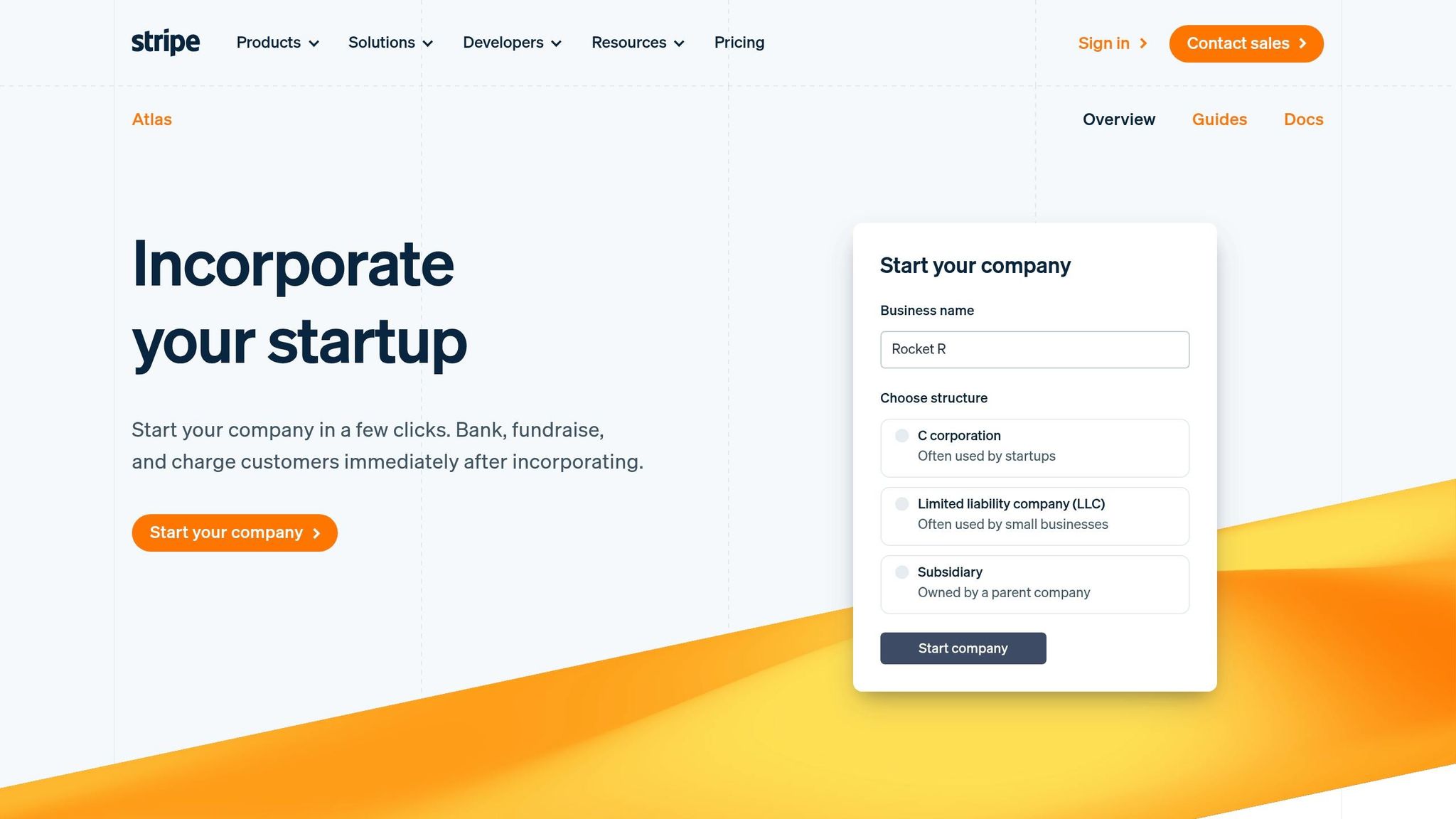
Stripe Atlas is a game-changer for non-U.S. residents looking to establish a Delaware LLC and access U.S. payment processing. It streamlines the entire process remotely – handling company formation, obtaining an EIN, and opening a U.S. business bank account remotely through its partners, such as Mercury. This eliminates the need for a physical U.S. presence, allowing you to start using Stripe for payments almost immediately.
"Stripe Atlas makes it simple to incorporate and set up your company so you’re ready to charge customers, hire your team, and fundraise as quickly as possible."
The service has an upfront cost of $500, which covers company formation and your first year of registered agent services. After the first year, maintaining the registered agent costs $100 annually. Stripe Atlas files your formation documents in Delaware within one business day and offers expedited 24-hour state-level processing at no extra cost. While obtaining an EIN as a non-resident can take longer, Atlas handles this for you, so you can start accepting payments even before the IRS officially assigns the EIN.
By 2026, Stripe Atlas is expected to facilitate 25% of all new company formations in Delaware. Beyond payment processing, it provides access to legal templates for contracts and hiring, and even lets you file an 83(b) tax election with a single click – potentially reducing future personal taxes. With your LLC established, you can use your U.S. EIN and bank account to verify your Stripe account as a U.S. entity, bypassing the usual restrictions non-residents face.
Stripe Atlas offers a streamlined solution, but if you’re considering PayPal, you’ll need to navigate its different set of rules.
PayPal Country Restrictions
PayPal has strict country-specific requirements that can complicate matters for non-resident LLC owners. To meet these, you’ll need to first establish a U.S. business entity and bank account, often through a service like Stripe Atlas. PayPal may also require additional verification, such as a U.S. address or phone number, to finalize your account setup.
If you’re accepting payments from international clients, be aware of the higher fees. For example, international card transactions incur a fee of 4.4% + $0.30 per transaction, compared to the domestic rate of 2.9% + $0.30. On top of that, currency conversion fees typically add another 1% to the total.
These higher fees and country-specific restrictions can make PayPal less appealing than Stripe for non-residents. However, if your clients prefer PayPal or you need advanced invoicing tools, it’s still a viable option – once you’ve set up your U.S. LLC and bank account. With the right preparation, you can navigate these hurdles and keep your payment processing running smoothly.
sbb-itb-ba0a4be
Payment Processor Fees Comparison
When choosing a payment processor for your LLC, understanding fee structures is just as important as evaluating features. US businesses paid a staggering $160.7 billion in processing fees in 2022 to handle over $10 trillion in card payments. For a growing LLC, selecting the right processor could mean saving thousands of dollars annually as transaction volume increases.
Here’s a breakdown of the core fees for five popular payment processors. These reflect standard pricing for new LLCs without any negotiated volume discounts:
| Processor | Transaction Fee | Monthly Fee | Setup Fee | Chargeback Fee | Best For |
|---|---|---|---|---|---|
| Stripe | 2.9% + $0.30 | $0 | $0 | ~$15 (varies by dispute) | Most LLCs, online sales |
| PayPal Business | 2.9% + $0.30 (domestic) 4.4% + $0.30 (international) |
$0 | $0 | ~$20 (varies by dispute) | Invoicing, one-time payments |
| Square | 2.9% + $0.30 (online) 2.6% + $0.10 (in-person) |
$0 | $0 | ~$15–$25 (varies by dispute) | In-person and hybrid sales |
| Shopify Payments | 2.9% + $0.30 (Basic plan) 2.7% + $0.30 (Shopify plan) |
Depends on Shopify subscription | $0 | ~$15 (varies by dispute) | E-commerce on Shopify |
| Authorize.net | 2.9% + $0.30 + gateway fees | $25 | $0 | ~$25 (varies by dispute) | High-volume, high-risk businesses |
This side-by-side comparison highlights important cost considerations. For example, Stripe and Square stand out for their transparent pricing with no recurring monthly charges, while Authorize.net’s $25 monthly gateway fee adds up to $300 annually before any transactions are processed.
Additional fees, such as PCI compliance ($5–$15 monthly), statement charges, and equipment rental for physical card readers, can also affect your total costs. For LLCs processing less than $10,000 monthly, pay-as-you-go models like Stripe or PayPal can help you avoid fixed costs. On the other hand, businesses handling over $50,000 monthly should reach out to processors to negotiate lower rates per transaction.
Digital payment methods are also more economical, costing 57% less than non-digital alternatives. This makes online-focused platforms like Stripe a cost-effective choice for businesses prioritizing digital transactions.
Understanding these fees is essential to managing tax considerations and optimizing your overall cost structure.
Tax Implications: What the 1099-K Means for Your LLC
Once your LLC starts accepting online payments, understanding Form 1099-K becomes essential. This form is how payment settlement entities report your business income to the IRS if your LLC processes $600 or more in gross transactions in a calendar year. It’s a key piece of your tax puzzle.
The 1099-K is linked to your Employer Identification Number (EIN), which is why having an EIN is so important for LLC payment processing. When setting up your payment processor, you’ll be required to provide your EIN and legal business name. Ensuring these match across all reports is crucial to avoid triggering an audit.
It’s important to note that the 1099-K reflects gross payment volume, not your net profit. For instance, if you processed $50,000 through Stripe but incurred $30,000 in expenses, the 1099-K will still report the full $50,000. Reconciling this figure with your tax records is vital. Using a dedicated business bank account can make it easier to track deductible expenses and keep personal and business finances separate.
To stay on top of your tax obligations, regularly compare your payment processor reports to your internal records. Many platforms, like Stripe, offer helpful tools such as Sigma and Data Pipeline for querying and verifying financial data. Integrating your payment processor with accounting software can further streamline this process and reduce the chance of manual errors.
If you’re using tools like Stripe Tax, which calculates and collects sales tax in over 40 countries, managing compliance across different jurisdictions becomes much simpler. Keeping your records in sync with processor reports ensures a smoother experience when tax season rolls around.
Choosing the Right Payment Processor for Your LLC
When selecting a payment processor for your LLC, consider your business model, transaction volume, and customer base to find the best fit.
For new online LLCs with moderate sales volumes, Stripe is often a top choice. It supports over 135 currencies, scales efficiently, and offers custom pricing for businesses handling high transaction volumes. If your LLC operates on a recurring revenue model, such as SaaS, Stripe’s recurring billing feature streamlines the payment process.
On the other hand, service-based LLCs may find PayPal to be a better match. PayPal Business is particularly beneficial for freelancers, consultants, and other service providers. Its globally recognized name builds trust, with 74% of PayPal users reporting they’re more likely to purchase from lesser-known sellers if PayPal is available at checkout. This makes it a strong option for invoicing and one-time payments without requiring complex integrations.
For high-volume or international sales, custom pricing and local payment options become essential. LLCs processing over $100,000 per month should negotiate custom interchange-plus pricing with Stripe. Additionally, offering local payment methods like SEPA, iDEAL, or Alipay can significantly reduce the global credit card failure rate, which often ranges from 10% to 15%.
Lastly, for large B2B transactions, ACH payments can provide substantial savings. For invoices exceeding $625, ACH payments – typically costing 0.8% and capped at $5 – are an economical alternative.
Next, we’ll tackle some common questions to help refine your payment processing strategy.
FAQs
Do I need an EIN to accept online payments as an LLC?
In practice, yes. An EIN is a unique nine-digit identifier issued by the IRS, and processors including Stripe, PayPal Business and Square use it to track and report your business’s tax obligations. Most of them will not approve an account without one.
Applying is free through the IRS website. You will be asked for your EIN and legal business name when you set the processor up, and those details need to match what appears on your other filings, because a mismatch is the kind of thing that draws an audit.
What is a 1099-K, and will my LLC get one?
Form 1099-K is how payment settlement entities report your business income to the IRS. Your LLC receives one if it processes $600 or more in gross transactions in a calendar year, and the form is linked to your EIN, which is part of why the EIN matters so much for payment processing. Thresholds have been revised more than once, so confirm the current figure for the tax year you are filing.
The number on it is gross payment volume, not net profit. Process $50,000 through Stripe against $30,000 of expenses and the 1099-K still reports the full $50,000, so reconciling that figure against your own records matters. A dedicated business bank account makes that reconciliation far less painful.
Can a non-U.S. resident set up payment processing for a U.S. LLC?
It is harder, but it is doable. Most processors insist on a U.S. address, an EIN and a U.S. business bank account, and all three are awkward to produce from abroad.
Stripe Atlas exists partly to solve that problem, and PayPal operates country restrictions you need to check against where you actually live before you commit to it. Sort the EIN and the U.S. banking side first: almost every obstacle non-resident owners hit at the payment-processor stage traces back to one of those two missing pieces.