


Moving your LLC to another state can save you money and simplify LLC compliance. The best method depends on your situation:
- Domestication: Transfer your LLC to a new state while keeping its EIN, history, and contracts intact. Only possible if both states allow it. Costs range from $710–$3,050.
- Foreign Registration: Operate in multiple states by registering in the new state while keeping your LLC in the original. Ideal for expansion but involves ongoing fees ($150–$800 annually).
- Dissolution and Reformation: Shut down your LLC in one state and start fresh in another. Necessary if domestication isn’t allowed but creates a new entity. Costs $1,100–$3,700.
Key Tip: Domestication is often the most efficient option if allowed. Always consult legal and tax professionals to avoid costly mistakes.
3 Ways to Move Your LLC to Another State
Relocating your LLC? You’ve got three main legal options to consider, depending on your needs and circumstances.
Domestication lets you transfer your LLC to a new state while keeping its EIN, formation date, contracts, and credit history intact. Essentially, it’s like changing your legal address without forming a new business.
Foreign registration allows your LLC to operate in a second state while remaining legally based in the original state. This involves obtaining a Certificate of Authority to do business in the new location. It’s a good choice for maintaining operations in multiple states but requires annual fees and paperwork in both.
Dissolving and reforming means closing your current LLC and starting fresh in the new state. While this creates a brand-new entity, it’s sometimes the only option if domestication isn’t allowed.
"Domestication is, in many circumstances, far preferable to registering an LLC or corporation as a foreign entity, especially where the LLC or corporation has permanently moved its operations."
- Chad D. Cummings, Attorney and CPA, Cummings & Cummings Law [3]
Let’s dive into each option, including the steps, perks, and potential challenges.
Option 1: Domestication (When Your State Allows It)
If you want to relocate your LLC without disrupting its legal identity, domestication is the way to go – provided both your current and new states allow it. Also called statutory conversion or LLC redomestication, this process ensures continuity for your business.
Why choose domestication? Your LLC keeps its tax accounts, banking details, business history, and contracts intact. There’s no need to amend or reassign existing agreements, licenses, or credit relationships.
The process involves filing specific paperwork in both states. You’ll need to submit Articles of Domestication (or equivalent documents) to the new state and notify your current state of the move. The timeline typically ranges from 2 to 6 weeks, and costs can vary between $710 and $3,050, depending on whether legal assistance is required [1].
However, domestication is only possible if both states have the necessary laws in place. If either state doesn’t permit it, you’ll need to explore other options.
Here’s a quick look at states that allow LLC domestication:
| State | Requirements/Notes |
|---|---|
| California | Requires a conversion plan, Articles of Conversion, and a Certificate of Good Standing [2] |
| Delaware | Allows entity conversions; known for business-friendly courts [1] |
| Florida | Requires Articles of Conversion and a formal conversion plan [2] |
| Texas | Requires a Certificate of Conversion and state authorization [2] |
| Wyoming | Requires Articles of Domestication and follows the Uniform LLC Act (ULLCA) [2] |
| Other States | Includes AK, AZ, CO, CT, DC, GA, ID, IL, IN, IA, KS, LA, ME, MA, MI, MN, MS, NE, NV, NH, NJ, NC, ND, OH, OR, PA, SC, SD, UT, VT, VA, WA, WI [2] |
For instance, if you’re moving to or from New York, domestication won’t be an option since the state doesn’t have laws permitting it.
Option 2: Foreign Registration
Foreign registration is a practical choice if you want to expand your LLC into another state while keeping it based in its original state. By obtaining a Certificate of Authority, your LLC gains the legal right to operate in the new location.
This approach is ideal for expansion rather than full relocation. Use it when opening a second office, hiring employees in another state, or testing a new market. It allows you to maintain operations in multiple states simultaneously.
The process is relatively simple and takes about 1 to 3 weeks [1]. You’ll file for foreign qualification in the new state and designate a registered agent in the new state there. However, this option comes with ongoing costs. Registered agent fees range from $100 to $300 annually, and you’ll need to handle annual report fees and tax filings in both states. Total yearly expenses can range from $150 to $800 or more [1].
Foreign registration works well as a short-term solution or when maintaining a dual presence is beneficial. But if you’re planning to leave your original state permanently, domestication or dissolution may be more cost-effective in the long run.
Option 3: Dissolve and Form a New LLC
If domestication isn’t allowed and foreign registration doesn’t fit your needs, dissolving your current LLC and forming a new one in the target state might be your only option. While this method creates a completely new legal entity, it can also be a fresh start.
To dissolve your existing LLC, you’ll need to file Articles of Dissolution, settle outstanding debts, cancel licenses, and distribute any remaining assets. Then, you’ll establish a new LLC in the new state by filing formation documents, obtaining a new EIN, opening new bank accounts, and transferring assets.
The downside? You lose your LLC’s continuity. The new entity will have a different formation date, no established credit history, and no connection to the original business. Contracts and agreements will need to be renegotiated, and existing bank accounts must be closed and reopened.
This process typically takes 8 to 16 weeks and costs between $1,100 and $3,700 [1]. Additionally, dissolution can trigger taxable events, such as depreciation recapture or income recognition on appreciated assets [1]. Despite these challenges, dissolving and reforming may be the only viable path when domestication isn’t an option or when you want a clean break from your original state.
sbb-itb-ba0a4be
How to Domesticate Your LLC to Wyoming (Step-by-Step)
Wyoming is a popular choice for LLC domestication, thanks to its lack of state income tax and strong privacy protections for members. If you’re considering moving your LLC to Wyoming, here’s a clear guide to help you through the process.
Step 1: Check If You’re Eligible
Start by making sure your LLC meets the requirements for domestication. Your LLC must be in good standing, meaning all taxes, fees, and annual reports are up to date. Additionally, your current state must allow outbound domestication.
You’ll need approval from your LLC members to proceed. Hold a meeting to vote on a Plan of Domestication, which outlines the terms of the move, and document everything in your meeting minutes. Also, check if your business name is available in Wyoming. If it’s already in use, you’ll need to pick a new name during the filing process. Once eligibility is confirmed, gather all necessary documents to move forward.
Step 2: Gather Your Documents
Prepare the required documents to submit to Wyoming. These include:
- A Certificate of Good Standing from your current state’s Secretary of State, which costs between $10 and $50. This proves your LLC is active and compliant.
- Certified copies of your Articles of Organization.
- The approved Plan of Domestication from your LLC members.
- Wyoming’s Articles of Domestication form.
You’ll also need to appoint a Wyoming-based registered agent to handle legal notices for your LLC. This can be an individual or a professional service.
Step 3: File Articles of Domestication with Wyoming
Submit your Articles of Domestication to the Wyoming Secretary of State along with all supporting documents. The filing fee is approximately $100. Be sure to include your Certificate of Good Standing and the certified copy of your original Articles of Organization.
Because domestication is a continuation of your existing LLC, you won’t need to apply for a new EIN from the IRS. Your LLC keeps its original formation date, tax accounts, and history. The filing process in Wyoming typically takes 2 to 6 weeks, though this can vary. Once Wyoming approves your filing, you can begin closing out your LLC in your original state.
Step 4: Close Out Your LLC in the Original State
Wait until Wyoming approves your Articles of Domestication before dissolving your LLC in the original state. Filing dissolution papers too early could cause your LLC to cease to exist entirely.
"The worst thing that can happen during this process is to submit your dissolution before your domestication paperwork has been accepted. If your dissolution is processed and your domestication application is rejected on a technicality, your company will no longer exist anywhere."
Once Wyoming confirms your domestication, you can file Articles of Dissolution with your original state’s Secretary of State. This typically costs between $50 and $200. Be sure to settle any outstanding debts and taxes, cancel state-specific business licenses and permits, and file your final tax returns. Some states, like California, may charge exit fees or require final franchise taxes upon dissolution.
Step 5: Update Your Business Information
After completing the domestication process, update your business records accordingly. File IRS Form 8822-B to notify the IRS of your new business address. Update your banking information, though you won’t need to open new accounts.
Inform lenders, landlords, vendors, and other business partners about the change in your governing jurisdiction. While your contracts remain valid, it’s a good idea to notify stakeholders of the move. Also, update your business licenses, insurance policies, and professional certifications to reflect your new Wyoming address.
The total cost of domestication can range from $200 to $1,000, depending on the fees charged by your original state.
Tax Consequences of Moving Your LLC
Relocating your LLC to a new state comes with a range of tax implications that you need to navigate carefully. At the federal level, domestication is typically treated as a tax-free transaction because your legal entity and EIN remain unchanged [3]. This process avoids triggering a taxable deemed sale of assets. However, there are several state-level tax issues to consider.
One key factor is exit fees and final state obligations, which can be costly. For example, California imposes a minimum annual franchise tax of $800 until you officially dissolve or complete the domestication process [4]. If your move happens mid-year, you might owe taxes in California until the process is finalized, while simultaneously becoming responsible for taxes in your new state as of your registration date [1]. On the other hand, states like Wyoming offer a more affordable setup, with no state income tax or franchise tax and an LLC report fee of just $60 annually [4].
It’s also important to note that relocating your LLC doesn’t automatically end your previous state’s tax obligations. If you still have employees, a physical office, or substantial sales activity in California, you may need to register as a foreign LLC and continue paying taxes there [1].
"If you commence the process on your own and without expert guidance, you may inadvertently trigger a significant tax bill from the federal Internal Revenue Service." – Chad D. Cummings, Esq., CPA [3]
Timing your domestication strategically can help minimize complications. Aligning the process with the end of your tax year can reduce the burden of dual-state filings and complex employment tax reporting [1]. Additionally, filing a final state tax return and notifying the IRS with Form 8822-B is crucial, especially if your LLC involves substantial assets, depreciation recapture, or operations in multiple states. Consulting a tax professional can help you avoid unexpected liabilities and ensure a smoother transition [4].
Timeline and Cost Comparison
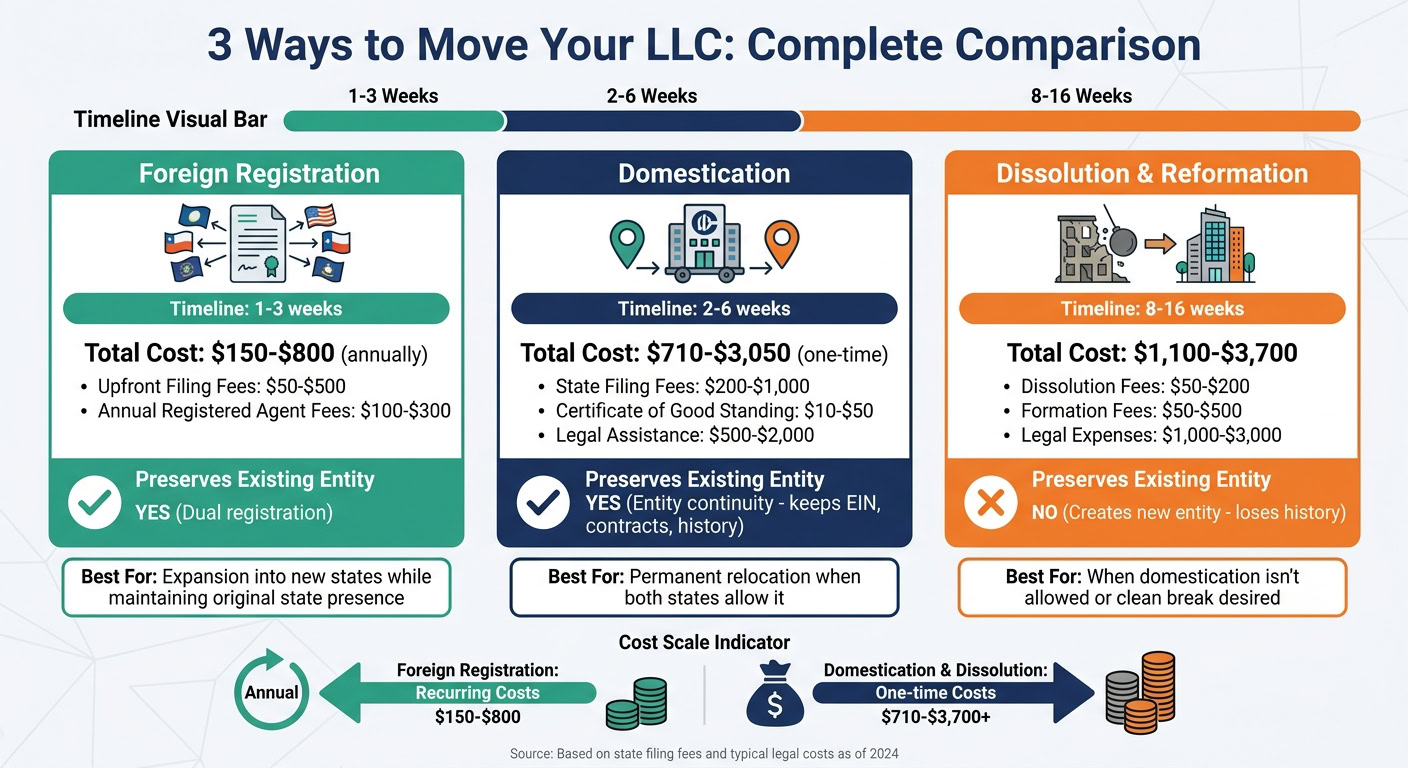
When deciding on a method, it’s important to weigh your timeline and budget carefully. Each approach comes with its own trade-offs in terms of time and financial commitment.
If speed is your priority, foreign registration is the quickest option, typically processed within 1–3 weeks. However, it involves ongoing costs. You’ll pay filing fees ranging from $50–$500 upfront, plus annual registered agent fees between $100–$300. Altogether, expect annual costs to fall between $150–$800 [1].
Domestication takes a bit longer – about 2–6 weeks – but it offers the advantage of preserving your LLC’s legal identity. This method involves one-time costs between $710 and $3,050, which include state filing fees ($200–$1,000), certificates of good standing ($10–$50), and legal assistance ($500–$2,000) [1].
If time isn’t a concern, dissolution and reformation is the slowest option, taking 8–16 weeks to complete. This route costs between $1,100 and $3,700, covering dissolution fees ($50–$200), formation fees ($50–$500), and legal expenses ($1,000–$3,000). Keep in mind, this method creates a brand-new entity, meaning your previous business history will be lost [1].
Side-by-Side Comparison
Here’s a quick look at how these methods compare:
| Method | Typical Timeline | Estimated Total Cost | Preserves Existing Entity? |
|---|---|---|---|
| Foreign Registration | 1–3 weeks | $150–$800 (annually) | Yes (Dual registration) |
| Domestication | 2–6 weeks | $710–$3,050 | Yes (Entity continuity) |
| Dissolution/Reformation | 8–16 weeks | $1,100–$3,700 | No (New entity formed) |
The main takeaway? Dissolution and reformation creates a completely new legal entity, while domestication and foreign registration allow you to keep your existing entity intact, along with its contracts and financial relationships [1].
When You Need a Lawyer
Navigating the choices between domestication, foreign registration, or dissolution can be tricky, and knowing when to bring in a lawyer can make the process much smoother. While single-member LLCs might handle straightforward domestications on their own, more complex situations often require legal expertise. For multi-member LLCs, legal assistance is almost always necessary – especially if there are disagreements among owners or if the operating agreement includes intricate transfer restrictions. An attorney ensures compliance with voting thresholds and handles dissenter rights effectively [1].
Legal counsel is also essential if your LLC has significant contracts, commercial leases, or loan agreements. Many of these documents include "change of control" clauses that could be triggered by a jurisdictional move. A lawyer can review these agreements beforehand and identify whether you need prior approval from lenders or landlords [1][4].
Chad D. Cummings, Attorney & CPA at Cummings & Cummings Law, emphasizes the risks of going it alone:
"If you commence the process on your own and without expert guidance, you may inadvertently trigger a substantial tax liability from the federal Internal Revenue Service." [3]
Tax complexities are another key reason to consult a professional. If your LLC has substantial assets, complicated depreciation schedules, or operates in states like California or New York – where exit taxes apply – legal advice becomes critical [1]. Timing the transfer correctly can significantly affect your tax obligations, and fixing errors in the process can lead to costs running into tens or even hundreds of thousands of dollars [3].
Some states require specific legal documents, such as a formal "Plan of Conversion" or "Unanimous Written Consent", which standard templates may not adequately cover [3]. In places like Florida and Texas, filing incorrect or misleading paperwork can even result in felony charges [3]. Legal fees for domestication typically range from $500 to $2,000, while more complicated transfers involving mergers can cost between $2,000 and $5,000 [1][4].
It’s also wise to have an attorney conduct a pre-filing review to confirm your LLC’s good standing and ensure the correct filing sequence. For instance, one expert warns that dissolving your LLC before your domestication is approved could leave your company legally nonexistent if the domestication is rejected due to a technical error [5].
With these legal considerations in mind, the next step is to explore real-world examples to help guide your decision-making process.
3 Real Examples: Which Option to Choose
To understand how these options play out in practice, here are three scenarios that highlight different approaches.
Example 1: Single-Member LLC Leaving California for Wyoming
Sarah owns a single-member consulting LLC in California but has relocated to Texas. She wants to eliminate California’s $800 annual franchise tax by moving her LLC to Wyoming. Since she no longer operates or has clients in California, domestication is the best route. Both states allow domestication – California permits outbound conversions, and Wyoming accepts inbound ones. This allows Sarah to fully transfer her LLC while keeping its EIN, banking, and credit history intact. The process involves obtaining a Certificate of Good Standing from California before filing Articles of Domestication in Wyoming. Once approved, Sarah needs to notify the IRS of her address change using Form 8822-B, even though her EIN remains the same. This method is efficient for her situation, but other cases may require alternative strategies.
Example 2: Real Estate Investor Operating in Multiple States
Marcus owns rental properties in Florida, Georgia, and Tennessee through a Florida LLC. He’s intrigued by top states for LLC asset protection and considers moving his LLC to Wyoming. Instead, Marcus opts for foreign registration, which allows him to maintain his Florida LLC while legally operating in Georgia, Tennessee, and potentially Wyoming if he expands there. This approach avoids the hassle of transferring property deeds or renegotiating management agreements, which would be required with full domestication. However, it does mean Marcus must comply with annual fees and regulations in multiple states. For real estate investors with properties in several states, foreign registration is a practical way to maintain existing ownership structures without disrupting operations.
Example 3: Moving from a State That Doesn’t Allow Domestication
Jennifer established her e-commerce LLC in Pennsylvania five years ago but now wants to relocate it to Nevada for tax advantages. Since Pennsylvania doesn’t permit outbound domestication, she must dissolve her Pennsylvania LLC and form a new one in Nevada. This involves closing the original LLC, obtaining a new EIN, and re-establishing vendor agreements under the new entity. While this process is more cumbersome, it’s the only option when statutory domestication isn’t allowed. Jennifer should work with an attorney to ensure a smooth transfer of assets, proper closure of the Pennsylvania LLC, and compliance with tax regulations. This example highlights how dissolution becomes necessary when domestication isn’t an option under state law.
What to Do Next
Now that you’ve got a handle on your transfer options and the legal details, it’s time to plan your next move.
Relocating an LLC isn’t a one-size-fits-all process. The best approach depends on several factors: whether both states involved allow domestication, whether you need to keep operations in your current state, and how taxes might be affected. Start by confirming that your current state permits outbound domestication and that your destination state allows inbound transfers. Around 38 states in the U.S. currently offer some form of LLC domestication or conversion [2].
Take a close look at your operating agreement. Check for any clauses that might restrict relocation or require member approval. For multi-member LLCs, it’s especially important to consult with legal and tax professionals. Their guidance can help you navigate tricky situations and avoid conflicts, such as dissenter rights issues or internal disagreements [1][2].
"Always consult with qualified legal and tax professionals before making business structure decisions, as laws and requirements change frequently." – Rick Mak, Global Entrepreneur and Business Strategist, BusinessAnywhere [1]
Before filing any paperwork, make sure your business is in good standing. Obtain a Certificate of Good Standing from your current state and verify that your business name is available in the state you’re moving to [1][2]. These steps will help ensure a smooth transition.
If you’re eyeing states like Wyoming, Nevada, or Delaware for their tax benefits and business-friendly policies, weigh the costs and complexity of the move against the potential advantages. For businesses with real estate assets or operations in multiple states, foreign registration might be a more practical option than full domestication. Choose the transfer method that aligns with your business needs.
FAQs
Can I keep my EIN if I move my LLC to another state?
Yes, you can keep your EIN when relocating your LLC to a different state by using LLC domestication or redomestication, provided the state you’re moving to permits it. This method allows your business to transfer seamlessly while retaining the same federal tax identification number.
How do I know if my state allows LLC domestication?
To determine whether your state permits LLC domestication, consult a reliable and current state-by-state guide on LLC domestication laws. Some states have laws that allow domestication (also known as statutory conversion), while others do not. For instance, states like Alaska permit both inbound and outbound domestication. If your state does not allow domestication, you might need to explore other options, such as dissolving your current LLC and forming a new one in the desired state.
Will I still owe taxes in my old state after moving?
When it comes to owing taxes in your previous state after moving your LLC, it largely depends on the laws of both the old and new states, as well as how you handle the transfer. For instance, if you choose domestication, some states, like California, may impose exit taxes. On the other hand, if you go with dissolution and reformation, you might still owe taxes for the period your LLC operated in the original state. To get a clear picture of your tax responsibilities, it’s best to consult a tax professional who can guide you based on your specific situation.