

Most startup grants are not open to everyone. If I were looking for grant money in the U.S. on July 29, 2026, I’d start with Grants.gov, then check SBIR/STTR, USDA rural programs, state economic development offices, and a short list of nonprofit or company-backed contests that match my business.
Here’s the short version:
- Grants don’t have to be repaid, but they often limit how I can use the money.
- Federal grants are usually narrow, not general startup cash.
- SBIR/STTR fit startups doing research or product development.
- USDA programs fit rural, farm, food, and energy-related businesses.
- State and local grants may be easier to target because they focus on location, hiring, and small expansion projects.
- Founder-focused grants often require 51% ownership and control by the person who qualifies.
- Scam check: if a grant asks for an upfront fee, I’d walk away.
- Time check: one application can take 8 to 250+ hours, so I’d only apply where the fit is clear.
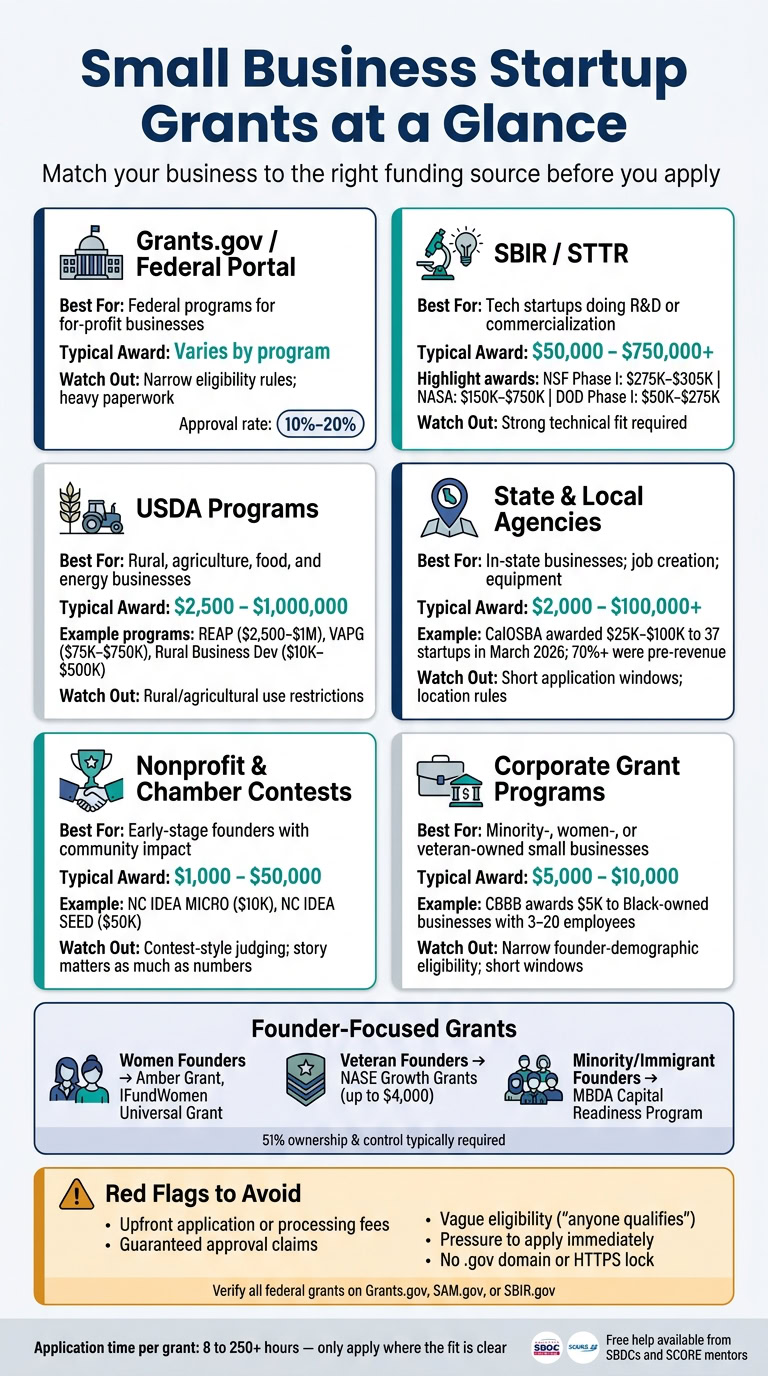
A few numbers stand out: many federal grant programs have approval rates around 10% to 20%; NSF SBIR Phase I awards can run $275,000 to $305,000; USDA REAP can range from $2,500 to $1,000,000; and local or nonprofit grants often land in the $1,000 to $50,000 range.
Quick Comparison
| Source | Best for | Typical award size | What I’d watch for |
|---|---|---|---|
| Grants.gov | Federal programs for for-profit businesses | Varies | Narrow rules, heavy paperwork |
| SBIR/STTR | R&D startups | $50,000 to $750,000+ | Strong technical fit needed |
| USDA programs | Rural, agriculture, food, energy | $2,500 to $1,000,000 | Rural/ag use limits |
| State agencies | In-state businesses, job creation, equipment | $10,000 to $100,000+ | Short application windows |
| Local grants | Brick-and-mortar and community-based firms | $2,000 to $25,000 | Tight location rules |
| Nonprofit/company contests | Early-stage founders or owner-specific groups | $1,000 to $50,000 | Contest-style judging |
My takeaway: I wouldn’t search for “free money” in general. I’d match the grant to my industry, location, and owner profile, confirm the rules first, and only then spend time applying.
Federal grant portals and national programs to check first
Federal grants are rarely just open-ended startup cash. Most are tied to a specific public goal, industry, or type of work. So the smart move is to begin with national databases and agency programs built for those uses. Federal sources should come first because they’re the most centralized and the easiest to verify.
How to use Grants.gov to search federal opportunities
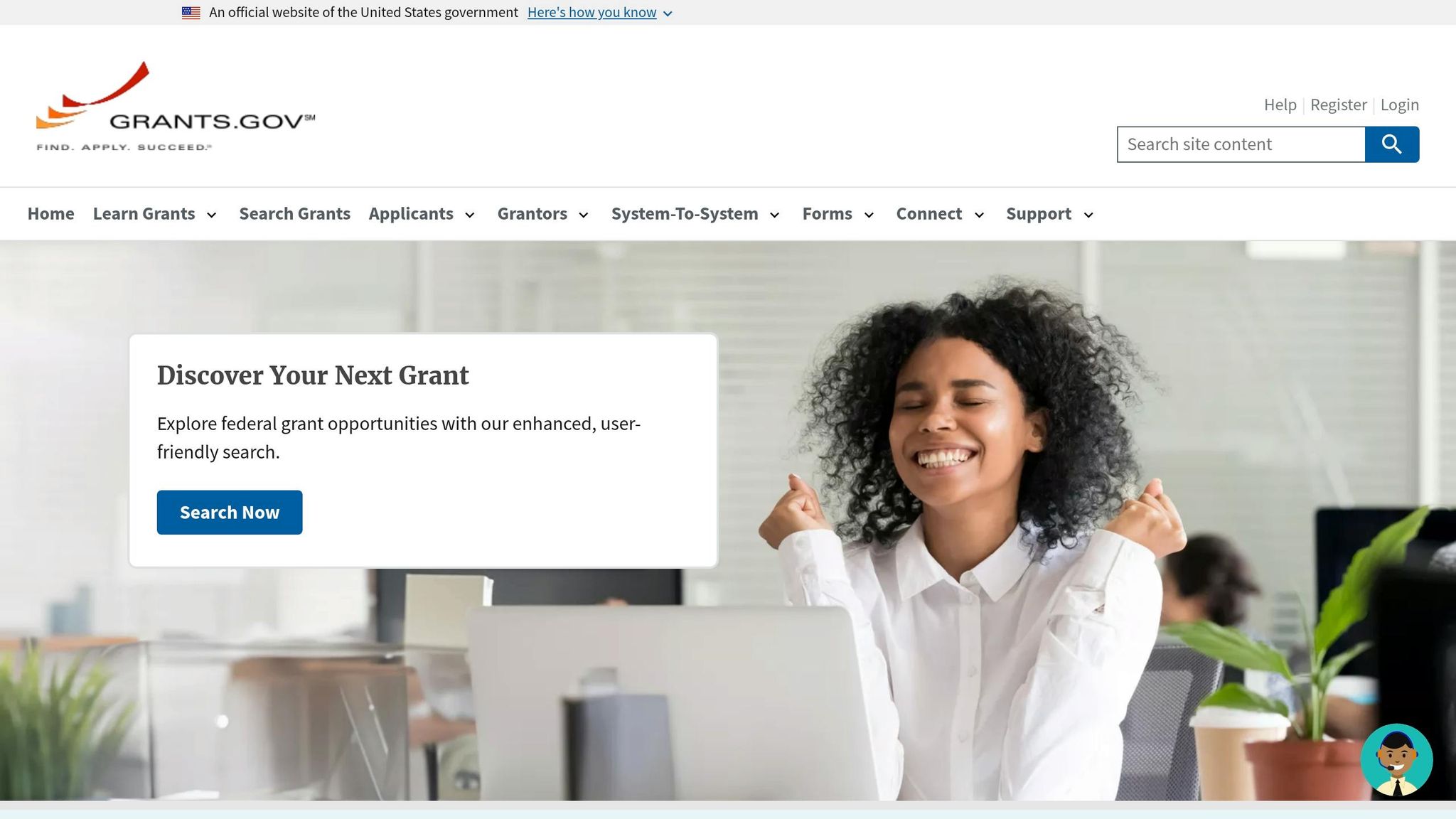
Grants.gov is the main centralized database for federal grant opportunities. You can filter by eligibility, agency, and keyword to screen out listings meant only for nonprofits or universities. Under Eligibility, choose "Small Business" or "other for-profit organizations" to narrow the field. Then use keywords like "innovation", "R&D", "rural development", "export assistance," and "commercialization."
One thing matters a lot here: federal grants never charge an application or processing fee. If a listing asks for money upfront, that’s a red flag.
After you review the federal database, the next step is to check agency programs that line up with your industry.
SBA-linked programs: SBIR, STTR, PRIME, and STEP
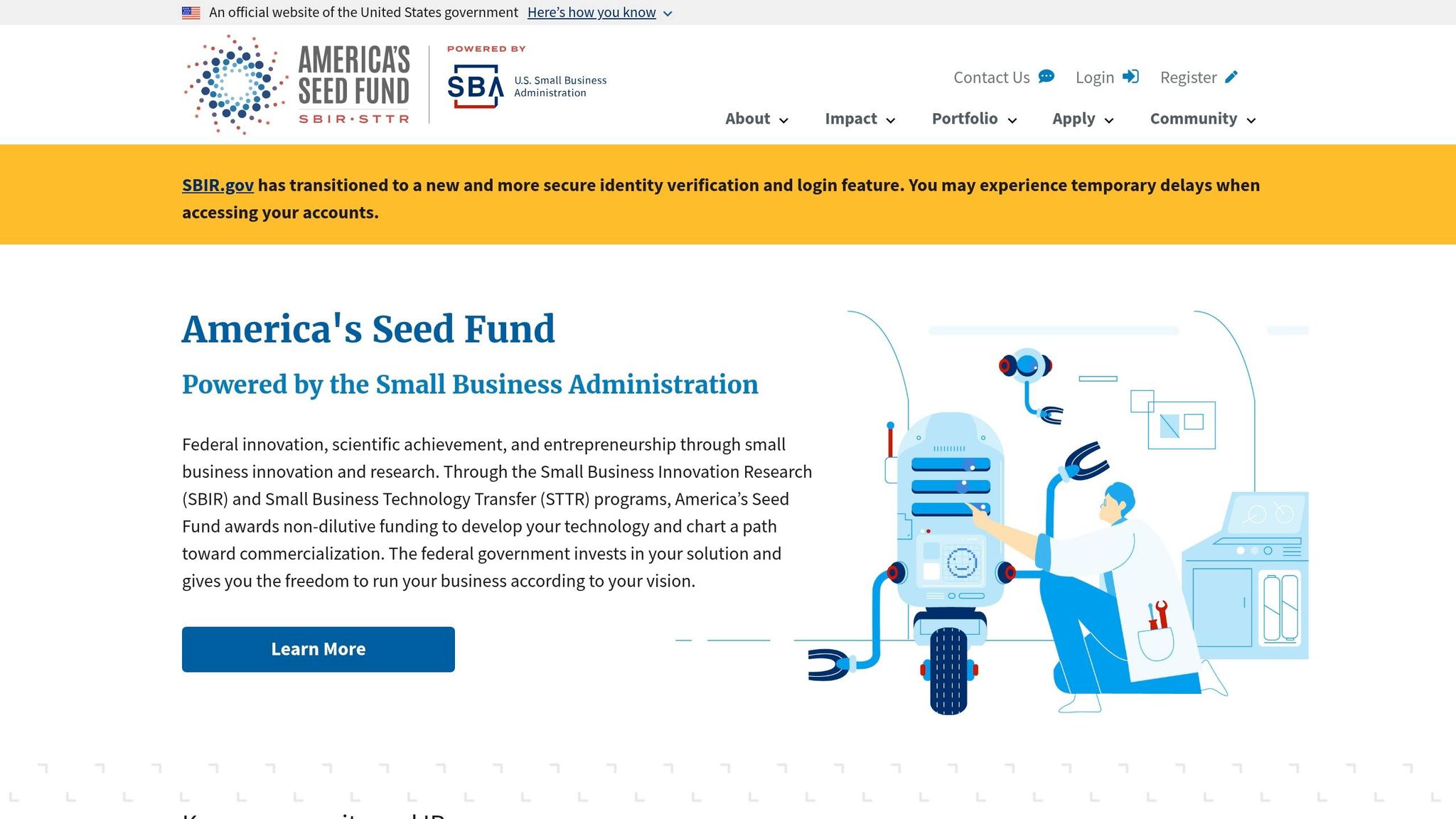
The SBA does not hand out general startup grants. What it does do is support targeted programs tied to innovation, exporting, and microenterprise help. Here’s a quick breakdown of the main options:
| Program | Best Fit For | How It Works |
|---|---|---|
| SBIR | Tech and innovation startups | Grants for for-profit small businesses doing federal R&D with commercialization potential |
| STTR | Research-heavy startups | Similar to SBIR, but requires a formal partnership with a nonprofit research institution |
| STEP | Export-ready businesses | Federal funds go to state agencies, which then help local small businesses enter international markets |
| PRIME | Community groups supporting micro-entrepreneurs | Grants go to community organizations and nonprofits that provide training and counseling to entrepreneurs |
SBIR award amounts depend on the agency. NSF SBIR Phase I awards range from $275,000 to $305,000, NASA SBIR/STTR awards range from $150,000 to $750,000, and DOD SBIR Phase I awards range from $50,000 to $275,000.
Competition is stiff. Approval rates across many federal grant programs usually land between 10% and 20%, so it makes sense to apply only when your business clearly meets every eligibility rule.
USDA and other federal programs for rural, agriculture, and sector-specific businesses
If your business is based in a rural area or works in food production or agriculture, USDA programs deserve a close look. The USDA Rural Business Development Grant provides between $10,000 and $500,000 on a rolling basis for business development in rural areas. The Value-Added Producer Grant offers $75,000 to $750,000 for agricultural producers moving into value-added work, such as turning raw farm goods into finished products. For rural businesses focused on energy, the Rural Energy for America Program (REAP) provides grants from $2,500 to $1,000,000 for renewable energy and energy efficiency projects.
Outside USDA, agencies like the Department of Energy and Department of Defense also post sector-specific opportunities on Grants.gov that for-profit businesses can pursue, especially in advanced manufacturing and clean energy. Checking agency portals directly can give you more program detail than the central database alone.
If you’re not sure where your business fits, an SBDC or SCORE mentor can help you match it to the right federal program before you apply. If nothing fits at the federal level, the next places to look are state, local, nonprofit, and corporate sources.
State, local, nonprofit, and corporate grant sources for early-stage founders
When federal programs are too narrow, state and local grants are usually the next stop. In many cases, these programs draw fewer applicants and move faster than national ones. For a brand-new business, that can mean a better shot.
State and local economic development programs
Most states have economic development agencies that offer grants tied to innovation, hiring, and target industries. California’s Office of the Small Business Advocate (CalOSBA) is one example. In March 2026, it awarded more than $2 million to 37 startups, with individual awards from $25,000 to $100,000. More than 70% of those recipients were pre-revenue companies. New York has Empire State Development, Illinois runs the DCEO, and other states have similar offices.
City and county programs tend to be smaller, but they’re often easier to access. The Long Island L.O.C.A.L. Small Business Grant Program – backed by Optimum Business and the Long Island Association Foundation – awarded $5,000 grants to 40 businesses in 2026. Eligibility was limited to small businesses with a physical presence in Nassau or Suffolk County.
That local focus matters. These grants often pay for the costs that hit early brick-and-mortar businesses first:
- Storefront launches
- Facade improvements
- Equipment purchases
- Local hiring
Nonprofit and chamber-backed grant competitions
Local foundations and startup nonprofits also run grant competitions. NC IDEA stands out here. Its Spring 2026 cycle offered $10,000 MICRO grants for early-stage companies still testing demand, and $50,000 SEED grants for early-stage companies ready to grow.
These programs are usually set up like contests. So numbers matter, but your story matters too. A clear mission, a strong local tie, and a simple explanation of the problem you solve can carry a lot of weight.
Chamber-backed competitions work in much the same way. They often lean toward founders who can explain:
- What the business does
- Who it serves
- Why it matters to the local community
If your company creates jobs, serves an underserved area, or has a strong origin story, these are worth a close look.
Corporate small-business grant programs
Established companies run grant contests too, and the application process is often simpler than what you’d see with government programs. The Coalition to Back Black Businesses (CBBB), a U.S. Chamber of Commerce Foundation program, awards $5,000 grants to for-profit Black-owned businesses with between 3 and 20 employees. Programs like this often have short application windows and narrow eligibility rules tied to founder background or business type.
The biggest differences across these sources usually come down to location, business stage, and founder fit. Here’s a side-by-side view:
| Grant Source | Typical Funding Size | Primary Eligibility | Typical Use of Funds |
|---|---|---|---|
| State Portals | $10,000 – $1,000,000+ | In-state registration; sector-specific (tech, manufacturing, clean energy) | R&D, equipment, job creation, seed funding |
| Local Programs | $2,000 – $25,000 | City/county location; brick-and-mortar presence; often fewer than 10 employees | Storefront launches, facade improvements, local hiring |
| Nonprofit/Chamber | $1,000 – $50,000 | Early-stage startups; community impact; founder demographic | Business model validation, prototype development, community projects |
| Corporate Grants | $5,000 – $10,000 | Small businesses; minority-, women-, or veteran-owned; fit with the company’s audience and values | Digital tools, marketing, general working capital |
One practical note: state-level opportunities can open and close fast. Checking your state’s economic development agency website once a month is a solid way to catch new programs before they fill up. A local SBDC advisor can also point you to regional grants.
After local and corporate options, narrow your search by industry and founder type.
sbb-itb-ba0a4be
Industry-specific grants and how to match the right source to your business
Chasing every grant is a time sink. A better approach is to start with your business type, then work backward to the programs built for that kind of company. Begin with the business itself. After that, use founder status to narrow the field.
Grant paths for tech, manufacturing, exporting, and rural businesses
If you run a tech startup with R&D or commercialization plans, SBIR/STTR should be your first stop. NSF, NASA, DOE, and DOD all run SBIR/STTR tracks, and Phase I awards vary by agency.
For rural and agriculture businesses, start with USDA programs tied to production, processing, or energy use. The Value-Added Producer Grant (VAPG) and the Rural Energy for America Program (REAP) are usually the strongest places to begin.
If your business is ready to sell abroad, check STEP through your state economic development office. If you own a manufacturing company, look at state capital and infrastructure grants.
Here’s a quick way to narrow the best grant path:
| Business Type | Primary Grant Channel | Example Program | Typical Award Range |
|---|---|---|---|
| High-Tech/R&D | Federal SBIR/STTR | NSF America’s Seed Fund | $275,000–$305,000 |
| Rural/Agriculture | USDA Rural Development | Value-Added Producer Grant | Up to $750,000 |
| Exporting | State Economic Development | Global NY Grant Fund | $10,000–$25,000 |
| Manufacturing | State Capital Programs | Illinois Small Business Capital & Infrastructure Grant | State-specific |
| Energy/Green Tech | USDA / DOE | USDA REAP Grant | $2,500–$1,000,000 |
Targeted grants for women, minority, veteran, and community-based founders
Some grants are built around the business model. Others focus on who owns the company. Once you’ve matched by industry, the next step is to filter by ownership and control.
These founder-focused grants often depend on ownership, control, or location. In many cases, the business must be at least 51% owned and controlled by the qualifying founder.
For women founders, private foundations and corporate programs are often the best place to start. Two well-known options are the Amber Grant for Women and IFundWomen Universal Grant.
Veteran founders can also look at NASE Growth Grants, which award up to $4,000 for general business needs. For minority and immigrant founders, the MBDA Capital Readiness Program is worth a look, often through local MBDA Business Centers.
Community-based grant programs often come through local nonprofits, chambers, and city economic development offices. The SBA HUBZone Program is aimed at businesses that operate in and hire from Historically Underutilized Business Zones.
Getting recognized as a Women-Owned Small Business (WOSB) or HUBZone business can open access to programs that may otherwise be off the table.
Many grant programs are reserved for very small companies. Our guide to what counts as a micro-business explains the definitions lenders and agencies use.
Eligibility checks, scam prevention, and next steps to apply
Common eligibility factors and application materials
Once you have a short list, check eligibility before you spend time on the application. Most grantors want to see a registered business entity, such as an LLC, corporation, or nonprofit organization, in good standing with your state, plus a valid EIN. Your business also needs to fit the grant’s rules for industry, location, size, or founder demographics.
It also helps to gather your paperwork up front. That way, you don’t get halfway through an application and realize you’re missing a tax return or proof of registration.
| Document Type | What to Prepare |
|---|---|
| Business Identity | EIN, proof of legal registration, proof of good standing |
| Financial Records | Tax returns, profit & loss statement, balance sheet |
| Business Plan | Problem statement, use of funds, expected outcomes |
| Supporting Materials | Pitch deck, detailed budget, team bios |
This part matters more than many people expect. A single application can take 8 to 250+ hours, so it’s smart to apply only when you meet every listed requirement. If you need help with the written portion or your documents, you can get free support from Small Business Development Centers (SBDCs) and SCORE mentors.
How to spot grant scams before you apply
One of the biggest warning signs is an upfront application or processing fee. Legitimate grants are free to apply for, and they should not ask for sensitive bank information before you’ve been selected. You should also watch for:
- Guaranteed approval claims
- Vague language that says almost anyone qualifies
- Pressure to apply right away
For federal opportunities, check the source on Grants.gov, SAM.gov, or SBIR.gov. Official U.S. government grant websites use a .gov domain and HTTPS with a lock icon in your browser.
Conclusion: Where to focus your grant search first
Start with the program that fits your business model, then branch out to state, nonprofit, and corporate options. If your business lines up with a federal program, begin there. If not, focus first on state and local economic development offices, then add nonprofit and corporate grants. Before you put hours into any application, confirm eligibility and make sure your LLC and EIN are ready to go.
FAQs
How do I know if a grant is worth the time?
Focus on grants where your business meets 100 percent of the eligibility criteria and lines up with the business stage, industry, and the grantor’s mission. Don’t take a spray-and-pray approach.
Before you spend hours on an application, make sure the grant is legit. Real grantors do not charge application or processing fees. And if the funding is worth the time it takes to apply, get your documents ready early so you don’t miss the deadline.
Can I get a startup grant without revenue?
Yes. Many organizations fund pre-revenue businesses, including federal R&D programs like SBIR Phase I, along with some corporate and nonprofit initiatives.
That said, not every grant is easy for a new company to use. Some require matching funds. Others reimburse costs after you’ve already spent the money. For an early-stage venture, that can be a tough hurdle.
If you’re a pre-revenue founder, it often makes more sense to focus on programs that care more about fit and stage than current sales, such as:
- Microgrants
- Pitch competitions
- Specialized government programs
Those options can be a better starting point when revenue isn’t on the board yet.
What should I prepare before applying?
Gather the key documents before you start: a detailed business plan, your EIN, up-to-date contact details, and financial statements like your balance sheet, profit and loss statement, and cash flow statement.
It also helps to make sure your books are reconciled and your project budget clearly shows how the funds will support your goals. On top of that, take time to understand the grantor’s mission and follow the instructions closely so you can tailor your application.