


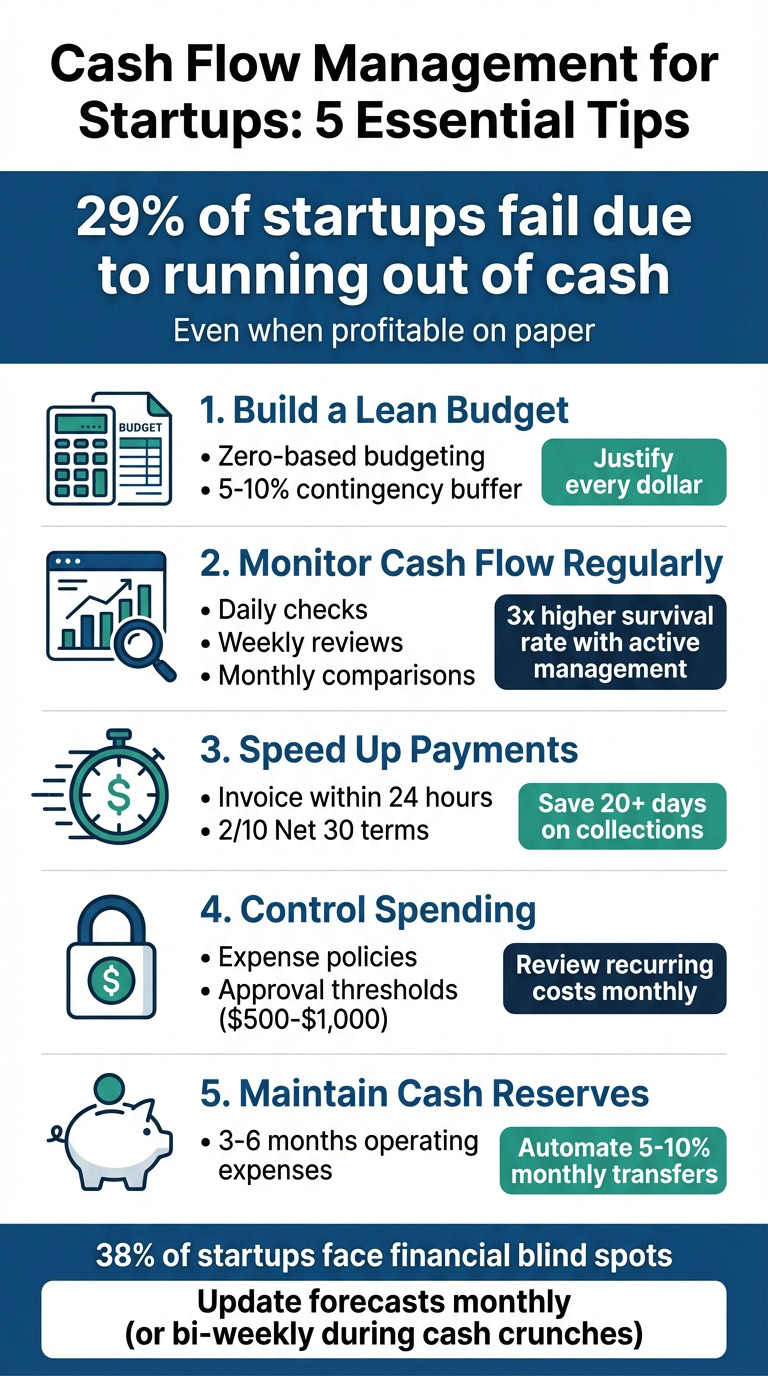
Managing cash flow is one of the biggest challenges for startups and a critical factor in avoiding failure. Nearly 29% of startups fail because they run out of cash, even if they seem profitable on paper. To ensure financial stability, here are five actionable tips:
- Create a Lean Budget: Focus on essential expenses and high-ROI investments. Use zero-based budgeting and set aside a 5%-10% contingency buffer.
- Monitor Cash Flow Regularly: Review financial statements frequently, calculate your burn rate and runway, and use rolling forecasts to anticipate cash shortages.
- Speed Up Payments: Send invoices promptly, offer early payment discounts, and automate follow-ups to improve cash inflows.
- Control Spending: Establish expense policies, approval thresholds, and review recurring costs to prevent unnecessary expenses.
- Maintain Cash Reserves: Save 3-6 months of operating expenses and update financial forecasts often to prepare for unexpected challenges.
These strategies help startups stay financially healthy, avoid cash flow crises, and focus on sustainable growth.
1. Build a Lean Budget and Stick to It
To create a lean budget, start by understanding your financial position. Gather your balance sheets, income statements, and cash flow statements to get a clear view of your assets, liabilities, and break-even point. Once you have this foundation, categorize your expenses into two groups: fixed costs (like rent, salaries, and insurance) and variable costs (such as marketing, shipping, and freelance services). This breakdown makes it easier to see which expenses are constant and which ones you can adjust.
The heart of lean budgeting lies in justifying every dollar. With zero-based budgeting, you rebuild your budget from scratch each period instead of rolling over past expenses. Ask yourself: Does this expense directly contribute to hitting our next funding round or revenue goal? If the answer is no, consider cutting, reducing, or delaying it.
Jeff Erickson, Head of Strategic Partnerships at Forecastr, emphasizes this point: "I have seen startups make the mistake of spending way too much on employee perks or things that are a little bit probably out-of-the-norm for their stage of a company."
Focus on high-ROI investments and avoid unnecessary spending. In the early days, direct your limited resources toward product development rather than costly marketing campaigns. Investors care more about traction and product viability than brand awareness at this stage. For specialized roles like legal or accounting, consider fractional hiring instead of full-time staff. You can also offer stock-based compensation to save cash while aligning your team’s goals with the company’s long-term success. Take advantage of free or freemium software tools, upgrading only when your revenue supports it.
Set aside a 5%-10% contingency buffer to cover unexpected expenses, such as legal fees or equipment repairs. This cushion helps you handle surprises without throwing your operations off track. As your business grows, regularly review and refine your budget through variance analysis – compare your actual spending to your planned budget, and make adjustments as soon as you notice discrepancies. Keep a close eye on your financial statements to ensure your cash strategy stays on point.
sbb-itb-ba0a4be
2. Monitor Cash Flow with Regular Financial Statements
Your cash flow statement is where the real story of your finances unfolds. Unlike a profit and loss statement, which follows accounting rules and may include non-cash items, the cash flow statement shows actual cash movements. As Ram Prasad Dutt from OPEN Money explains:
"For startups, cash flow is more than just a financial metric. It’s your daily oxygen. Without it, even profitable businesses risk shutting shop."
To make sense of your cash flow, break it into three key sections:
- Operating Activities: Covers daily revenue and expenses.
- Investing Activities: Focuses on long-term assets.
- Financing Activities: Tracks funding sources.
Understanding these categories helps you budget wisely and forecast more accurately, providing a clearer picture of your financial health.
Here’s an example: A startup using a 13-week cash flow view discovered it had only 11 weeks of liquidity left, not the 8 months suggested by its profit and loss statement. This insight led them to cut $40,000 in monthly expenses within just 48 hours.
Consistency Is Key
Set up a regular review schedule to stay on top of your cash flow. Here’s a simple routine to follow:
- Check your bank account daily.
- Spend 15 minutes each week spotting red flags.
- At the end of the month, compare your actual results to your budget.
During these reviews, calculate your burn rate (monthly cash expenses minus revenue) and runway (cash divided by burn rate). These metrics are critical, especially since businesses that actively manage cash flow have survival rates three times higher than those that don’t.
Plan Ahead with a Rolling Forecast
A rolling 13-week cash flow forecast can help you anticipate shortages and adjust spending before problems arise. Be realistic – track only cleared payments in your "Cash In" column. For instance, a $500,000 contract won’t help much if the funds arrive in quarterly chunks, but payroll is due on Friday. A proactive approach like this can protect your startup from unexpected financial gaps.
3. Speed Up Payments with Fast Invoicing and Early Payment Discounts
The time it takes to get paid after delivering your product or service can be a game-changer for your startup. Delayed invoicing can leave your cash flow stuck in limbo, which is the last thing you want.
By keeping a close eye on cash flow and streamlining your invoicing process, you can ensure a steady stream of income.
Invoice the Same Day
Send invoices within 24 hours of delivery. Prompt invoicing not only shows professionalism but also speeds up the payment process. Adding direct payment links – whether for credit cards, ACH transfers, or digital wallets – makes it easier for clients to pay right away, cutting down on delays.
Use Smart Payment Terms
Try a 2/10 Net 30 payment term. Here’s how it works: clients get a 2% discount if they pay within 10 days, but the full amount is due in 30 days. This setup can shave over 20 days off your collection timeline. While offering a 2% discount might feel like giving up some profit, it’s often cheaper than chasing late payments or relying on short-term loans.
For bigger projects, ask for an upfront payment of 25–50%, with the rest tied to milestones. This approach keeps cash flowing throughout the project.
Automate Your Follow-Up
Set up automated reminders to nudge clients about payments. Send reminders 3–5 days before the due date, on the due date itself, and at regular intervals afterward (e.g., 7, 14, and 30 days). This keeps your invoices on their radar without requiring constant manual follow-ups.
These steps can help you bring in cash faster, setting the stage for better spending controls in the next section.
4. Set Clear Spending Rules and Approval Processes
As your cash inflows grow, managing expenses becomes just as important as generating revenue. Without clear guidelines, your startup could burn through cash reserves on unnecessary costs. Once invoicing is under control, the next step in protecting your funds is setting up strong spending rules.
Create Expense Policies Early
From the start, outline clear expense policies that match your lean budget’s categories. Prioritize spending based on how it supports your current funding goals. These policies ensure that every dollar spent is tied to your growth strategy, keeping your finances aligned with your objectives.
Implement Approval Thresholds
To reinforce these policies, set up approval processes for larger purchases. For instance, any expense over $500 or $1,000 could require approval from both a department head and a finance lead. This step prevents unnecessary spending and ensures your funds are used wisely. Consider using automated spend management tools to enforce approval workflows and track receipts, reducing the chance of unauthorized expenses.
Review Recurring Costs Regularly
Recurring expenses, like software subscriptions, can quietly drain your budget over time. Conduct monthly reviews of these costs to spot overlapping tools or unused features. Canceling just a few unnecessary subscriptions can save a surprising amount and keep more cash in your reserves.
These spending controls aren’t about cutting corners – they’re about ensuring your runway lasts long enough to achieve profitability. Every dollar saved is a step closer to reaching your goals.
5. Maintain Cash Reserves and Update Financial Forecasts
Having a solid cash reserve is like having a safety net for your business. Experts recommend keeping enough to cover 3 to 6 months of operating expenses. Christopher Stroup from Silicon Beach Financial explains:
"A strong small business cash reserve is not about fear or hoarding money. It is about control."
You don’t need a sudden windfall to build this reserve. Start by automating a transfer of 5%–10% of your monthly revenue into a separate account. During high-revenue months, you can increase this percentage to prepare for leaner times. Automating these transfers ensures steady growth of your reserves, giving you the stability to plan ahead.
While a cash reserve acts as a cushion, accurate financial forecasts help you steer clear of trouble. Forecasting allows you to identify potential cash flow gaps before they become critical. Create three forecast scenarios – realistic, pessimistic, and optimistic – to prepare for shifts in costs or delays in payments. Remember, revenue is just a promise, but cash flow reflects reality. For example, a $100K contract may look great on paper, but payment delays – common in enterprise (30 to 90 days) or government contracts (60 to 120 days) – can strain your cash flow.
Make it a habit to update your forecasts monthly. If your business faces a cash crunch, revisit and adjust them every two weeks. This practice helps avoid the financial blind spots that nearly 38% of startups encounter. As Jeff Erickson, Head of Strategic Partnerships at Forecastr, emphasizes:
"Your number one responsibility as a founder is to not run out of cash."
Conclusion
Effectively managing cash flow gives your startup the breathing room to grow and the strength to tackle challenges head-on. The five strategies highlighted here – crafting a lean budget, keeping a close eye on financial statements, accelerating payments, setting clear spending guidelines, and maintaining cash reserves with updated forecasts – work together to establish a solid financial base for both stability and growth.
Startups that lack disciplined cash management often face alarmingly high failure rates, while those with structured financial strategies dramatically improve their chances of success. This is the fine line between shutting down and building something lasting.
Start small – automating a 5% transfer to savings or conducting weekly financial reviews can extend your financial runway and lead to smarter decisions around hiring, expansion, and investments.
Streamlining these practices doesn’t just secure cash flow – it also boosts overall efficiency. With tools like BusinessAnywhere, which centralizes business registration, compliance, and bookkeeping basics, you can simplify administrative tasks and focus on what truly matters: growing your business and ensuring steady cash flow.
FAQs
How do I set my startup’s burn rate and runway targets?
To figure out your burn rate and runway targets, start by calculating your burn rate. Simply subtract your monthly revenue from your total monthly expenses. Next, use this formula to determine your runway: Runway (months) = Current cash balance ÷ Monthly burn rate. Ideally, aim for a runway of 12–18 months. If needed, tweak your expenses or revenue strategies to hit this target. Make it a habit to update these calculations regularly to ensure they align with your growth objectives.
What should a simple 13-week cash flow forecast include?
A straightforward 13-week cash flow forecast is all about keeping tabs on your weekly cash movements. Start with your current cash balance as the foundation. From there, outline:
- Cash inflows: Include expected customer payments, sales, or any other revenue sources.
- Cash outflows: Factor in operational expenses, supplier payments, and any other regular or irregular expenditures.
Don’t forget to account for any known upcoming payments or receivables. The key is to update this forecast regularly, so you can maintain a clear picture of potential cash shortages or surpluses. This proactive approach helps you make informed decisions and stay ahead of any financial hiccups.
How much cash should I keep in reserves before hiring or scaling?
Startups need to keep at least six months’ worth of net cash burn in reserves before diving into scaling or hiring. This financial cushion helps ensure stability and provides a safety net to handle potential cash flow issues that often arise during periods of growth.