


If I had to boil it down to one line, it’s this: a GP is the simplest but puts all partners’ personal assets at risk, an LP splits managers from passive investors, and an LLP lets partners manage together with more liability protection.
Here’s the short version I’d want before choosing:
- GP: low setup hassle, but unlimited personal liability for each partner
- LP: one or more general partners manage, while limited partners invest and usually risk only what they put in
- LLP: partners usually share management and get limited liability protection, but state rules can be tight
- Taxes: all three usually use pass-through taxation, with the business filing Form 1065 and each partner getting a Schedule K-1
- Self-employment tax: active partners generally pay it, often at 15.3%; limited partners typically do not
- State costs: LP and LLP filing fees often run about $35 to $500, with yearly state and agent costs often around $300 to $800
What matters most is simple:
- Who controls the business
- Who takes the liability risk
- How much state paperwork you can handle
- Whether you need passive investors
- Whether your state even allows an LLP for your line of work
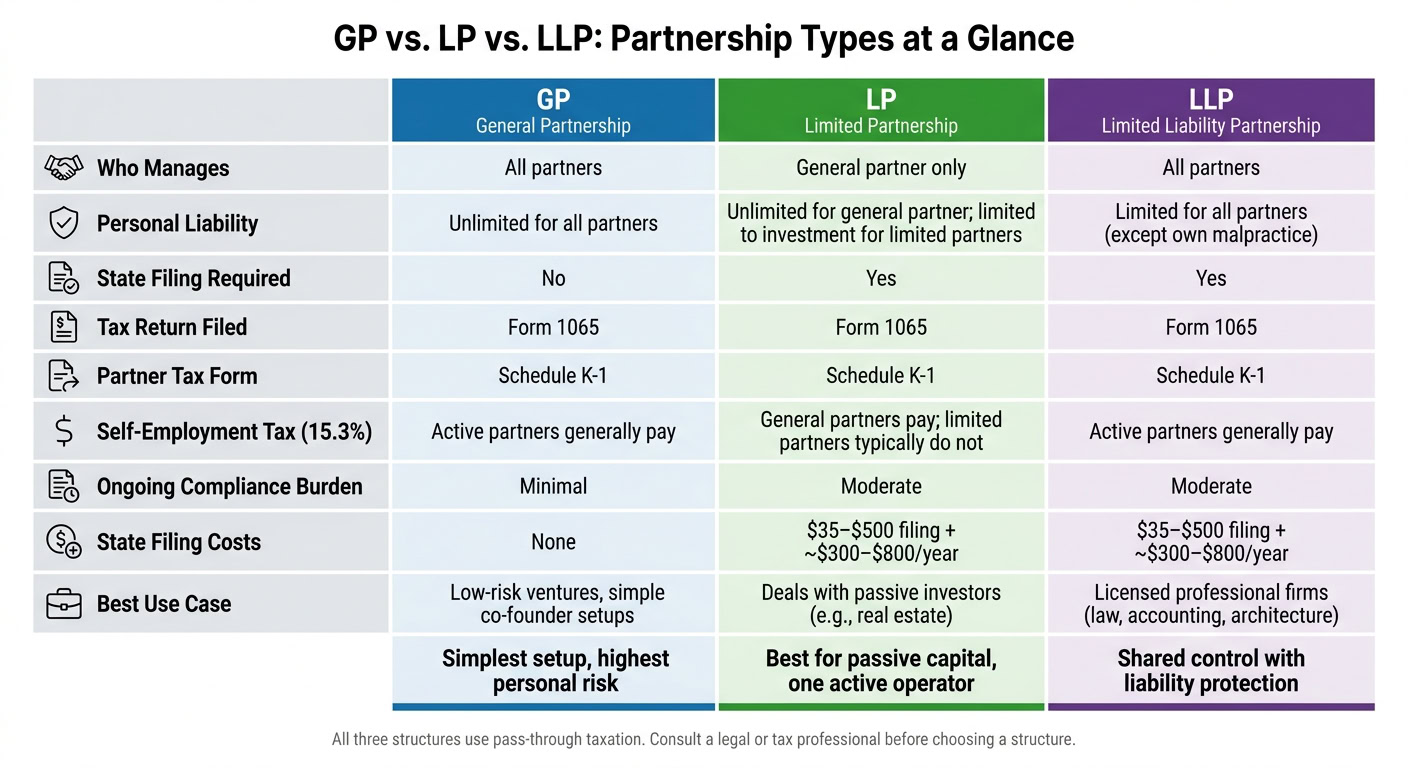
GP vs LP vs LLP: Partnership Types Compared
Quick Comparison
| Type | Who manages | Liability | State filing | Best use |
|---|---|---|---|---|
| GP | All partners | Unlimited for all partners | Usually no | Small, low-risk businesses |
| LP | General partner only | Unlimited for general partner; limited partners usually risk only their investment | Yes | Deals with passive investors |
| LLP | All partners | Limited for all partners, though not for their own malpractice | Yes | Many professional firms |
So if I were screening these fast, I’d use this rule: pick a GP for simplicity, an LP for passive capital, and an LLP for shared control with more protection.
How each partnership structure works
The core tradeoff is pretty simple: GPs are the easiest to start, LPs split operators from investors, and LLPs let partners share management while cutting personal exposure.
General Partnership (GP): simple setup, full shared liability
A GP forms when two or more people run a business together as co-owners, often without filing anything with the state. In most cases, each partner can take part in day-to-day management.
The catch is unlimited personal liability. If the business can’t pay its debts, creditors may go after each partner’s personal assets, including bank accounts, real estate, investments, and vehicles. A GP also creates joint and several liability. That means one partner can be held on the hook for the full amount of a business debt, even if another partner caused the problem.
That’s why a GP tends to fit lower-risk businesses where the partners know each other well and have a lot of trust. Even if the law doesn’t require a written agreement, putting one in place is a smart move. It should spell out ownership splits, roles, profit sharing, and what happens if someone leaves.
Limited Partnership (LP): active managers and passive investors
An LP includes at least one general partner and one or more limited partners. The general partner runs the business and takes on unlimited personal liability. Limited partners put in money and usually stay out of daily management. In return, they usually risk only the amount they invested, which helps protect their personal assets so long as they don’t step into a management role.
This setup can work well when a business wants outside funding without handing over control. Forming an LP usually means creating a Limited Partnership Agreement and filing a Certificate of Limited Partnership with the state.
Limited Liability Partnership (LLP): shared management with liability protection
An LLP allows all partners to share management while adding liability protection. Most LLPs must register with the state, often through the Secretary of State. That said, LLP protection isn’t the same everywhere. State rules vary, and many states limit LLPs to licensed professionals such as lawyers, accountants, and architects.
Those differences stand out more when you look at the side-by-side comparison below.
GP vs. LP vs. LLP: side-by-side comparison
Ownership, liability, and management control
The tables below lay out the differences at a glance. If you’re trying to line up control, liability, and paperwork with the way your business will run, this is where things start to click.
| Structure | Owner Types | Management Rights | Personal Liability | Best Fit |
|---|---|---|---|---|
| GP | Partners | All partners manage | Unlimited for all partners | Low-risk ventures, testing ideas |
| LP | General partners + limited partners | Only general partners manage | Unlimited for general partners; limited to investment for limited partners | Capital-only investor structures |
| LLP | Partners | All partners manage | Limited for all partners | Professional service firms |
The main tradeoff is pretty straightforward. In a GP, every partner shares full personal risk. In an LP, passive investors get protection, but management stays with the general partners. In an LLP, all partners can take part in management while getting liability protection.
Formation, tax filing, and compliance workload
Liability isn’t the only thing that matters. Filing rules, tax forms, and state upkeep can change both cost and day-to-day hassle.
| GP | LP | LLP | |
|---|---|---|---|
| State filing required | No | Yes | Yes |
| State filing burden | None | Varies by state | Varies by state |
| Annual reports | No | Yes, varies by state | Yes, varies by state |
| Tax return | Form 1065 | Form 1065 | Form 1065 |
| Partner tax form | Schedule K-1 | Schedule K-1 | Schedule K-1 |
| Self-employment tax | Active partners generally pay it | General partners generally pay it; limited partners typically do not | Active partners generally pay it |
| Ongoing compliance burden | Minimal | Moderate | Moderate |
For federal tax purposes, all three are pass-through entities. The business files Form 1065 as an information return, and each partner gets a Schedule K-1 that shows their share of profits or losses for their personal tax return. Active partners are generally subject to self-employment tax at 15.3%, while limited partners typically are not.
Advantages and drawbacks of each structure
This is where the tradeoffs become more concrete. The right pick often depends on whether you’re starting small, bringing in passive money, or running a firm where multiple professionals need to share control.
| Structure | Main Advantages | Main Drawbacks |
|---|---|---|
| GP | No filing fees, simple setup | Unlimited personal liability for all partners; joint and several liability |
| LP | Attracts passive capital without giving up control | General partner still has unlimited liability; limited partners can’t manage |
| LLP | All partners get liability protection with shared management | Requires state registration; often limited to licensed professionals |
A common workaround in an LP is to make an LLC or corporation the general partner. That can add another layer of protection, but it also means more setup, more moving parts, and more cost.
sbb-itb-ba0a4be
Which partnership type fits your business goals
Use the liability, control, and compliance differences above to line up each structure with how your business actually works.
When a GP makes sense
A GP is a good fit when two or more co-founders want the simplest, lowest-cost setup for a low-risk venture. There’s no state formation filing, so startup costs stay low.
Even with that simplicity, a written partnership agreement matters. It should spell out roles, profit splits, and exit terms.
When an LP makes sense
An LP works well when one partner handles operations and others put in capital without taking part in day-to-day control. Real estate deals are a classic example: one operator manages the property and tenant relationships while passive investors provide capital and collect returns without taking on personal liability beyond what they invested.
The tradeoff is pretty clear: the general partner still takes on unlimited personal liability.
When an LLP makes sense
For licensed professional firms, the big draw is shared management plus liability protection. An LLP is often the best fit for professional service firms such as law and accounting practices because it lets all partners take part in management while still getting limited liability protection. Availability depends on the state, and many states limit LLPs to licensed professionals.
Professional liability insurance still matters. LLP protection does not cover a partner’s own malpractice claims.
Conclusion: Key differences to remember before choosing
Each structure handles control, liability, and complexity in a different way. The right pick is the one that lines up with your mix of control, risk, and compliance.
It also pays to plan for compliance costs early. State filing fees for LPs and LLPs usually range from $35 to $500, and annual costs for state reports and registered agent services often fall between $300 and $800 per year. A GP keeps paperwork lighter, but it also leaves partners personally exposed. That tradeoff matters a lot if you expect steady filing and maintenance work year after year.
Final decision points
Use these questions to narrow your choice and match the structure to your risk, control, and compliance needs.
- Need shared management, or one operator with passive investors? Shared management usually points to a GP or LLP. One operator with passive investors usually points to an LP.
- Need protection for all partners, only limited partners, or none? A GP offers none. An LP protects limited partners only. An LLP protects all partners, except for their own malpractice.
- Will there be passive investors? Choose an LP.
- Is an LLP available for your profession in your state? Some states limit LLPs to licensed professionals or require a PLLC instead. Check this before filing.
- How much ongoing compliance can you support? A GP has the lightest load. LPs and LLPs both need state filings and, for remote founders, a registered agent with a physical in-state address.
In practice, the best partnership setup is the one that fits how you want to run the business without adding avoidable liability or extra compliance work. It comes down to three things: who controls the business, who carries the risk, and how much compliance you can keep up with.
FAQs
Which partnership is best for startups?
There’s no one-size-fits-all partnership for startups. The right pick depends on your goals, your liability risk, and the kind of industry you’re in.
For many small businesses, a multi-member LLC is a popular choice because it offers flexibility and personal liability protection. An LLP can be a good fit for licensed professionals, while a general partnership usually makes the most sense for low-risk, small-scale ventures.
Can an LLP have passive investors?
No. An LLP usually runs on a shared management model. That means partners are expected to play an active part in running the business and making decisions.
In many states, LLP ownership is also limited to licensed professionals in the same field, such as attorneys or accountants. That setup points to hands-on involvement, not passive investing.
How do I switch partnership types later?
Switching partnership types usually takes formal restructuring, not a simple “upgrade.” Start by reviewing your current partnership agreement. In many cases, that document already lays out how to deal with partner rights, liabilities, exits, transfers, or buyouts.
From there, work with an attorney to complete your state’s filing and registration steps for the new structure. You’ll also need to update the partnership agreement, management terms, profit-sharing language, and any compliance filings that still apply.