
Forming an LLC often exposes your personal information, like your name and address, to public records. Wyoming, however, offers strong privacy protections, making it a popular choice for business owners who value confidentiality. Here’s why:
- No Member or Manager Disclosure: Wyoming doesn’t require listing LLC members or managers in public filings.
- Registered Agent Services: Use a registered agent to keep your personal address private.
- Holding Companies: Set up a Wyoming LLC to own other LLCs, shielding your identity.
- Nominee Services: List a third party as the organizer or registered agent to keep your name off public records.
- Minimal Fees: Annual costs start at $60, with no state income tax.
While Wyoming protects your information from public databases, federal agencies like the IRS and FinCEN still require disclosure. You must report ownership details for tax and compliance purposes.
This balance between state privacy and federal transparency ensures your business stays compliant while keeping your personal details secure.
What Information Becomes Public When You Form an LLC
What Details Show Up in Public Records
Filing LLC formation documents in most states means certain details will become part of the public record. The Articles of Organization, the main document required to establish an LLC, usually include the business name, the principal office address, and the registered agent’s name and physical street address [1][2].
Additionally, the organizer’s information – the individual or service responsible for submitting the paperwork – will appear in public filings [2].
In many states, LLC members (owners) and managers must disclose their names and addresses either during the initial filing or through periodic updates like annual or biennial reports. These reports refresh information such as business addresses and registered agent details [1][2][5].
Other details, including the LLC’s formation date, state-assigned file number, and any amendments to the original filings, also become part of the permanent public record. These records are often accessible online, free of charge, making it easy for anyone to look up this information [1][2].
This level of public disclosure highlights the privacy challenges that many business owners face, paving the way for understanding the appeal of Wyoming’s more protective legal framework.
Why Public Records Create Problems for Business Owners
Having personal information in public records can lead to several issues. For example, disgruntled individuals might use public records to track down a home address, potentially leading to harassment [2]. Marketing companies also mine this data, flooding business owners with unwanted solicitations [1][2].
Publicly visible personal details can also create legal risks. Lawyers may more easily connect individuals to business assets, making it simpler to name someone personally in a lawsuit [2]. For those using their residential address for business purposes, this exposure increases the chances of identity theft and can even jeopardize personal safety [1][2].
These risks emphasize the importance of privacy-focused strategies. Many business owners adopt these measures – not to avoid legal responsibilities, but to maintain a reasonable separation between their personal lives and business operations.
sbb-itb-ba0a4be
How Wyoming’s Laws Protect LLC Owner Privacy
How Wyoming Keeps Owner Names Private
Wyoming stands out from other states by not requiring member or manager names in its Articles of Organization. When filing, the state only asks for the LLC name, registered agent, principal office address, and organizer name [1][2]. The organizer can be anyone, such as a professional formation service or attorney, which means your name can stay off public records if you use a third-party filer.
This minimal disclosure extends to Wyoming’s annual reports, which also avoid requiring member or manager information. Instead, they focus on basics like the registered agent and principal office address [2]. This straightforward process sets the stage for additional privacy perks.
Wyoming also offers strong legal protections through its charging order laws, specifically Wyoming Statutes Section 17-29-503. Under this statute, a creditor’s only remedy is a charging order against a member’s transferable interest. This prevents creditors from seizing assets or gaining control of the LLC. National asset protection attorney Brian T. Bradley, Esq., explains:
"Wyoming Statutes Section 17-29-503 provides that a charging order is the exclusive remedy against a member’s transferable interest in a Wyoming LLC – a creditor cannot foreclose the membership interest or step into management" [3].
This legal measure not only safeguards owner privacy but also enhances asset protection, aligning perfectly with Wyoming’s approach to limited public disclosure.
Benefits of Wyoming’s Privacy Laws
Wyoming’s privacy-centric filing procedures bring a host of advantages. By keeping member names off public records, the state helps shield LLC owners from risks like harassment, unsolicited contact, and identity theft. This limited disclosure also makes it harder for others to link individuals to business assets, which can deter frivolous lawsuits [2].
In addition to privacy, Wyoming offers financial incentives. The state has no state income tax, corporate tax, franchise tax, or gross receipts tax [2][6]. The annual report fee starts at just $60 for entities with less than $300,000 in Wyoming assets, making it one of the most affordable states for maintaining an LLC.
Wyoming’s commitment to privacy is rooted in its history – it was the first state to introduce LLC laws in 1977, establishing a stable legal environment that continues to attract business owners [2]. A pivotal moment came on March 26, 2025, when a federal interim final rule exempted domestic U.S. entities from beneficial ownership reporting to FinCEN. This ruling reinstated the privacy benefits of anonymous LLCs, which had been threatened by the Corporate Transparency Act [7]. Meanwhile, other states like New York are moving in the opposite direction, with measures like the LLC Transparency Act set to take effect on January 1, 2026 [7]. Wyoming’s stance solidifies its reputation as a go-to state for privacy-conscious entrepreneurs.
The Anonymous LLC Strategy: Using a Holding Company
What Is an Anonymous LLC?
Wyoming’s strong privacy laws make it a go-to state for forming an anonymous LLC, a type of limited liability company designed to keep your personal details out of public records.
Here’s how it works: In many states, forming an LLC requires listing the names of owners or managers in public business databases. An anonymous LLC, however, keeps this information private at the state level [6]. While your name remains hidden from public view, it’s important to note that this doesn’t make you invisible to the government. Agencies like the IRS will still know who you are when you apply for an EIN, and FinCEN requires you to report beneficial ownership details to a secure federal database [1][2].
This privacy is designed to protect you from prying eyes – whether it’s competitors, marketers, or anyone conducting a casual search..
Wyoming is particularly attractive for anonymous LLCs due to its minimal disclosure requirements, low fees, no state income tax, and strong asset protection laws. Other states like New Mexico and Nevada offer similar privacy perks, but Wyoming’s combination of affordability and legal protections makes it stand out [6].
Once you’ve got a handle on what an anonymous LLC is, the next step is learning how to set up a Wyoming holding company to maximize the privacy benefits.
How to Set Up a Wyoming Holding Company
A Wyoming holding company is essentially an LLC that doesn’t directly manage operations. Instead, it owns other LLCs or assets [6]. This creates an added layer of privacy. For example, if you form an operating LLC in another state like California or Texas, you can list your Wyoming holding company as the owner. This way, public records in those states will show "ABC Holdings LLC" as the member, not your personal name.
Here’s a step-by-step guide to forming a Wyoming holding company:
- Form your holding LLC using a third-party organizer to keep your name off public filings [1].
- Appoint a registered agent with a Wyoming address to handle official correspondence and shield your home address [1][2].
- draft a private Wyoming Operating Agreement that names you as the owner. This document is confidential and doesn’t need to be filed with the state [1][2].
- Use your Wyoming LLC as the member when creating operating companies in other states.
Costs are relatively low: Wyoming charges $100 for online filing and $60 annually for renewals. Registered agent services range from $25 to $125 per year, while professional formation services average $349 plus state fees [2].
Don’t forget to file Beneficial Ownership Information with FinCEN within 30 days of forming your LLC. Missing this deadline can lead to fines of up to $500 per day [2]. Additionally, banks will require identity verification under "Know Your Customer" regulations [2].
This layered approach not only enhances your privacy but also aligns perfectly with Wyoming’s LLC-friendly policies. It keeps your name out of public searches and helps you avoid unsolicited contacts or casual background checks.
Nominee Registered Agent Services: What They Are and When to Use Them
What a Nominee Registered Agent Does
When it comes to safeguarding your privacy as a Wyoming LLC owner, nominee registered agent services add an extra layer of protection. These services go beyond the basics of a standard registered agent by keeping your personal details off public records. Every Wyoming LLC is required to have a registered agent to handle legal documents and state notices – this ensures your home address doesn’t appear in public filings. A nominee service takes this a step further by listing a third party’s name instead of yours on public documents [9].
Under Wyoming law, registered agents must maintain a "communications contact" list with the real owner’s name, address, and phone number. This information can only be shared with authorities upon legal request, as outlined in Statute 17-28-107 [2].
Jonathan Feniak, a Wyoming LLC attorney, explains the concept of nominees succinctly:
"A nominee is someone whose name is provided as a placeholder. They satisfy a requirement, often with their name publicly available, but they do not in truth own or control the underlying asset or document" [10].
By using a nominee, anyone searching for your business will see the nominee’s name and the registered agent’s address instead of your own. This setup not only shields you from unwanted attention but also helps maintain a clear separation between your personal and business identities.
While nominee services offer privacy benefits, it’s essential to understand the legal framework for using them correctly.
How to Use Nominee Services Legally
Wyoming allows the use of nominee services, but there are specific rules to follow. It’s important to note that nominee services do not exempt you from tax reporting obligations. You’re still required to disclose your identity to the IRS when applying for a Wyoming EIN and to report Beneficial Ownership Information (BOI) to FinCEN. Banks, too, will need your real identity under federal "Know Your Customer" rules.
Here’s how to stay compliant when using nominee services:
- Create a formal nominee agreement that explicitly states the nominee has no beneficial ownership or control over the business [9][10].
- Keep full operational control over all aspects of your business, including bank accounts, financial decisions, and daily operations. As Jonathan Feniak emphasizes:
"We also do not want to be seen as having an active role in your company. We are not a part of your daily affairs and that separation should be clear" [10].
- File your BOI report with FinCEN within 30 days of forming your LLC. Use your real information on all federal filings. For example, your Social Security Number or EIN must be included on IRS Form SS-4, and your actual name should appear on tax returns like Forms 1065, 1120, or 1120-S. Non-compliance can lead to civil penalties of up to $500 per day and criminal penalties of up to two years [2].
Take Virex Analytics LLC as an example. In 2025, the company used a Wyoming nominee manager service to keep the founder’s name off public records. To remain compliant, the founder used their own Social Security Number for the EIN application, identified themselves as the owner on IRS Form 1120-S, and submitted a BOI report to FinCEN with their personal details [9].
What Wyoming Does Not Hide: Limits of Privacy Protection
Information You Must Still Disclose
While Wyoming offers robust privacy protections, it’s important to understand their boundaries. These laws can shield your name from public records, but they don’t make you invisible to everyone. Federal agencies, courts, and financial institutions still require access to your personal information.
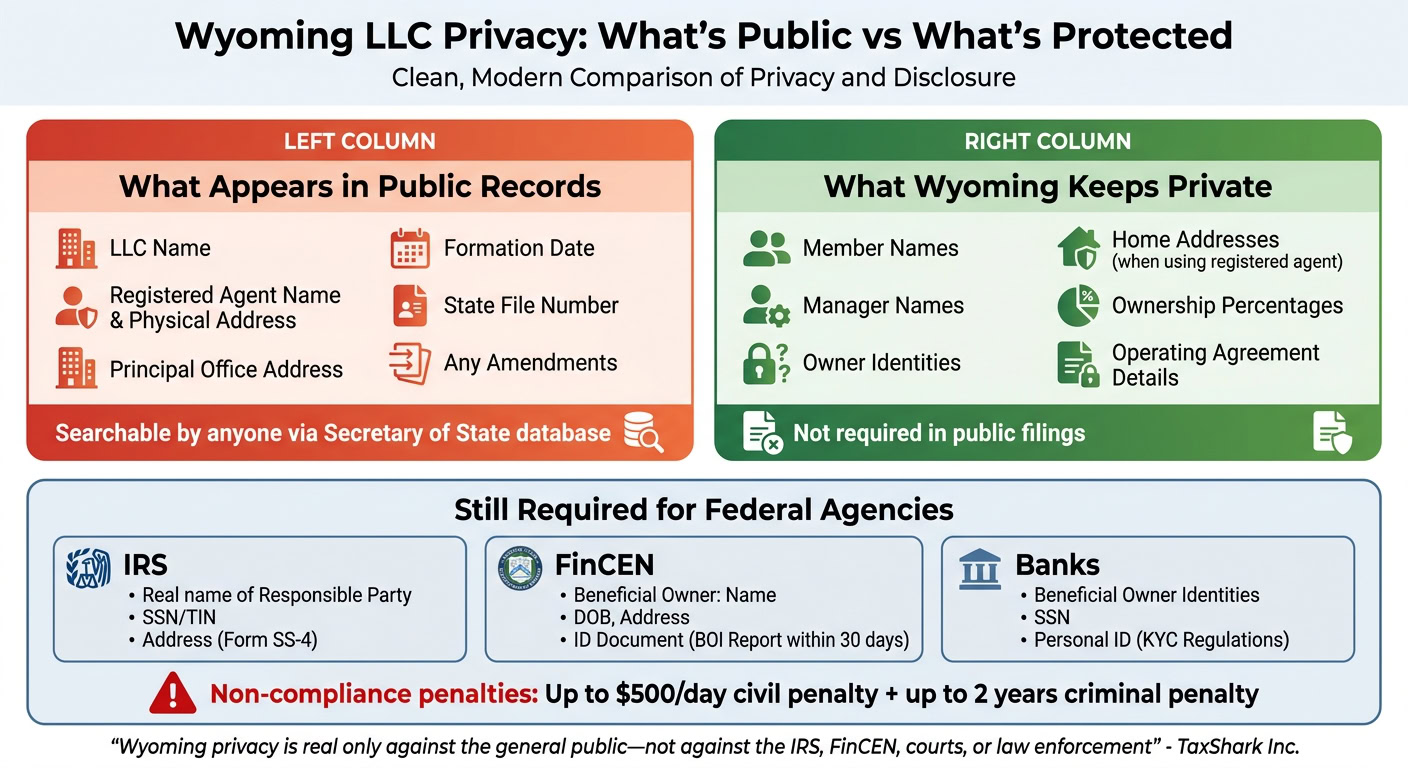
Certain details must remain on public records in Wyoming. For instance, your LLC’s name, the registered agent’s name and physical address, the principal office address, and the organizer’s name listed in the Articles of Organization are all publicly accessible through the Secretary of State’s database.
On a federal level, privacy laws don’t exempt you from disclosing personal details. For example, when applying for an EIN with the IRS or submitting FinCEN’s BOI reports, your real identity is required. While this information isn’t public, it is stored in federal databases accessible to law enforcement and other authorized entities.
Banks also require full transparency. Federal "Know Your Customer" (KYC) regulations mandate that banks verify the identities of business owners. This means that even if your state filings are private, your real identity must be disclosed to open a business account. As TaxShark Inc. aptly explains:
"Wyoming privacy is real only against the general public – not against the IRS, FinCEN, courts, or law enforcement" [2].
Here’s a quick breakdown of disclosure requirements:
| Disclosure Type | Publicly Searchable? | Required Information |
|---|---|---|
| Wyoming Articles of Organization | Yes | LLC Name, Registered Agent, Principal Office, Organizer |
| IRS EIN Application (SS-4) | No | Real name of "Responsible Party", SSN/TIN, Address |
| FinCEN BOI Report | No (Gov/Law Enforcement only) | Name, DOB, Address, ID Document |
| Bank Account Opening | No (Internal Bank Records) | Beneficial owner identities, SSN, personal ID |
Privacy protections also don’t shield you from legal actions. If you face a lawsuit, opposing attorneys can use court orders or subpoenas to compel your registered agent to reveal your identity. Similarly, creditors can demand ownership details during debtor’s examinations. As Brian T. Bradley, a national asset protection attorney, puts it:
"Privacy is camouflage, not armor. Wyoming’s anonymous filing structure keeps your name out of a public database – not out of a debtor’s examination, not off a bank subpoena, not out of a federal BOI database" [3][4].
Being aware of these limits is essential for staying compliant with federal reporting requirements.
Why You Still Need to Stay Compliant
Failing to meet federal disclosure obligations can lead to severe consequences. Non-compliance may result in civil penalties of up to $500 per day or even criminal penalties, including up to two years of imprisonment [2]. Federal agencies actively enforce these penalties, so ignoring these rules isn’t an option.
Compliance also goes hand in hand with protecting your LLC’s legitimacy. If you fail to maintain proper records, mix personal and business funds, or neglect corporate formalities, courts can "pierce the corporate veil." This would make you personally liable for business debts, undermining the entire purpose of forming an LLC.
Wyoming’s privacy laws operate within the framework of the legal system. They help keep your name off public databases and casual searches, but they don’t exempt you from transparency with tax authorities, regulators, or courts. This balance ensures your privacy strategy remains both effective and lawful.
Combining Wyoming LLC with Registered Agent Services for Maximum Privacy
How Registered Agents Protect Your Privacy
Using a registered agent is a key part of maintaining privacy for your Wyoming LLC. This service ensures your personal details, like your home address, stay off public records. Instead, the registered agent’s Wyoming address is listed on official filings, keeping your information out of the Secretary of State’s searchable database.
Many registered agent services go a step further by acting as the organizer for your LLC. This means your name won’t appear on the initial formation documents. The agent also handles all legal notices, state correspondence, and service of process on behalf of your LLC, forwarding these documents to your private address. This arrangement helps you avoid unwanted marketing, harassment, or surprise legal issues.
However, Wyoming Statute 17-28-107 requires registered agents to maintain a "communications contact" list with your real name and contact details. If a court issues a subpoena, the agent must provide this information to authorities. As Wyoming Discount Registered Agent explains:
"Your registered agent’s address appears instead of yours on public records… this is the primary state-level privacy protection" [1].
Given these benefits, selecting the right registered agent service is an essential step in safeguarding your privacy.
How to Choose a Registered Agent Service
To make the most of the privacy advantages a registered agent provides, it’s important to choose the right service. Start by ensuring the agent has a physical street address in Wyoming – not a PO Box or virtual office. State law requires agents to be available during business hours to accept legal documents in person. If an agent fails to forward notices promptly, it could result in costly default judgments ranging from $5,000 to $50,000.
Experience matters too. Look for agents with at least 10 years in business and a solid track record. Check customer reviews and confirm their physical presence in Wyoming. Prices for these services typically range from $25 to $125 per year. For example, Wyoming Corporate Services charges $35 annually, while Northwest Registered Agent offers additional privacy features for $125 per year [5].
Ask if the service includes organizer services as part of their package. Some agents also offer mail scanning and forwarding, which keeps your personal contact details separate from public records entirely.
Finally, make sure the registered agent is upfront about their record-keeping responsibilities and how they handle subpoenas. A trustworthy agent will clearly explain that while they protect your information from public databases, they cannot shield it from courts or law enforcement. This transparency ensures you understand the limits of privacy protection.
Choosing a dependable registered agent is a key step in securing your Wyoming LLC’s privacy and keeping your personal information confidential.
Privacy for Non-US Residents Forming a Wyoming LLC
Why Wyoming Works Well for Non-US Residents
Wyoming’s privacy laws make it an attractive choice for entrepreneurs worldwide, including those outside the United States. You don’t need to be a U.S. citizen, have a Social Security Number, or even set foot in Wyoming to form an LLC. The entire process can be handled remotely, no matter where you’re located.
One of Wyoming’s standout features is its emphasis on privacy. Unlike many states, Wyoming does not require the names of members or managers to be listed in the Articles of Organization or annual reports. This ensures your name stays off the Secretary of State’s public database, shielding you from unwanted solicitations or data brokers. Instead, the address of a professional registered agent is listed on public records, keeping your home country address private [1][2].
For international business owners, Wyoming offers even more flexibility. You can use a Wyoming-based virtual office or commercial mailing address as your principal office. Plus, by hiring a registered agent or attorney to act as the "organizer" on your LLC formation documents, your name won’t appear in the initial public filings. Wyoming also keeps its annual disclosure requirements minimal – just a $60 annual report with no need to list member or manager names [2].
However, it’s important to recognize the limits of this privacy. TaxShark Inc. explains:
"Wyoming privacy is real only against the general public – not against the IRS, FinCEN, courts, or law enforcement" [2].
While your details remain hidden from public view, they must still be disclosed to federal agencies. For example, the IRS requires a "responsible party" to provide their name and tax ID when applying for an Employer Identification Number (EIN). Starting in 2024, the FinCEN Beneficial Ownership Information (BOI) rule will also require reporting beneficial owners to a secure federal registry.
With state-level privacy in place, navigating federal tax and compliance requirements becomes the next key step for non-U.S. residents.
Handling International Tax and Compliance Requirements
Although Wyoming helps protect your personal information from public records, federal tax laws for non-U.S. residents remain strict. If you don’t have a Social Security Number, you’ll need to apply for an EIN using Form SS-4 and may also need an Individual Taxpayer Identification Number (ITIN) via Form W-7 [12][2].
If your LLC is a foreign-owned single-member entity, you’re required to file IRS Form 5472 alongside a pro forma Form 1120 each year. Missing this filing can lead to steep penalties – starting at $25,000 per form, per year [11]. Additionally, if you establish your LLC in 2026, you’ll need to file your FinCEN BOI report within 30 days of formation. Failing to comply with this requirement can result in civil penalties of up to $500 per day and even criminal penalties, including up to two years in prison [2].
Your U.S. tax obligations depend on how and where your income is earned. If your LLC conducts business within the U.S. – such as employing staff or holding inventory – the income is classified as Effectively Connected Income (ECI) and taxed at rates ranging from 10% to 37%. On the other hand, passive income like dividends or royalties is subject to a flat 30% withholding tax. This rate may be reduced if your home country has a tax treaty with the U.S., which can be claimed by filing Form W-8BEN. Income generated entirely outside the U.S. by a non-resident owner with no U.S. "nexus" is generally exempt from federal income tax [11][12].
To stay compliant, it’s essential to maintain detailed records. Clearly separate U.S.-source income from foreign-source income and document your physical location with travel records and calendars to prove work performed outside the U.S. Balancing Wyoming’s privacy protections with federal transparency requirements is key to safeguarding your privacy while meeting all regulatory obligations.
Conclusion
Wyoming offers effective legal privacy measures to help business owners keep personal information out of public records. By not requiring member or manager names in the Articles of Organization, allowing the use of professional registered agents to shield home addresses, and permitting nominee services to act as organizers, Wyoming provides a solid privacy framework at the state level. However, it’s crucial to remember that these state-level protections don’t override federal disclosure requirements.
Federal agencies like the IRS and FinCEN still mandate full disclosure. For example, the IRS requires identifying a responsible party when applying for an EIN, while FinCEN demands beneficial ownership information be reported within 30 days of forming your business. Missing these deadlines can lead to civil penalties of up to $500 per day [2]. Understanding this balance between state privacy and federal transparency is key to maintaining compliance while protecting your information.
To enhance privacy, consider using a registered agent or attorney to keep your name off public filings, maintain a private operating agreement, and ensure a clear separation between personal and business finances. For non-U.S. residents, staying compliant with FinCEN BOI reporting, Form 5472, and any relevant tax treaty benefits is equally important.
Wyoming’s privacy laws are most effective when paired with strict adherence to federal regulations. Whether your goal is to avoid unwanted solicitations, protect against harassment, or simply maintain your right to privacy, Wyoming provides a reliable framework – as long as you fully understand its protections and limitations.
Looking to form a Wyoming LLC while safeguarding your privacy? BusinessAnywhere offers $0 business formation (plus state fees), a free first-year registered agent, and full compliance support – all handled remotely.
FAQs
Will a Wyoming LLC keep my name off Google searches?
A Wyoming LLC can help keep your name off public state records. However, it won’t prevent your name from showing up in Google searches if it’s connected to the LLC through other sources, like online directories or public databases. To protect your privacy, make sure your personal details aren’t tied to the LLC in external listings or websites.
Can I open a bank account without revealing my identity?
You can open a bank account without revealing your personal identity by using a Wyoming LLC. Wyoming’s laws emphasize privacy, meaning LLC formation records usually only include the registered agent’s details – not the names of the members or owners. This provides a layer of anonymity while remaining fully compliant with legal standards.
Do I still have to file FinCEN BOI for a Wyoming LLC?
Yes, it is. Even though Wyoming is known for its strong privacy protections, these do not exempt you from federal laws. If you own a Wyoming LLC, you’re required to file FinCEN Beneficial Ownership Information (BOI) reports under federal law. Failing to comply with these reporting requirements can lead to penalties, so it’s important to ensure everything is filed correctly and on time.