

Miss a Delaware franchise tax deadline, and the state can add a $200 late penalty plus 1.5% interest per month for corporations. If I want the short version, it’s this: Delaware LLCs pay a flat $400 by June 1, and Delaware corporations file and pay by March 1 using the lower of two tax methods.
Here’s the full picture in plain English:
- LLCs, LPs, and GPs: pay $400 each year
- Corporations: pay a tax that depends on:
- authorized shares, or
- assumed par value capital
- Corporations also file an annual report
- LLCs, LPs, and GPs do not file an annual report
- Late payment can lead to:
- $200 in penalties
- interest for corporations
- loss of good standing
- trouble getting a Certificate of Good Standing
If I run a Delaware corporation, the biggest thing to check is which tax formula gives the lower bill. For example, a startup with 10,000,000 authorized shares could owe $85,165 under one method but only $2,000 under the other.
Quick Comparison
| Entity | Tax | Due date | Annual report | Late cost |
|---|---|---|---|---|
| Corporation | Varies | March 1 | Yes | $200 + 1.5% monthly interest |
| LLC | $400 | June 1 | No | $200 |
| LP / GP | $400 | June 1 | No | $200 |
So if I need the answer fast, it comes down to amount, method, and deadline: corporations calculate; LLCs pay a flat fee; and paying on time helps keep the business in good standing.
How Much Delaware Franchise Tax Corporations Pay
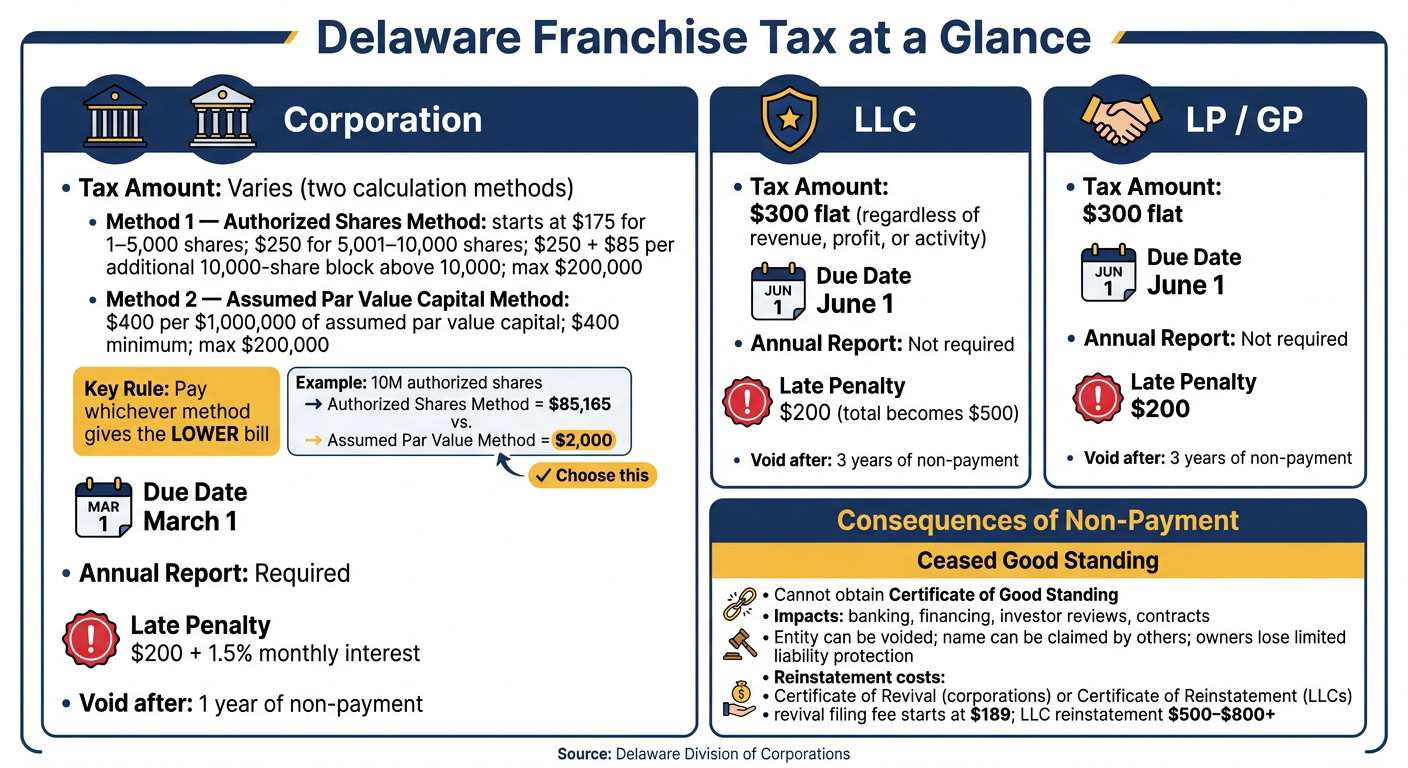
Most Delaware corporations need to file an Annual Franchise Tax Report each year. The key point is simple: corporations can calculate the tax in two ways and pay whichever amount is lower. So if you’re filing a corporation report, it’s smart to run both calculations before you pay.
Authorized Shares Method: Tax Brackets and Who Pays More Under This Method
This method looks only at the total number of authorized shares listed in the certificate of incorporation. You don’t need financial data for it.
Here’s how the tax brackets work:
- 1–5,000 authorized shares: $175
- 5,001–10,000 authorized shares: $250
- Over 10,000 authorized shares: $250, plus $85 for each additional block of 10,000 shares, or any fraction of 10,000, above the first 10,000
This method stays low when the share count is low. But once the authorized share count gets large, the bill can climb fast.
For example, a corporation with 10,000,000 authorized shares would owe $85,165 under this method. That comes from $250 + 999 blocks × $85. The yearly tax under this method is capped at $200,000.
Assumed Par Value Capital Method: The Formula Many Startups Use to Lower Their Tax
This method uses three inputs: gross assets, issued shares, and authorized shares.
The calculation works in three steps:
- Divide total gross assets by total issued shares to get the assumed par value per share.
- Multiply that assumed par value by total authorized shares to get the assumed par value capital.
- Apply $400 per $1,000,000 of assumed par value capital, or any fraction of that amount, with a $400 minimum tax.
Here’s what that looks like for a startup with 10,000,000 authorized shares, 1,000,000 issued shares, and $500,000 in gross assets:
$500,000 ÷ 1,000,000 issued shares = $0.50 assumed par value per share. Then $0.50 × 10,000,000 authorized shares = $5,000,000 assumed par value capital. Tax = $400 × 5 = $2,000.
That’s a big gap compared with the Authorized Shares Method, which is why many startups check this method first when they have a high share count.
Here is a quick comparison of the two methods.
| Feature | Authorized Shares Method | Assumed Par Value Capital Method |
|---|---|---|
| Data Needed | Total authorized shares only | Gross assets, issued shares, authorized shares |
| Minimum Tax | $175 | $400 |
| Maximum Tax | $200,000 | $200,000 |
| Typical Use Case | Corporations with relatively few authorized shares | Startups with high authorized shares and low assets |
When Each Calculation Method Usually Makes Sense
The Authorized Shares Method usually works best for corporations with a fairly low number of authorized shares, such as under 100,000.
The Assumed Par Value Capital Method usually works better when a corporation has a very high number of authorized shares – like 10,000,000 or more – but not many assets on the books. The numbers below show how that plays out in practice.
| Scenario | Authorized Shares Method | Assumed Par Value Capital Method | Lower Bill |
|---|---|---|---|
| 5,000 authorized shares | $175 | $400 (minimum) | Authorized Shares |
| 10,000 authorized shares | $250 | $400 (minimum) | Authorized Shares |
| 20,000 authorized shares, $150,000 gross assets | $335 | $400 (minimum) | Authorized Shares |
| 10,000,000 authorized shares, $500,000 gross assets | $85,165 | $2,000 | Assumed Par Value |
LLCs, LPs, and GPs use flat annual taxes instead.
sbb-itb-ba0a4be
How Much Delaware Franchise Tax LLCs, LPs, and GPs Pay
Delaware handles LLCs, LPs, and GPs much more simply than corporations. These entity types owe a flat $400 annual tax and do not file an annual report.
Delaware LLC Annual Tax: Flat $400
Every Delaware LLC pays the same $400 annual tax. It doesn’t matter how much the business made, whether it turned a profit, how many members it has, or whether it was active during the year.
The payment is due by June 1 each year.
LP and GP Annual Tax: A Quick Overview
Delaware LPs and GPs owe that same $400 annual tax, also due on June 1.
The rule is the same across all three entity types:
| Entity Type | Annual Tax Amount | Annual Report Required? | Filing Office |
|---|---|---|---|
| LLC | $400 flat | No | Delaware Division of Corporations |
| LP | $400 flat | No | Delaware Division of Corporations |
| GP | $400 flat | No | Delaware Division of Corporations |
Next, review when the payment is due and how to file it online.
When Delaware Franchise Tax Is Due and How to Pay It
Annual Due Dates for Corporations and LLCs
After you figure out what you owe, the next step is simple: don’t miss the deadline. The due date depends on your entity type. Corporations must file an annual report and pay franchise tax by March 1 each year. LLCs, LPs, and GPs must pay their annual tax by June 1 each year.
| Entity Type | Annual Due Date | Annual Report Required? |
|---|---|---|
| Corporation | March 1 | Yes |
| LLC | June 1 | No |
| LP / GP | June 1 | No |
Estimated Payments for Corporations With Larger Tax Bills
Some corporations need to pay earlier throughout the year. If a corporation expects to owe $5,000 or more in franchise tax, it must make quarterly estimated payments.
Here’s how that schedule works: 40% by June 1, 20% by September 1, 20% by December 1, and the rest by March 1. If your tax bill is large, this is the part you don’t want to overlook.
What You Need Before Filing Online
Before you file online, it helps to get everything in one place first. For corporations, that usually means having:
- Your 7-digit Delaware file number, which you can find with the Delaware Division of Corporations Entity Search tool
- Total authorized shares, issued shares, and par value
- Gross assets as reported on IRS Form 1120, Schedule L
- Officers’ and directors’ names and addresses
- A valid payment method, such as ACH or a credit card
Once you have those details ready, the online filing process is pretty simple.
Penalties, Good Standing, and Key Takeaways
Late Fees, Interest, and Loss of Good Standing
Once the tax comes due, the main problem is simple: missing the deadline gets expensive fast.
For corporations, a late filing triggers a $200 penalty plus 1.5% monthly interest on any unpaid tax. For LLCs, the late penalty is $200, which pushes the flat $400 tax up to $600.
Missing payment can also put your entity into Ceased Good Standing. That creates a chain reaction. You can’t get a Certificate of Good Standing, and that can slow down banking, financing, investor reviews, and contract work because banks, investors, and counterparties often ask for that document before moving ahead.
If the tax still goes unpaid, Delaware steps in harder. A corporation can be voided after one year of non-payment, while an LLC can be voided after three years. Once that happens, the business name can be claimed by someone else, and the owners lose limited liability protection in Delaware.
Getting a void entity back in place takes time and money. Corporations must file a Certificate of Revival. LLCs must file a Certificate of Reinstatement. In both cases, you also have to pay all back taxes, interest, and penalties. The revival filing fee starts at $189, and reinstating a dissolved LLC can run $500 to $800 or more.
Conclusion: The Amounts and Dates to Remember
Here are the main amounts and deadlines in one place:
| Entity Type | Tax Amount | Due Date | Late Penalty |
|---|---|---|---|
| Corporation | Varies by calculation method | March 1 | $200 + 1.5%/month interest |
| LLC | $400 flat | June 1 | $200 (total becomes $600) |
| LP / GP | $400 flat | June 1 | $200 |
Paying on time keeps your entity in good standing. That matters for banking, fundraising, contracts, and day-to-day operations without delays. It helps to set a calendar reminder well before the deadline and check your status anytime through the Delaware Division of Corporations Entity Search tool.
FAQs
How do I know which corporation tax method to use?
Delaware corporations can figure out franchise tax in one of two ways: the Authorized Shares Method or the Assumed Par Value Capital Method. The state runs both calculations and uses the lower amount.
For many startups with a large number of shares, the Assumed Par Value Capital Method often leads to a lower tax bill. There’s a catch, though: you need your total gross assets and issued shares to use it. The Authorized Shares Method doesn’t require that info.
Do I still owe Delaware franchise tax if my business made no money?
Yes. Delaware franchise tax is a required annual fee you pay for the right to operate or stay incorporated in the state. It applies whether your company made money or not, and even if the business had little or no activity.
For LLCs, the franchise tax is a flat $400 per year. For corporations, the amount depends on the company’s share structure, with a minimum tax of $175.
If you don’t pay, Delaware can add penalties and interest. You can also lose your company’s good standing, which can cause headaches fast.
What happens if I miss the Delaware franchise tax deadline?
Missing the deadline comes with a $200 penalty. On top of that, the unpaid balance accrues 1.5% interest per month.
If the balance stays unpaid, things can snowball. Your business may lose good standing and could be declared void or revoked. You may also be blocked from getting certificates of good standing or filing for dissolution until all back taxes, interest, and fees are paid.