

If you miss your LLC annual report deadline, your business can face late fees, lose good standing, or even be dissolved by the state. In most states, I only need to file basic business details, like my address, registered agent, and management info, but the deadline, fee, and filing name depend on the state.
Here’s the short version:
- Most LLCs must file a periodic report, even if the business made $0 or had no activity.
- This filing is not a tax return. It usually does not ask for income or profit numbers.
- Some states charge nothing, while others charge a lot. Fees can range from $0 to $500 per year.
- Some states file every year, while others file every 2 years.
- A few states usually do not require a standard LLC annual report, including Arizona, Missouri, and New Mexico.
- Late penalties can hit hard. Florida’s late penalty is $400 on top of its base fee.
Before I file, I need to check:
- what my state calls the filing (see this LLC compliance checklist)
- when it’s due
- how much it costs
- whether I file with the Secretary of State or another agency
- whether my state also has a separate franchise tax or tax filing
A few due-date patterns show up again and again:
| Filing pattern | What it means | Example states |
|---|---|---|
| Fixed date | Same deadline every year for all LLCs | Florida |
| Anniversary month | Due by the last day of the formation month | Colorado, Illinois, Nevada |
| Anniversary date | Due on the exact formation date | Massachusetts, Oregon |
| Biennial | Due every 2 years | California, New York, Iowa, Indiana |
The filing itself is usually simple: I look up my LLC in the state portal, review the prefilled details, update changes, pay the fee, submit, and save proof. After that, I should check the state registry within 1 to 3 business days to make sure the status shows Active or Good Standing.
Bottom line: this is a simple compliance task, but the rules change by state, and missing it can get expensive fast.
What you need to know before you file
State names for this filing can differ, but in most cases, LLCs still have to file even if the business had no activity at all. So the first step is simple: find out what your state calls the filing, then pull together the information you’ll need.
What information states typically ask for
Most states want the same basic details:
- LLC’s legal name
- State entity ID number
- Principal business address
- Mailing address
- Registered agent name and address
- Whether the LLC is member-managed or manager-managed
It’s smart to check these records before you begin. In some states, you can update an address or management detail as part of the same filing, which can save you a separate step.
How annual reports differ from franchise tax and income tax filings
An annual report usually goes to your state’s business filing office. Its job is simple: keep your company’s contact and management information up to date.
Franchise tax and income tax filings are different. Those are tax obligations, and they’re usually filed with a state Department of Revenue or the IRS. This matters because some states handle both in a similar online portal or during the same filing period. That can make them seem like one requirement when they’re actually two separate filings.
| Filing Type | Primary Purpose | Financial Data | Filed With |
|---|---|---|---|
| Annual Report | Update contact and management info | None | Secretary of State |
| Franchise Tax | Fee for the right to do business | Varies by state | Dept. of Revenue / Comptroller |
| Income Tax Return | Report profits and pay taxes | Full disclosure | IRS / State Tax Dept. |
With those filing types split out, the next thing to figure out is who has to file and when.
Who must file and common exceptions
Both domestic LLCs and foreign LLCs usually have to file.
- Domestic LLCs are formed in the state.
- Foreign LLCs are registered to do business in a state other than the one where they were formed.
Even inactive LLCs often still need to file to stay in good standing. That catches a lot of people off guard. No sales doesn’t always mean no filing.
There are a few exceptions. Some states don’t require a recurring LLC report at all.
Some states also ask for an initial report soon after formation, separate from the recurring filing schedule. California, for example, requires a Statement of Information within 90 days of formation, then a biennial filing after that. If your LLC was formed in the middle of the year, check whether your state expects a first-year filing before your usual filing cycle starts.
How to file your LLC annual report, step by step
Once you know what your state asks for, filing your LLC annual report is usually a pretty short admin job.
Gather your LLC details and payment method before you start
Before you begin, get your basic LLC information in one place: your LLC name, state entity ID, current addresses, registered agent details, and current management information. If you have that ready, the filing itself is mostly just filling out the form.
It’s also smart to confirm that your registered agent appointment is still current.
For payment, most state portals accept:
- Credit cards
- Debit cards
- E-check or ACH
How to use your state filing portal or paper form
Most states let you file through the state’s official business portal. In most cases, that means filing online, though some states still allow paper forms.
In most states, the process looks like this:
- Search for your LLC by name or entity ID in the state’s business database.
- Choose the File Annual Report option, or a similar option, on your business record.
- Review the pre-filled information from your last filing.
- Update anything that changed, like your address, registered agent, or member or manager information.
- Sign electronically as an authorized member or manager.
- Pay the fee and submit.
If you’re filing on paper, write clearly. An illegible form can be rejected, which can slow everything down.
Review, submit, and save proof of filing
Before you hit submit, double-check the spelling of your LLC’s name. Then confirm your principal address, registered agent details, and member or manager information are all current.
After the filing goes through, save or print your payment confirmation and a copy of the submitted report. Then, after 1 to 3 business days, look up your LLC in the state’s business registry and make sure the status changed to Good Standing or Active, depending on the state.
A paid filing isn’t always the same as a processed filing. If the payment went through but the status didn’t change, it’s worth checking.
sbb-itb-ba0a4be
State-by-state basics: deadlines, fees, and filing patterns
Once you understand the filing process, the next piece is timing, cost, and where your state wants the report filed. This is where things start to split. States use different due dates, different filing names, and different agencies, so it helps to know your state’s basic pattern before a deadline sneaks up on you.
The main due date models states use
Most states fall into a few simple deadline setups.
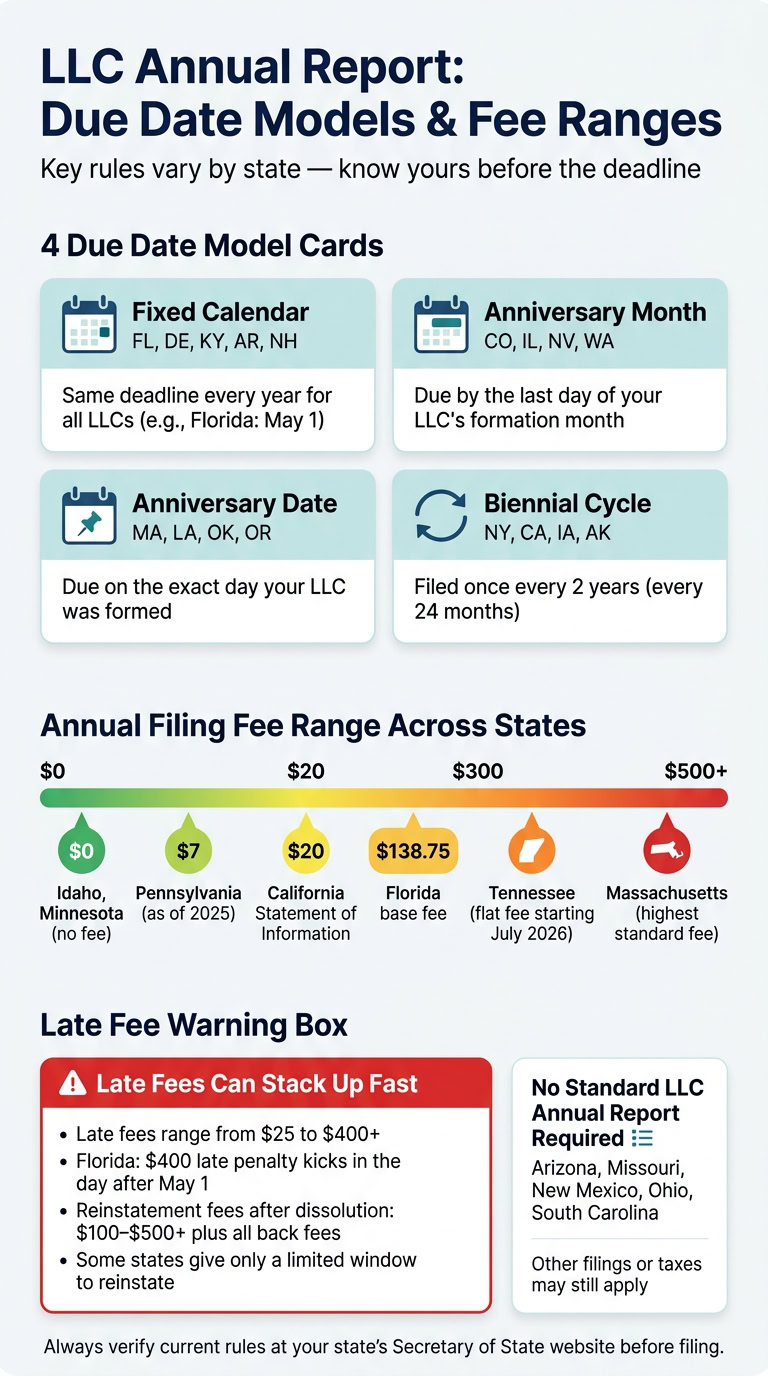
Fixed calendar states use the same due date for every LLC, no matter when the business was formed. Florida is a good example. All LLCs file by May 1.
Anniversary-based states tie the deadline to your LLC’s formation date. But there are two versions of that rule.
Some states, including Colorado, Illinois, and Nevada, use the anniversary month. That means your report is due by the last day of the month your LLC was formed.
Others, including Massachusetts and Oregon, use the anniversary date. That means the report is due on the exact day your LLC was formed.
That small difference can trip people up. If your LLC was approved on March 14, a month-based state gives you until March 31. A date-based state expects the filing by March 14.
A smaller set of states uses a biennial cycle, so you file once every two years. New York, California, Iowa, and Indiana fall into this group. California’s Statement of Information is biennial and costs $20, but the separate $800 minimum franchise tax still applies.
Arizona, Missouri, New Mexico, Ohio, and South Carolina generally do not require a standard LLC annual report, though other filings may still apply.
Typical fee ranges and what can change the cost
Filing fees are all over the map. Some states charge $0, while others go much higher. Idaho and Minnesota charge nothing, and Massachusetts charges $500.
A few examples stand out.
Pennsylvania switched to an annual report system in 2025 with a $7 fee. Florida’s base fee is $138.75, and its $400 late penalty kicks in the day after the May 1 deadline. That’s one of the harshest late fees in the country. Tennessee also changed its fee setup, with a flat $300 annual fee starting in July 2026.
And the base filing fee isn’t always the full story. Costs can pile up through:
- Late fees ranging from $25 to $400+
- Reinstatement fees after administrative dissolution, often $100 to $500+ plus all back fees
- Separate franchise tax duties in states like California and Delaware
In Texas, this filing runs through the Comptroller, not the Secretary of State.
Quick-reference table: due date models
Start with your state’s due-date model. That’s the part that tells you when reminders matter, when payment is due, and how early you should act.
The table below shows the main patterns across states. Even so, check your state’s current rules on the Secretary of State website before filing.
Common due date models
| Pattern | Example States | Filing Timing | What It Means for Your Calendar |
|---|---|---|---|
| Fixed Calendar | FL, DE, KY, AR, NH | Same date for all LLCs (e.g., May 1) | Easy to remember; same deadline every year regardless of formation date |
| Anniversary Month | CO, IL, NV, WA | Last day of the month the LLC was formed | Deadline is tied to your formation month |
| Anniversary Date | MA, LA, OK, OR | The exact day the LLC was formed | Requires tracking the specific day of state approval |
| Biennial Cycle | NY, CA, IA, AK | Every two years | Only one filing every 24 months |
How to avoid late fees and keep your LLC in good standing
Build a simple compliance system for one or multiple states
Once you know your state’s deadline setup and how you need to file, the next step is simple: don’t miss the date.
That sounds obvious, but here’s the catch. Many states no longer send reminder notices by mail, which means LLC owners often have to track deadlines on their own.
A simple system usually works well:
- Set one reminder 60 days before the deadline to review your LLC details
- Set another reminder 30 days before the deadline to submit the filing
- If you manage more than one LLC, keep a single spreadsheet with each entity’s state, deadline, and filing fee
After you file, don’t just assume everything went through. Check the state registry within 1 to 3 business days to make sure your LLC status shows as Active or Good Standing. Then save both the receipt and the report you submitted as proof.
That extra check can save you a headache later. A late filing can quickly snowball into late fees, delinquency, loss of good standing, and, in some cases, administrative dissolution.
And if your LLC does get dissolved, reinstating your LLC can cost a lot. Some states also give you only a limited window to reinstate.
How BusinessAnywhere can help with annual report compliance

If you want all your reminders and notices in one place, a central system can make life easier. BusinessAnywhere can keep annual report reminders, registered agent notices, and filing help together in one dashboard.
Key points to remember
An LLC annual report is a routine update you file with the state. It is not a tax return.
Deadlines, fees, and filing rules change from state to state, so your Secretary of State website, or the state’s matching agency, is the best place to confirm what applies to your LLC. A basic reminder system, one compliance file, and a quick status check after filing can help you avoid most late fees and dissolutions.
FAQs
How do I find my LLC’s annual report deadline?
Visit the official Secretary of State website, or the matching business filing agency, for the state where your LLC is registered. Then use the public business entity search tool to find your company by its legal name or entity number.
In most cases, the search result will show your next due date and current filing status. The deadline is usually set one of two ways:
- A fixed calendar date
- An anniversary-based date tied to your LLC’s formation month
That means your due date may land on the same date each year, or it may line up with when the LLC was first formed.
What happens if my LLC annual report is late?
Filing your LLC annual report late can cause more trouble than many owners expect. In some states, you may have to pay late fees that climb as high as $400.
If the delay drags on, your LLC can lose its good standing. That can make everyday business tasks harder, like getting a loan, signing contracts, or growing into new markets.
And if things go too far, the state can administratively dissolve your LLC. At that point, the business may lose its legal protections and its right to operate.
Do I still have to file if my LLC made no money?
Yes. You still need to file.
An annual report is a required state filing that helps keep your LLC in good standing, even if the business made $0.
It’s not a tax return. In most cases, it covers basic company details, like your registered agent and principal address.
If you skip it, the state may charge late fees, mark your LLC as not in good standing, or even dissolve the business administratively.