
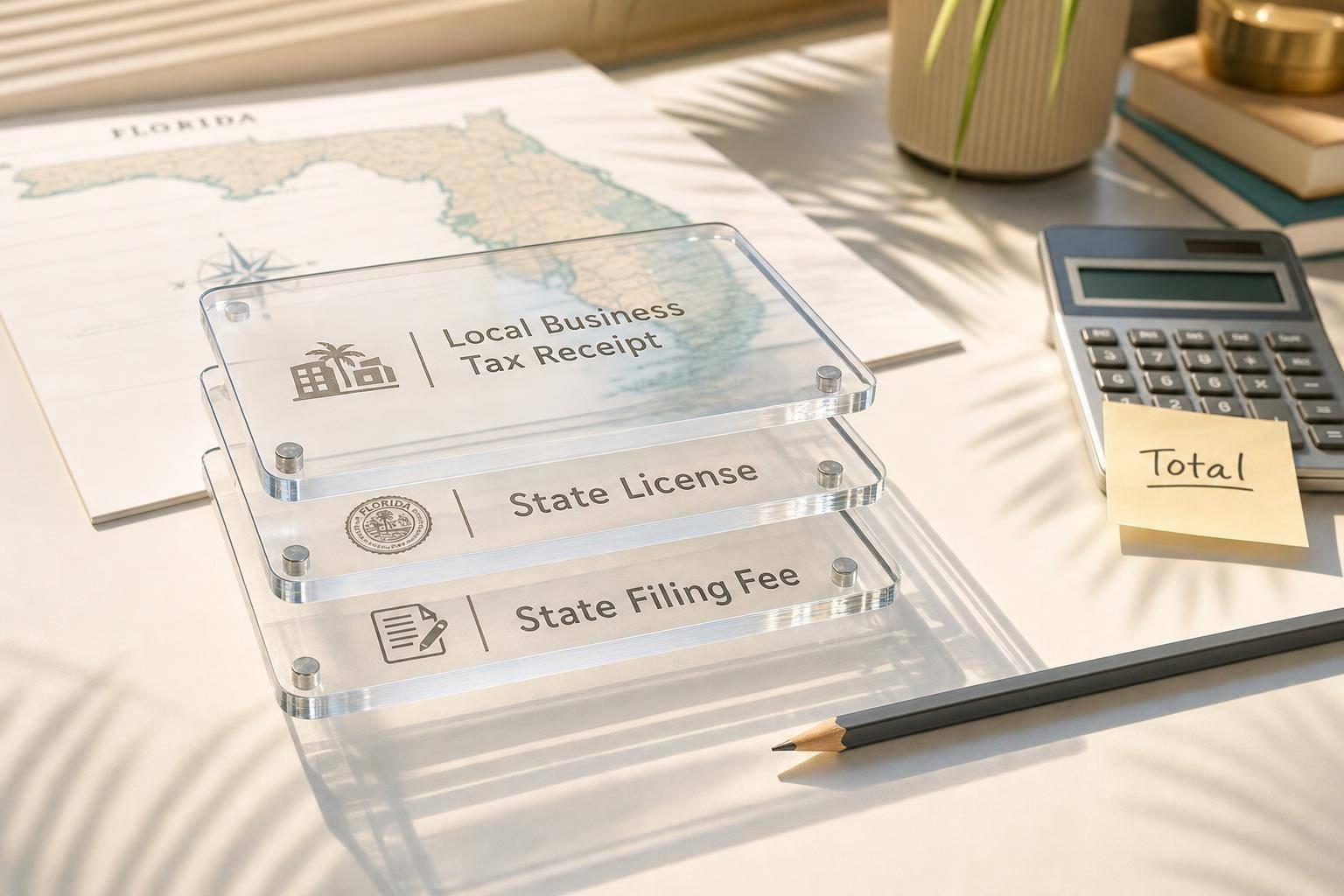
Florida does not have one flat statewide business license fee. In most cases, I’d budget for three separate cost buckets: a city or county business tax receipt, a state license if the business is regulated, and special permits for fields like food, alcohol, lodging, or childcare.
Here’s the short answer:
- Local business tax receipts: often $15 to $2,500+ per year
- Many small local businesses: often land around $50 to $100
- State professional licenses: often $50 to $300 to start
- Industry permits: often start near $100 and can reach the low thousands
- Florida LLC filing fee: $125
- Florida LLC annual report: $138.75, due January 1 through May 1
- Late annual report penalty: $400
- DBA (fictitious name): $50
If I were estimating a first-year budget, I’d keep it simple:
- Add the entity filing fee
- Add city and county license fees if both apply
- Add any state license or permit
- Add the annual report
- Leave a small cushion for extra filing or copy fees
That means a low-cost Florida business might spend only a few hundred dollars in year one, while a regulated business or one in a higher-fee county can spend much more.
| Cost Type | Common Range |
|---|---|
| Local business tax receipt | $15 to $2,500+ |
| State professional license | $50 to $300 |
| Industry permit | $100 to low thousands |
| LLC formation | $125 |
| Annual report | $138.75 |
| DBA filing | $50 |
Bottom line: if you want a usable estimate, I’d total local fees + state license fees + state filing fees instead of looking for one “Florida business license” price.
The 3 Types of Florida Business License Costs to Check
Florida license costs usually come in three layers: a local business tax receipt, a state professional license for regulated work, and industry permits for certain kinds of business. Start with the local receipt. Then check whether your business also needs a state license or a separate permit.
Local Business Tax Receipts from Cities and Counties
When people say “Florida business license,” they’re usually talking about the local business tax receipt. The Local Business Tax Receipt (LBTR) is issued by your city, your county, or both. If your business has a physical location inside city limits, you’ll likely need one from the city and one from the county.
Local business tax receipts often range from $15 to $2,500+ per year, depending on the jurisdiction and the type of business. For smaller operations, fees often land around $50 to $100. In Miami-Dade County, for example, receipts usually range from $50 to $500+.
Before you apply, check zoning. That step can save you a headache later. And if your work falls into a regulated field, you’ll need to add a state license on top of the local fee.
State Professional Licenses for Regulated Work
If your business is in a regulated profession, there’s another cost to plan for: a state license. DBPR oversees fields like real estate, cosmetology, electrical contracting, and architecture. DACS handles other licenses, including pawn shops and private investigators.
Application and initial license fees for these boards usually run $50 to $300, based on the license class. That’s the upfront part. Renewal timing depends on the board, so it’s smart to build that into your long-term budget. Some businesses also need a separate industry permit on top of this.
Industry Permits for Food, Lodging, Alcohol, Childcare, and Similar Activities
Some businesses need a third layer of licensing: industry permits tied to health, safety, or alcohol rules. That includes food service, alcohol sales, lodging, and childcare facilities. Each one goes through its own approval process and has its own fee setup.
These permits come from agencies such as the Florida Department of Health and other state regulators. Unlike local receipts, which are often flat fees, permit costs can change based on the size or scope of the business. In many cases, they start around $100 and can run into the low thousands, depending on the activity.
How to Look Up Your Exact Florida License Fees
Fee amounts change, so check the official source before you set your budget.
Check Your County and City Business Tax Offices
Start with your county tax collector’s office and your city’s business tax office. Contact them separately. Then ask how fees are figured for your exact business type.
That part matters more than most people think. Some local offices charge based on business category. Others use gross receipts. For example, Miami-Dade County bases fees on business type and category, while Orange County uses a graduated fee schedule based on gross receipts.
| Location | Typical Fee Range | How the Fee Scales |
|---|---|---|
| Miami-Dade County | $50 – $500+ | Based on business type and category |
| Orange County | Varies | Graduated fee schedule based on gross receipts |
| Hillsborough County | Varies | Required for all businesses |
| Boca Raton | Varies | General local license required for all businesses |
| Orlando | Varies | Occupational basis; may require multiple receipts based on activities |
Once you confirm the local business tax receipt, check whether your work also needs a state license or permit.
Review Florida State Licensing Board and Department Fee Schedules
Go straight to the official site for the license tied to your line of work. Check DBPR for fields like real estate, construction, and electrical contracting. Check DACS for licenses such as pawn shops and private investigators.
Initial fees and renewal cycles can vary a lot by license class. So don’t just look at the first payment. Check the renewal amount too before you map out your budget.
| License/Permit Type | Typical Initial Cost | Renewal Range | Confirming Agency |
|---|---|---|---|
| Professional (Real Estate, Construction) | Varies by license class | Annual or biennial | DBPR |
| Pawn Shops, Private Investigators | Varies | Varies | DACS |
| Food Service / Restaurant | $100 – $300+ | Annual | Department of Health / DBPR |
Then keep those licensing fees separate from one-time formation filings when you total your first-year costs.
Separate License Costs from Other Startup Filing Fees
These costs are not license fees, but they still hit your first-year compliance budget.
For example, Florida LLC formation costs $125 in state fees. On top of that, there’s a $138.75 annual report due from January 1 through May 1. File late, and Florida adds a $400 penalty.
If you plan to use a business name that’s different from your registered legal name, a fictitious name (DBA) registration costs $50 and stays valid for five years.
A simple way to avoid confusion: track formation fees, annual report costs, DBA filings, and license fees in separate budget lines.
sbb-itb-ba0a4be
How to Estimate Your First-Year Florida Compliance Budget
A 5-Step Method to Total Your Costs
Once you know which licenses and permits your business needs, the next job is simple: turn those fees into one working first-year number.
Here’s a clean way to do it:
- Add your formation or name-registration fee: LLC $125, corporation $70, fictitious name $50.
- Check your county and city tax offices. If your business operates inside city limits, you may need a tax receipt from both the city and the county. Add each local tax receipt your business needs.
- Identify any required state license or permit. Some businesses need one. Many don’t.
- Add recurring fees. Florida charges $138.75 for the annual report due by May 1. Miss that deadline, and the state adds a $400 late fee.
- Add a small buffer for incidentals. Certified document copies cost $8.75 each. And some home-based businesses need a separate home occupation permit.
First-Year Cost Ranges for Common Small Business Types
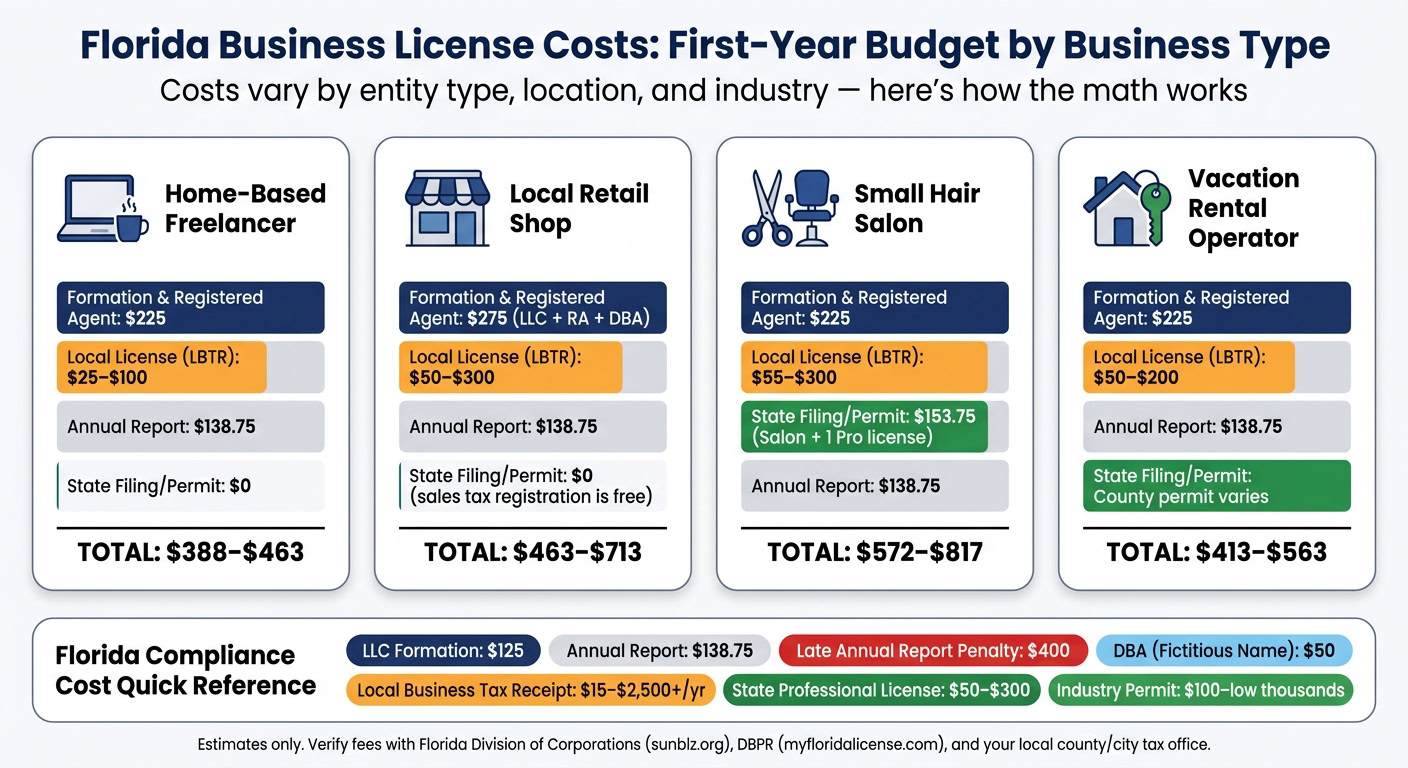
The table below shows sample first-year totals for four common Florida small business types. These numbers combine entity filing, a registered agent, local licensing, and state permits where needed. It’s a simple way to see how the math works in practice.
| Business Type | Formation & Registered Agent | Local License (LBTR) | State filing / permit | Annual Report | Est. First-Year Total |
|---|---|---|---|---|---|
| Home-Based Freelancer | $225 (LLC + RA) | $25 – $100 | $0 | $138.75 | $388 – $463 |
| Local Retail Shop | $275 (LLC + RA + DBA) | $50 – $300 | $0 (Sales tax registration is free) | $138.75 | $463 – $713 |
| Small Hair Salon | $225 (LLC + RA) | $55 – $300 | $153.75 (Salon + 1 Pro) | $138.75 | $572 – $817 |
| Vacation Rental Operator | $225 (LLC + RA) | $50 – $200 | County permit varies | $138.75 | $413 – $563 |
Your exact total will depend on where your business is located, whether your city and county both charge local fees, and whether your line of work needs a state license.
Tools to Stay Compliant and Avoid Surprise Fees
Official Florida Offices and Fee Lookup Tools
Florida compliance runs through state, county, and city offices. So before you file anything, it helps to check each official source and confirm the fees that apply to your business. The simplest path is to match your business type to the right office first. That usually gets you to the right fee page faster.
| Agency | What It Handles | Where to Look |
|---|---|---|
| Florida Division of Corporations (Sunbiz) | Entity formation, annual reports, and fictitious names | sunbiz.org |
| Florida Department of Business and Professional Regulation (DBPR) | Professional licenses for regulated work such as real estate, construction, and beauty services | myfloridalicense.com |
| Florida Department of Agriculture and Consumer Services (DACS) | Industry permits and licenses for businesses such as pawn shops and private investigators | fdacs.gov |
| County Tax Collectors & City Licensing Departments | Local Business Tax Receipt (formerly occupational license) | Your county or city government website |
Use Sunbiz to file annual reports and check filing deadlines. If you haven’t locked in a business location yet, look at your local zoning or planning department before you sign a lease or start from a home-based setup. That extra check can save a lot of hassle later.
How BusinessAnywhere Fits Into the Process
If you want fewer moving parts, using one system for admin can make life easier. BusinessAnywhere can help you manage Florida LLC formation, registered agent service, virtual mailbox support, and filing reminders in one place.
That said, it doesn’t replace DBPR, county tax collectors, or local zoning offices. Think of it this way: use BusinessAnywhere to keep paperwork organized, and use Florida offices to confirm who handles your license and whether you have local approval.
Conclusion: The Fastest Way to Estimate Your Florida License Cost
Florida does not have one statewide business license. Instead, your costs usually come from three buckets: Sunbiz filing and annual report fees, your county or city business tax receipt, and any DBPR or DACS licenses or permits tied to your business.
Local business tax receipts can range from $15 to $2,500+ per year, depending on the city or county and the kind of business you run. To estimate your Florida license cost, check the right state, county, and city offices, then add up the filing, permit, and renewal fees that apply.
FAQs
Do I need both a city and county license in Florida?
It depends on where your business is based and what it does, because Florida does not issue a general statewide business license.
Instead, many cities and counties require a local business tax receipt. If you operate in both areas, you may need one from each. Rules can change from place to place, so check with your city licensing department and your county tax collector.
What’s the difference between an LLC fee and a business license fee?
An LLC fee is what you pay to register your business with the state and legally set up your LLC.
A business license fee is usually a recurring state or local fee that lets you legally operate in a certain city, county, or line of work. In Florida, this is often called a Business Tax Receipt.
How can I find my exact Florida license cost?
To find your exact Florida license cost, check with your city and county offices. Florida doesn’t have one statewide general business license, so the price depends on where your business is based and what kind of work you do.
A good first step is your local county tax collector or city licensing department. They can tell you the fee for a local business tax receipt, which is often the main local requirement.
If your business falls into a regulated trade or profession, check the right state agency too:
- Florida Department of Business and Professional Regulation
- Florida Department of Agriculture and Consumer Services
Those agencies handle many profession- and industry-based licenses, and their fees can be separate from local costs.