
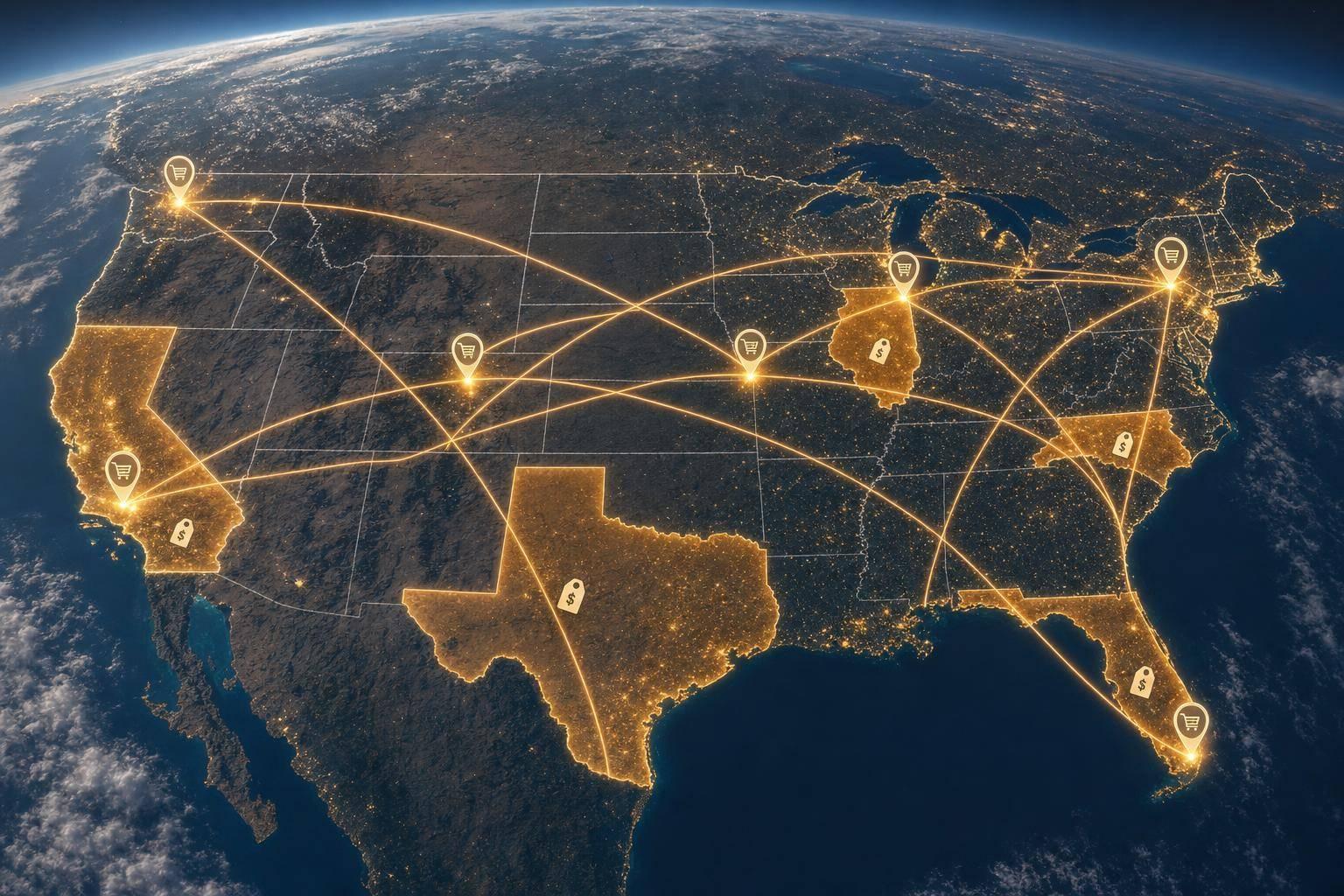
You can owe sales tax in a state even if you have no store, staff, or inventory there. If your online sales cross a state threshold, you may need to register, collect tax, file returns, and send in the tax you collected.
Here’s the short version:
- Many states use a $100,000 sales threshold
- Some states also use a transaction count, like 200 sales
- What counts is not the same everywhere
- Some states count gross sales
- Some count only taxable sales
- Some include marketplace sales, while others do not
- The lookback period can be the previous calendar year or a rolling 12 months
That means two businesses with the same revenue can have different sales tax duties in different states.
A few examples from the article make that clear:
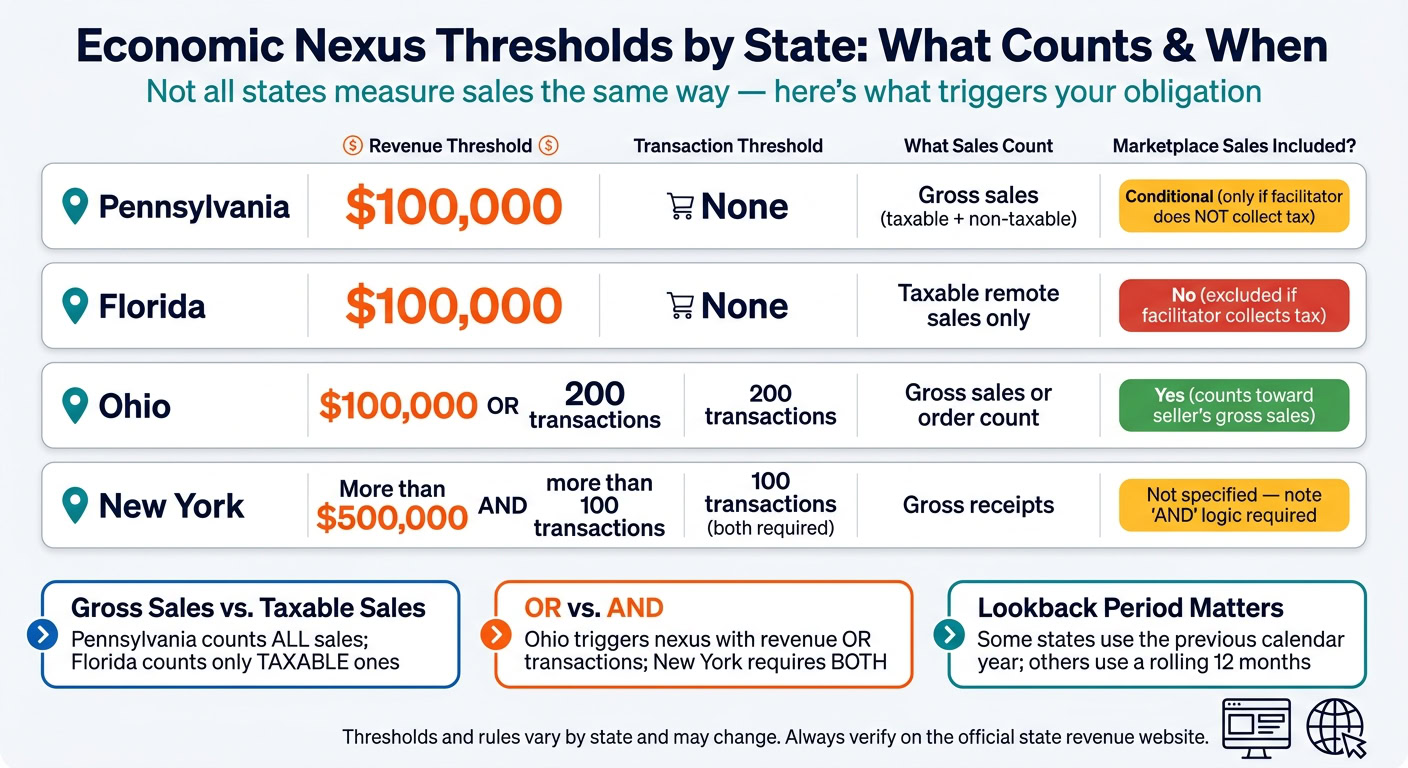
- Pennsylvania: more than $100,000 in gross sales; non-taxable sales still count
- Florida: $100,000 in taxable remote sales; marketplace sales collected by the marketplace do not count
- Ohio: $100,000 in gross sales or 200 transactions
- New York: more than $500,000 in gross receipts and more than 100 transactions
If I wanted to check whether my business has economic nexus, I’d do four things first:
- Pull a sales-by-state report
- Separate gross sales, taxable sales, and transaction count
- Check each state’s threshold and measurement period
- Register before collecting tax if I cross the line
Here’s a quick snapshot:
| State | Main Threshold | What Counts |
|---|---|---|
| Pennsylvania | $100,000 | Gross sales |
| Florida | $100,000 | Taxable remote sales |
| Ohio | $100,000 or 200 transactions | Gross sales or order count |
| New York | More than $500,000 and more than 100 transactions | Gross receipts plus transaction count |
Bottom line: economic nexus is about where your sales happen, not just where your business sits. If you sell online across state lines, it’s smart to check your numbers now instead of waiting until a filing deadline sneaks up on you.
What Economic Nexus Means
Nexus is the legal link that gives a state the right to require sales tax registration, collection, remittance, and filing. For online sellers, the big issue is simple: have your sales in a state crossed that state’s threshold?
Economic nexus is based on sales activity, not where your business is located. In Pennsylvania, for example, businesses with no physical or economic presence are exempt from sales tax duties. So the trigger isn’t where you sit. It’s what your sales are doing.
How Economic Nexus Differs from Physical Nexus
Physical nexus comes from having a real footprint in a state, like a storefront, warehouse, employees, or inventory. And it applies right away, no matter how much you’re selling.
Economic nexus works differently. If you sell into a state from somewhere else, you can still owe sales tax there even if you have zero in-state footprint. Once your sales pass the state’s threshold, the rule can kick in. Put plainly: physical nexus is about presence, while economic nexus is about sales.
| Feature | Physical Nexus | Economic Nexus |
|---|---|---|
| Primary Trigger | Physical presence (office, warehouse, employees, inventory) | Total revenue or transaction count within a state |
| Example | Storing inventory in a Pennsylvania warehouse | A remote seller with enough sales to exceed Pennsylvania’s threshold but no physical assets there |
| Compliance Requirement | Register and collect tax as soon as physical presence is established | Register and collect tax once the state’s specific threshold is met |
| Measurement Basis | Location of business assets or personnel | Economic activity – gross sales or number of transactions |
What Crossing a Threshold Requires
Once your sales cross a state’s economic nexus threshold, four things happen fast:
- Register for a sales tax permit through the state’s revenue department. Pennsylvania, for instance, uses its myPATH portal.
- Collect sales tax from customers on taxable transactions going forward.
- Remit the tax you’ve collected based on that state’s filing schedule.
- File returns on time and keep records of gross sales by state so you can show whether you’ve met or passed each threshold.
This is where it gets a little tricky: thresholds and measurement periods change from state to state. That’s why reviewing economic nexus thresholds by state isn’t just helpful. It’s part of doing this right.
sbb-itb-ba0a4be
How Online Businesses Trigger Economic Nexus
States don’t all play by the same rules. Some look at revenue. Some look at transaction count. Some use both. So the first job is simple in theory, but a bit messy in practice: figure out which sales tax nexus rules apply in each state.
And here’s the part that trips people up: it’s not ONLY about how much you sold. It’s also about which sales count.
Revenue, Transaction, and Combined Thresholds
Many states use a revenue threshold, often around $100,000, but the measuring rules aren’t the same from one state to the next.
Pennsylvania measures gross sales, which means all sales count, including non-taxable items. Florida takes a narrower approach. It counts only taxable remote sales, so non-taxable items, like some SaaS or digital goods, do not count toward the threshold.
Some states also use a transaction threshold, where the number of orders matters just as much as the dollar amount. Ohio is a good example. It triggers nexus if you exceed either $100,000 in gross sales or 200 or more transactions in the current or previous calendar year. Pennsylvania and Florida have dropped transaction counts, so they now look only at dollar volume.
| Threshold Type | What Counts | What to Monitor |
|---|---|---|
| Revenue | Total dollar volume of sales into the state | Gross vs. taxable sales; whether marketplace sales are included |
| Transactions | Total number of orders or invoices | Individual order counts, even low-dollar ones |
| Either | A dollar amount or a transaction count | Both total revenue and total order volume |
Sales Activity That Counts Toward Nexus
Direct sales, marketplace sales, and taxable services do not always get treated the same way. That’s where things can get slippery.
Direct ecommerce sales, meaning orders placed through your own online store and shipped into a state, are part of the nexus calculation. Marketplace sales are where the rules start to split.
In Florida, marketplace sales do not count if the facilitator collects and remits the tax. In Pennsylvania, sellers count direct sales and marketplace sales only when the facilitator does not collect tax. Ohio goes the other way: marketplace-facilitated sales do count toward the seller’s gross sales total.
Service sellers need to be careful too. If you sell services instead of physical goods, check whether that service is taxable in each state before you assume sales tax applies. For example, Florida does not tax SaaS delivered electronically, and those sales do not count toward its $100,000 threshold.
Once you sort out what counts and what doesn’t, you can compare each state’s threshold with your own sales data.
Hypothetical Examples of Common Nexus Scenarios
Scenario 1 – Gross sales threshold (Pennsylvania): An online clothing retailer ships $105,000 worth of goods to Pennsylvania customers during 2025. Around $10,000 of those sales are for non-taxable items. Pennsylvania still counts those sales because it uses gross sales, meaning taxable and non-taxable sales are combined. That puts the retailer over the $100,000 threshold, so it must register and begin collecting when Pennsylvania requires it.
Scenario 2 – Transaction count threshold (Ohio): A small tool manufacturer sells $45,000 worth of products to Ohio customers in 2026 but makes 215 transactions. Revenue is below $100,000, but Ohio’s 200-transaction rule still triggers economic nexus.
Scenario 3 – Marketplace exclusion (Florida): A handmade jewelry brand sells $150,000 to Florida customers, but $60,000 of those sales happen through a marketplace that collects and remits the tax. That leaves only $90,000 in direct sales counting toward the threshold, so the brand has not crossed Florida’s limit yet.
With those rules in place, the next move is to review each state one at a time.
How to Check Nexus State by State
Start with a Sales-by-State Review
Start with your own numbers.
Pull a sales-by-state report from your ecommerce platform or bookkeeping software for the last 12 months. Organize it by the state where the customer is located, and make sure it includes these three columns:
- total gross revenue
- total taxable revenue
- total transaction count
For your threshold math, use revenue before sales tax. If you include sales tax you collected, you can look like you crossed a state threshold earlier than you actually did. If a state is getting close, dig into it right away.
Check Each State’s Threshold and Measurement Period
After that, review four things for every state on your list:
| What to Check | Why It Matters | Example |
|---|---|---|
| Threshold amount | The dollar amount changes by state | Pennsylvania: $100,000 in gross sales |
| What sales count | Gross sales vs. taxable-only sales can change your total | Florida counts taxable remote sales only |
| Marketplace-facilitated sales | Some states count them, others do not | Florida excludes marketplace sales where the facilitator collects tax |
| Measurement period | This tells you when nexus begins | Florida uses the previous calendar year; Texas uses rolling 12 months |
This part matters more than many sellers think. A rolling 12-month window means you can cross a threshold in the middle of the year and miss it if you’re only checking once in a while. A calendar-year lookback is easier to follow because it resets on a set schedule.
Pennsylvania is a good example. It uses the previous calendar year and gives sellers a grace period, with collection starting April 1 of the following year.
Once you know the measurement period, confirm the rule on the state’s official revenue site. For example, Pennsylvania’s is mypath.pa.gov, and Florida’s is floridarevenue.com. The Streamlined Sales Tax (SST) organization also posts threshold charts for its 24 member states.
Use Software to Reduce Tracking Errors
If you cross a state’s threshold, this stops being a one-time check. You need to keep watching it.
Manual tracking across dozens of states is where mistakes creep in. Sales tax tools and Certified Service Providers can help you track thresholds and manage filing. In Pennsylvania, vendors with no physical presence who use a Certified Service Provider may not need a separate sales tax license or file returns on their own.
Use one system to track threshold status, registrations, filing dates, and return deadlines. That keeps the process a lot cleaner and cuts down on missed deadlines.
What to Do After Nexus Is Triggered
Register and Start Collecting Tax
Once you cross a state’s threshold, the clock starts ticking.
The first step is simple: register before you collect. You should not charge sales tax until you have a valid sales tax license.
Use the state’s official portal to register. For example, Pennsylvania uses myPATH at mypath.pa.gov. After approval, set up your checkout or invoicing system so it applies the right tax rules for that state.
Timing matters here. Pennsylvania, for example, says sellers that cross the $100,000 threshold in one calendar year must start collecting on April 1 of the following year. That date isn’t flexible. If you start too early, you can create problems. If you start too late, you can also end up in a mess.
Set Up Filing, Recordkeeping, and Threshold Monitoring
After registration, the work shifts to filing, recordkeeping, and keeping an eye on your numbers.
The state will assign your filing frequency based on sales volume. That might be monthly, quarterly, or annual. Follow that schedule even if you had no taxable sales during that period. Specific states have strict requirements, such as the New York sales tax filing deadlines for remote sellers.
Your records should stay clean and easy to pull up. That usually means keeping track of:
- Sales by state
- Tax collected
- Exemption certificates, if they apply
- Copies of filed returns
Good records matter during an audit. They can save you a lot of time and stress.
If you want help, an approved Certified Service Provider (CSP) can take care of filing, remittance, and threshold tracking. If you handle compliance by hand, all of it falls on you: registration, tax calculation, filing, remittance, and threshold tracking. Automation puts those jobs in one place, which makes the process easier to manage.
It also helps to review your sales-by-state data every filing period. That’s the best way to spot changes before they turn into missed tax duties.
Conclusion: How to Determine Whether Your Business Has Economic Nexus
After you cross a threshold, confirm what sales count, register before collecting, file on time, and keep watching sales by state.
FAQs
When should I register after crossing a state threshold?
Registration deadlines differ from state to state, so check the rules in every state where you triggered nexus. Some states want you to register right away. Others give you 30 to 90 days, and a few let you wait until the next calendar year.
In most cases, you can’t collect sales tax without a valid permit. So if it looks like you’re about to cross a threshold, register as early as you can. That way, you’re set before your first taxable sale.
Do exempt, service, or marketplace sales count toward nexus?
It depends on the state.
Many states use gross sales to measure economic nexus. That means they may count both taxable and non-taxable transactions toward the threshold.
Marketplace sales often count too, even when the platform collects and remits the tax for you. Since the rules change from state to state, check each state’s guidance to see which sales are included.
What if I crossed a threshold and did not collect sales tax?
If you crossed an economic nexus threshold and didn’t collect sales tax, you could owe back taxes, interest, and penalties for past periods. And those costs can start adding up from the date you first went over the threshold, so it’s smart to move fast.
Register with the right state tax authorities so you can start collecting and remitting tax going forward. A Voluntary Disclosure Agreement may lower what you owe in back taxes or waive some penalties. A tax professional can also help you figure out your liability and file everything the right way.