

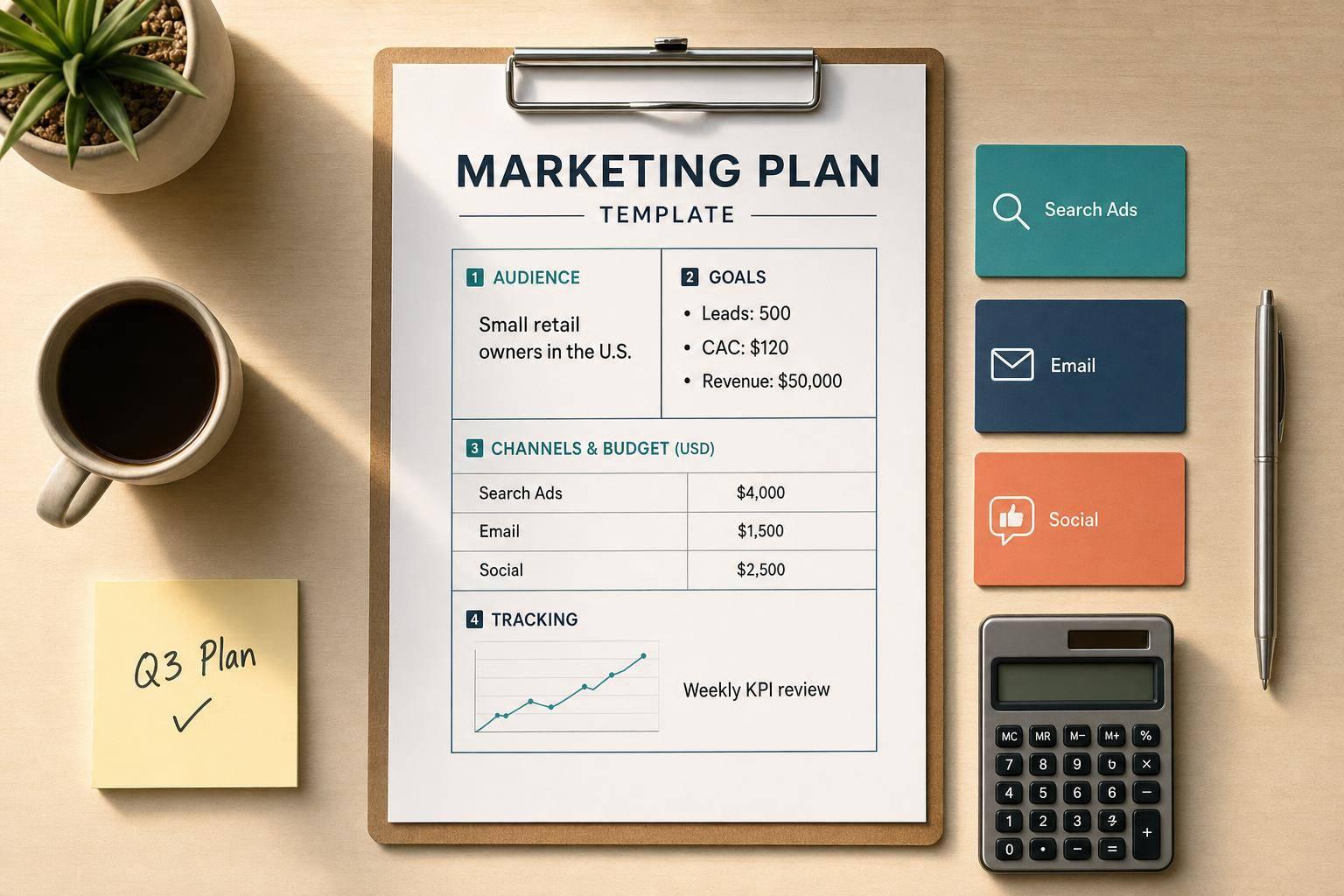
A marketing plan is simple: pick a clear audience, set a number-based goal, choose 2–3 channels, assign a monthly budget, and track results on a set schedule. If I skip any of those parts, I don’t have a plan – I just have ideas.
Here’s the short version of what matters most:
- I define who I want to reach and the problem they want solved
- I write a short message that says why my business is the better choice
- I turn “get more customers” into business goals that stick with a number and deadline
- I set a budget by channel in U.S. dollars
- I focus on a small number of channels instead of trying everything
- I use a 90-day calendar and review results each month
A few numbers from the article stand out:
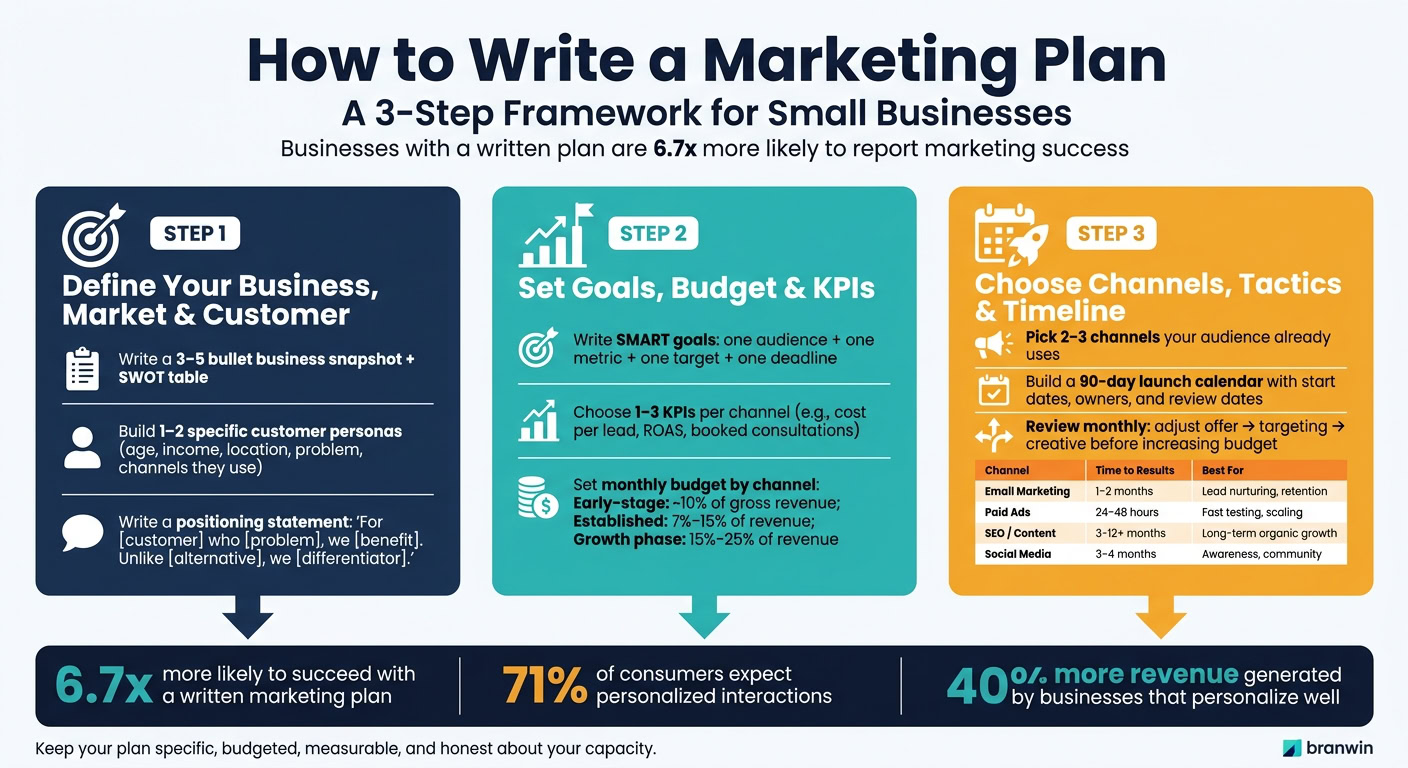
- 71% of consumers expect personalized interactions
- Companies that do personalization well can generate about 40% more revenue
- Businesses with a written marketing plan are 6.7x more likely to report marketing success
- A common starting budget range is 7%–15% of revenue for established businesses, 15%–25% for growth-stage businesses, and about 10% of gross revenue for early-stage businesses
What I like about this guide is that it keeps the job grounded. It doesn’t tell me to be everywhere. It tells me to pick fewer channels, stay consistent, and measure what leads to calls, bookings, sales, or subscribers.
If I had to sum up the whole article in one line, it would be this: a good marketing plan tells me exactly what I’m doing, how much I’m spending, and how I’ll know if it worked.
Step 1: Document Your Business, Market, and Target Customer
Before you choose a channel or write an ad, get clear on three things: what your business does, who it helps, and why someone should pick you over the other options out there. That picture shapes your audience, your message, and where your budget goes.
Write a Short Business Snapshot and Market Context
Keep your business snapshot short: 3–5 bullets is enough. Include:
- Your business type
- Your core services
- Your service area
- Whether you’re a startup, growing, or established
- One thing that sets you apart, like fast turnaround, niche expertise, or bilingual support
Then pair that with a short SWOT table. Aim for 3–5 bullets per quadrant. This gives you a simple way to look at what’s working, what’s not, where demand may be heading, and what you’re up against.
For example, a residential cleaning company in Denver might list "five-star Google reviews and flexible evening appointments" as strengths, "no email list yet" as a weakness, "growing demand for eco-friendly cleaning" as an opportunity, and "national franchises with larger ad budgets" as a threat. That kind of quick scan can help you make smarter calls on channels and budget.
Once that’s clear, move to the people your business is meant to serve.
Define Your Target Market and Customer Personas
Write one or two focused personas. Don’t try to market to everyone. That usually turns into vague messaging that doesn’t land.
Each persona should include plain, specific details:
- Age range
- Household income in USD
- Location: city, suburban, or rural
- Job role or life situation
- The exact problem they want to solve
- Where they look for answers
The more specific you are, the easier it is to decide where to advertise and what to say.
Here’s what that can look like. Say you serve property investors who need LLC help. A useful persona might be: age 35–60, income $120,000+, managing 2–15 rental properties across multiple states, unsure how to structure LLCs and stay compliant, and looking for answers on BiggerPockets forums, YouTube real estate channels, and Google searches like "LLC for rental properties." That gives you a clear read on both channel choice and message.
This matters because 71% of consumers expect personalized interactions, and companies that get personalization right generate about 40% more revenue than those that don’t. Good personas make that possible.
Those details show you where to find people and how to talk to them without sounding generic.
Write Your Positioning Statement and Core Message
Your positioning statement is for internal use. Keep it short, plain, and direct. Use this formula:
"For [target customer] who [key problem], [business name] is a [category] that [primary benefit]. Unlike [main alternative], we [key differentiator]."
For example: "For busy families in Denver who want a consistently clean home without spending weekends scrubbing, Mile High Cleaners is a residential cleaning service that provides trusted, scheduled cleanings with eco-friendly products. Unlike gig apps and one-time cleaners, we offer vetted staff, recurring plans, and satisfaction guarantees."
Next, turn that statement into a headline, subheadline, and proof points. Use the same core benefit phrase across your homepage, email subject lines, and social bios. The wording can be trimmed or expanded based on the channel, but the main promise should stay the same.
As Rick Mak, Global Entrepreneur and Business Strategist, puts it:
"By differentiating your products and services, not only can you start out in the industry strong, but you can keep being a force to be reckoned with." – Rick Mak, Global Entrepreneur and Business Strategist
If you’re unsure whether your positioning works, test two headline versions in an email or ad. One can focus on the benefit. The other can focus on the feature set. Then use the version that gets more clicks or inquiries.
Use that message as the base for your goals, budget, and channel choices in the next step.
sbb-itb-ba0a4be
Step 2: Set Goals, Budget, and Success Metrics
Once you have your business snapshot, personas, and positioning, it’s time to turn that research into a plan you can track – and pay for.
Turn Business Goals into SMART Marketing Goals
A goal like “get more clients” sounds nice, but it doesn’t help you make decisions. It’s too loose.
Each SMART goal should name one audience, one metric, one target, and one deadline. That gives you a straight line between your marketing work and a business result.
For example, a service business might set a goal like this: “Generate 40 qualified leads per month by December 31, 2026, through website forms and paid search.” A newer business that’s still building an audience might use: “Grow the email subscriber list by 1,000 contacts within six months through a free downloadable resource.” And a service business getting ready for a busy season might aim to “Increase booked consultations by 25% in Q4 2026 through social media outreach and a targeted email nurture sequence.”
Your business stage should shape your goals:
- New businesses focus on awareness and list growth
- Growing businesses focus on leads, conversion rate, and CAC or ROAS
- Established businesses also track retention and LTV
These targets shape the channels you pick next and how much money goes into each one.
Choose KPIs That Show Whether the Plan Is Working
Pick KPIs that tell you if a channel is bringing in leads, sales, or bookings. If a KPI doesn’t connect to revenue, pipeline, or customer behavior, it’s mostly noise.
A simple rule helps here: choose one to three main KPIs per channel. Then use supporting metrics to spot what’s going wrong if results dip.
The right KPIs depend on how your business makes money:
| Business Type | Primary KPIs |
|---|---|
| Service business | Qualified leads, consultations booked, lead-to-client conversion rate, cost per lead, CAC |
| Ecommerce | Conversion rate, average order value, revenue per visitor, cart abandonment rate, ROAS |
| Local business | Calls, direction requests, appointment bookings, Google Business Profile actions, review volume and rating |
For paid ads, watch cost per lead (CPL) and ROAS first. Those are your clearest signals. If clicks look strong but conversions stay low, the issue is often the landing page or the offer – not the ad itself.
Build a Monthly Budget in USD by Channel
Set a monthly budget for each channel based on your goals, expected return, and cash flow.
A common starting range looks like this:
- Established businesses: 7% to 15% of revenue
- Businesses in a growth phase: 15% to 25%
- Early-stage businesses: about 10% of gross revenue
That won’t make every choice easy, but it gives you a practical place to start.
Here’s a simple format for tracking planned spend against actual spend each month:
| Channel | Planned Monthly Spend | Actual Spend | Variance | Expected Outcome |
|---|---|---|---|---|
| Google Ads | $500 | $620 | +$120 | 15 qualified leads |
| Email software | $100 | $100 | $0 | Monthly newsletter + nurture sequence |
| Design/content support | $250 | $210 | -$40 | 4 blog posts + social graphics |
Variance matters more than people think. If a channel goes over budget and brings in strong lead results, spending more may make sense. If it goes over budget and produces nothing, that line item needs to be cut or rebuilt.
The Expected Outcome column keeps the budget tied to results, not just expenses. That’s the whole point. You’re not just buying tools or ad space. You’re paying for leads, bookings, traffic that converts, or list growth.
Start with the one channel most likely to reach the persona you built in Step 1. Then stick with it for 2 to 4 months before adding another channel. That keeps spending tight and makes results much easier to read.
Use these numbers to decide which channels and tactics you can support in Step 3.
Step 3: Choose Channels, Tactics, and a Timeline
Now that your goals, KPIs, and budget are set, it’s time to decide where to show up, what to do there, and when to do it.
Pick the Right Marketing Channels for Your Business Stage
Stick with 2–3 channels your audience already uses, your budget can handle, and your team can manage every week. That keeps things focused and easier to run.
| Channel | Cost | Time to Results | Precision | Best Use Case |
|---|---|---|---|---|
| Social media | Low to medium | Medium (3–4 months) | Medium | Brand awareness, community, visual storytelling, light demand generation |
| Email marketing | Low | Fast (1–2 months) | High | Lead nurturing, retention, repeat sales, announcements, promotions |
| SEO / content | Low to medium | Slow (3–12+ months) | Medium to high | Long-term organic discovery, authority building, high-intent search capture |
| Local partnerships | Low | Medium | High | Referrals, community trust, local growth |
| Direct outreach | Low | Fast to medium | High | B2B prospecting, one-to-one selling, local service sales |
| Paid ads | Medium to high | Fast (24–48 hours) | High | Fast testing, high-intent traffic, launch support, scaling once tracking is in place |
Use your customer’s habits and your KPI targets to narrow the list. The goal isn’t to be everywhere. It’s to pick the few places most likely to work.
For new businesses, social media, local partnerships, and direct outreach tend to make the most sense. If your business is growing, email, local partnerships, and SEO/content are often a better fit. If you’re ready to scale, paid ads can join the mix once tracking is in place.
After that, turn each channel into a repeatable tactic.
Map Tactics to Each Channel with Concrete Examples
Choosing a channel is only the first move. Each one needs a clear tactic tied to a goal.
- Social media: Run a 30-day Instagram campaign with three posts per week, one weekly Story, and one customer testimonial per month. Cadence: 2–3 hours per week. KPI: 10–20 profile inquiries per month.
- Email marketing: Send a weekly newsletter every Tuesday with one helpful tip, one customer story, and one clear call to action like "Book a free consultation." Cadence: 2–3 hours to draft and schedule. KPI: open rate, click-through rate, and consultation requests.
- Local partnerships: Identify 2–3 nearby businesses, set up a referral arrangement such as a 10% discount or free add-on service, and check in monthly. Cadence: monthly check-in. KPI: number of referrals received per partner per month.
- Paid search: Start with 5–10 high-intent keywords tied to your service and location, such as "emergency plumber near me" or "small business CPA in Austin", with a daily budget of $10–$20. Cadence: 1–2 hours per week of monitoring and optimization. KPI: calls or form fills generated per keyword.
This is where marketing starts to feel less fuzzy. Instead of saying, “We’ll do email,” you’re saying, “We send a newsletter every Tuesday, and we track consultation requests.” That’s a plan you can run.
Build a 90-Day to 12-Month Marketing Calendar
A calendar turns strategy into weekly action. For each tactic, add a start date, owner, KPI, and review date.
Use a 90-day calendar to launch, test, and review. In August 2026, launch your Instagram campaign and set up your email list. In September 2026, test a small paid search campaign with a $300–$500 budget. In October 2026, hold a scheduled review. Check which channel brought in the most leads, then shift time or budget toward it.
For the 12-month view, map your work by quarter. Use Q4 2026 for awareness and list building, Q1 2027 for lead generation, and Q2 2027 for optimization and scaling.
If a tactic misses its KPI, don’t just throw more money at it. First, confirm the shortfall. Then adjust the offer, then targeting, then creative, before increasing budget. If you test it more than once and it still falls short, move that time and spend to a channel that is hitting its goals.
Write every change directly in the calendar. Later on, that record helps you see what changed, why you changed it, and what paid off.
Marketing Plan Template and Key Takeaways
Marketing Plan Template: Copy and Fill In
Drop this template into a doc or spreadsheet, then fill it out with short, specific entries. Keep it tight. No long paragraphs. Use what you worked out in Steps 1–3 to complete each section.
| Section | Fill In |
|---|---|
| Executive Summary | Business goal and marketing priority in 2–3 sentences |
| Business Overview | What you sell, where you operate, what stage you’re in |
| Target Market | One primary customer group with demographics and key pain points |
| Positioning Statement | Why you’re different and the main benefit you deliver |
| Marketing Goals | SMART goals tied to leads, sales, or retention |
| KPIs | Specific metrics per channel (open rate, cost per lead, booked calls) |
| Budget | Dollar amounts by channel per month (e.g., $300 local ads, $100 email tools) |
| Channels | 2–3 channels |
| Tactics | Specific actions per channel with cadence and owner |
| Timeline | 90-day calendar plus a high-level 12-month view |
| Review Process | How often you check results, who reviews them, and how you adjust |
At the top, add a version number, owner name, date, and review date. It sounds small, but it saves a lot of confusion later when the plan starts changing.
What Your Plan Should Include Before You Start
Before you launch anything, make sure these six pieces are in place:
- Audience definition specific enough to guide targeting
- Core message that explains your main value in one sentence
- Goals with numbers and deadlines
- 2–3 channels
- A calendar covering at least the next 90 days
- One tracking system with one monthly reviewer assigned
If even one of these six is missing, the plan isn’t ready to run.
Key Takeaways
A marketing plan works when it is specific, budgeted, measurable, and honest about your current capacity. A 2024 small business marketing study found that businesses with a written marketing plan are 6.7 times more likely to report marketing success than those without one. That gap usually comes from focus, not complexity.
For most small businesses, the answer isn’t more channels. It’s fewer channels used with consistency.
Use the template weekly. Keep your audience definition tight, your channel list short, and your results tied to actual targets.
FAQs
How detailed should my marketing plan be?
Your marketing plan should give you a clear roadmap for your goals, audience, budget, and channels. It needs enough detail to guide action, but it shouldn’t turn into a giant document no one wants to use.
A full plan is often 15 to 20 pages. That’s usually enough space to map out the core pieces without getting lost in the weeds.
When it comes to channels, start small. Pick 2 to 4 channels, focus on one at a time, and build from there. Trying to do everything at once is a fast way to burn time and money.
As your business grows, revisit the plan often and update it to match where you are now.
What if I have a small marketing budget?
With a limited budget, put your energy into one high-ROI channel instead of trying to be everywhere at once. Spreading yourself across a bunch of platforms can drain time and money fast. A lower-cost option like social media or email marketing is often a smarter place to start, especially if you can handle the work yourself and keep spending under control.
You can cut costs in other areas too. Use DIY branding tools, or offer discounts or free products in exchange for content. That keeps overhead down while still helping you get the word out.
Once that channel starts bringing in profit, reinvest what you earn and grow step by step.
How often should I update my marketing plan?
Treat your marketing plan like a living document. It shouldn’t sit in a folder and collect dust. Go back to it often and update it as you learn what’s working and what isn’t.
A simple rhythm works well:
- Review it weekly to check campaign performance and budget allocation.
- Review it monthly to look at channel performance and make strategy adjustments.
- Review it quarterly for bigger strategy shifts or annual planning.
You should also update the plan when new information comes in. That includes findings from market research, A/B testing, and customer feedback. If the data points to a clear change, your plan should reflect it.