


A U.S. LLC alone does not create effectively connected income (ECI). I start with three checks: your tax residency, where you do the work, and whether your income connects to a U.S. trade or business.
For nonresident individuals, ECI generally faces graduated tax rates after allowed deductions. Certain other U.S.-source income faces a 30% tax on gross income, unless an exemption or treaty lowers it.
Here’s what I’ll walk you through:
- Work and business activity: How U.S. workdays, business locations, and partnership income can create ECI.
- Income type: Why investments, rental income, and real estate sales need separate checks.
- Tax and paperwork: Which expenses may reduce taxable income, how withholding works, and when Form 1040-NR or separate LLC filings may be required.
- Treaty rules: When U.S. tax treaties may limit U.S. tax – and which reporting duties may remain.
The key distinction: owing no ECI tax does not mean having no U.S. filing duties.
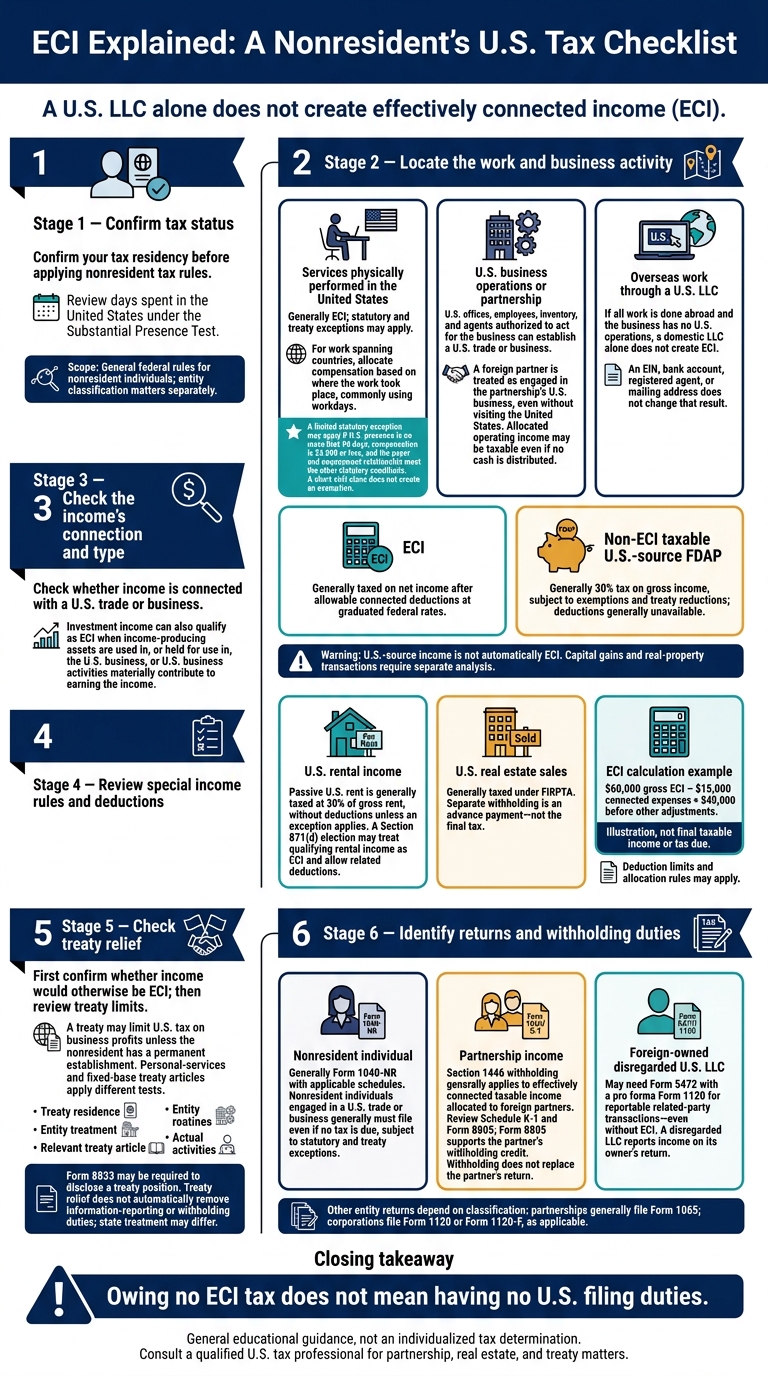
ECI Explained: A Nonresident’s U.S. Tax Checklist
What ECI Is and When It Applies
Once US taxes for non-resident entrepreneurs are understood and taxpayer status is clear, check whether the income is tied to a U.S. trade or business.
Effectively connected income (ECI) is income connected with conducting a U.S. trade or business. Start by determining whether the nonresident conducts a U.S. trade or business. Then check whether the income is directly connected to it. U.S.-source income tied to that business generally qualifies. Investment income can also qualify when U.S. business activity or assets materially produce it.
For a nonresident individual, ECI is generally taxed on a net basis at graduated federal rates. Allowable connected business expenses reduce taxable income. That differs from the 30% tax on gross income commonly applied to certain non-ECI U.S.-source payments.
Services Physically Performed in the United States
For example, a consultant performing work during a U.S. visit generally earns U.S.-source service income.
For projects that span countries, allocate compensation based on where the work took place, commonly using workdays. Keep travel logs, calendars, and time records to support that allocation.
A limited statutory exception may apply if U.S. presence is no more than 90 days, compensation is $3,000 or less, and the payer and employment relationship meet the other statutory conditions. Treaty relief needs a separate review. A short visit alone does not create an exemption.
The same rule applies when income flows through a partnership.
U.S. Business Operations and Partnership Income
U.S. offices, employees, inventory, and agents authorized to act for the business can establish a U.S. trade or business. A foreign partner is treated as engaged in the partnership’s U.S. business, even without visiting the United States.
Review Schedule K-1 and Form 8805. Section 1446 withholding generally applies to effectively connected taxable income allocated to foreign partners. The partner’s allocated operating income is taxable even if no cash is distributed.
Why a U.S. LLC Alone Does Not Create ECI
If all work is done abroad and the business has no U.S. operations, a domestic LLC alone does not create ECI.
An EIN, bank account, registered agent, or mailing address does not change that result. BusinessAnywhere’s business registration, EIN application, and virtual mailbox services help with administration – they do not determine tax treatment. Assess the LLC’s federal tax classification separately from the owner’s activities.
Use the table below to match each activity with its likely tax treatment.
| Activity | Likely ECI exposure | Potential filing duties |
|---|---|---|
| Services physically performed in the United States | Generally ECI; statutory and treaty exceptions may apply | Possible Form 1040-NR and related schedules. |
| Allocation from a partnership operating a U.S. business | Connected operating income is ECI | Partnership withholding; foreign individual’s Form 1040-NR; Schedule K-1 and Form 8805. |
| Overseas consulting through a U.S. LLC, without U.S. operations | Formation alone does not create ECI | Entity-level filing duties depend on the LLC’s classification and facts. |
sbb-itb-ba0a4be
ECI vs. Other U.S.-Source Income
U.S.-source income is not automatically ECI. Separate income connected to a U.S. trade or business from other U.S.-source income. Non-ECI fixed or determinable annual or periodical income (FDAP) is generally taxed on gross income, subject to exemptions and treaty reductions.
The distinction affects tax rates, deductions, withholding, and reporting:
| Feature | ECI | Non-ECI U.S.-source income |
|---|---|---|
| Common income types | Income connected to a U.S. trade or business | Passive dividends, interest, royalties, and rents not connected with a U.S. business |
| Tax base | Net income after allowable connected deductions | Gross income for taxable FDAP |
| Individual federal rates | Generally graduated rates | Generally 30% for taxable FDAP, subject to exemptions and treaty reductions |
| Deductions | Allowable expenses connected with earning ECI | Generally unavailable against gross-basis FDAP income |
| Withholding | Usually not subject to ordinary nonresident FDAP withholding when the payer receives a valid Form W-8ECI, though other withholding or reporting rules may apply | Generally 30% on taxable FDAP unless properly documented relief applies |
| Individual reporting | Form 1040-NR with applicable schedules, such as Schedule C, D, or E | Form 1040-NR may still be required |
This comparison applies to individuals. Capital gains and real-property transactions need separate analysis – they don’t automatically fall under the FDAP column.
Dividends, Interest, Royalties, and Capital Gains
Qualifying portfolio interest may be exempt if statutory requirements are met. Form W-8BEN documents foreign status and treaty claims.
Investment income can qualify as ECI when the income-producing assets are used in, or held for use in, a U.S. trade or business. It can also qualify when U.S. business activities materially contribute to earning that income.
Don’t assume stock-sale gains are taxable FDAP. Capital gains require a separate review of their source, and some gains are taxed only in limited cases.
U.S. Rental Income and Real Estate Sales
U.S. real estate follows its own rules. Passive U.S. rent is generally taxed at 30% of gross rent, with no deductions for repairs, mortgage interest, or depreciation unless an exception applies.
A nonresident may elect under Section 871(d) to treat qualifying rental income as ECI and deduct related expenses.
U.S. real property sales are generally taxed under FIRPTA. Separate withholding applies, but it counts as an advance payment – not the final tax.
Calculating ECI and Filing Tax Returns
Once income qualifies as ECI, subtract allowable deductions and determine which tax return to file.
Net Income, Deductions, and Partnership Withholding
Example: $60,000 gross ECI minus $15,000 of connected expenses leaves $45,000 before other adjustments.
Deduct only expenses directly tied to ECI, and keep records: receipts, invoices, contracts, mileage logs, payroll records, and proof of payment. Separate personal costs and expenses tied to exempt or non-ECI income. Use a reasonable basis to allocate shared costs. Capitalization, business-interest, at-risk, and passive-activity rules may limit deductions.
Partnerships must withhold under Section 1446 on ECI allocated to foreign partners. They use Forms 8813, 8804, and 8805 to pay and report that withholding. Partners then use Form 8805 to claim the withholding credit on their returns. Withholding is not the final tax, and it does not replace the partner’s return.
Form 1040-NR and Separate LLC Filing Duties
The correct return depends on the taxpayer’s status and the entity’s classification. Start by identifying who earned the income and how the entity is classified. Nonresident individuals generally file Form 1040-NR, partnerships file Form 1065, and corporations file Form 1120 or Form 1120-F. A disregarded LLC reports income on its owner’s return. Nonresident individuals engaged in a U.S. trade or business generally must file even if no tax is due, subject to statutory and treaty exceptions.
Check the IRS Form 1040-NR instructions for deadlines, extensions, estimated payments, and timely-filing rules that protect deductions. A foreign-owned disregarded U.S. LLC may also need to file Form 5472 with a pro forma Form 1120 for reportable related-party transactions – even without ECI.
Tax Treaties and Permanent Establishment Rules
After sorting out the income and filing rules, check whether a treaty reduces or eliminates U.S. tax. First, confirm that the income would otherwise be ECI. A treaty may limit U.S. tax on business profits unless the nonresident has a permanent establishment. Personal-services and fixed-base treaty articles apply different tests.
Check treaty residence, entity treatment, the relevant article, and actual activities against the IRS tax treaty resources. Disclose treaty positions on Form 8833 when required. A protective Form 1040-NR may preserve the ability to claim deductions or treaty benefits if later facts show a filing obligation. Treaty relief does not automatically remove information-reporting or withholding duties, and state tax treatment may differ.
Conclusion: Review Your Activities, Income, and Filing Duties
Once you’ve classified your income and checked treaty limits, review your U.S. filing duties.
ECI depends on U.S. business activity and the income’s connection to it – not simply forming a U.S. LLC. It’s generally taxed on net income after allowable deductions. Even without ECI, you may still have separate U.S.-source tax, withholding, or information-reporting duties.
Consult a qualified U.S. tax professional for partnership, real estate, and treaty matters.
Use this checklist to separate ECI from other U.S. tax obligations:
- Residency status: Confirm your tax status, including days spent in the United States under the Substantial Presence Test.
- Work location: Document your U.S. workdays.
- U.S. operations: Note any U.S. offices, employees, inventory, or agents.
- Partnership income: Review allocated ECI and withholding.
- Income type: Separate ECI from income taxed under other rules.
- Connected deductions: Gather expense records that support your deductions.
- Treaty claim: Confirm your residence and the applicable treaty article.
- Required filings: List all required filings, including Form 1040-NR and any Form 5472 with a pro forma Form 1120.
FAQs
Do U.S. clients make my overseas income ECI?
No. Having U.S. clients alone does not make your overseas income effectively connected income (ECI). For services, what matters is where you physically do the work – not where your clients live or do business.
If you work outside the United States and have no U.S. trade or business presence, such as an office, U.S.-based employees, or dependent agents, your service income is generally foreign-sourced and not subject to U.S. federal income tax.
Can working during a U.S. vacation create ECI?
Yes. Working during a U.S. vacation can create effectively connected income (ECI). The IRS bases the source of service income on where you physically perform the work. That means work you do while in the United States may generate U.S.-source income.
If those activities are part of a continuing trade or business, they could count as engaging in a U.S. trade or business. The related earnings may then be subject to U.S. federal income tax.
What if I discover unreported ECI from prior years?
If you find unreported effectively connected income (ECI) from prior years, talk to a qualified tax professional. You may need to amend past tax returns to report that income correctly.
Failing to report ECI or file required information returns – such as Form 5472 for foreign-owned LLCs – can lead to penalties exceeding $25,000 per year. Taking steps to address the issue now helps you meet U.S. tax requirements.