
I’d start with Wise for international client transfers and currency conversion, or Payoneer for supported marketplace payouts. Before applying, check whether each service supports your country of residence, business activity, and payment sources. A US LLC for non-residents alone does not guarantee approval.
I’d compare the full payment path: receiving money, holding currencies, paying suppliers, and withdrawing to a bank account – not just the advertised fee.
Quick Comparison
| What I’d check | Wise Business | Payoneer |
|---|---|---|
| Main use | Client bank transfers and currency conversion | Marketplace payouts and eligible client payments |
| Currency costs | Mid-market exchange rate plus a quoted fee | Conversion may include an exchange-rate markup |
| Setup and recurring fees | Check current setup pricing | Check registration, annual, and account-specific fees |
| Documents | LLC records, EIN, owner ID, and physical address proof | LLC records, tax details, owner ID, and requested address proof |
| Access to funds | Supported bank transfers and card options | Bank withdrawals, supplier payments, and card options |
Small fee differences add up: a 1% cost difference on $10,000 is $100. I’d compare the amount delivered after all fees, then confirm receiving details, withdrawal routes, and card access.
<u>Address checks and LLC compliance are separate issues.</u> I’d prepare matching documents, avoid using a registered agent address as proof of physical location, and keep tax filings and state duties separate from either payment account.
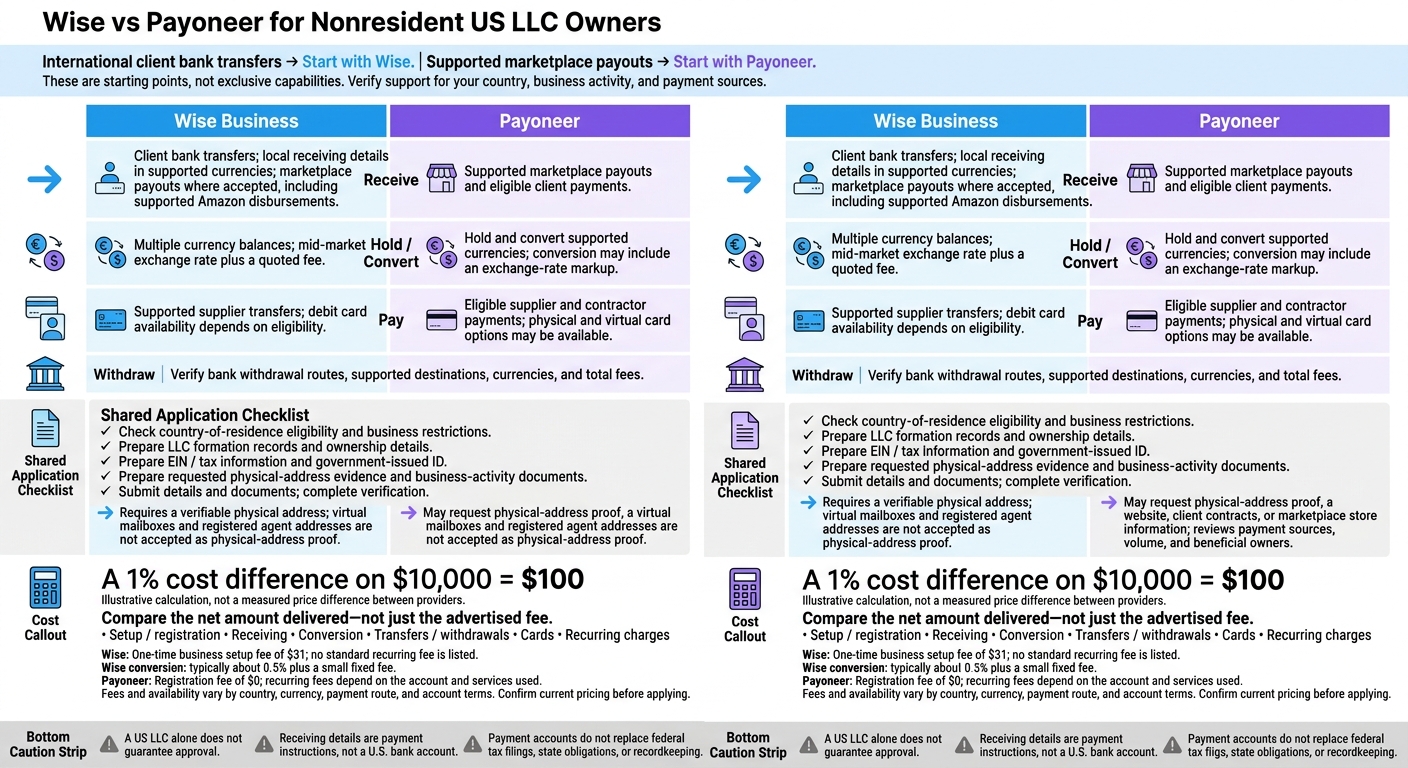
Wise vs Payoneer for Nonresident US LLC Owners
Wise Business: Opening and Using an Account
Wise Eligibility and Required Documents
Eligibility depends on your country of residence, not just your LLC’s US registration. Before applying, check Wise’s current supported countries and business restrictions. You’ll need a verifiable physical address – Wise doesn’t accept virtual mailboxes or registered agent addresses.
Your verification documents must support that address and your LLC’s business activity. Describe what your business does in specific terms rather than using a generic description.
How to Apply for Wise Business
Once you’ve confirmed eligibility, open a personal Wise profile and apply for a business account. Enter your LLC’s legal name, EIN, address, business description, and ownership details. Then upload the requested documents and submit your application. The entire process takes place online.
Wise Payments, Currency Conversion, and Withdrawals
Once approved, Wise is best suited to LLCs that receive client payments, hold currency balances, and move money across borders. You can use local account details to collect eligible client payments in supported currencies. Wise also supports Amazon marketplace disbursements and lets you hold multiple currencies, converting funds when needed.
You can pay suppliers and transfer balances to bank accounts through supported payment routes. A Wise debit card may also be available, but delivery requires a valid US mailing address. Transfer limits can reach $2 million.
Wise uses the mid-market exchange rate and typically charges about 0.5% plus a small fixed fee. Check your account’s pricing for setup, receiving, conversion, transfers, withdrawals, cards, and recurring fees.
Keep proof of address ready for verification. If Wise flags an address issue, users typically have 5 to 10 business days to provide an accepted physical address and proof of address.
Next, compare Payoneer’s payout and marketplace tools with Wise’s transfer and currency features.
sbb-itb-ba0a4be
Payoneer: Opening and Using an Account
Payoneer supports marketplace payouts, client payments, and supplier transfers. For nonresident owners, the starting point is where your payments come from: marketplaces, clients, or both.
Nonresident-owned US LLCs can qualify, but approval depends on your country of residence, business activity, and incoming payment sources. Payoneer also reviews monthly payment volume and beneficial owners. Not every country or business type qualifies.
Payoneer Eligibility and Required Documents
Have your government-issued ID, LLC formation documents, EIN or tax information, and ownership details ready. Payoneer may also ask for proof of your physical US address.
To check your business activity, Payoneer may request a website, a clear description of your business, client contracts, or marketplace store information.
How to Apply for a Payoneer Business Account
Create an account, enter your LLC and owner details, upload the requested documents, and complete verification.
Payoneer Payouts, Client Payments, and Withdrawals
You can receive funds through marketplace payouts or eligible client payments. Once funds arrive, you can hold and convert currencies, pay suppliers and contractors, or withdraw to a bank account. Keep your bank details ready for withdrawals. Card options may include physical and virtual cards.
Fees vary by country, so check the current fee schedule before applying. Currency conversion may include an exchange-rate markup. Payoneer often costs more than Wise, especially for currency conversion. Pay close attention to these differences when comparing fees, currency handling, and withdrawal access.
Wise vs Payoneer: Features and Fees Compared
Compare each service against how your LLC receives, converts, and sends money. Then check the total cost, not just the advertised fee.
| Feature or cost | Wise Business | Payoneer Business |
|---|---|---|
| Eligibility | Approval depends on country support and verification. | Approval depends on country support and verification. |
| LLC and EIN requirements | Formation records, EIN, and ownership details. | Formation records, EIN or tax info, and ownership details. |
| Identity and address checks | Requires a physical address. | Requires identity and business verification. |
| Direct client payments | Best for bank-to-bank client transfers. | Supports eligible client and business payments. |
| Marketplace payouts | Supported where marketplaces accept your receiving details. | Best for supported marketplace payouts, including Amazon. |
| Currencies and receiving details | Multiple currency balances and local receiving details for supported currencies. | Multiple supported currencies and receiving accounts for major currencies. |
| Conversion fees | Uses the mid-market rate with low fees. | Conversion usually includes a markup. |
| Supplier payments and withdrawals | Transfer funds to supported supplier and bank accounts. | Send eligible supplier payments and withdraw to linked bank accounts. |
| Withdrawal fees | Vary by currency, destination, and transfer method. | Vary by bank location, currency, and withdrawal route. |
| Registration or setup | One-time business setup fee of $31. | Registration fee of $0. |
| Monthly or annual charges | No standard recurring fee is listed. | Recurring fees depend on the account and services used. |
| Receiving fees | Vary by currency and payment rail; local transfers and wires have different fees. | Vary by payment source, method, currency, and account terms. |
| Review risks | Address mismatches or verification requests can interrupt access. | Business verification requests may delay access. |
Terms vary by non-resident LLC and country. Advertised prices aren’t offers of approval.
For client payments, marketplace payouts, or supplier spending, use the table below to narrow your options.
Which Service Fits Your Payment Needs?
| Payment need | Better starting point | What to verify |
|---|---|---|
| International client transfers | Wise for direct bank transfers and transparent conversion pricing. | Sending currency, transfer rail, and receiving fees. |
| Marketplace payouts | Payoneer for supported marketplace connections. | Marketplace acceptance and payout currency. |
| Currency conversion | Compare Wise’s mid-market pricing with Payoneer’s quoted rate. | Net amount delivered for the same transfer. |
| Supplier payments | Compare both against the supplier’s receiving requirements. | Supported destination, payment method, and total delivery cost. |
| Card spending | Choose only after confirming card availability. | Issuance, conversion, and ATM charges. |
Receiving details are payment instructions, not a U.S. bank account.
Conclusion: Choose Based on Your LLC’s Transactions
After comparing features and fees, focus on how your LLC gets paid. Match the account to your payment flow: Wise suits low-cost cross-border transfers and currency balances. Payoneer suits marketplace payouts and supplier payments.
Before applying, check eligibility, required documents, and how you’ll withdraw funds. Account access helps you handle payments – it doesn’t cover your filing duties.
Payment Accounts Do Not Replace LLC Compliance
Neither service handles your LLC’s federal tax filings, state obligations, or recordkeeping. Foreign-owned U.S. disregarded entities with reportable transactions must file Form 5472 with a pro forma Form 1120.
Keep payment records, and track state filings and registered agent renewals separately from your payment account.
FAQs
Can my LLC use both Wise and Payoneer?
Yes, your LLC can use Wise and Payoneer at the same time. You can use Wise for its competitive currency conversion rates and Payoneer for its marketplace integrations.
Having both accounts also gives you more options for global payments. If one service is temporarily unavailable, the other can serve as a backup for paying suppliers and receiving client funds.
Can I withdraw LLC funds to a personal bank account?
Yes, both Wise and Payoneer let you transfer LLC funds to your personal bank account. Fees and processing times depend on the platform.
Payoneer withdrawals to local bank accounts typically cost up to 2% and follow standard banking timelines. They aren’t instant like transfers between Payoneer accounts. Wise generally charges a small fixed fee plus a percentage of the transfer amount.
What happens to my funds during an account review?
Unresolved issues during an account review, such as incorrect address documents, can lead to account suspension or closure. That can disrupt both client and contractor payments.
If your account is suspended, contact support immediately and submit the required information, including a verifiable physical address and proof of residency. Once you’ve provided valid information and resolved the compliance check, account access is typically restored within 5 to 10 business days.