


If my LLC works in another state, I may need to register there before I start. That step is called foreign qualification. It does not create a new LLC. It means my current LLC gets permission to do business in another state.
Here’s the short version:
- If I have an office, workers, property, or inventory in another state, registration is often required.
- If I skip it, I may face state fees, penalties, back filings, and in some states I may not be able to sue there until I fix it.
- The filing usually asks for a Certificate of Authority, a registered agent, and often a Certificate of Good Standing.
- After approval, I still may need annual reports, tax accounts, payroll setup, and withdrawal filings if I later leave that state.
In other words: the hard part is not just filing once. It’s knowing when I must register and then keeping up with each state’s rules after that.
A few facts stand out from the article:
- Some states use clear tests. For example, Mississippi notes that 30 days of employee presence in a year can trigger a closer look.
- Annual or biennial report fees in some states can be more than $300.
- A one-time project may not trigger registration, but repeated in-state work often does.
My quick check is simple: if the business has a steady in-state footprint, I should review that state’s LLC rules before I start work there.
| Situation | Likely result |
|---|---|
| Office, warehouse, or storefront in another state | Registration often needed |
| Employees or workers based there | Registration often needed |
| Property or inventory in that state | Registration often needed |
| One-time visit or short isolated project | May not require registration |
| Remote work with no in-state footprint | Depends on state rules |
The rest of the article walks through the same path I’d follow in practice: figure out if my activity counts as doing business, file the state forms, and then keep both states up to date.
How to Determine Whether Your LLC Must Register in Another State
Start with one question: does your LLC count as “doing business” in the other state?
That’s the test. To answer it, compare the state’s rule with what your business actually does there. Look at the facts on the ground:
- physical locations
- employees
- property
- inventory
- recurring work
- contracts
- project length
This gives you a fast first check. If the facts are fuzzy, confirm them with the state or a business attorney. Once you line up your activity with the state’s definition, it becomes easier to sort your setup into likely trigger or likely exception.
Activities That Commonly Trigger Foreign Qualification
In most cases, ongoing in-state activity points toward registration. A one-off transaction usually does not.
The clearest example is opening a staffed office, storefront, or warehouse in another state. Other common triggers include owning or leasing business property, storing inventory at an in-state fulfillment center, hiring employees who regularly work from that state, and performing recurring in-person services like installation, repair, or consulting visits.
Longer local projects can also push an LLC into registration territory. For example, if a New York consulting LLC sends employees to manage a six-month construction project in Pennsylvania, that’s a strong reason to check Pennsylvania’s foreign-entity rules. The work is recurring, local, and physically done there. Mississippi’s Secretary of State guidance gives another useful clue: employee presence totaling 30 days in a year can raise a registration issue, which shows that some states rely on clear thresholds, not just broad wording.
Activities That May Not Require Registration
Some activities are less likely to require registration, but they are not automatic safe harbors.
A one-time sale, occasional meeting, short visit, isolated project, or conference attendance usually makes a weaker case for registration than steady local operations. Remote work done entirely outside the destination state for an out-of-state client may also fall outside the rule, depending on how that state reads its statute.
Mississippi’s guidance is a good example. It lists activities that do not automatically count as transacting business: maintaining legal proceedings, internal governance meetings, bank accounts, independent-contractor sales, qualifying order solicitation, and an isolated transaction completed within 30 days. Still, the exact statutory language – and any agency reading of it – in the destination state is what controls the answer.
Decision Examples for Small Business Owners
Use the chart below as a quick gut check for common business setups.
| Activity | Likely Outcome | State-Specific Rule to Verify |
|---|---|---|
| Office, storefront, or warehouse | High – strong indicator | Whether maintaining a place of business is listed as transacting business |
| In-state employees or remote workers | High – frequently a trigger | Whether employee presence, minimum days, or work type creates a registration duty |
| Owned or leased business property | High – continuing local presence | Whether property ownership or leasing qualifies as doing business |
| Inventory stored in-state or with a fulfillment center | High – especially with regular sales | Whether inventory storage or third-party fulfillment is covered or exempt |
| Recurring in-person services | High – commonly treated as transacting business | Whether service frequency, location, or profession-specific licensing matters |
| Long-term local project | Moderate to high – increases with duration | Whether project duration or physical performance creates a registration duty |
| One-time or isolated project | Low – may qualify for an exception | The state’s exact definition of "isolated transaction" and any time limit |
| Occasional meeting or conference | Low – weak indicator by itself | Whether solicitation or repeated visits change the analysis |
| Remote work for an out-of-state client | Fact-dependent | Where work physically occurs and whether local personnel or operations exist |
A few examples make this easier to picture:
- E-commerce seller: An Illinois apparel LLC ships products from its Illinois warehouse directly to customers nationwide. Once inventory sits in a California fulfillment warehouse, the registration issue gets much more serious.
- Consultant: A Massachusetts technology consultant completes a single virtual engagement for a client in Maine. Repeated on-site visits or a year-long Maine implementation would give the owner a much stronger reason to check Maine‘s foreign-entity rules.
- Real estate investor: A Delaware LLC owns and manages a rental property in North Carolina. Property ownership plus ongoing local management is a stronger sign of continuing in-state activity, so the owner should review North Carolina’s foreign-LLC rules and any property-management licensing rules.
- Digital nomad: An LLC owner temporarily works from another state while serving clients elsewhere. The key facts are where the work is physically done, how long the owner stays, whether local contracts are signed, and whether separate payroll or income-tax duties apply apart from foreign qualification.
Keep a written log of employee work locations, project length, property and inventory locations, and how often transactions happen. If the activity triggers registration, follow a checklist for multi-state foreign qualification to begin the filing steps.
sbb-itb-ba0a4be
How to Prepare and File Foreign Qualification Paperwork
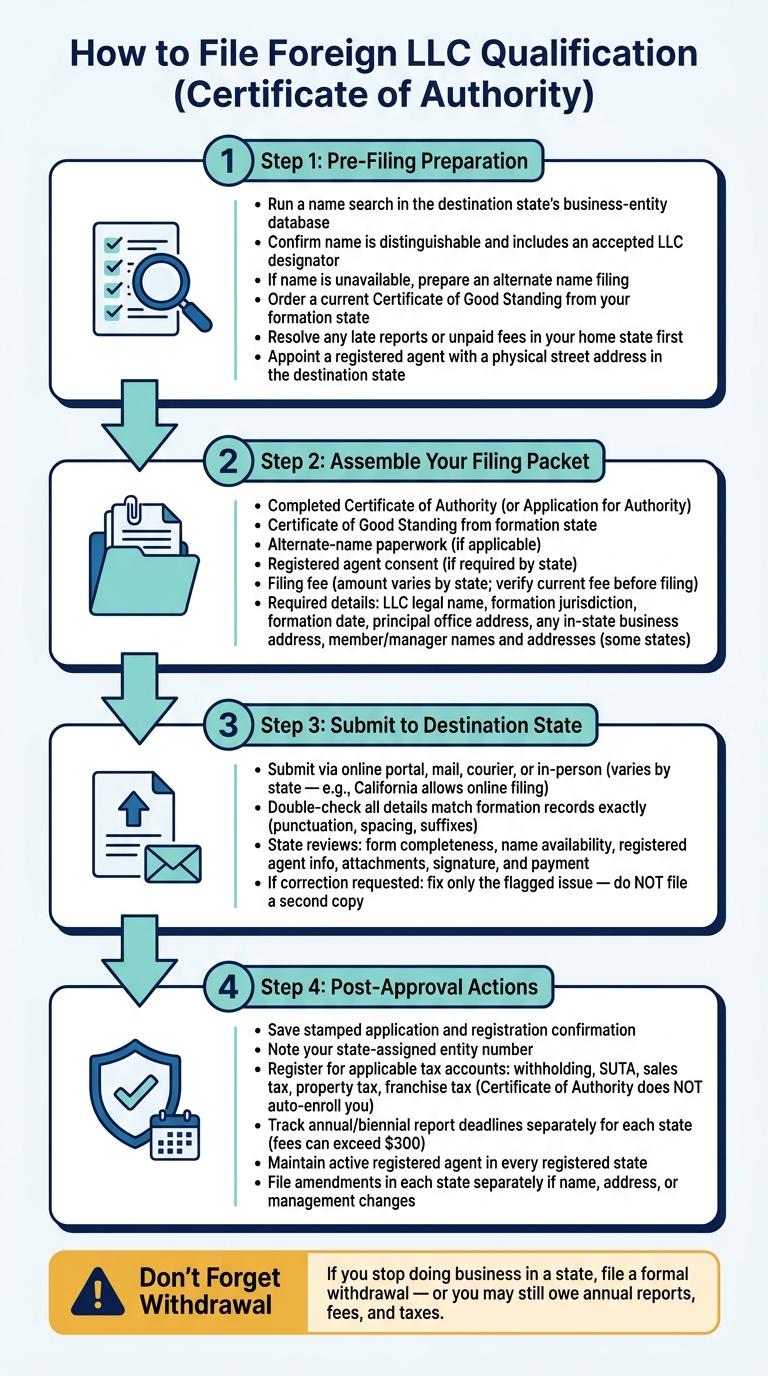
Foreign LLC Qualification: Step-by-Step Filing Process
Once you know your LLC needs to register, the next step is filing the destination state’s foreign-qualification paperwork. The form is often called a Certificate of Authority, Application for Authority, or something close to that. The process usually starts with a name check, then moves into pulling together your LLC details, registered-agent information, and proof that your company is in good standing.
Here’s the full path from prep to post-approval records:
| Filing stage | Required document or information | State office involved |
|---|---|---|
| Document preparation | Certificate of Authority or similar application; legal name; formation state; principal office; member or manager details; registered-agent information | Destination state business-entity office |
| Supporting records | Current Certificate of Good Standing, alternate-name filing, registered-agent consent, or other state-specific attachments | Formation-state entity office and destination-state entity office |
| Submission and payment | Completed and signed filing, attachments, filing fee, and approved payment method | Destination state Secretary of State or equivalent |
| Approval and recordkeeping | Approved registration, stamped application, state-assigned entity number, and compliance-calendar information | Destination state business-entity office |
Documents and Information States Typically Require
Start with a name search in the destination state’s business-entity database before you fill out anything. Your LLC’s legal name usually needs to be distinguishable from names already on file and include an accepted LLC designator. If the name isn’t available, you’ll need to file under an alternate name and then use that name the same way everywhere, including on filings, contracts, and invoices.
Many states also ask for a current Certificate of Good Standing from your formation state. It’s smart to order that close to your filing date so it doesn’t expire before the state reviews your paperwork. If your home-state record shows late reports or unpaid fees, take care of those first.
The application itself usually asks for:
- Your LLC’s exact legal name
- Formation jurisdiction
- Date of formation
- Principal office address
- Any in-state business address
- The name and physical street address of your registered agent in the destination state
Some states also ask for member or manager names and addresses, your business purpose, and how long the LLC will exist. Set up your registered agent before you complete the form because that information goes straight into the application. And yes, states usually want a physical street address, not a P.O. box.
How to Submit the Certificate of Authority and Pay State Fees
Put together one filing packet with the completed and signed application, your Certificate of Good Standing, any alternate-name paperwork, registered-agent consent if the state asks for it, and the filing fee. Before you send it in, check every detail against your formation records. Even small mismatches in punctuation, spacing, or suffixes can trigger a rejection.
States don’t all handle filing the same way. California permits online filing through its business filing portal; other states accept mail, commercial courier, or in-person delivery. Fees change by state, so check the current amount and accepted payment methods with the Secretary of State before you file.
After you submit, the state reviews the form, name availability, registered-agent details, attachments, signature, and payment. If something is missing or your name doesn’t work, the office will send a correction request. Fix the exact issue they flagged and don’t file a second copy. Processing times and rush options vary, so look up the current schedule before you send anything. Once the filing is approved, keep the stamped application and registration confirmation with your company records. Approval gets you in the door, but the state will still expect future reports and registered-agent upkeep.
How to Stay Compliant in Both Your Formation State and Foreign State
Once your foreign qualification is approved, the work doesn’t stop. Your LLC now has to stay on top of filings, tax registrations, and withdrawal rules in each state where it is registered.
In practice, that means compliance usually falls into three separate buckets: entity filings, tax registrations, and withdrawal filings.
Annual Reports, Registered Agent Updates, and State Records
Each state where your LLC is registered has its own filing rules for keeping your status active. In most cases, that means filing an annual or biennial report and paying a fee that can top $300.
The tricky part? Deadlines often don’t line up.
Your formation state might base the deadline on your original LLC approval date, while the foreign state may use a fixed date on the calendar. That’s why it helps to track each state on its own, instead of assuming one deadline covers everything.
Your registered agent also has to stay active in every state where your LLC is registered. The agent must be available during business hours and listed with a valid physical street address. If a legal notice gets missed, you could face penalties or lose good standing.
And if your LLC changes its name, address, management, or registered agent, you usually need to file separate amendments in each state. An update in your formation state does not automatically update the records in your foreign state.
Entity upkeep is only part of the job. Tax and payroll rules are a separate issue and need their own review.
Tax and Employer Registrations That May Apply Separately
A Certificate of Authority gives your LLC permission to do business in the state. That’s all it does. It does not sign you up for withholding, unemployment, sales, property, or franchise tax.
If your LLC has employees working in the foreign state, you’ll likely need to register there for state income tax withholding and State Unemployment Tax (SUTA). If you own or lease property in that state, store inventory there, or make taxable sales, you may also trigger sales tax, property tax, or franchise tax duties.
Some states use economic nexus rules too. So even if you don’t have a physical office there, crossing a revenue threshold can still create a tax filing duty.
After approval, reach out directly to the state tax and labor agencies to confirm which accounts your LLC needs.
How to Withdraw When You Stop Doing Business in a State
If your LLC later stops doing business in a state, you’ll need to end the registration with a formal withdrawal or cancellation filing.
Just walking away isn’t enough. If you stop operating without filing, the state may still treat your registration as active. That means you can still be on the hook for annual reports, fees, and tax filings.
Before a withdrawal is approved, many states require you to catch up on any past-due reports and fees.
After the withdrawal goes through, close any tax or employer accounts tied to that state. It’s also smart to keep a forwarding address on file in case notices show up after your exit. And save copies of the withdrawal filing and payment confirmation with your compliance records.
Conclusion: Expand Your LLC Without Missing State Requirements
Your LLC only needs to register as a foreign LLC if the new state sees your activity as doing business there. In plain English, the big thing is whether you have a real, steady presence in that state. Physical presence and repeated business activity are usually what tip the scale.
The most common triggers are easy to spot: an office, employees, owned or leased property, or inventory stored in the state. If one of those applies, the next move is filing a Certificate of Authority. But here’s the part people sometimes miss: approval is just the start. It opens the door to more compliance work, not less. Your formation state and each foreign state can all have their own annual reports, fees, and registered agent rules, often on different schedules.
Before you file or start operating, run through this quick check:
- Confirm whether your activity counts as doing business in that state
- Check name availability, or file an assumed name if needed
- Get a current Certificate of Good Standing if the state requires it
- File the Certificate of Authority and appoint a registered agent with a physical street address
- Register for any tax, payroll, and licensing accounts you need
Check the destination state’s rules before you begin operations. Fees, deadlines, and filing triggers can change from state to state.
FAQs
Do I need foreign qualification for online sales?
Usually, no. If your online sales are occasional or limited, and you don’t have much of a presence in that state, you often won’t need to register there.
But that can change fast if your activity counts as doing business in the state.
That often includes things like:
- Going over economic nexus thresholds, such as $100,000 in sales or 200 transactions within 12 months
- Having employees in the state
- Operating a physical office or warehouse there
- Doing repeated client work in the state
The key point: don’t assume you’re exempt just because you sell online. State rules vary, and small details can make a big difference. Check that state’s rules before relying on an exception.
Can one remote employee trigger registration?
Yes. Hiring even one W-2 remote employee who lives and works in another state can trigger foreign registration.
Many states see an employee’s presence as a meaningful connection, or nexus, and as a clear sign that your business is operating there. Since the rules change from state to state, check the filing requirements in the state where the employee lives.
What happens if I register late?
Registering late for foreign qualification can get expensive fast. You may owe back taxes, interest, and daily late fees that keep piling up.
There’s also a legal downside. Your business can lose the right to use state courts to enforce contracts. And in some states, the penalties go further: officials may freeze bank accounts, revoke permits, or even hold officers personally liable.
The good news is that these problems can often be fixed. But fixing them usually means registering late and paying everything you owe, which often costs more in the end.