

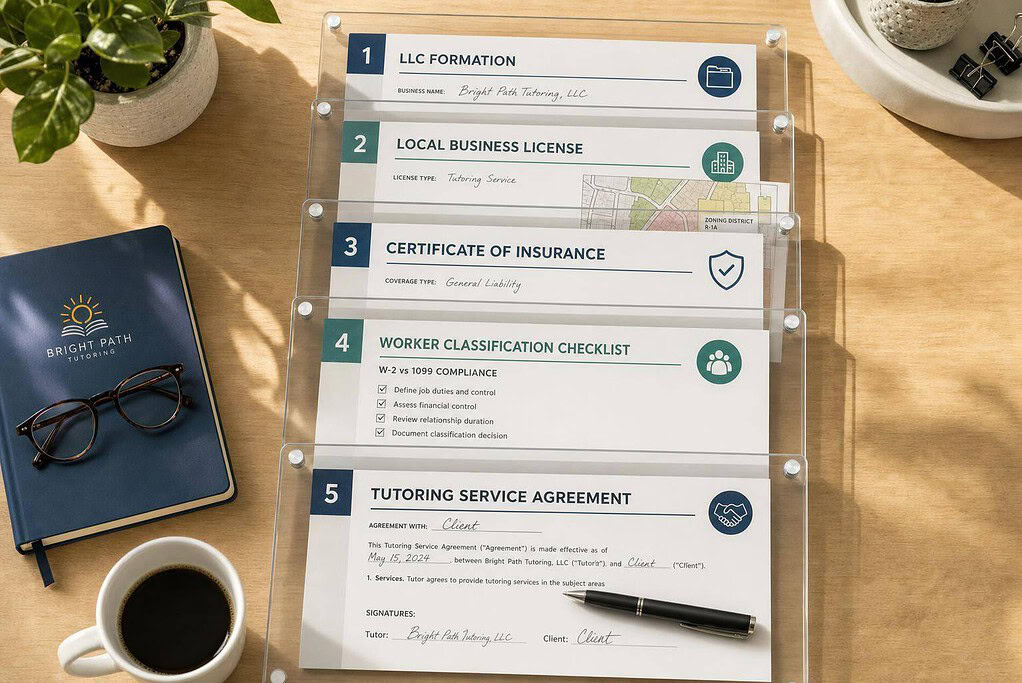
If I want to start a tutoring business LLC, I need to handle four things first: form the LLC, check local licenses, buy insurance, and set up my records and contracts. That’s the short answer.
Here’s the part many people miss: an LLC does not give me permission to operate, and it does not replace insurance. In most cases, there is no national tutoring license, so I need to check rules at the state, city, and county level. And if I hire people, worker classification can affect taxes, payroll, and insurance from day one.
Before I take my first paid session, I should make sure I have:
- LLC formation documents on file
- An EIN if needed for banking, payroll, or tax use
- A separate business bank account
- Local approvals like a business license, tax registration, or home-occupation permit
- Insurance such as general liability and professional liability
- Worker paperwork for employees or contractors
- Signed client agreements and a basic data-handling plan
A few facts stand out:
- A single-member LLC is usually disregarded for federal tax purposes unless I elect another tax treatment
- A multi-member LLC is usually taxed as a partnership unless it elects corporate treatment
- Form I-9 must be collected by an employee’s first day of work, and Section 2 must be finished within 3 business days
- Many tutors working from home still need zoning or home-occupation approval, even for online services
Bottom line: if I skip licensing, insurance, or worker setup, the LLC alone will not fix that. The safest path is to set up the company, confirm local rules, insure the business, and lock down paperwork before launch.
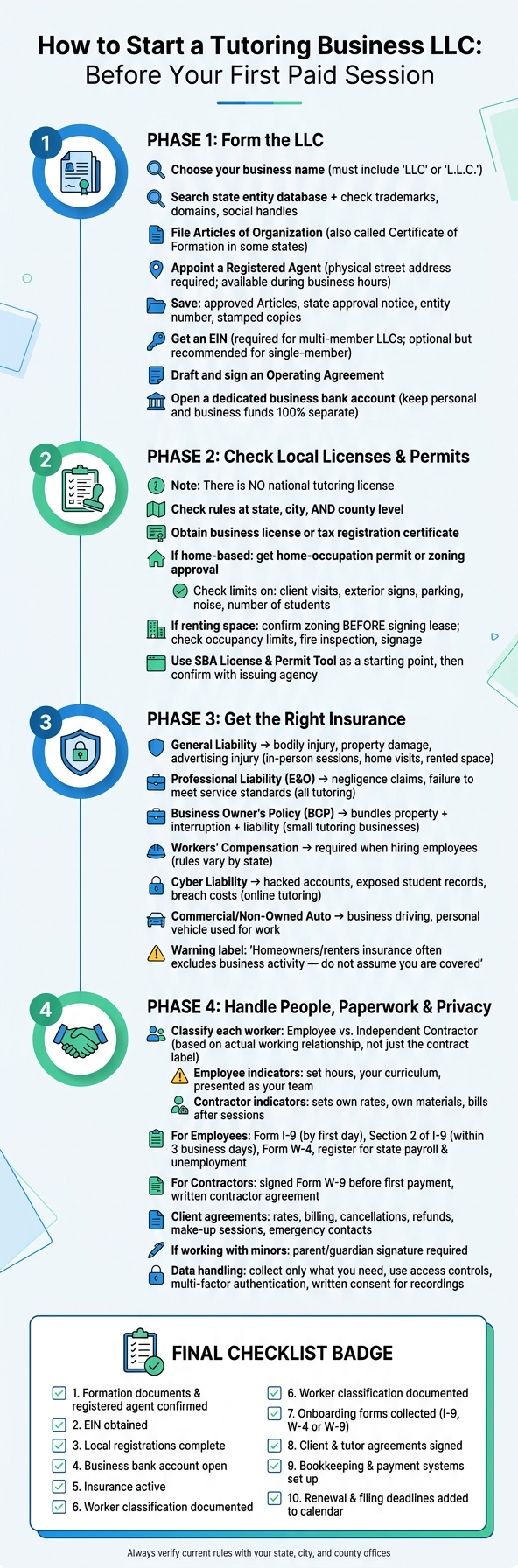
How to Start a Tutoring Business LLC: Step-by-Step Setup Guide
Choose the LLC Structure That Fits Your Tutoring Business
Pick the LLC setup that lines up with how you teach, where you work, and whether you bring in other people. A single-member LLC is usually disregarded for federal tax purposes. A multi-member LLC is usually taxed as a partnership unless it elects corporate treatment.
That said, an LLC is not a shield against everything. It still won’t protect you from negligence, personal guarantees, or sloppy mixing of personal and business money. Keep a separate business bank account, sign contracts in the LLC’s legal name, maintain records, and carry the right insurance.
Once you’ve nailed down the structure, the next move is filing the LLC and setting up your tax and banking basics.
Pick Your Business Name, State, and Operating Format
Before you file, search your state’s business-entity database. Then check federal trademark records, domain names, and social media handles before you lock in your brand. Your LLC name must include a required designator such as "LLC" or "L.L.C." If the name you use in public is different from the legal name of the LLC, file a DBA with the right state, county, or city office. A DBA only registers the name. It does not create a separate legal entity or add liability protection.
Form the LLC in the state where you actually do business. Filing in another state does not erase registration or tax duties in the state where you teach.
Your operating format matters more than many people expect. Whether you teach online, from home, in a tutoring center, or at a client’s location will affect the licenses, zoning rules, and insurance you need. It can also shape later compliance steps, so define it before you file.
Solo Owner, Employees, or Contractors: How Your Staffing Model Changes Your Obligations
Your staffing setup affects taxes, payroll, insurance, and recordkeeping. Each worker needs to be classified as either an employee or an independent contractor under IRS rules.
Here’s the key point: calling someone a "contractor" in a written agreement or sending them a Form 1099 does not settle it. Federal guidance looks at the working relationship itself, including control, pay, and the nature of the relationship, not just the label on the paperwork.
The table below shows how each model changes your duties:
| Business model | Control and relationship | Payroll obligations | Insurance impact | Core records |
|---|---|---|---|---|
| Solo LLC | Owner controls instruction and runs the business personally | No employee payroll; owner handles applicable income and self-employment taxes | General liability and professional liability coverage, plus any home-based or online operation risks | Formation documents, operating agreement, client contracts, invoices, and insurance documents |
| LLC with employees | LLC controls schedules, curriculum, pricing, and performance expectations | Payroll setup, wage-and-hour compliance, tax withholding, payroll filings, unemployment registration, and employee tax forms | Workers’ compensation may be required; general and professional liability limits may need to increase | Hiring forms, Form I-9, Form W-4, payroll and time records, tax filings, and workers’ compensation documents |
| LLC using independent contractors | Contractors control meaningful aspects of how they perform services and operate independently | No employee withholding when properly classified; collect Form W-9 and complete required information reporting | Confirm contractors carry their own professional and general liability coverage; consider additional-insured requirements | Written contractor agreements, Form W-9, invoices, payment records, and certificates of insurance |
Get this wrong, and the cost can sting. Misclassifying a worker can lead to back wages, payroll taxes, penalties, and benefit claims. If the line feels blurry – for example, a tutor uses your lesson plans, works the schedule you assign, and shows up to clients as part of your team – document how you reached your classification decision and get tax or employment advice before moving ahead.
Once your staffing model is set, move on to formation filings, tax registration, and banking.
sbb-itb-ba0a4be
Form the LLC and Complete the Core Registrations
Once you know if you’ll work solo, hire employees, or use contractors, it’s time to form the LLC and handle the main registrations. Get any federal tax ID you need, and set up a clear line between business money and personal money before you take on clients.
File Your Formation Documents and Appoint a Registered Agent
The document that creates your LLC is usually called the Articles of Organization. In some states, it’s named Certificate of Formation or Certificate of Organization instead. It usually asks for your LLC’s legal name, principal business address, registered agent details, management structure, and business purpose. For a tutoring business, a broad purpose statement like "educational tutoring and related instructional services" is usually enough unless your state wants more detail.
Every LLC must name a registered agent with a physical street address in the state where you form the business. That person or service must be available during normal business hours to receive lawsuits and state notices. A P.O. box by itself usually doesn’t meet the rule. If you teach from home, a registered-agent service can help keep your home address off public records.
After the filing goes through, download and save the approved Articles of Organization, the state approval notice, your entity number, and any stamped copies. Store them in a secure digital folder, and keep a paper copy too.
Get an EIN, Create an Operating Agreement, and Open a Business Bank Account
A multi-member LLC usually needs an EIN. A single-member LLC with no employees doesn’t need one for federal income-tax reporting, but getting one can still help with banking and privacy. Apply straight through the IRS for free.
Your Operating Agreement is an internal document that spells out who owns the LLC, how decisions get made, how profits and losses are handled, and what happens if you add another owner or shut the business down. The SBA recommends having one even if your state doesn’t require it. Sign and date it, keep it with your formation records, and update it after any major ownership change.
To open a business checking account, bring:
- Approved Articles of Organization
- EIN confirmation
- Operating Agreement
- Government-issued photo ID
Some banks may also ask for a business license or DBA certificate. Put all tutoring revenue into the business account, and pay all business expenses from that same account. Mixing personal and business funds is asking for trouble. Keeping them separate helps protect the LLC’s liability shield.
Once the LLC is funded and your records are in place, check local approvals and insurance before launch.
Set Up Ongoing Compliance From Day One
Start tracking recurring filings right away. Missing them can lead to penalties or even administrative dissolution. Build a compliance calendar the same week you file, then verify every deadline on your state’s Secretary of State website. Save proof of each submission as you go.
| Compliance Task | Frequency | Notes |
|---|---|---|
| Annual or biennial report | Annual or every 2 years | Fees and due dates vary by state |
| Registered-agent renewal | Annual | Confirm the agent’s address stays current |
| Address, member, or manager updates | As changes occur | File amendments promptly with the state |
After the state filings are done, check local licenses, permits, and insurance before you start teaching.
Check Licenses, Permits, and Insurance Before You Start Teaching
Forming the LLC is only the first step. Before you start teaching, check the local rules that apply to your setup. Approvals and insurance can shift based on where you work, how you teach, and whether you hire anyone. A solo online tutor working from home may face one set of rules. A tutoring center with staff may face another.
The simplest way to think about it: confirm local approvals first, then line up insurance with your day-to-day setup.
Verify Business Licenses, Home-Occupation Rules, and Facility Approvals
Most tutoring businesses don’t need a state tutoring license. But many cities and counties still require a business license, tax certificate, or tax registration. The exact rules depend on your city, county, and state. The SBA recommends checking license and permit rules where the business operates.
Home-based tutoring can still trigger local rules. In some places, you may need a home-occupation permit or zoning approval. It’s smart to ask the city or county zoning office about limits on:
- Client visits
- Exterior signs
- Parking
- Noise
- Employee activity
- The number of students allowed at one time
Even if you tutor online, rules may still tie back to your business address or home office. That catches people off guard all the time.
If you plan to rent space for a tutoring center, confirm zoning approval before you sign the lease. Then check occupancy limits, fire inspection rules, signage rules, and whether the landlord allows your use. It’s a lot easier to sort this out before you commit than after you’ve signed paperwork and paid a deposit.
A good path is to contact the state business-registration office first, then the city or county licensing department, and then the state Department of Revenue or Taxation. You can use the SBA’s License & Permit Tool as a starting point, but always confirm final rules and renewal dates with the issuing agency.
Choose the Right Insurance Based on How You Teach and Who You Hire
Once you know what local approvals you need, choose insurance that fits the way you actually run the business. Coverage should match your operating model. If you teach online, meet students in person, rent classroom space, or hire tutors, your risk profile changes. The table below lays out the main coverage types and the risks they usually address.
| Coverage Type | Risk It Addresses | When It Usually Applies | Questions to Ask an Insurance Professional |
|---|---|---|---|
| General liability | Student or visitor bodily injury, property damage, and advertising injury | In-person sessions, tutoring-center operations, home visits, rented classrooms, or customers visiting a business location | Are student injuries, premises claims, and off-site sessions covered? |
| Professional liability (errors and omissions) | Claims that tutoring services were negligent, inaccurate, or failed to meet agreed standards | Academic tutoring, test prep, educational consulting, and specialized instruction | Are tutoring services, test preparation, curriculum advice, and allegations involving minors covered? |
| Business owner’s policy (BOP) | Bundles business property, business interruption, and liability coverage | Small tutoring businesses with eligible premises and equipment | Does the policy include business interruption, equipment, and off-premises property? |
| Workers’ compensation | Employee work-related injury, disability, or death under applicable state law | When the business hires employees, subject to state rules and exemptions | When does coverage become mandatory, and are part-time tutors included? |
| Cyber liability | Hacked accounts, ransomware, exposed student records, and breach-response costs | Online tutoring platforms, payment systems, cloud storage, and electronic records | Are notification, restoration, legal, and social-engineering losses covered? |
| Commercial auto / hired and non-owned auto | Vehicle-related liability while conducting business | Tutors drive to sessions, transport materials, or use personal vehicles for business errands | Is personal-vehicle use covered, and are student rides allowed? |
One point matters here: general liability is not the same as professional liability. If a student trips in your space, that’s one kind of risk. If someone claims your tutoring service fell short of agreed standards, that’s another.
Also, homeowners’ or renters’ insurance often excludes business activity. So if you teach from home, don’t assume your personal policy has you covered. Tell the insurer exactly how the business works. That includes whether tutors enter homes, transport students, or teach under your LLC’s brand.
Ask for written answers about minors, abuse or molestation claims, in-home instruction, transportation, online instruction, subcontracted tutors, and one-on-one sessions.
Hiring, Contracts, and Launch Tasks to Handle Before Day One
Once your LLC is set up and your licensing and insurance are in place, there’s one more piece to lock down before launch: people, paperwork, and privacy. Handle these items before you take your first payment.
Classify Tutors Correctly and Collect the Right Onboarding Documents
Worker status turns on the actual working relationship, not whatever title you put in the agreement.
Start with the basics. Who sets the schedule? Who provides the materials? Who assigns the students? Can the tutor work for other clients?
A tutor who sets their own rates, uses their own materials, and bills you after finished sessions looks more like an independent contractor. A tutor who works set hours, follows your curriculum, and is presented to families as part of your team looks more like an employee. If the answer still feels muddy, you can ask the IRS for a determination with Form SS-8. That call affects the forms you collect, your payroll setup, and the terms in your agreements.
Once you classify the worker, gather the right documents.
For employees:
- Collect a completed Form I-9 no later than the first day of work.
- Complete Section 2 of the I-9 within three business days of the employee’s first day.
- Collect Form W-4 for federal income tax withholding.
- Register for state payroll and unemployment accounts.
- Check whether your state requires workers’ compensation coverage.
For contractors, get a signed Form W-9 before you issue any payment. You’ll also want a written contractor agreement that spells out scope of work, rates, invoicing, confidentiality, student safety rules, and insurance requirements.
Use Written Agreements and Protect Student Data
Before the first session, put a signed client agreement in place. It should cover rates, billing, cancellations, refunds, make-up sessions, emergency contact rules, and any promises about results.
If you work with minors, a parent or guardian should sign. You’ll also want emergency contacts, pickup authorization, and consent for recordings or testimonials.
If you offer online tutoring or keep digital records, data handling needs attention before launch, not after. For student data, including session notes, recordings, and shared files, collect only what you need for scheduling, instruction, billing, and emergencies. Keep records in systems with access controls. Don’t send sensitive student information through personal email accounts. Use multi-factor authentication on any platform that stores student data.
If you plan to record virtual sessions, decide on that policy upfront. Get written consent from the right party, explain why you’re recording, state how long recordings will be kept, and limit who can view them. You should also check whether your state requires all-party consent for recording. FERPA and COPPA apply only in some situations, so review your role, the tools you use, and any school contracts tied to your services.
Conclusion: Your Before-Launch Checklist for a Tutoring Business LLC
Before you accept your first paid session, review this checklist:
| Task | Details |
|---|---|
| Formation documents and registered agent confirmed | Approved formation documents saved; registered agent current (see the benefits of professional services) |
| EIN obtained | If needed for banking, payroll, or tax administration |
| Local registrations complete | Business license, tax registration, home-occupation or zoning clearance, and facility approvals if needed |
| Business bank account open | Personal and business funds fully separated |
| Insurance active | General liability, professional liability, workers’ compensation if required |
| Worker classification documented | Written basis for employee or contractor decision for each tutor |
| Onboarding forms collected | I-9 and W-4 for employees; W-9 and signed agreement for contractors |
| Client and tutor agreements signed | Before any services begin |
| Bookkeeping and payment systems set up | Invoices, receipts, and refund workflow confirmed |
| Renewal and filing deadlines added to calendar | Annual reports, tax filings, payroll deadlines, insurance and license renewals, and contract reviews |
One last thing: this setup fits your business as it stands today. If you later hire employees, open a physical location, serve clients in another state, or add a new service format, go back through every item on this list. New states, new locations, and new staffing setups can each trigger new registration, tax, insurance, and compliance duties.
FAQs
Do I need an LLC to start tutoring?
No. You can start a tutoring business as a sole proprietorship, which is the default setup for many independent tutors.
That said, forming an LLC is often a smart move. It helps separate your personal assets from business debts or legal issues. It can also give your business more credibility, offer tax flexibility, and provide better long-term protection as you grow.
What licenses do online tutors usually need?
Online tutors usually need a general business license from their city or county. In some cases, you may also need a state sales tax permit, depending on where you operate and what services you offer.
If you’re a certified teacher or counselor, the rules can get a bit more specific. Some states may require you to set up a PLLC and hold certain professional certifications. It’s also smart to check whether your state requires registration for educational services and whether local zoning rules apply if you run your business from home.
When does a tutor count as an employee?
A tutor counts as an employee when you hire them to work for your business. Once that happens, legal and tax duties kick in.
You’ll need an EIN, state payroll tax registration, unemployment insurance registration, and, in most cases, workers’ compensation insurance when you hire your first employee.