


When expanding your business into a new state, two terms often come up: Certificate of Authority and Foreign Qualification. While they’re closely related, they’re not the same. Here’s the quick breakdown:
- Foreign Qualification: This is the process of registering your business to legally operate in another state.
- Certificate of Authority: This is the document you receive after completing the foreign qualification process, proving your business is authorized to operate in that state.
Failing to follow these steps can lead to fines, back taxes, and even legal troubles. Here’s what you need to know:
- Foreign Qualification: Required if your business has a physical presence, employees, or meets certain financial thresholds in a new state.
- Certificate of Authority: Often needed to open bank accounts, sign contracts, or hire employees in the new state.
- Key Filing Details: Most states require a Certificate of Good Standing, registered agent info, and a filing fee (ranging from $70 to $750).
Skipping these steps can result in penalties like daily fines, back taxes, and losing the ability to enforce contracts in that state. Staying compliant ensures smooth operations and avoids unnecessary complications.
Quick Comparison:
| Feature | Foreign Qualification | Certificate of Authority |
|---|---|---|
| Definition | Process of registering in a state | Document proving authorization |
| Purpose | Ensures legal compliance | Proof of legal operation |
| Who Handles It | Business owner files | Issued by the Secretary of State |
| Duration | One-time process | Must be renewed annually |
Understanding these terms and the filing process can save your business from costly mistakes. Let’s dive into the details.
What Is a Certificate of Authority?
A Certificate of Authority (COA) is an official document issued by a state’s Secretary of State, granting your business the legal right to operate within that state. Essentially, it confirms that your business complies with local laws and regulations.
This certificate is the outcome of the foreign qualification process. It allows your existing LLC or corporation to legally conduct business in a new state without having to form a separate entity. Your business remains the same – you’re simply expanding its legal presence to another jurisdiction.
Some states might refer to it as an "Application for Registration" or "Foreign Registration Certificate", but the purpose is the same. Knowing these alternate terms can help you navigate the process more smoothly when filing in multiple states.
Required Information for Filing
To obtain a Certificate of Authority, you’ll need to provide specific details about your business. This information helps the state verify your company’s legitimacy and ensures they can contact you for legal or administrative purposes.
| Required Information | Description |
|---|---|
| Legal Business Name | The name registered in your home state (or a DBA if the name is unavailable). |
| Home State & Formation Date | The state where your business was formed and the date of incorporation. |
| Principal Office Address | The main mailing address or headquarters of your business. |
| Registered Agent Info | The name and physical address of your registered agent in the new state. |
| Business Purpose | A brief explanation of what your business will be doing in the new state. |
| Officers/Managers | Names and addresses of those managing or governing the business. |
Most states also require a recent Certificate of Good Standing from your home state to confirm your business is in compliance there. Processing times vary but generally take between 5 to 10 business days. If needed, expedited services can shorten this to 1 to 3 days.
Why Businesses Need This Document
A Certificate of Authority is more than just a legal requirement – it’s essential for conducting business smoothly in a new state. For example, without it, you may face challenges opening local bank accounts, securing financing, or even hiring employees legally. Many financial institutions insist on a COA before allowing you to open an account or apply for loans.
Additionally, hiring even one remote employee in another state can trigger the need for a COA due to remote work tax nexus rules. This document also allows your business to:
- Sign legally binding contracts.
- Participate in government contract bids.
- Obtain professional or local licenses.
Failing to secure a Certificate of Authority can lead to hefty fines, back taxes with interest, and restrictions on your ability to defend your business in court. It’s a critical step to ensure your operations remain compliant and protected.
Next, we’ll dive into the specific steps and details required to file for this important document.
sbb-itb-ba0a4be
What Is Foreign Qualification?
Foreign qualification refers to the process of registering your business so it can legally operate in a state other than the one where it was originally established. In the context of U.S. business law, "foreign" doesn’t necessarily mean international – it simply refers to any state outside your business’s home state. Haley R. Ayure from Buchanan Ingersoll & Rooney PC explains:
"The term ‘foreign,’ when used in the corporate context, does not necessarily mean from another country… any entity that is not organized in a particular state is deemed a ‘foreign’ entity".
For example, if you formed an LLC in Delaware but want to operate in Texas or California, you’d need to qualify your business in those states. The Glencoyne Editorial Team likens this to "a permission slip" that allows your business to expand into new states.
Certain activities trigger the need for foreign qualification. For instance, having a physical location in another state or surpassing economic nexus thresholds – commonly $100,000 in sales or 200 annual transactions (or $500,000 in states like California, New York, and Texas) – requires registration.
However, not all business operations require foreign qualification. If your activities are limited to interstate commerce, such as shipping products to customers in other states without maintaining a local presence, you’re generally exempt. Other exemptions include maintaining a bank account, defending a lawsuit, or conducting isolated transactions completed within 30 days.
Knowing when foreign qualification is necessary helps you avoid unnecessary filings while ensuring compliance where it matters.
The Foreign Qualification Filing Process
If you determine that foreign qualification is required, here’s how to proceed:
- Evaluate Your Nexus: Start by identifying whether your business has established a sufficient connection (nexus) to the state requiring registration. Running quarterly sales reports by state can help you monitor when you approach economic thresholds in new jurisdictions.
- Obtain a Certificate of Good Standing: This document, issued by your home state, confirms that your business is in compliance there. Most states require it to be issued within 30 to 90 days before submitting your foreign qualification application.
- Appoint a Registered Agent: You’ll need a registered agent in the new state – someone with a physical address (not a P.O. box) who is available during business hours to accept legal documents on your behalf. Registered agent services typically cost $100–$300 annually per state.
- Submit Your Application: File your foreign qualification application with the Secretary of State in the new state. Filing fees vary widely, from around $70 in Colorado to more than $750 in Texas. Standard processing usually takes 5–10 business days, though expedited options are available. Some states, like New York, may have additional steps, such as publishing a notice in local newspapers for six consecutive weeks.
What Happens If You Don’t File
Skipping the foreign qualification process can lead to serious penalties and legal problems. In California, for instance, the penalty for willfully failing to qualify is $250, plus an additional $20 for each day your business remains unregistered. These daily fines can quickly escalate into a significant financial burden.
Beyond fines, you could face back taxes with interest for the entire period of non-compliance. States may also revoke your ability to defend your business in court. Amanda Hayes, an attorney at the University of North Carolina School of Law, cautions:
"A court will delay or dismiss your lawsuit if the defendant objects because you didn’t qualify your business in the state".
This means you could lose the ability to enforce contracts or protect your business interests through legal action.
Non-compliance can also damage your reputation and hinder growth opportunities. Venture capital firms and potential acquirers might interpret a failure to qualify as poor management, which could jeopardize funding or acquisition deals. Banks may refuse to open accounts, lenders could deny loans, and you might be unable to secure necessary local licenses or permits. The risks far outweigh the relatively modest cost of proper registration.
Next, we’ll explore how these requirements compare to the Certificate of Authority to clear up common misunderstandings.
Certificate of Authority vs Foreign Qualification: How They Differ
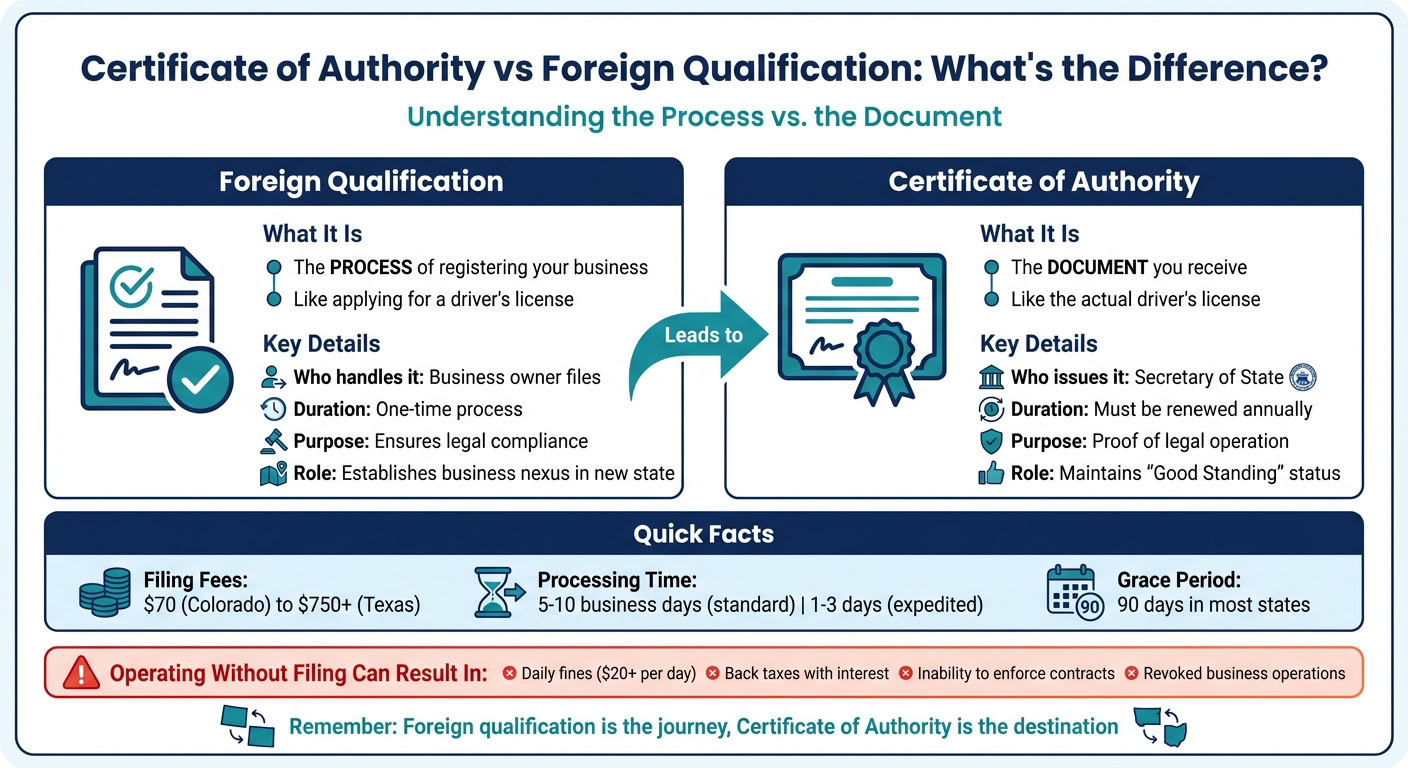
Let’s break it down: foreign qualification is the process of registering your business to operate in another state, while the Certificate of Authority is the document you receive after completing that process. Think of it like applying for a driver’s license – the application process is foreign qualification, and the license you get is the Certificate of Authority.
Haley R. Ayure, an attorney at Buchanan Ingersoll & Rooney PC, makes an important point:
"A certificate of authority is not the same as forming a new entity in another state." – Haley R. Ayure, Attorney, Buchanan Ingersoll & Rooney PC
Why does this matter? Filing for a new entity in another state creates a separate legal entity, which can complicate your taxes and governance structure.
Side-by-Side Comparison
| Feature | Foreign Qualification | Certificate of Authority |
|---|---|---|
| Definition | The process of registering a business in a new state | The official document that allows a business to operate legally |
| Purpose | Ensures legal compliance and establishes "nexus" | Serves as proof of the right to conduct business |
| Who Files It | Business owner or authorized representative | Issued by the Secretary of State after approval |
| Duration | A one-time registration process | Must be renewed annually to remain active |
| Role in Compliance | The step to avoid penalties and fines | Maintains the business’s "Good Standing" in the new state |
This table highlights the key differences, but confusion between the two terms is still common.
Common Confusion Between the Two
One of the biggest misunderstandings is treating these terms as interchangeable. To make things trickier, some states refer to the Certificate of Authority as a "Certificate of Registration". It’s also a common mistake to skip the foreign qualification process entirely and instead form a new entity in the other state. While this might seem like a shortcut, it creates separate legal entities with different tax IDs, annual filings, and governance requirements – leading to unnecessary complexity and higher costs.
Timing is another critical factor. Most states allow a 90-day grace period from the time you start doing business to complete the foreign qualification process. After that, late fees kick in. For instance, in Texas, operating for more than 90 days without registering can result in a late fee equal to the registration fee for each year of delinquency. The standard processing time for foreign qualification is usually 5–10 business days, but expedited options can reduce this to as little as 1–3 days.
Filing Requirements and Staying Compliant
Once you’ve successfully completed foreign qualification and obtained your Certificate of Authority, the journey doesn’t end there. Compliance becomes an ongoing responsibility in both your home state and every state where your business is registered. This means juggling various deadlines, fees, and regulations across multiple jurisdictions.
What Proper Filing Enables
Filing correctly does more than check a box – it legitimizes your business in the eyes of the state. Your Certificate of Authority acts as proof that you’re legally allowed to operate in that jurisdiction. With it, you can apply for local business licenses, sign commercial leases, and enter into vendor agreements without legal hurdles.
Penalties for Non-Compliance
Skipping foreign qualification can lead to more than just fines – it can jeopardize your entire operation. Jack Nicholaisen, Founder of Businessinitiative.org, warns:
"Operating without foreign qualification is illegal… You can’t enforce contracts in that state [and] you face penalties and fines." – Jack Nicholaisen, Founder, Businessinitiative.org
States don’t take non-compliance lightly. Take Texas as an example: while the state offers a 90-day grace period for businesses to register, missing this deadline means paying late fees equal to the annual registration fee for every year of non-compliance. Beyond fines, the Attorney General can issue an injunction, effectively halting all business operations in the state.
The ripple effects of non-compliance don’t stop there. Unregistered businesses may encounter banking issues, delays in funding during investor reviews, and scrutiny during audits. States may also demand retroactive filings with accumulated penalties, making delayed compliance far more costly than handling it on time.
These risks underscore why staying compliant is not just a legal necessity but also a smart business move.
Maintaining Compliance After Filing
Compliance doesn’t end with filing – it requires regular attention. Most states mandate annual reports, with fees ranging from $0 to $300 per year. Additionally, you must maintain a registered agent with a physical address in each state, typically costing $100 to $300 annually per state. Missing deadlines for these requirements could result in your Certificate of Authority being revoked.
To stay on top of these obligations, consider using a centralized tracking system. This should include details like state-issued entity numbers, annual report deadlines, filing fees, and links to state portals. Many businesses also rely on top registered agent services, which often provide automated reminders for upcoming deadlines. These tools not only help maintain your legal standing but also save you from the headaches – and costs – that come with falling behind.
Conclusion
Foreign qualification is essential when expanding your business into a new state, while the Certificate of Authority serves as proof that you’re legally allowed to operate there. These aren’t separate choices – they work together as part of the same process.
Failing to meet these requirements can lead to steep fines and legal complications. Non-compliance not only brings financial penalties but also creates issues during investor evaluations and may even undermine your ability to enforce contracts in that state. As one expert highlights:
"Foreign qualification is not just a legal requirement, it’s a signal of expansion." – File Business
Each state has its own rules and associated costs, making it crucial to understand the specific obligations where you plan to operate. Beyond avoiding penalties, staying compliant demonstrates your business’s growth and professionalism to potential investors.
Keeping track of ongoing fees and administrative deadlines is equally important. A simple centralized system, like a spreadsheet, can help you stay organized and ensure you maintain your Certificate of Authority without interruptions. Missing deadlines can risk your compliance status, so vigilance is key.
FAQs
What counts as “doing business” in another state?
"Doing business" in another state generally refers to more than just having an office or employees there. It includes activities like maintaining regular client relationships, engaging in repeated transactions, or establishing a consistent operational presence. Essentially, it involves significant and ongoing business operations within that state.
Do I need foreign qualification for remote employees or online sales?
Whether you need foreign qualification depends on what your business does, not just having remote employees or selling online. If your activities align with a state’s definition of "doing business" – such as running a physical office, employing staff, or surpassing certain sales limits – you’ll probably need to file. On the other hand, limited activities like occasional sales or internal tasks might not trigger this requirement. Be sure to review each state’s specific rules to stay compliant.
How do I keep a Certificate of Authority active each year?
To keep your Certificate of Authority active, you need to file an annual report with the state authority before the first day of your business’s anniversary month. If the state offers an online filing system, use it to streamline the process. Make sure to pay all required fees on time to avoid complications. Staying on top of these filings is crucial to keep your certificate in good standing.