

If I run my business in a state where it was not formed, I may need to register there before I keep working. If I do not, I could face fines, back taxes, and I may lose the right to bring a lawsuit in that state until I fix the filing.
Here’s the short version:
- A Certificate of Authority lets my LLC or corporation do business in a state outside its home state.
- This is called foreign qualification. It does not create a new company.
- I may need it if I:
- hire a W-2 employee in another state
- open an office, store, or warehouse
- store inventory there, including Amazon FBA stock
- own or lease property there
- do repeat in-state client work under long-term contracts
- I usually do not need it for:
- a one-time sale
- a trade show visit
- a bank account by itself
- many 1099 contractor setups
A few numbers stand out. Filing fees can run from $50 to $750. Many states want a Certificate of Good Standing dated within 60 to 90 days of filing. And if I wait too long, back fees and taxes can climb into the five figures.
Quick comparison
| Topic | What it means |
|---|---|
| Certificate of Authority | State approval for an existing LLC or corporation to work in another state |
| Foreign qualification | The filing process to get that approval |
| New entity formation | Setting up a separate LLC or corporation with its own EIN and records |
My rule of thumb is simple: if my business has people, property, or repeat contract work in another state, I should check that state’s rules before I keep operating there.
sbb-itb-ba0a4be
What a Certificate of Authority Is
A Certificate of Authority is a state-issued document that gives an LLC or corporation the legal right to operate in a state other than the one where it was originally formed. Put simply, it’s state approval to do business in a state where the company was not formed.
This process is called foreign qualification. In U.S. business law, foreign means the company was formed in another state, not another country. From there, the key issue is whether what you’re doing in that state counts as doing business there.
Foreign qualification means registering an existing company in another state
Here’s a simple example. If a Delaware LLC starts hiring employees and opens an office in Texas, it does not create a second LLC in Texas.
Instead, it applies for a Certificate of Authority in Texas. That filing registers the existing Delaware LLC as a foreign entity that can operate there, following a checklist for multi-state foreign qualification. The company stays the same company. It just gets legal permission to do business in one more state.
A Certificate of Authority is not the same as forming a new entity
This part trips people up. Foreign qualification does not create a new business entity. It registers the same company in another state.
Your original LLC keeps its EIN, ownership, and home state status. The only change is that it now has permission to operate in the new state.
When You Need a Certificate of Authority
If your business has an ongoing presence in another state, you usually need to register for foreign qualification there. A one-off deal usually doesn’t set off registration. The main issue is simple: does your activity amount to doing business there on a steady basis?
Common triggers: employees, offices, inventory, and regular client work
The clearest triggers are physical presence and employment. If you open an office, storefront, or warehouse in another state, you need to register there. The same goes for hiring even one W-2 employee who lives and works in that state, even if you don’t have a physical office.
Inventory is another big one, and it’s easy to miss. If your products sit in a local warehouse or an Amazon FBA fulfillment center in another state, that physical presence can count as doing business there. Owning or leasing real property in another state also triggers registration.
Regular client work inside a state can also create a filing duty. If you’re repeatedly soliciting orders, signing contracts, or delivering services there, that can be enough. A long-term service contract in a state where your company isn’t registered is usually a trigger.
Here are the most common situations:
| Activity | Requires Certificate of Authority? |
|---|---|
| Opening a physical office or store | Yes |
| Hiring a W-2 remote employee | Yes |
| Storing inventory in a local warehouse or Amazon FBA fulfillment center | Yes |
| Owning or leasing real property | Yes |
| Recurring service contracts in-state | Yes |
| Using 1099 independent contractors | Usually no |
| Attending a trade show or conference | No |
| Maintaining a bank account only | No |
| Isolated, one-time sale | No |
How remote businesses and digital nomads can assess their risk
If you run a remote business, start with three things: people, property, and recurring contracts. That’s the cleanest way to size up risk. Look at every state where your company has employees, physical assets or inventory, or repeat contract work. If any of those show up in a state, that’s where your registration risk usually sits.
For remote businesses, the issue isn’t that sales happen online. It’s whether your work starts to look local in another state. Pure online sales from a distance usually don’t trigger registration. The risk goes up when your operation has a local footprint, like a payroll employee, a warehouse, or a long-term client contract in that state.
If any of those apply, file in that state before you keep operating there.
How to File for a Certificate of Authority
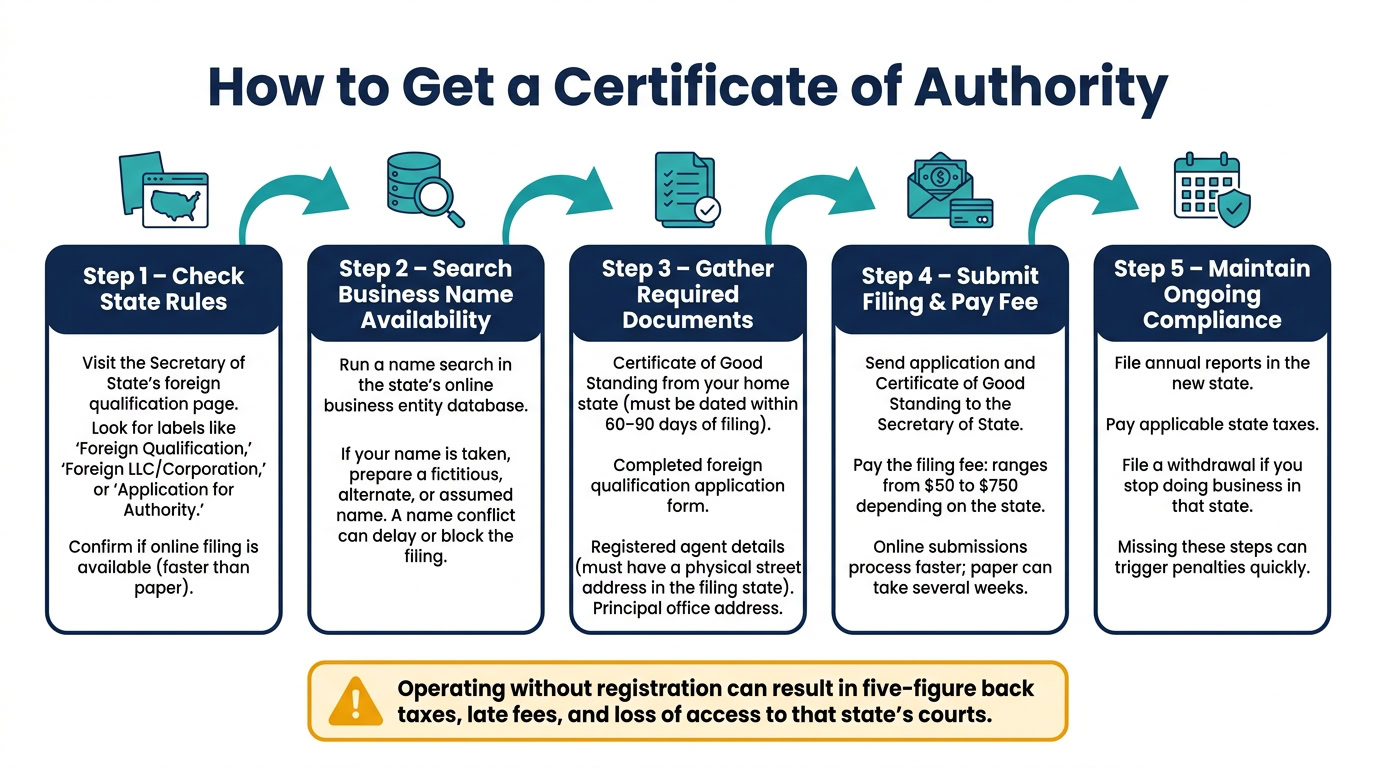
The process looks pretty similar in most states. The details change – mainly the forms and filing fees – but the path is usually the same once you know registration is required.
Check the state’s rules before you file
Start on the Secretary of State‘s foreign qualification page. You’ll usually find what you need under labels like "Foreign Qualification", "Foreign LLC/Corporation," or "Application for Authority."
Before you do anything else, check whether your business name is available. If another company in that state is already using it, you’ll often need to file under a fictitious, alternate, or assumed name. That step matters more than it may seem. A name conflict can slow down the filing or stop it altogether, so it’s smart to run a search in the state’s online business entity database before you submit anything.
It also helps to see whether the state allows online filing. In many cases, online submissions move faster, while paper filings can take several weeks.
Gather your documents and appoint a registered agent
Most states ask for a recent Certificate of Good Standing, your application, registered agent details, and your principal office address.
A Certificate of Good Standing shows that your home state still lists your company as active and compliant. Timing matters here. Most states want that certificate dated within 60 to 90 days of your application date, so don’t order it too far in advance.
You’ll also need a registered agent in the state where you’re filing. That agent must have a physical street address there. If you’re expanding into more than one state, using the best registered agent service can make the paperwork a lot easier to track.
Submit the filing and keep up with ongoing requirements
Once your paperwork is ready, send the application and Certificate of Good Standing to the Secretary of State and pay the filing fee. Fees can range from $50 to $750 depending on the state.
Some states add post-filing steps, so check for any extra requirements before you assume you’re done.
After the filing is approved, you still have to stay on top of reports, taxes, and withdrawal filings if you stop doing business in that state. Miss those, and penalties or compliance issues can show up fast.
What Happens If You Do Not Register
Skipping a required Certificate of Authority can lead to fines, back taxes, and legal roadblocks until the business gets registered.
The fallout usually hits in two places: money and legal standing.
Penalties can include back taxes, late filing fees, and tax issues
States can charge late filing fees, franchise taxes by state, interest, and penalties going back to when you first started doing business there. By the time back taxes, interest, and civil penalties stack up, the total can easily reach five figures.
Operating without registration can hurt your legal and business standing
Most states do not let an unregistered foreign company start or keep a lawsuit going in state court until it registers. You can usually still defend yourself if someone sues you. But in most cases, you cannot use that state’s courts to enforce your own claims.
In Drake Manufacturing Co. v. Polyflow, Inc., the court dismissed a $300,000 claim because the company had not registered in the state.
"The courthouse door simply closes. . . an unregistered foreign entity doing business in a state without proper registration may be barred from maintaining any action in that state’s courts." – Rob G. Breunig, Partner, Adams and Reese
Operating without registration can also create financing problems. Banks and lenders often want proof that a business is allowed to operate in the state tied to the loan or collateral.
If you find out your business has been operating without a required Certificate of Authority, the usual fix is to register retroactively and pay the back fees and penalties. Retroactive registration often cures the filing defect and puts the business back into compliance.
From there, the next step is figuring out whether foreign qualification or a new entity makes more sense. Understanding the process of foreign qualification is essential for staying compliant.
Certificate of Authority vs. Forming a New Entity
Once registration is on the table, you usually have two paths: foreign qualify your current company or form a new entity. The choice comes down to a simple idea: do you want one business working across many states, or separate businesses with separate records? If your activity already triggers registration, this is the next call you need to make.
Here’s the side-by-side view:
| Feature | Foreign Qualification (Certificate of Authority) | Forming a New LLC or Corporation |
|---|---|---|
| Legal Result | One legal entity registered in multiple states | Two or more separate legal entities |
| EIN | Uses the existing federal EIN | Requires a brand-new EIN from the IRS |
| Liability | The same entity-level liability applies in every state where it operates. | Isolated within the new entity |
| Filing Burden | One federal tax return, plus annual reports in each required state | Separate tax returns and compliance for each entity |
| Best Use Case | One company expanding into another state | A separate venture or isolated risk |
Use foreign qualification when one company is expanding into another state
This path fits when the same brand, ownership, and operations continue across state lines. In plain English, it means you’re not starting over. You’re extending the company you already have into another state.
That keeps things simpler on the back end too: one EIN, one core set of records, and one legal entity doing business in more than one place.
Form a new entity when you need a separate legal entity
A new LLC or corporation makes sense when you want a clean legal split. For example, real estate investors often form a new entity for each individual property so that a lawsuit tied to one property cannot reach the rest of the portfolio.
The same setup can also make sense if you’re starting a different venture, bringing in partners for one project only, or stepping into higher-risk work in a new state.
There is a clear tradeoff, though. A separate entity means a separate EIN, separate bank accounts, separate operating agreements, and separate tax filings.
Conclusion
Once your activity crosses a state’s doing-business threshold, the next move is foreign qualification. A Certificate of Authority lets an existing LLC or corporation legally operate in another state without setting up a new entity.
Skip that registration, and the costs can add up fast: fines, back taxes, and even loss of access to that state’s courts. Put plainly, a company can have a strong legal claim and still be blocked from enforcing it if it isn’t registered.
Before you expand, review the state’s foreign qualification rules, filing process, and compliance duties. A registered agent can help manage these requirements across state lines. If there’s any doubt, check the state’s rules before you hire staff, sign a lease, store inventory, or start recurring client work there. Fixing the filing later is usually harder and more expensive than doing it right the first time.
FAQs
How do I know if I’m legally doing business in another state?
It depends on whether your activities count as transacting business. And that phrase doesn’t mean the same thing everywhere. Each state sets its own rules.
In general, you may need a Certificate of Authority when your presence in a state is regular and ongoing, not just occasional.
Common signs include:
- a physical office, store, or warehouse
- employees or leased property in the state
- regularly meeting clients, storing inventory, or earning significant revenue there
By contrast, purely online activity is often exempt.
Do remote employees trigger foreign qualification?
Yes. Hiring remote employees often triggers foreign qualification rules. Even one W-2 employee living and working in another state can create payroll tax nexus and mean your business has to register there.
By contrast, purely online activity or interstate commerce usually doesn’t require registration. But a remote team can create the kind of physical presence many states treat as doing business.
State laws differ, and sometimes they differ a lot. So before you assume you’re in the clear, talk with an attorney about your specific duties.
Can I fix it if I should have registered earlier?
Yes. In most cases, you can fix it by registering with the state after the fact.
Most states let you correct the problem by filing the required foreign qualification paperwork and paying any unpaid fees, back taxes, and penalties. But there’s a catch: this usually costs more than registering before you start doing business. It can also lead to headaches like delays or being blocked from filing a lawsuit in that state’s courts.