

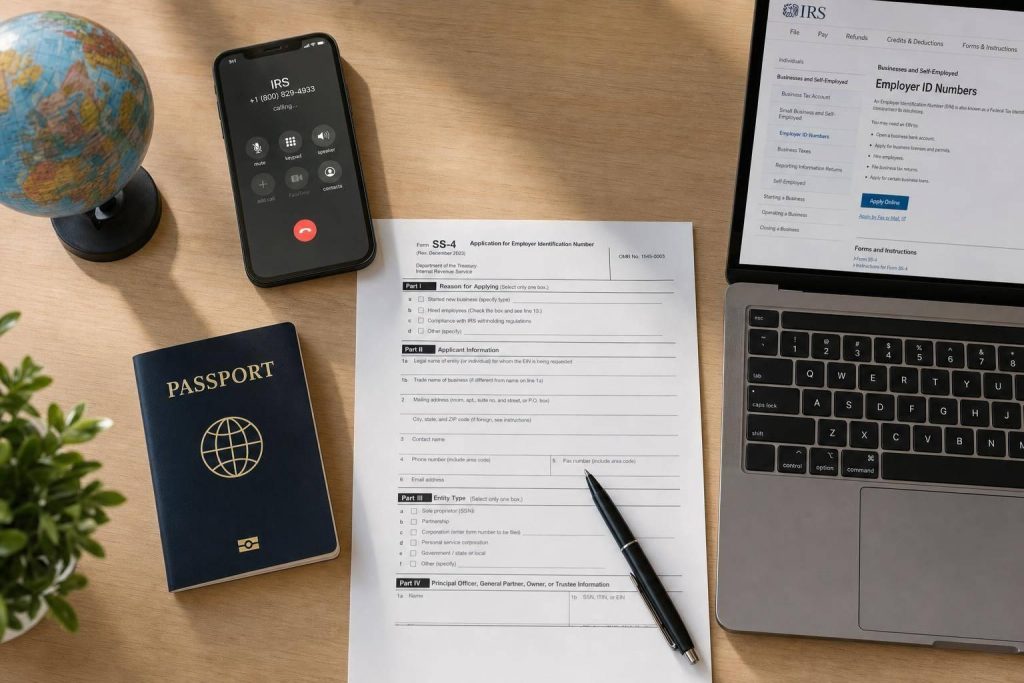
Yes – you can get an EIN without an SSN if you live outside the U.S. I’d sum it up like this: form your business, fill out IRS Form SS-4, put the correct responsible party on the form, and submit it through the IRS international process. If you don’t have an SSN or ITIN, line 7b is usually entered as “Foreign” based on current IRS instructions and filing practice.
Here’s the short version:
- An EIN is for a business. An SSN and ITIN are for people.
- Non-U.S. residents can apply. You do not need U.S. citizenship or a visa to request an EIN.
- You can file by phone, fax, or mail through the IRS international unit.
- An EIN helps with tax forms, banking, and payment processors, but it does not guarantee approval.
- Foreign-owned U.S. entities may still have filing duties, including Form 5472, which can carry a $25,000 penalty if missed.
A few points matter most: use the exact legal business name, list the actual individual who controls the business as the responsible party, and keep your records matched across your formation papers, SS-4, bank forms, and tax filings.
If I were doing this today, I’d focus on four things first:
- Check entity details
Make sure the company name, address, and formation date match your state filing. - Fill out Form SS-4 carefully
Most delays come from line 7b, the wrong responsible party, or name mismatches. - Submit only once
Don’t send the same EIN request by fax and mail at the same time. - Plan for what comes after the EIN
An EIN is only the tax ID. You may still need bank review, state filings, payroll setup, sales tax registration, or foreign-owner reporting.
Bottom line: if you’re a foreign founder, freelancer, or e-commerce seller, this process is allowed, common, and fairly direct when the form is filled out the right way. The rest of the article walks through who can apply, how to file, what to put on Form SS-4, and which mistakes tend to slow things down.
Who Can Apply and What to Gather Before Filing
Once the entity is legally formed, a foreign owner can apply for an EIN through Form SS-4. This usually comes up when you need to open a bank account, accept payments, hire staff, or handle tax filing.
Responsible Party Rules for Foreign Applicants
The IRS generally treats the responsible party as the person who ultimately owns or controls the business and its assets. That person must be an individual – not an entity and not a registered agent.
If a foreign founder owns a single-member LLC, that founder is usually the responsible party. If the LLC is owned by a parent company, list the individual who ultimately controls that company.
On Form SS-4, line 7a, enter the responsible party’s full legal name. On line 7b, if that person does not have an SSN or ITIN, enter "Foreign" or "N/A". Don’t leave the field blank, and don’t use a made-up number.
Pre-Filing Checklist for Form SS-4
Before you start, gather all of the details in one place. Delays often happen because the form is incomplete or the information doesn’t match across documents.
| Form SS-4 Field | What to Prepare |
|---|---|
| Legal business name | Exact name from your formation documents |
| Trade name (DBA) | Public-facing name, if different |
| Mailing address | A deliverable address; include country for international addresses |
| Formation jurisdiction and date | State or country where the entity was legally created |
| Entity type | Single-member LLC, corporation, partnership, etc. |
| Responsible party name | Full legal name matching their passport or other identity document |
| Line 7b identifier | SSN, ITIN, or "Foreign"/"N/A" as applicable |
| Principal business activity | Specific description, e.g., "IT consulting" or "retail – e-commerce" |
| Reason for applying | New business, banking, payments, or tax filing |
| Expected employees and first payroll date | Enter 0 employees if none are planned |
| Accounting year-end | Usually December for calendar-year businesses |
Use the same spelling, punctuation, and address format that appear in your formation records. Even a small mismatch – like leaving out "LLC" or using a different postal code – can trigger IRS follow-up and create headaches during bank onboarding later.
With the SS-4 details ready, the next move is filing the form from outside the U.S.
Documents Banks May Request Later
Form SS-4 is the main IRS form used to request an EIN. The IRS does not ask for attachments, but banks and payment processors often do.
Keep these records organized:
- Passport
- Certificate of formation
- Operating agreement
Here’s the simple rule: make sure your formation records, Form SS-4, and onboarding documents all match. If one document says one thing and another says something slightly different, delays can pile up fast. These records matter later for onboarding, but the EIN itself still comes from Form SS-4.
Once these details are ready, complete Form SS-4 and submit it from outside the U.S.
sbb-itb-ba0a4be
How to Apply for an EIN Without an SSN
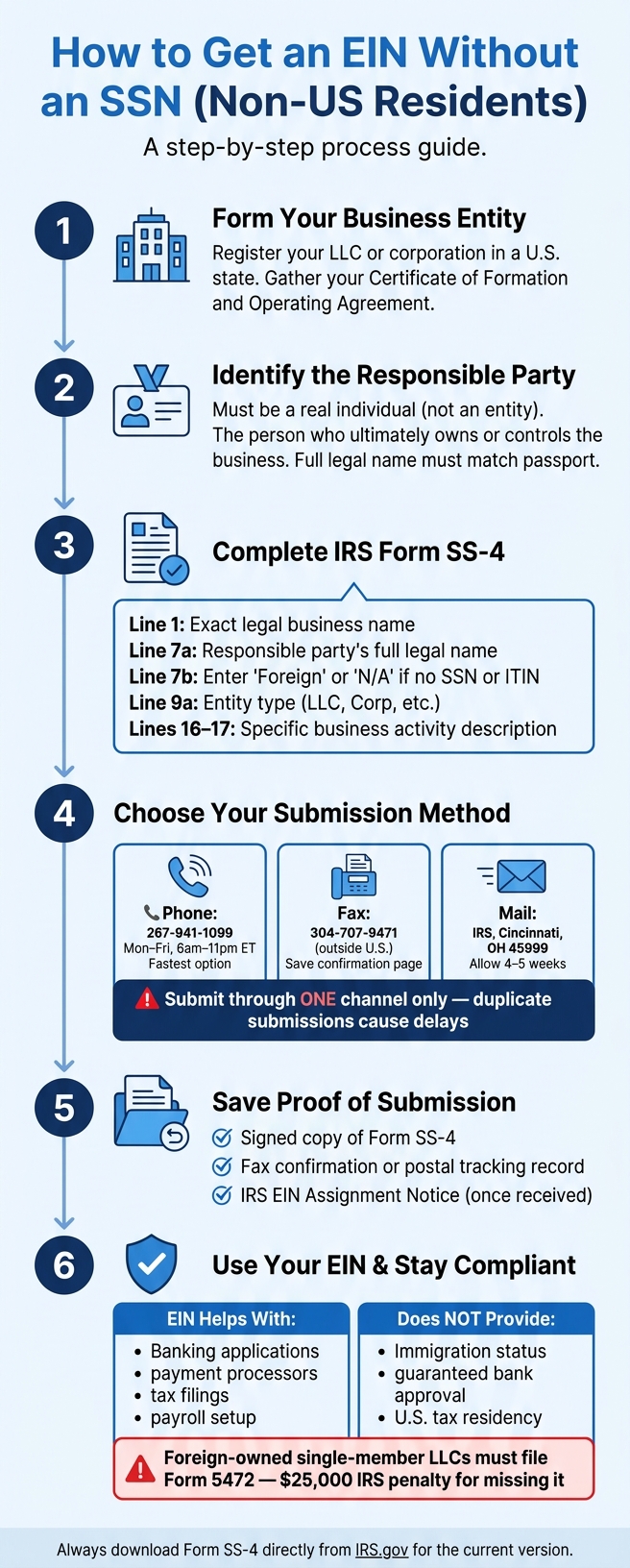
How to Get an EIN Without an SSN: Step-by-Step for Non-US Residents
How to Fill Out Form SS-4 as a Foreign Applicant
Once you have the needed details, fill out Form SS-4 in this order. The form is pretty simple once you know which fields matter most.
On line 1, enter the exact legal business name. On lines 4a–5b, use the business mailing address. Lines 7a and 7b tend to trip people up the most. On line 7a, enter the responsible party’s full legal name. On line 7b, enter that person’s SSN, ITIN, EIN, or “Foreign” if none applies.
On lines 8a–8b, say whether the business is an LLC and list the number of members. On line 9a, pick the right entity type. On line 10, give the reason for filing, such as starting a new business or opening a US business bank account. On lines 16–17, describe the business activity in plain, specific terms, like software consulting or online retail.
After you finish the form, submit it through the IRS route for international applicants.
How to Submit Form SS-4 From Outside the US
If you’re outside the U.S., you can file through the IRS international process by phone, fax, or mail. Before you send anything, double-check the current IRS contact details.
| Route | Contact / Address | Notes |
|---|---|---|
| Phone | 267-941-1099, Mon–Fri, 6 a.m.–11 p.m. ET | Best if you can answer SS-4 questions on the spot; international calling charges may apply |
| Fax | 304-707-9471 (from outside the U.S.) | Keep the fax confirmation page |
| IRS, Attn: EIN International Operation, Cincinnati, OH 45999 | Allow at least 4–5 weeks before you need the EIN |
After filing, keep proof that you submitted the application. This is a critical step for running a U.S. LLC from overseas while maintaining compliance.
How to Save Proof of Submission and Your EIN Assignment Notice
As soon as you file, save three items:
- A full copy of the signed Form SS-4
- Your fax confirmation page or postal tracking record
- The IRS EIN assignment notice, once it arrives
Store a digital backup in a secure place.
When the notice comes in, compare the entity name and address with your formation documents. Even a small mismatch can cause a headache later. If anything looks wrong, contact the IRS right away using the contact details in their notice. If a third party will speak with the IRS about the application, fill out the designee section with that person’s contact details and authority.
What You Can Do With an EIN After Approval
Once your EIN notice shows up, you can start using it for banking, tax filings, and business onboarding that asks for a U.S. tax ID.
Using the EIN for Banking, Payments, and US Operations
Banks use the EIN as the business tax ID. But here’s the catch: the EIN does not get you a bank account by itself. Banks still make their own approval calls.
Before you apply, it helps to have your paperwork ready, including:
- formation documents
- EIN notice
- passport
- ownership details
- sometimes a U.S. mailing address
- expected transaction volume
The EIN also shows up on tax filings, vendor forms, and payroll records. If you hire workers, you’ll use the EIN on federal employment-tax returns and wage reports. That said, you still need to deal with withholding, payroll deposits, and state payroll registration on a separate track.
So yes, the EIN matters. But it’s only one piece of the puzzle. It doesn’t replace other legal or tax steps.
What an EIN Does Not Do
An EIN identifies the business for tax purposes. It does not give you immigration status, work authorization, U.S. tax residency, or automatic approval from banks or payment processors.
| Helps with | Does not provide |
|---|---|
| Identifying the business on applicable federal tax and information returns | U.S. immigration status, a visa, or work authorization |
| Applying for a U.S. business bank account, subject to the bank’s approval and due-diligence requirements | U.S. tax residency, citizenship, or an SSN or ITIN |
| Setting up payment processors and vendor accounts, subject to each provider’s rules | Guaranteed approval by any bank, payment processor, marketplace, or lender |
| Identifying an employer for payroll and employment-tax administration if the business hires workers | Automatic compliance with state registration, licenses, sales tax, payroll tax, or annual reports |
| Supporting filings such as Form 5472 and a pro forma Form 1120 when applicable to a foreign-owned single-member LLC taxed as a disregarded entity | A finding that no tax is due |
Approval and identification are separate from your state and federal filing duties.
Ongoing Compliance Foreign Owners Should Not Overlook
Getting an EIN is one step, not the finish line. State rules like annual reports, registered agent service, foreign qualification, sales tax registration, and franchise taxes all run on their own timelines. Fees and annual taxes also change from state to state.
If you own a foreign-owned single-member LLC, you may still need to file Form 5472 with a pro forma Form 1120 for reportable transactions with the owner or related parties. The IRS penalty for failing to file Form 5472 is $25,000, and that can apply even if the business has little or no U.S. income. Keep close records of owner contributions, distributions, loans, and any payments between you and the LLC.
BOI reporting has its own rules too. Current FinCEN guidance says U.S.-formed domestic companies are exempt from federal BOI reporting, while some foreign companies registered to do business in a U.S. state still have to file. Check the latest FinCEN guidance before you rely on an exemption.
Common EIN Application Problems and Final Takeaways
Mistakes That Cause Rejections or Delays
Once you’ve finished the filing steps, the biggest risk is usually plain old form error.
Most EIN delays come down to three things: a wrong entry on line 7b, the wrong responsible party, or legal details that don’t match. It also helps to double-check the legal name, mailing address, and that you’re using the current IRS form version before you send anything in.
How to Fix a Rejected or Delayed Application
If the IRS flags your Form SS-4, fix the exact issue listed and resubmit once. Keep a copy of the original filing, the IRS notice, and your proof of submission. That paper trail can save a lot of hassle later.
| Problem | Likely cause | Practical correction |
|---|---|---|
| Blank or wrong line 7b | Responsible party has no SSN or ITIN and field was skipped or filled incorrectly | Enter "foreign" or "N/A" when the responsible party has no SSN or ITIN and is ineligible to obtain one. |
| Wrong responsible party | Application names an entity or nominee instead of the individual with control | Replace with the responsible individual’s full legal name and the appropriate line 7b entry. |
| Legal name differs from state records | SS-4 uses a trade name, abbreviation, or alternate spelling | Use the entity’s exact legal name from its formation documents. If you haven’t formed your entity yet, you can start a US LLC online as a non-citizen. |
| Outdated Form SS-4 | Applicant reused an old saved form or downloaded it from a third-party site | Download the current Form SS-4 and instructions directly from the IRS. |
One more thing: don’t file through more than one channel at the same time. That can create duplicate records and slow the process down even more.
Conclusion: The Short Answer and Your Next Step
The short answer is yes: a non-U.S. resident can get an EIN without an SSN by filing Form SS-4 through the IRS international applicant process.
The key is to use the exact legal entity details, list the real responsible party, and submit the application only once. An EIN can help with banking, payment processing, and tax filing for non-residents. If ownership or withholding rules are unclear, get U.S. tax advice before you move ahead.
FAQs
How long does it take to get an EIN from outside the U.S.?
For non-U.S. residents, the timing depends on how you apply.
Calling the IRS international line is usually the fastest route. In many cases, you can get your EIN right away once your information is verified.
If you apply by fax, it usually takes about 4 business days. If you apply by mail, expect a wait of around 4 to 8 weeks.
Can I open a U.S. bank account with just an EIN?
Usually, yes. In many cases, you can open a U.S. business bank account with an EIN. And if you’re a non-U.S. founder, you can often get that EIN without an SSN by filing Form SS-4.
That said, the EIN by itself usually isn’t the whole story.
Banks still run KYC/AML checks, which means they’ll want proof that both the business and the owner are legitimate. So it’s common for them to ask for:
- Your LLC formation documents
- Your personal ID
- A usable U.S. business address or physical address in some cases
One detail trips people up all the time: a registered agent address alone often isn’t enough.
Do I need to file taxes after getting an EIN?
Yes. Your LLC may still need to file tax forms even if it had no income and owes no tax.
If your LLC is at least 25% foreign-owned, you must file Form 5472 and a pro forma Form 1120 every year. Miss those filings, and penalties can start at $25,000.
Other returns may apply too. For example, an LLC taxed as a partnership may need to file Form 1065.