
Yes – I can form a U.S. LLC from the Philippines without traveling to the United States. In most cases, I only need to pick a state, hire a registered agent, file the LLC, get an EIN, open a bank account, and keep up with tax and filing rules after setup.
Here’s the short version:
- No U.S. citizenship or residency is required
- No SSN is required to form the LLC
- Setup often takes about 1–2 weeks, depending on the state
- Wyoming is often the simpler fit for solo online founders
- Delaware is often used by startups that want VC money
- An EIN is needed for banking and tax filings
- A registered agent with a U.S. street address is required
- A U.S. LLC does not remove Philippine tax filing duties
A few costs show up early:
- State filing fee: about $90–$100
- Registered agent: about $50–$300 per year
- Wyoming annual report: $60 minimum
- Delaware franchise tax: $300 per year
Before I file, I’d make sure I understand three things: where to form, how to get the EIN, and what I still have to report in both the U.S. and the Philippines. That’s where most filing mistakes start.
If I want the short answer: forming the LLC is the easy part; keeping it in good standing is what matters after that.
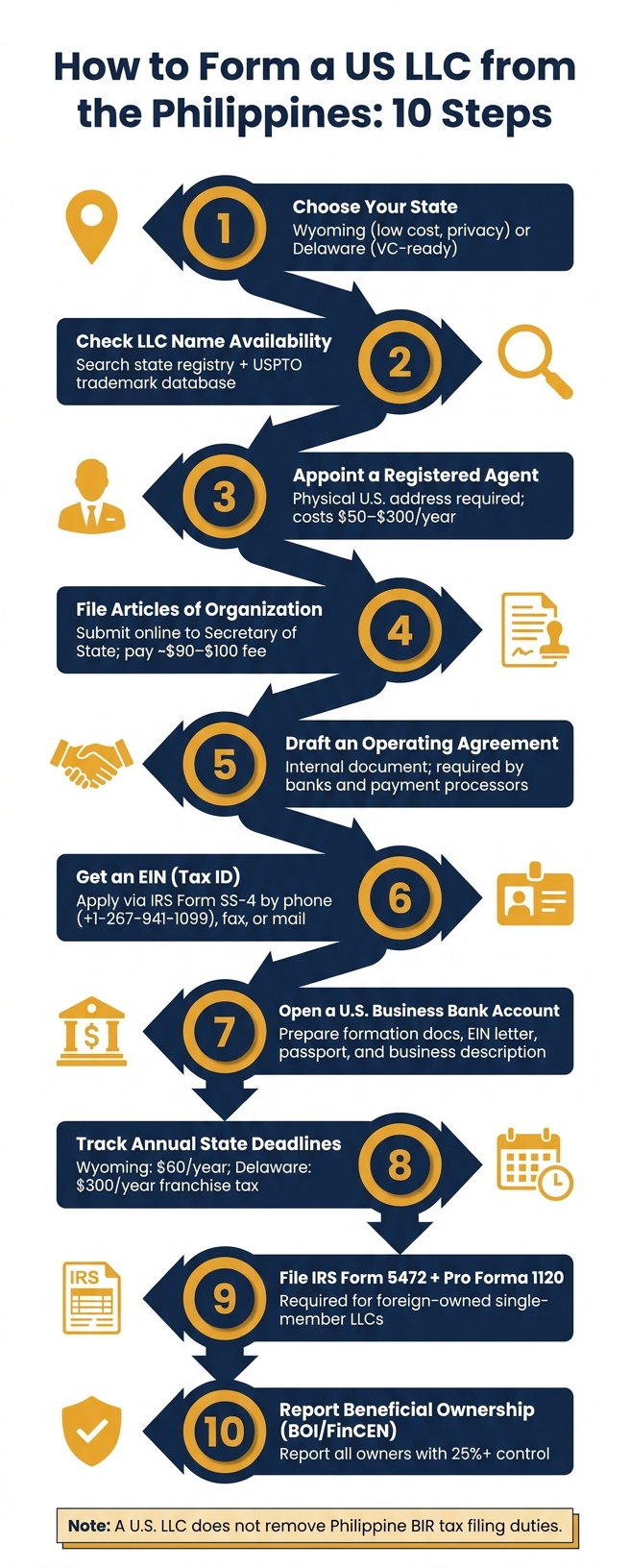
How to Form a US LLC from the Philippines: 10-Step Guide
Choose Your State, LLC Name, and Registered Agent
Three choices shape your filing path and day-to-day compliance: the state, the LLC name, and the registered agent. Each one affects cost, privacy, and how easy it is to keep the business in good standing while you’re based in the Philippines.
Wyoming vs. Delaware: Which State Works Best for a Philippine-Based Founder?
For most Philippine-based online founders, Wyoming is the simpler pick. It tends to work well for online businesses that want low state costs and less friction. Delaware still has its place, but it’s usually a better fit for startups that expect VC funding or plan to go public.
| Feature | Wyoming LLC | Delaware LLC |
|---|---|---|
| Best For | Online businesses, SaaS, freelancers | Startups seeking VC or planning to go public |
| Formation Fee | ~$100 | ~$90 |
| Annual State Cost | $60 (Annual Report) | Annual Franchise Tax (varies) |
| Privacy | High – members do not appear on public filings | High – anonymous options available |
| Legal System | Simplified compliance | Specialized Chancery Court |
| State Income Tax | None | None (for non-residents not doing business in-state) |
If you’re running a lean online business from the Philippines, Wyoming usually checks the right boxes. If you’re building the kind of company investors expect to see in Delaware, that changes the math.
How to Check LLC Name Availability and Basic Trademark Risk
Before you file, check if your business name is taken by searching your state’s business registry. Your LLC name must include a designator like “LLC,” “L.L.C.,” or “Limited Liability Company”, and it must be different enough from names already registered in that state.
That state-level approval does not mean the name is safe from trademark trouble. Think of it this way: the state checks whether the name can be registered there, while trademark law looks at whether you may be stepping on someone else’s brand. So before filing, search the USPTO database at uspto.gov.
How to Appoint a Registered Agent With a Physical State Address
Every LLC must have a registered agent with a physical street address in the state where the LLC is formed. A P.O. Box doesn’t count.
If you’re based in the Philippines, you can’t act as your own registered agent unless you have a physical U.S. address in that filing state. That’s why most non-U.S. founders hire a registered agent service, which usually costs $50–$300 per year.
Before you hire one, check a few basics:
- They use a real street address in the state
- They scan and upload documents to an online portal without delay
- They send reminders for annual report deadlines
- Their address, not yours, appears on public filings so your Philippine address stays private
If your registered agent service expires or lapses, the state can move to administratively dissolve your LLC. That can create problems with banking and contracts.
Once these three choices are set, you’ll be ready to gather the information needed for the Articles of Organization. The next step is filing the LLC formation documents.
sbb-itb-ba0a4be
File Your LLC and Organize Your Formation Documents
Once you’ve picked your state and registered agent, get the filing details together before you start. That makes the process much smoother. You can fill out the state form in one sitting instead of stopping halfway to hunt for missing info.
Information You Need Before Filing Your LLC
Most states ask for the same basic details on the Articles of Organization form. Have these ready:
- LLC name
- Principal business mailing address – a U.S. mailing address for correspondence
- Registered agent name and street address in the filing state
- Member or manager names and addresses, if required by the state
- Organizer – the person or entity submitting the filing
- Payment method – a valid credit or debit card to pay the state fee in U.S. dollars
It also helps to keep three addresses separate. Use the registered agent address for legal notices, the business mailing address for correspondence, and your Philippine home address for your own records.
How to File Articles of Organization and Save Your Approval Records
File on your Secretary of State’s website, pay the fee, and then download the approved formation document and receipt. Save both in a dedicated formation folder. You’ll likely need them again when you apply for your EIN and business bank account.
After approval, move everything into that same folder so the next steps go faster and you don’t end up digging through email later.
"Articles of Organization: The filing document that usually creates the LLC at the state level." – LLC Passport
Why You Need an Operating Agreement Even for a Single-Member LLC
An Operating Agreement is an internal document. You don’t file it with the state. But don’t let that fool you – it matters a lot.
U.S. banks and payment processors, including Mercury, Relay, Bluevine, and Stripe, often ask for it during Know Your Customer (KYC) and compliance reviews to confirm the company’s structure. If you don’t have one, your application can be delayed or rejected.
There’s also a legal reason to have it. The Operating Agreement helps show that your LLC is separate from you as a person. That separation matters if you want your personal assets kept apart from the LLC’s liabilities. Without a written agreement, courts and banks have less proof that the LLC stands on its own. In states like Wyoming, where member names don’t appear on public Articles of Organization, the Operating Agreement is also the main private record showing who owns the company.
For a single-member LLC, a solid Operating Agreement usually covers:
- ownership
- management structure
- signing authority
- profit distributions
- transfer rules
- dissolution steps
Templates often cost $0–$200. Sign the agreement right after your LLC is approved, then keep it ready for the EIN and bank account steps.
Get an EIN and Open a US Business Bank Account
With your LLC approved and your Operating Agreement signed, the next two jobs are simple on paper: get an EIN and open a US business bank account.
These two steps matter a lot. You’ll use your approval records and your Operating Agreement for both the EIN application and the bank review.
How to Apply for an EIN as a Non-US Owner
An EIN is the federal tax number your LLC needs for banking, payment processors, and tax filings. The IRS issues it for free.
If you’re based in the Philippines and don’t have a Social Security Number or ITIN, you can’t use the IRS online application. Instead, you need to apply with IRS Form SS-4 by phone, fax, or mail.
| Method | Available to Non-US Founders | Processing Time |
|---|---|---|
| Online | No (requires SSN or ITIN) | Instant |
| Phone (+1-267-941-1099) | Yes | Same call |
| Fax (Form SS-4) | Yes | 4–6 weeks |
| Mail (Form SS-4) | Yes | 6–8 weeks |
The phone method is the fastest. You call +1-267-941-1099, answer the Form SS-4 questions, and get your EIN during the call.
When filling this out, list the real owner or controller as the responsible party. Don’t use a nominee or agent.
After that, keep the IRS letter on file. If you ever need a replacement, ask for a 147C copy.
Once you have the EIN letter, it’s time to pull together the paperwork banks usually want to see.
Documents to Prepare for a US Business Bank Account Review
Banks tend to look closely at foreign-owned LLCs, so it helps to have your documents lined up before you apply.
| Document | What Banks Are Looking For |
|---|---|
| Formation Certificate | Approved Articles of Organization from the state, such as Wyoming or Delaware |
| EIN Confirmation | CP 575 or 147C letter from the IRS |
| Operating Agreement | Ownership structure, signing authority, and management details |
| Passport | Valid government-issued ID for all owners |
| US Business Address | A physical or virtual mailbox address, not your registered agent’s address |
| Business Description | Your products or services, customers, and payment flow |
| Ownership Details | Names and information for all members holding 25% or more |
Banks will usually ask about your source of funds too. Be ready to explain where your starting capital came from and how the business will run day to day.
A virtual mailbox can help here. It gives you a US street address for banking and other verification, separate from your registered agent’s address. BusinessAnywhere‘s Basic plan starts at $20/month when billed annually.
If you have these files ready from the start, your application is less likely to get stuck in back-and-forth requests.
Bank Account Options for Remote Founders: A Side-by-Side Comparison
Founders based in the Philippines can often apply for US business accounts online once the LLC and EIN are set up. When you compare options, focus on what matters most for a remote, foreign-owned LLC.
| Feature | What to Look For |
|---|---|
| Remote Application | Fully online process; no US presence required |
| Monthly Fees | No-fee or low-fee options that don’t require a minimum balance |
| Multi-User Access | Ability to add team members or accountants with role-based permissions |
| International Transfers | Support for wire transfers, multi-currency accounts, or competitive FX rates |
| Best Fit | Acceptance of foreign-owned LLCs and a simple document requirement set |
No bank guarantees approval, and processing times can vary. That’s why it helps to apply with complete documents the first time. Once the account is open, keep business and personal funds separate so your LLC’s liability protection stays in place.
Stay Compliant With State, Federal, and Philippine Requirements
Once your LLC is open, compliance becomes part of the job. Miss a deadline, and your LLC can fall out of good standing or even get dissolved.
After your bank account is open, the focus shifts from setup to essential post-formation steps like filings, renewals, and due dates.
How to Track Annual State Filings, Taxes, and Registered Agent Renewals
Each state runs on its own timeline, and the due dates are not always obvious. Wyoming charges a minimum of $60 per year, due on the first day of your anniversary month. Delaware charges a flat $300 annual franchise tax, due June 1. Miss either one, and the state may administratively dissolve your LLC.
If you’re running the business from the Philippines, you need your own tracking system. State notices and deadline reminders usually won’t go to a local Philippine address. That’s where a registered agent helps. The agent keeps a physical address on file in your formation state. BusinessAnywhere’s registered agent service covers that requirement year-round.
A simple rule works well here: set reminders 30 days before every deadline.
Federal Tax Reporting and Beneficial Ownership Rules for Foreign-Owned LLCs
If your LLC is foreign-owned, federal reporting rules can still apply even if the business has no U.S. office.
Foreign-owned single-member LLCs generally need to file Form 5472 and pro forma Form 1120. These forms are required because of foreign ownership, not because the LLC owes U.S. income tax. BusinessAnywhere’s US LLC tax filing service can handle both forms if needed.
There is also ownership reporting. FinCEN‘s Beneficial Ownership Information (BOI) rules require most LLCs to report the people who own or control the company. Update ownership records as soon as anything changes. BOI reporting should sit on its own calendar, separate from state filings and IRS forms.
A U.S. LLC also does not remove Philippine tax duties. The Philippine BIR may still require reporting on foreign-sourced income.
Launch and Compliance Checklist
Use this checklist to confirm each step before launch.
| Step | Action |
|---|---|
| 1. Choose state | Choose state |
| 2. Check LLC name availability | Check name |
| 3. Appoint registered agent | Appoint registered agent |
| 4. File Articles of Organization | File formation documents |
| 5. Draft Operating Agreement | Draft Operating Agreement |
| 6. Get EIN | Get EIN |
| 7. Open US bank account | Open bank account |
| 8. Track deadlines | Track deadlines |
| 9. File Form 5472 + pro forma 1120 | File IRS forms |
| 10. Check BOI/FinCEN requirements | Report beneficial ownership |
The biggest problems often come from small, quiet mistakes. A form gets filled out the wrong way. Funds get mixed. A filing gets skipped. That’s when trouble starts.
| Mistake | Why It Matters |
|---|---|
| Wrong responsible party on SS-4 | The IRS requires accurate responsible-party information on the form |
| Mixing personal and LLC funds | This can pierce the corporate veil and weaken liability protection |
| Skipping Form 5472 | Foreign-owned LLCs may still have federal reporting duties even when no US income tax is owed |
| Assuming the US LLC removes Philippine tax duties | The Philippine BIR may still require reporting on foreign-sourced income |
FAQs
Do I need an ITIN to get an EIN?
No. You do not need an ITIN to get an EIN.
The IRS online application asks for an SSN or ITIN. But that doesn’t block non-residents from getting an EIN.
If you don’t have an SSN or ITIN, you can still apply by sending Form SS-4 by fax, mail, or phone. In the SSN or ITIN field, write "foreign" or "N/A".
Can I use my registered agent address for banking?
No. A registered agent address is only for legal and official government mail, like lawsuits and tax notices.
Banks and payment processors usually want a separate business address for banking and day-to-day mail. If you use your registered agent address for that, you can run into problems.
A better move is to use a dedicated business address or a virtual mailbox instead.
Will my US LLC be taxed in the Philippines?
It depends on your tax residency and Philippine tax law. Setting up a US LLC does not automatically remove your tax duties where you live, and your LLC profits may still be taxed in the Philippines.
The tricky part is that tax treatment can change based on your setup, where you manage the business, and the kind of income the LLC earns. So while the LLC is formed in the U.S., that doesn’t mean the Philippines will ignore it.
Because the rules turn on your personal facts and business activity, it’s smart to speak with a cross-border tax professional about local filing rules and any risk of double taxation.