
Your LLC’s home office may qualify for a deduction – but working from home alone isn’t enough. I’d first check how you use the space and how your LLC is taxed. The simplified method allows $5 per square foot, up to 300 square feet, for a maximum of $1,500 before income limits.
Here’s what I’d check before filing:
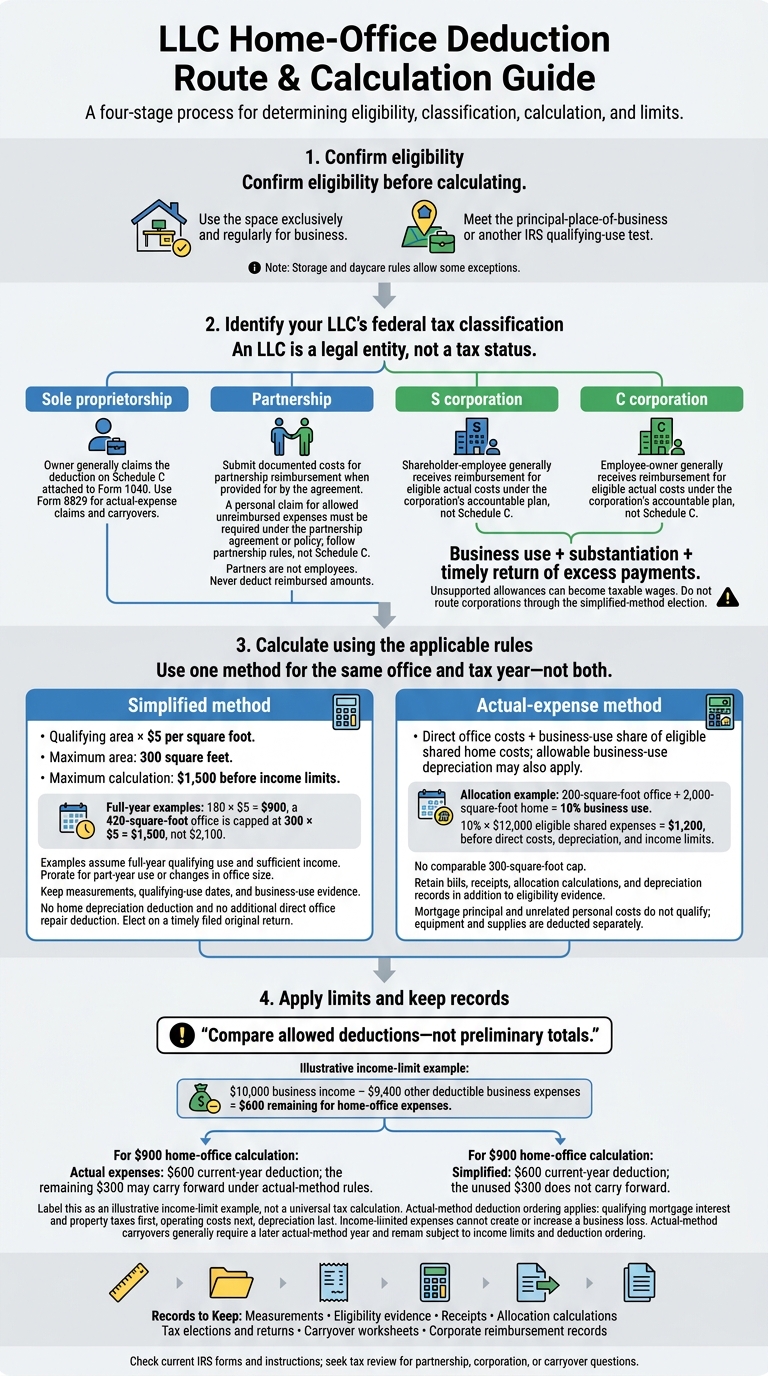
- Eligibility: Use the space only for business and regularly, and meet an IRS qualifying-use test. Storage and daycare rules allow some exceptions.
- Tax treatment: Sole proprietors claim costs on Schedule C. Partners follow partnership rules. S and C corporation employee-owners use documented reimbursements.
- Calculation: Compare the simplified method with actual expenses. A 200-square-foot office in a 2,000-square-foot home represents 10% business use for allocating shared costs.
- Limits and records: Apply the income cap, track allowed actual-expense carryovers, and keep measurements, receipts, and reimbursement records.
My starting rule: <u>confirm eligibility before calculating the deduction</u>. Then compare what you can actually claim, not just which method produces the larger total.
LLC Home Office Deduction: Eligibility, Methods and Limits
Claim Expenses Based on Your LLC’s Tax Classification
An LLC is a legal entity, not a tax status. For federal taxes, your home-office deduction depends on how your LLC is taxed: as a sole proprietorship vs. LLC, partnership, S corporation, or C corporation.
That classification determines whether you claim the deduction yourself or receive reimbursement. Check your filed election and tax return to confirm your LLC’s tax status.
| Federal tax classification | Claiming route | Key conditions |
|---|---|---|
| Single-member LLC taxed as a sole proprietorship | Owner claims the deduction on Schedule C | Home office must meet exclusive and regular use requirements, plus the principal-place-of-business or another qualifying-use requirement |
| LLC taxed as a partnership | Partnership reimburses documented costs, or partner claims allowed unreimbursed expenses under partnership rules | Expense must be ordinary and necessary and related to partnership work; a partner’s claim must also be required under the partnership agreement or policy |
| LLC taxed as an S corporation | Corporation reimburses the shareholder-employee under an accountable plan | Requires business use, substantiation, and timely return of excess payments |
| LLC taxed as a C corporation | Corporation reimburses the employee-owner under an accountable plan | Same accountable-plan requirements apply; the owner does not deduct corporate costs on Schedule C |
LLCs Taxed as Sole Proprietorships or Partnerships
If your LLC is taxed as a sole proprietorship, report business income and expenses on Schedule C attached to Form 1040. Use Form 8829 for actual-expense claims and carryovers.
If your LLC is taxed as a partnership, check the partnership agreement before claiming expenses personally. When the agreement provides for reimbursement, submit documented costs to the partnership. Don’t deduct an amount you’ve already been reimbursed for.
Partners are not employees. If the partnership doesn’t reimburse you, the agreement determines whether you can claim a personal deduction. When it requires you to pay the cost yourself, claim only the allowed unreimbursed expense under partnership rules – not on Schedule C.
Reimbursements for S Corporation and C Corporation Owners
S and C corporations handle home-office costs through reimbursement rather than owner-level deductions. As a shareholder-employee, use the corporation’s accountable plan for eligible actual costs, not Schedule C.
Adopt a written reimbursement policy. Submit expense reports with bills, payment records, office and home measurements, the allocation calculation, and the business purpose. You must document the expenses, show business use, and return any excess reimbursement on time.
Properly administered accountable-plan reimbursements stay separate from wages. Unsupported allowances can become taxable wages.
sbb-itb-ba0a4be
Compare the Simplified and Actual-Expense Methods
Once you know how your LLC is taxed, choose how to calculate your home office deduction. Use one method for the same office and tax year – not both. To elect the simplified method, use a timely filed original return. S and C corporations follow separate reimbursement rules as part of their tax planning.
Compare the methods based on your office size, the records you keep, and your expected deduction.
| Comparison point | Simplified method | Actual-expense method |
|---|---|---|
| Calculation | Qualifying area × $5 | Direct expenses plus the business-use share of eligible indirect expenses |
| Area limit | Up to 300 square feet | No comparable 300-square-foot cap |
| Records | Measurements, qualifying-use dates, and business-use evidence | The same records, plus bills, receipts, allocation calculations, and depreciation records |
| Home depreciation | No home depreciation deduction; depreciation is treated as zero | Allowable business-use depreciation may be included |
| Income limits | Cannot exceed the applicable gross-income limit | Cannot exceed the applicable gross-income limitation; disallowed amounts may carry forward |
| Carryovers | No carryover of a disallowed simplified deduction | Disallowed expenses may carry forward, subject to later-year limits |
You can use carryovers from the actual-expense method only in a later year when you choose that method again.
Simplified Method: $5 per Square Foot, Up to 300 Square Feet
The simplified method takes less time but offers less flexibility. The IRS simplified option caps the calculation at $1,500 before income limits. Prorate the amount for part-year use or changes in office size. Keep measurements and records showing when the space qualified. You can’t add direct office repairs to this amount.
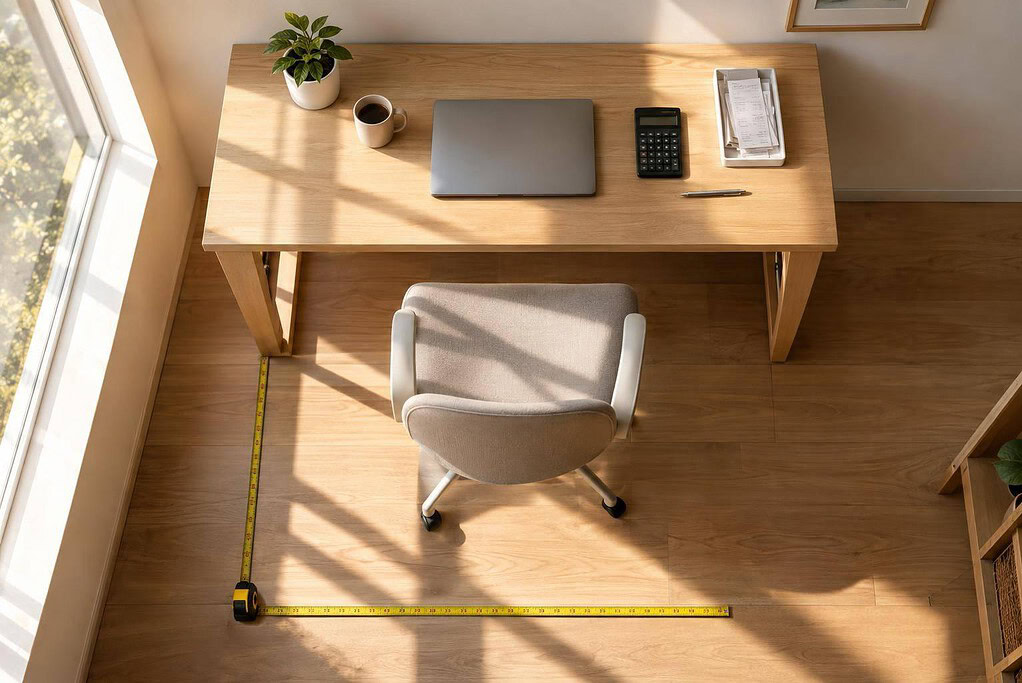
Full-year calculations: A qualifying 180-square-foot office produces 180 × $5 = $900. A qualifying 420-square-foot office uses only 300 square feet, producing 300 × $5 = $1,500, not $2,100. These figures assume full-year qualifying use and sufficient income under the applicable limit.
Actual Expenses: Office Costs and Shared Home Costs
The actual-expense method requires more records, but it may give you a larger deduction – especially when eligible shared home costs are high.
Separate direct office costs from shared home costs. Repainting only the office is a direct expense and can be allocated fully to that space. For rent, utilities, insurance, and whole-home repairs, use a business-use percentage backed by your records.
Homeowners may also deduct the business-use share of mortgage interest, property taxes, and allowable depreciation. Mortgage principal and unrelated personal costs don’t qualify. Deduct equipment and supplies separately; allocate only shared home costs.
Allocation calculation: A 200-square-foot office in a 2,000-square-foot home represents 10% business use. Applying that percentage to $12,000 in eligible shared expenses produces $1,200 before direct office costs, depreciation, and income limits. Calculate both methods before filing, then compare the allowed deductions – not just the preliminary totals.
Check Income Limits and Document Your Claim
Income Limits and Carryover Rules
Once you choose the simplified or actual-expense method, apply the income cap before filing. For a sole proprietor, start with net business income from the home office before the home-office deduction. Under the actual-expense method, deduct qualifying mortgage interest and property taxes first, home operating costs next, and depreciation last. Income-limited expenses cannot create or increase a business loss.
A $900 calculation does not guarantee a $900 deduction. If gross business income is $10,000 and other deductible business expenses are $9,400, only $600 remains for home-office expenses. If the actual home-office calculation produces $900, the current-year deduction is limited to $600, and the remaining $300 may be subject to the actual-method carryover rules.
If the simplified method produces that same $900, your deduction is still capped at $600 – but the unused $300 does not carry forward. An actual-method carryover can be used in a later year when you use the actual method, subject to that year’s income limit and deduction order. That applies even if you no longer live in the same home.
Records for Deductions and Reimbursements
After calculating the cap, document your claim and keep the records that support it. Your yearly file should include:
- Eligibility evidence: Floor plan, measurements, qualifying-use dates, photos, and lease or ownership records.
- Expense support: Receipts, payment records, and calculations separating direct expenses from shared costs.
- Basis and depreciation records.
- Tax records: LLC election, selected method, filed returns, required Form 8829, and carryover worksheets that separate operating expenses from depreciation.
For corporate reimbursements, keep the written policy, employee-status records, timely expense reports and receipts, allocation calculations, approvals, payment records, and proof that excess amounts were repaid. Update the file each year and whenever the office, home, qualifying use, or tax classification changes.
Keep property-basis records until the limitations period expires for the year you dispose of the property. You may need them to calculate depreciation, basis, gain, or loss.
Conclusion: Your Home Office Claim Checklist
Use this checklist before filing.
Start with your LLC’s tax classification. Confirm exclusive and regular business use, along with the qualifying-use test. Then choose the correct filing route: Schedule C for qualifying sole-proprietor activity, partner-specific reporting for partnerships, or documented reimbursement for S and C corporations. Your classification determines whether you claim expenses on your return or receive reimbursement.
Use your chosen method and its calculation rules outlined above. Claim only eligible costs under that method. For actual expenses, separate direct office costs from shared home costs, then apply your business-use percentage to the shared costs.
Apply the income cap before filing. Track actual-expense carryovers separately, and keep records that support eligibility, calculations, and reimbursements.
Get a tax review if you have questions about partnerships, LLC, S-Corp, or C-Corp structures, or carryovers. Administrative help alone does not prove eligibility.
Check the current IRS forms and instructions before filing.
FAQs
Can my home office qualify if I also work elsewhere?
Yes, your home office may qualify even if you work or meet clients elsewhere. It must be your principal place of business – the place where you handle key administrative or management tasks, like billing, bookkeeping, and scheduling.
You must use a specific area of your home exclusively and regularly for these business activities, no matter where you do your other work.
Can I switch deduction methods each year?
You can switch between the simplified method and the actual expense method from year to year.
The actual expense method requires you to account for depreciation. You won’t claim depreciation in years you use the simplified method, but depreciation recapture may still apply if you later sell your home.
Check the current IRS guidelines when preparing your tax return.
Will claiming home depreciation affect taxes when I sell?
Yes. With the actual-expense method, you must calculate and claim depreciation on the portion of your home used for business. When you sell your home, that depreciation is recaptured as taxable income at a rate of up to 25% – even if you never claimed it on your tax return.
The simplified method doesn’t involve depreciation, so it avoids this recapture tax.