
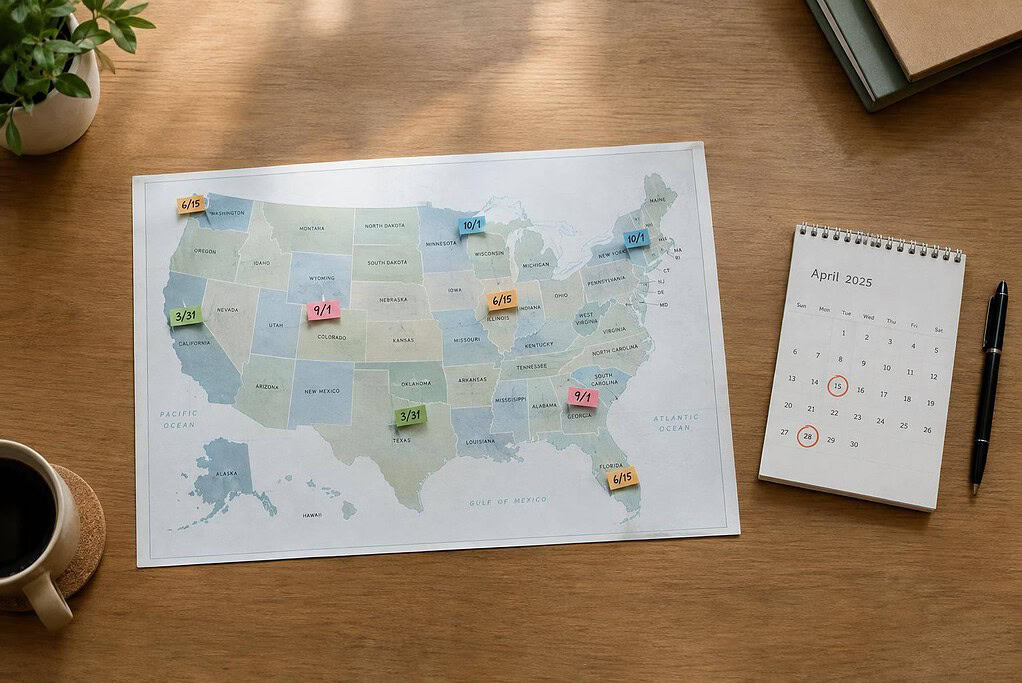
Some DBAs need renewal; others don’t. I recommend checking your original filing record first: your deadline depends on the state, local filing office, and business type – not your annual report deadline.
For example, Minnesota requires renewal every year by December 31, while Florida uses a five-year term with a $50 renewal fee. Idaho has no periodic renewal requirement.
Here’s what I check before filing:
- Deadline and status: Confirm the expiration date with the office that issued the DBA.
- Forms and costs: Check current fees, filing methods, and any publication requirements.
- Business changes: Ask whether changes to the owner, address, or name require a different filing.
- Missed deadlines: Find out whether renewal, reinstatement, or a new registration is required.
<u>Track each DBA separately</u> from taxes, annual reports, and licenses. I suggest reminders 90 and 60 days before expiration, then checking the official record after filing. A payment receipt alone doesn’t confirm that your DBA is active.
DBA Renewal Deadlines and Fees by State
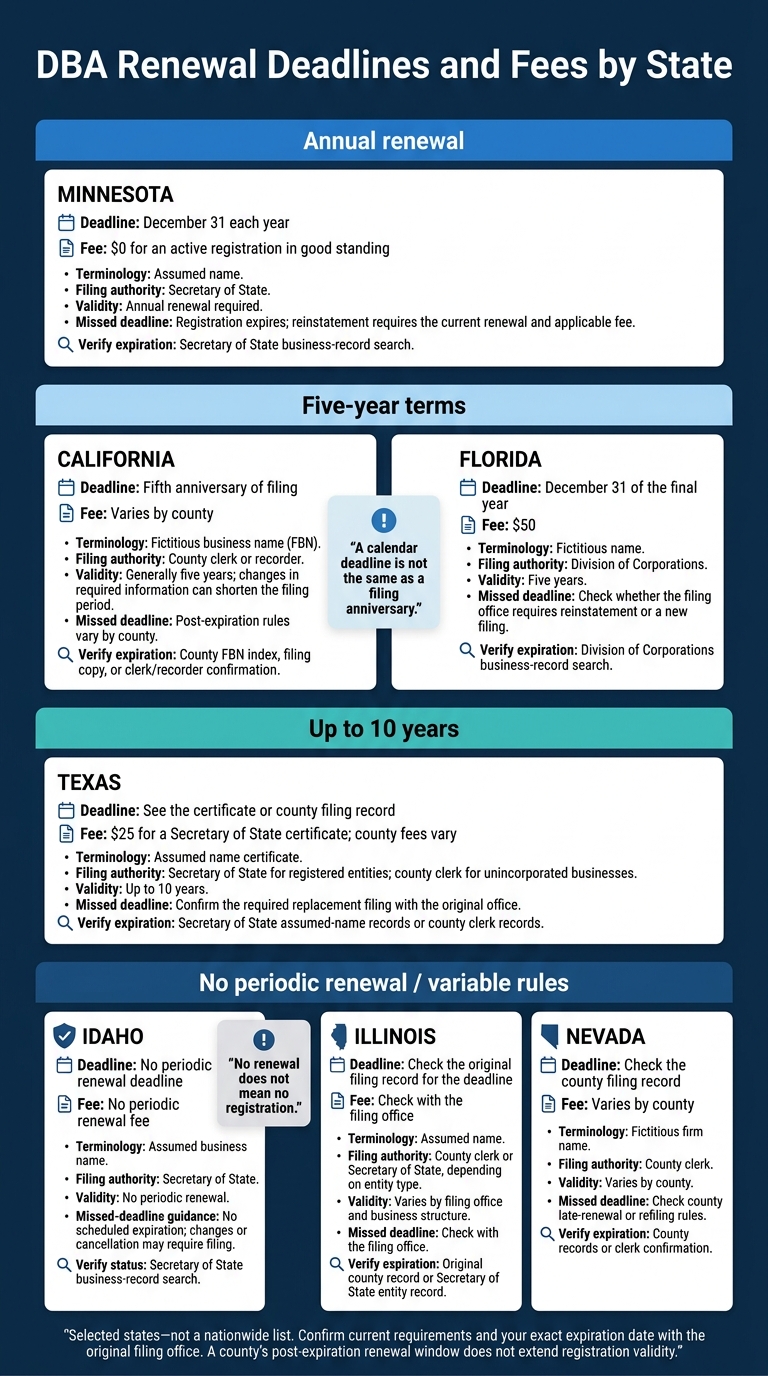
DBA Renewal Deadlines and Fees by State
| State or District | DBA Terminology | Filing Authority | Validity Period | Renewal Deadline | Renewal Fee | Missed-Deadline Consequence | Expiration Verification Method |
|---|---|---|---|---|---|---|---|
| California | Fictitious business name (FBN) | County clerk or recorder | Five years in most cases; changes in required information can shorten the filing period | Fifth anniversary of filing | Varies by county | Post-expiration rules vary by county | County FBN index, filing copy, or clerk/recorder confirmation |
| Florida | Fictitious name | Division of Corporations | Five years | December 31 of the final year | $50 | Check whether the filing office requires reinstatement or a new filing | Division of Corporations business-record search |
| Idaho | Assumed business name | Secretary of State | No periodic renewal | No periodic renewal deadline | No periodic renewal fee | No scheduled expiration; changes or cancellation may require filing | Secretary of State business-record search |
| Illinois | Assumed name | County clerk or Secretary of State, depending on entity type | Varies by filing office and business structure | Check the original filing record for the deadline | Check with the filing office | Check with the filing office | Original county record or Secretary of State entity record |
| Minnesota | Assumed name | Secretary of State | Annual renewal required | December 31 each year | $0 for an active registration in good standing | Registration expires; reinstatement requires the current renewal and applicable fee | Secretary of State business-record search |
| Nevada | Fictitious firm name | County clerk | Varies by county | Check the county filing record | Varies by county | Check county late-renewal or refiling rules | County records or clerk confirmation |
| Texas | Assumed name certificate | Secretary of State for registered entities; county clerk for unincorporated businesses | Up to 10 years | See the certificate or county filing record | $25 for a Secretary of State certificate; county fees vary | Confirm the required replacement filing with the original office | Secretary of State assumed-name records or county clerk records |
Start with the table to find your state’s requirements. The notes below explain the main patterns and exceptions.
Annual and Multiyear Renewal Schedules
DBA renewal schedules differ by filing office. Some require annual renewal; others use five-year terms. A calendar deadline is not the same as a filing anniversary. Also, a county’s post-expiration renewal window does not extend the registration’s validity.
DBAs With No Periodic Renewal
No renewal does not mean no registration. Even without an expiration date, changes to ownership or business details may call for an update, cancellation, or new filing.
Rules by County, City, and Business Type
Check the rules for your business structure and filing office. The office that handles your DBA can differ by county, city, or entity type, so the same office won’t necessarily handle every DBA.
Check your original record with that office for the exact renewal date and filing steps.
sbb-itb-ba0a4be
How to Check Your DBA Expiration and Renew
Find the Office That Handles Your Renewal
Once you know the deadline, check the filing office’s record to confirm how to renew. Gather your filing confirmation, stamped certificate, receipt, renewal notice, or online record. Note the exact DBA name, legal owner or registrant name, registration number, filing date, and expiration date.
Search the issuing office’s database using the registration number and legal owner’s name. Confirm that the DBA name and expiration date match your paperwork. If the certificate and official record disagree – or neither shows an expiration date – ask the filing office to confirm the deadline.
The office that filed your DBA is the source of truth for its expiration date.
| Filing Location | Filing Office | Renewal Submission Office | Official Expiration Record |
|---|---|---|---|
| State | Secretary of state or corporations division | Agency’s designated portal, mailing office, or service counter | State registration record or certificate of status |
| County | County clerk, recorder, or clerk-recorder | Original county office or its authorized filing system | County certificate or indexed DBA record |
| City | City clerk, licensing office, or local tax office | Office identified on the registration or license | City license, permit, or local assumed-name record |
Renew through the office that accepted your original filing, and follow its current instructions. Reminder letters don’t replace official records.
If you operate in multiple jurisdictions, renew each DBA separately wherever it was filed. Check which filing methods each office accepts: online, by mail, in person, or through an authorized agent.
Check Renewal Documents, Fees, and Filing Steps
Before renewing, compare your current owner, address, business name, and business type with the registration. Ask whether any changes require an amendment or a new filing. Also check the rules for signatures, notarization, ID, required documents, and publication.
San Diego County says that a renewal filed within 40 days of expiration does not require new publication when there are no changes.
Check the fee schedule and keep government fees separate from charges for publication, notarization, certified copies, processing, mailing, and filing services. Confirm which payment methods the office accepts.
Florida lists a $50.00 renewal fee and a separate $10.00 certificate-of-status fee.
Confirm whether the deadline depends on when your filing is mailed, received, or accepted. Save the submitted form, payment receipt, confirmation number, accepted certificate, and any publication affidavit.
After filing, check the official record again for the correct owner, DBA name, and updated expiration date. If the update hasn’t appeared after the office’s processing period, contact the office.
If the filing office shows that your DBA has already expired, follow the missed-deadline rules below.
What to Do If You Miss a DBA Renewal Deadline
If you’ve missed the deadline, ask the filing office whether you can renew, reinstate, or refile your DBA.
Determine Whether to Renew, Reinstate, or Refile
Confirm the next step with the issuing office: renewal, reinstatement, or a new filing. Also ask whether changes to ownership or other registration details require an amendment or new filing – even before the normal expiration date.
In Minnesota, an expired assumed name may be reinstated if the name is still available; file the current renewal and the reinstatement fee with the office. Colorado and Utah require a new filing after expiration rather than reinstatement.
Ask whether a new filing requires publication or license updates. Don’t assume the original publication covers it.
Then check how the expired status affects your day-to-day use of the name.
Check the Rules for Using an Expired DBA
Ask the issuing office whether local rules limit using or advertising the expired name on websites, signs, invoices, or new documents. Check with licensing agencies about any required certificate updates.
Review your bank, payment processor, insurance, lease, and contract records for DBA references. Ask each institution what it needs. Expiration does not automatically close a bank account or invalidate a contract. Don’t treat the DBA as active until the filing office confirms its status.
An expired DBA does not dissolve the entity or permanently free the name. After confirming whether you may use the DBA, check the entity’s status separately. Review competing registrations or trademark claims before using the name again.
If another party claims the name, or you need to use it during the lapse, consult a qualified attorney. The filing office handles filing status, not ownership disputes.
Conclusion: Track Each DBA Deadline Separately
Track each DBA separately, and confirm the current rules with the filing office.
For each DBA, record the filing authority, certificate number, owner or entity name, filing date, expiration date, renewal window, filing method, and where to verify its status.
Before renewing, check the current fee, payment method, required form, signature and notarization rules, publication requirement, and filing options. Confirm that the business name, principal address, and contact information are correct, then gather the required documents. Set reminders 90 days and 60 days before expiration, plus one shortly before the deadline.
Save the filing copy, receipt, confirmation number, and issued certificate. After filing, check the public record to make sure the renewal was accepted and the expiration date was updated.
Keep entity annual reports, tax registrations, licenses, permits, and professional credentials on separate schedules. Renewing a DBA does not renew those obligations.
For official forms and filing rules, start with the issuing office’s record.
DBA Renewal Guidance and Resources
The SBA notes that business names may be registered at the state, county, or city level.
BusinessAnywhere’s existing company maintenance can help organize compliance tasks and renewal tracking. Its virtual mailbox can help handle correspondence, while its corporate documents service may help with compliance recordkeeping.
Before assuming DBA renewal is included, confirm the service scope, included filings, document handling, and additional fees. These tools do not replace the responsible filing office. Track the DBA deadline separately according to that office’s rules.
FAQs
Can I renew my DBA before it expires?
You can renew your DBA before it expires to keep your registration active without a gap. Some jurisdictions, including Texas, let you refile during the final months of your current term.
Renewing early helps prevent a lapse that could mean a new filing, extra fees, or losing the legal right to use your trade name. Set a reminder at least 60 days before your expiration date.
Do I need to renew a DBA I no longer use?
If you stop using a DBA, file a formal statement of abandonment with the state or county office where you registered it. Don’t just let it expire. Filing clears the public record and ends future renewal obligations.
In states like Florida, you must file a cancellation within 30 days of stopping use. Properly abandoning the name keeps records accurate and helps prevent administrative or legal complications.
What if my DBA renewal is still pending at expiration?
If your DBA renewal is still pending when your registration expires, your registration will lapse. You’ll lose the legal right to use the trade name, which could affect your ability to enforce contracts, collect unpaid invoices, or use your business bank account.
Most jurisdictions don’t offer a grace period. You’ll likely have to register again and pay all filing fees again. If your jurisdiction requires publication, you may also have to repeat the public notice process.