
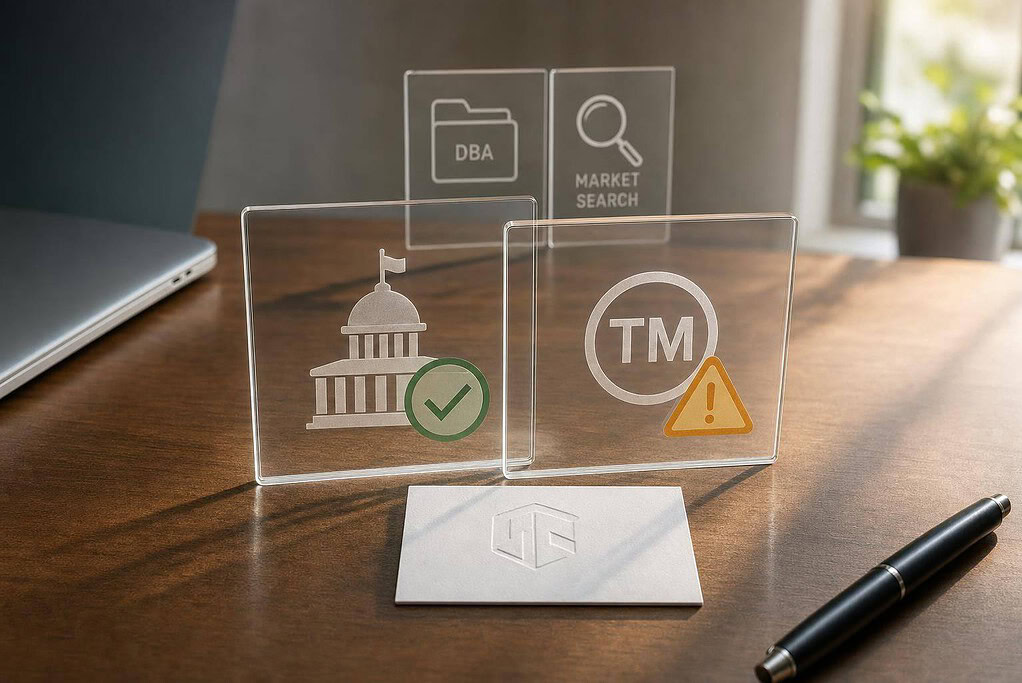
Yes – two businesses can sometimes share a name. But state approval alone does not mean you can use that name as a brand.
If I were checking a name today, I’d treat it like a two-part test:
- State filing rules: Can I register the business name in that state?
- Trademark rules: Will customers think my business is connected to someone else’s?
That’s the whole issue in plain terms. A name can pass a state filing check and still put you at risk of a trademark claim later.
Here’s the short version:
- A legal entity name is not the same thing as a trademark
- A DBA does not give exclusive brand rights
- Common-law rights can exist even without federal registration
- A USPTO registration can block use across the U.S. for related goods or services
- Websites, online ads, and national shipping make name conflicts more likely
A simple example: if one company is a local landscaper in Washington and another is a software firm in Georgia, the risk may stay low. But if both sell the same service to the same buyers – or one starts selling nationwide – the risk goes up fast.
Before I reserve a business name or file anything, I’d check:
- State entity records
- DBA or assumed-name records
- The USPTO database
- Google, domains, and social profiles
One fact matters most: trademark disputes usually turn on customer confusion, not exact spelling. Even small changes like “Lite” vs. “Light” or “LLC” vs. “Inc.” may not be enough.
Quick Comparison
| Issue | State filing rule | Trademark rule |
|---|---|---|
| What it checks | Whether the name is available in that state’s records | Whether buyers may confuse the source of goods or services |
| Scope | Usually one state | Can reach across the U.S. |
| Does it give brand rights? | No | Yes, if rights exist |
| Exact match required? | Often looks for names that are not too close | No; sound, meaning, look, and market overlap all matter |
| Main risk | Rejected filing | Demand letter, rebrand, legal dispute |
Bottom line: if you want a name people will see on your site, ads, packaging, or social media, I would not stop at the secretary of state search and reservation. I’d clear the brand name too.
sbb-itb-ba0a4be
State business names and trademarks are not the same thing
A state approval only clears a name under that state’s filing rules. It does not give you the right to use that name as a brand. Trademark law looks at confusion in the market, not whether two names match in a state database.
Entity name, DBA, trademark, and common-law rights: what each one means
These terms sound close, but they do different jobs:
| Term | What creates it | What it protects | Geographic scope |
|---|---|---|---|
| Legal entity name | State approval (secretary of state) | The name in that state’s records; no trademark rights | That state’s filings |
| DBA / assumed name | State, county, or city registration | Public notice of the operating name | The registering jurisdiction |
| Common-law trademark | Actual use in commerce | Your brand in the market where you operate | Limited to where you actively use it |
| Federal trademark (USPTO) | Use in commerce + registration | Brand identity for listed goods/services | Nationwide for the listed goods/services |
That distinction matters. A name can pass a state’s filing check and still be a bad bet as a brand. So when people ask whether two businesses can share a name, the answer depends on which set of rights is in play.
Registering a DBA lets a business operate under a different public name. But it does not give exclusive brand rights.
Common-law trademark rights come from actual use in commerce and usually cover only the places where the name is being used.
USPTO registration gives stronger nationwide protection for the listed goods and services. That’s why two businesses may both get state approval for the same or a similar name and still end up in a trademark dispute.
Why one state can approve a name another state would reject
Each state uses its own naming test. So approval in one state doesn’t mean another state will say yes. A name that looks open in one state’s records can get blocked in another if a similar name is already active or reserved there.
Oregon and Ohio are good examples. Both states treat entity labels like "LLC" or "Inc.", along with punctuation and plural forms, as changes that do not make names different enough under state naming rules. So Lighthouse Media LLC and Lighthouse Media, Inc. may still be seen as too similar in those states, even if they look different at first glance.
Next comes the part that trips people up most: when shared names are no big deal, and when they turn into trademark trouble.
When two businesses can use the same name and when that becomes a problem
Two businesses can use the same name if customers are not likely to assume they come from the same company. In most cases, that comes down to industry, market, and geography. But here’s the catch: state approval does not settle trademark clearance.
Lower-risk situations founders often encounter
Take Harbor Light Landscaping in Washington and Harbor Light Analytics in Georgia. One is a local landscaping business. The other sells software. Different buyers, different services, different markets. They don’t compete head-to-head, so the risk is usually lower. Each state might approve its own filing without issue, and that can work fine unless one company moves into the other’s lane or one of them already has a federal trademark.
Identical LLC names can sometimes exist in different states if each filing office allows it and the businesses stay in separate local markets. But that safe zone can shrink fast. A website, online ads, or national sales can change the picture in a hurry. So the full answer still depends on trademark rights, branding, and online sales.
Higher-risk situations that raise trademark concerns
The risk goes up when the names are close and the businesses chase the same customers. Picture Harbor Lite Lawn Care in Georgia while an established Harbor Light Lawn Services already advertises across the Southeast. Those names sound similar. The services line up. The customer base overlaps. That’s a high-risk setup.
Online sales make things even messier. If a clothing store launches nationwide under a name already used by an apparel brand in another state, conflict can start right away. Internet sales and national shipping weaken the distance buffer that once gave local businesses some breathing room.
A new logo or a tiny spelling tweak may not fix the problem. The USPTO looks at similarity in sound, appearance, meaning, and the overall impression customers get, not just whether the names look a little different on paper.
| Situation | Risk level | Key reason |
|---|---|---|
| Identical LLC names in separate states, serving separate local markets | Lower | State records may permit both names; local markets don’t overlap |
| Similar names for landscaping and unrelated software services | Often lower | Different industries, customers, and purchasing decisions |
| Same or nearly identical name for two businesses serving the same area and customer base | High | Names, services, customers, and geography overlap |
| Same or nearly identical name for related goods or services sold online | High | National digital reach reduces the protection geographic distance can provide |
| Same wording, different logos, for related services | Potentially high | Similarity analysis covers sound, meaning, appearance, and overall impression customers get |
That cushion is a lot thinner now because websites and social media can put a business in front of a national audience almost overnight. That’s why a name approved at the state level can still run straight into trademark trouble.
Why state approval does not remove trademark risk
That gap matters because state approval is only step one. It clears the filing. It does not clear trademark use.
A federal registration gives you nationwide priority for the listed goods or services. It also gives you a presumption of ownership, notice to later users, and access to federal-court enforcement. After that, the main issue is simple: are people likely to confuse the two names?
And that’s where many business owners get tripped up. Trademark law doesn’t hinge on exact spelling. It looks at how a name lands in the minds of customers.
Unregistered businesses can still have common-law rights. Those rights are usually tied to the area where the business has built name recognition. Even so, an earlier user can object if a later business enters that market with a confusingly similar brand.
Trademark reviewers focus on confusion, not perfect matches. Courts and USPTO examiners look at things like mark similarity, related goods or services, shared customers and sales channels, geography, actual confusion, and mark strength. Those are the factors to use when deciding whether to move ahead, pick a new name, or get legal help.
When to get a legal review before moving forward
Bring in a trademark attorney before you spend on branding if any of these fit:
- Your business will operate or advertise across state lines
- You’re about to spend money on signage, packaging, a website, or a major ad campaign
- Your search results showed similar names in related industries
- You’re entering a crowded or regulated industry
- You plan to franchise or license the brand
Rebranding after you’ve built a customer base and paid for marketing materials can get expensive fast. A trademark attorney can help you sort out priority, geographic limits, and whether changing the name now would cut your risk before you get in too deep.
How to check a business name before you file
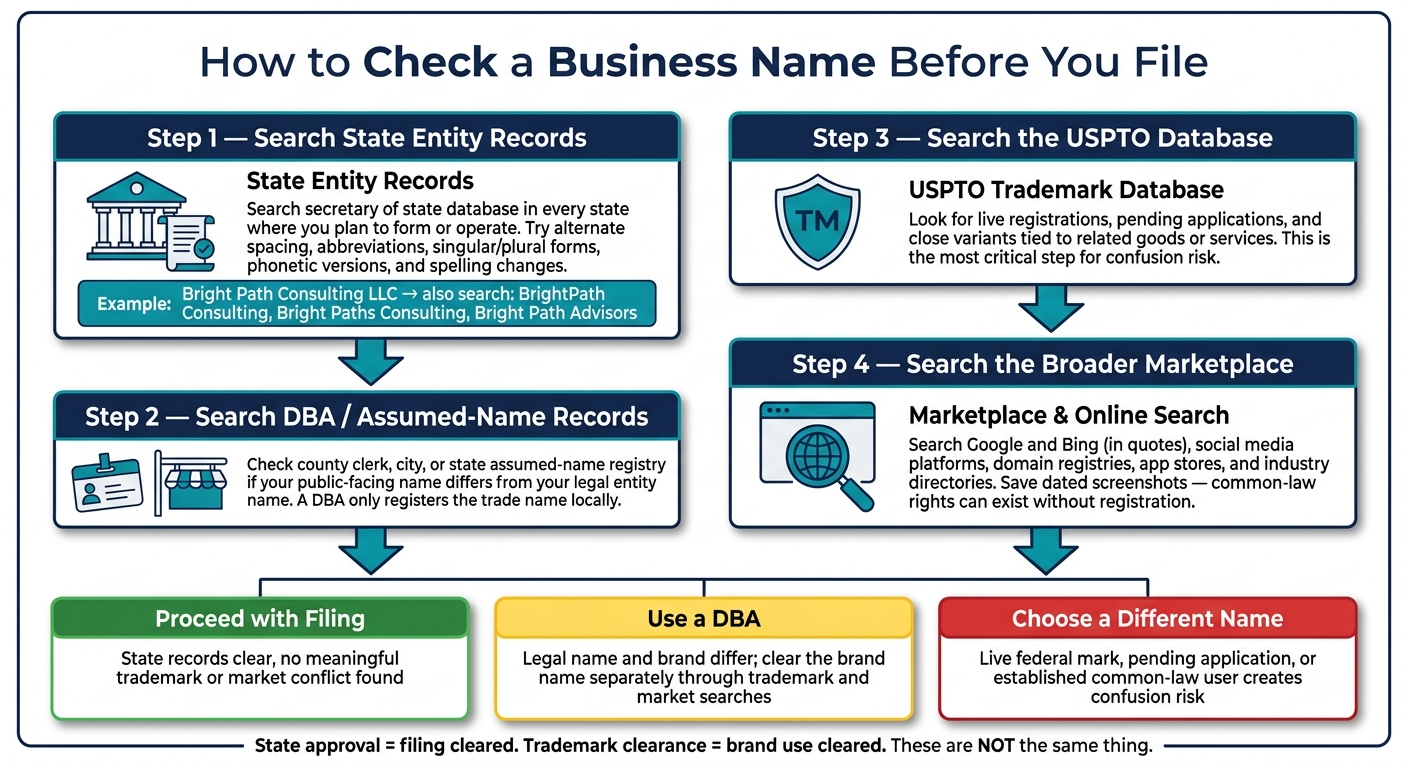
How to Check a Business Name Before You File
Search state records, DBA records, and the USPTO database
Use this checklist to clear a name before you file.
Start with the secretary of state’s business entity database in every state where you plan to form or do business. And don’t stop at the exact match. Search the name in a few different ways: alternate spacing, abbreviations, singular and plural forms, phonetic versions, and obvious spelling changes.
For example, if you’re thinking about "Bright Path Consulting LLC," also search:
- BrightPath Consulting
- Bright Paths Consulting
- Bright Path Advisors
Check each state where you plan to form or operate, such as performing a New Mexico business entity search.
If your public-facing name will be different from your legal entity name, search DBA records too. DBA filings may be handled by a state, county, or city office. A DBA only registers the trade name locally.
Then search the USPTO database. Look for live registrations, pending applications, and close variants tied to related goods or services. That’s the part that matters most, because confusion risk usually comes from marks used for similar things.
Check the broader market and decide what to do next
Database searches are just the first pass. Market use can create risk too.
Search the name in Google and Bing using quotation marks. Then check social media platforms, domain registries, app stores, and industry directories. Even if a business hasn’t registered a mark, it may still block your use through common-law rights in the market. Save dated screenshots or URLs that show current use, because search results can shift over time.
Use what you find to decide your next move. Proceed with filing if state records are clear and you don’t see a meaningful trademark or market conflict. Use a DBA if your legal entity name and public brand need to be different, but clear the brand name on its own through trademark and market searches. Choose a different name if a live federal mark, pending application, or established common-law user creates confusion risk.
If the brand is meant to grow across the U.S., think about filing for federal trademark protection after clearance. Forming the business by itself does not give you that.
| Search stage | Where to look | What it tells you |
|---|---|---|
| State entity records | Secretary of state database in each formation or operating state | Whether the name is available under that state’s filing rules |
| DBA records | County clerk, city, or state assumed-name registry | Whether a public-facing trade name is already registered locally |
| USPTO database | USPTO trademark search system | Whether similar federal marks cover related goods or services |
| Marketplace search | Search engines, social platforms, domain registries, app stores, industry directories | Whether unregistered common-law users exist in your market |
Conclusion: State approval covers filing, not the right to use a name
State approval means the name passed that state’s filing rules. That’s it. It does not mean you have clear trademark rights to use the name in the market. State approval deals with filing. Trademark clearance deals with confusion risk. That’s why approval is the starting point, not the finish line.
In plain English, a shared name only works when the businesses stay far enough apart that people aren’t likely to mix them up. Two companies can use the same name only if the risk of confusion stays low.
Before you file, check:
- State entity records
- DBA records
- The USPTO database
If you find a similar earlier user in a related field, stop before you build the brand and get a legal review.
FAQs
Can I use a name my state approved?
Not necessarily. State approval only means the name is open to use as a business entity name in that state. It does not give you trademark rights or shield you from federal trademark claims.
If the name is already protected by a federal trademark, the trademark owner may still take legal action. Check both the USPTO trademark database and state business registries first.
Do I need a trademark if I have an LLC?
No. You do not need a trademark to form or run an LLC.
When you register an LLC with your state, that filing creates your legal business entity. In most cases, it also stops other businesses in that state from registering the exact same name. But that’s where the protection usually ends. It does not give you intellectual property rights, and it does not protect your name across the U.S.
A trademark gives your brand broader protection.
You can also get common-law trademark rights just by using a name in commerce. But those rights are limited and can be harder to enforce. If you plan to do business in more than one state, or you want stronger control over your brand name, federal trademark registration is a smart move.
What should I search before choosing a business name?
Before choosing a business name, run a broad search. It can help you avoid legal trouble and the cost of rebranding later.
Check your state’s business entity database, the USPTO trademark database, county-level DBA records, domain availability, and general web searches. That includes search engines and social media. The goal is to catch registered, pending, or unregistered common-law trademark conflicts before the name sticks.