


A new LLC can miss thousands in deductions if I don’t track expenses from day one. The big idea is simple: write-offs lower taxable income, not revenue, and the IRS usually wants each expense to be ordinary, necessary, and backed by records.
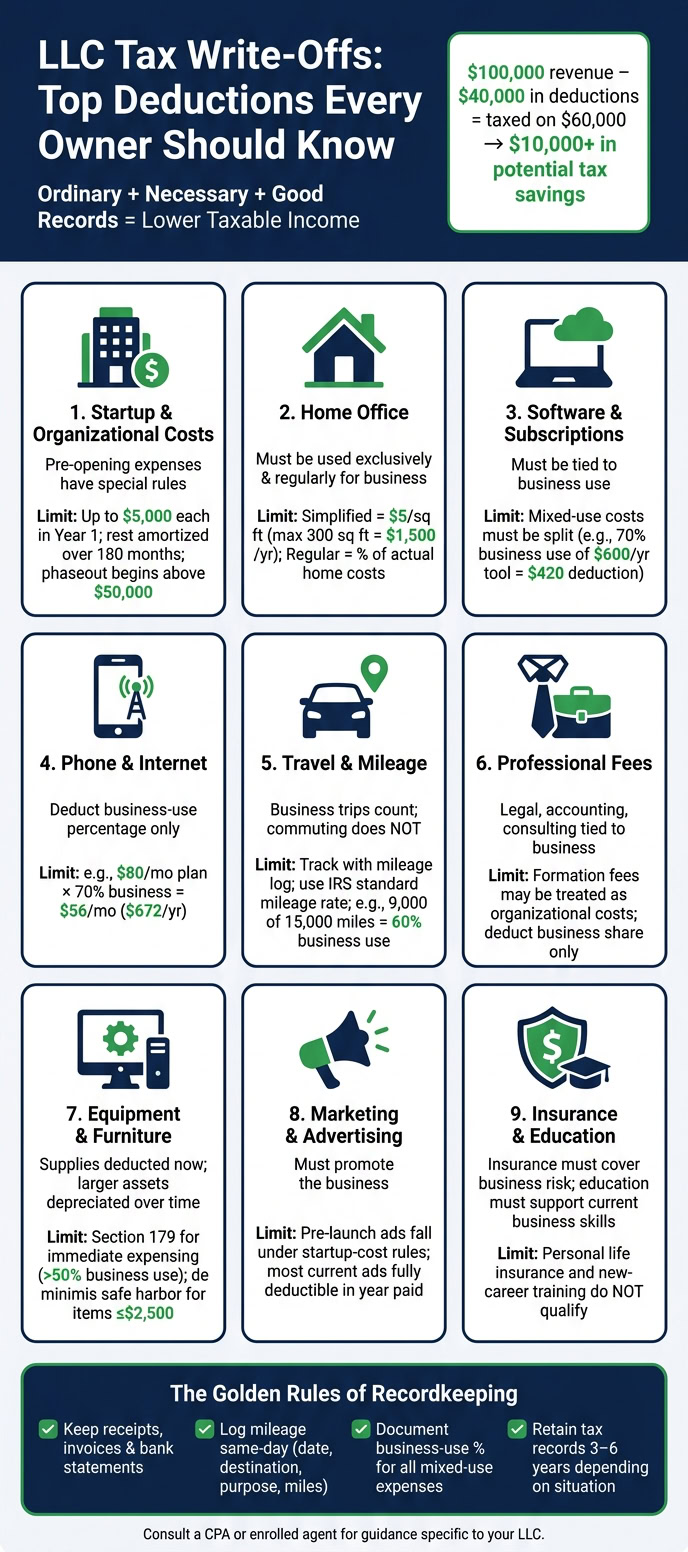
If my LLC made $100,000 and I had $40,000 in deductible business costs, I may be taxed on $60,000 instead. That gap can mean $10,000+ in tax savings, depending on my tax rate.
Here’s the short version of what matters most:
- Startup and formation costs may give me up to $5,000 each in first-year deductions, with the rest spread over 180 months
- Home office costs may be deducted if I use a space regularly and only for business
- Software, phone, and internet are often deductible, but only for the business-use share
- Mileage and travel can count for client trips and business travel, but commuting usually does not
- Professional fees, supplies, equipment, marketing, insurance, and training often count when tied to the business
- Records matter: receipts, invoices, mileage logs, and notes about business purpose can make or break a deduction
Quick comparison
| Write-off area | Main rule | Common limit or note |
|---|---|---|
| Startup and organizational costs | Pre-opening costs have separate rules | Up to $5,000 each first year, then amortized |
| Home office | Must be used exclusively and regularly for business | Simplified method: $5/sq. ft., up to 300 sq. ft. |
| Software and subscriptions | Must be tied to business use | Mixed-use costs must be split |
| Phone and internet | Deduct only business use | Keep a usage method and notes |
| Travel and mileage | Business trips count; commuting does not | Mileage log is a must |
| Equipment and furniture | Some items deduct now, others over time | Section 179 and safe harbor rules may apply |
| Marketing and advertising | Must promote the business | Pre-launch ads may fall under startup rules |
| Insurance | Must cover business risk | Personal coverage does not count |
| Education and training | Must support my current business | New-career training does not count |
The article’s core message is straightforward: if I separate business from personal spending, track mixed-use items the right way, and keep proof, I give myself a much better shot at keeping more of what the LLC earns.
sbb-itb-ba0a4be
What Makes an LLC Expense Tax-Deductible?
The IRS looks at two main ideas here: ordinary and necessary.
An ordinary expense is one that’s common in your line of work. A necessary expense is one that helps you run the business and makes sense for what you do. If a cost is ordinary, necessary, and linked to business use, it may be deductible. That’s what decides whether day-to-day LLC spending can lower your taxable income.
If an expense is part business and part personal, you can deduct only the business portion.
Travel rules trip people up all the time. Commuting to a regular office isn’t deductible. But trips from a home office to a client, supplier, or bank usually count as business travel.
Paperwork matters too. Every deduction needs support. Keep receipts, invoices, account statements, and mileage logs that show the amount, date, and business purpose.
Here’s the basic rule in practice.
| Expense Type | Deductible? | Key Rule |
|---|---|---|
| Industry-standard software or tools | Yes | Ordinary and necessary for your trade |
| Personal groceries or household items | No | Personal expense |
| Mixed-use phone or internet | Partially | Deduct the business-use percentage only |
| Commuting to a regular office | No | Personal expense |
| Driving from home office to a client | Yes | Business transportation |
With those ground rules in place, it helps to start with one of the most common write-offs: startup and organizational costs.
1. Startup and Organizational Costs
Before your LLC brings in any revenue, you may still have some tax write-offs on the table. The IRS treats pre-opening expenses differently from normal business expenses, so the rules change a bit at this stage. Some of these costs can be deducted once the business is active, and after that, your regular operating expenses follow a different set of tax rules.
Ordinary and Necessary Business Purpose
Startup costs are pre-opening expenses connected to getting the business off the ground. Organizational costs are tied to forming the LLC itself, like state filing fees or legal fees for drafting your operating agreement.
Business-Use Percentage
If a pre-opening expense was partly personal, only deduct the business-use share.
How the Deduction Works
Here’s where people often get tripped up: you usually can’t deduct all of it at once.
You can generally deduct up to $5,000 in startup costs and up to $5,000 in organizational costs in the first year. Any amount left over is amortized over 180 months. If total startup costs or total organizational costs go above $50,000, that first-year deduction starts to phase out dollar for dollar.
So the main thing to watch is simple: what you can deduct now versus what must be spread out over time.
| Expense Category | First-Year Deduction | What Happens to the Rest |
|---|---|---|
| Startup costs | Up to $5,000 | Reduced dollar-for-dollar once total startup costs exceed $50,000; any remaining amount is amortized over 180 months |
| Organizational costs | Up to $5,000 | Reduced dollar-for-dollar once total organizational costs exceed $50,000; any remaining amount is amortized over 180 months |
Records Needed to Support the Write-Off
Keep your receipts, contracts, filing confirmations, bank statements, and the date the LLC became active. That start date matters more than it may seem. It helps determine when amortization begins and whether a cost counts as a startup expense or a regular operating expense.
After launch, the next costs to track are the day-to-day ones, like home office expenses, software, and internet.
2. Home Office Deduction
If you work from home, this can be one of your biggest repeat deductions after startup costs. Part of what you pay for housing may count as a business write-off. But there’s a catch: the IRS only allows it if you meet the exclusive and regular use test before claiming anything.
Principal Place of Business
Your home office counts only if you use that space exclusively and regularly for business. That includes things like client work, bookkeeping, and management tasks. A spare room used only for LLC work may qualify. A kitchen table that also gets used for meals or homework does not.
Business-Use Percentage
Once the space qualifies, the next step is simple. Figure out how much of your home the office takes up.
Divide the office’s square footage by your home’s total square footage. So if your office is 200 sq ft and your home is 2,000 sq ft, your business-use percentage is 10%. You’d then apply that percentage to indirect home costs like rent, utilities, insurance, and repairs.
Simplified Method vs. Regular Method
You can choose between two methods.
The simplified method gives you $5 per square foot, up to 300 sq ft. That means the biggest deduction available under this method is $1,500 per year. It also comes with much lighter recordkeeping.
The regular (actual expense) method works differently. You apply your business-use percentage to your actual home costs. There’s no fixed dollar cap, though the deduction is still limited by the business income test. Under this method, bigger improvements are usually depreciated over time.
| Feature | Simplified Method | Regular Method |
|---|---|---|
| Calculation | $5 per sq ft (max 300 sq ft) | Business-use % of actual home costs |
| Maximum Deduction | $1,500/year | No fixed cap; subject to the business income test |
| Recordkeeping | Minimal (office square footage) | Extensive (all home expense receipts) |
| Depreciation | Not allowed | Allowed for business portion of home |
| Best For | Small offices, modest housing costs | Large offices, high rent or mortgage |
Records Needed to Support the Write-Off
Good records matter here. Keep:
- Measurements of the office space
- Photos that show exclusive business use
- Rent, mortgage, utility, and insurance records for the year
- Receipts for direct office costs, if you use the regular method, such as repainting the office walls
Next, track the software, subscriptions, internet, and phone costs you use to run the LLC.
3. Business Software and Subscriptions
For many new LLCs, software is one of the first recurring costs to track. In many cases, you can deduct it if it’s ordinary for your line of work and directly tied to the business. Put simply: if the tool helps you do your job and makes sense for the work you do, it may count.
Ordinary and Necessary Business Purpose
Tools for accounting, communication, design, and project management are common examples of deductible software when you use them to run the business. Marketing tools, such as email platforms and social media schedulers, may also qualify.
On the other hand, a streaming entertainment subscription used only for personal downtime does not.
Business-Use Percentage
If you use a tool for both business and personal reasons, you can deduct only the business share. Here’s a simple example: if Adobe Creative Cloud costs $600 per year and you use it 70% for client projects, your deduction is $420.
That same rule applies to other recurring monthly costs too. The key is to use a reasonable, consistent method and keep proof to back it up.
Current Deduction vs. Depreciation/Amortization
Most recurring software fees, like monthly SaaS products and cloud services, are deducted in the year you pay them. That’s the simple case.
Large one-time software purchases can work differently. In some cases, you may need to deduct the cost over time instead of taking the full amount at once. If you’re dealing with a bigger purchase, it’s smart to check with a tax professional before you file.
Records Needed to Support the Write-Off
For each subscription, keep:
- The invoice or receipt
- The bank or credit card statement showing the charge
- A short note that explains the business purpose
If a tool has mixed use, save your business-use calculation too. That could be a usage report or even a brief written explanation. It also helps to categorize these charges separately in your books, so year-end deductions are much easier to track with an LLC expenses cheat sheet.
Next, review internet and phone costs, which often overlap with software and subscriptions.
4. Internet and Phone Bills
Internet and phone bills are common monthly deductions, but only the business portion is deductible. These are the bills that keep your business online and make it easy for clients to reach you.
Ordinary and Necessary Business Purpose
You can deduct internet and phone costs only to the extent they support business use, like client calls, invoicing, and order management. Personal use doesn’t count.
Business-Use Percentage
Most business owners use the same phone and internet connection for both work and personal life. So you need to split the cost between the two. A simple way to do that is to track a few sample weeks, then use that ratio for the full year.
Here’s what that looks like: if your phone plan costs $80 per month and 70% of your usage is for business, your monthly deduction would be $56, or $672 per year. The key is to use a business-use percentage that lines up with your records.
Current Deduction vs. Depreciation/Amortization
Monthly service charges like your phone plan and internet bill are current operating expenses. In most cases, you deduct them in the year you pay them.
Records Needed to Support the Write-Off
Keep 12 months of bills and statements, plus a short note showing how you figured out the business-use percentage. You don’t need a call-by-call log for cell phones, but your estimate should still have support behind it. Using a separate business account can make this much easier to track.
After monthly connectivity costs, the next area to watch is trips and driving expenses, which can also reduce taxable income.
5. Travel, Mileage, and Local Transportation
After monthly bills, transportation is one of the day-to-day costs many new LLC owners may be able to deduct. If the travel is for business, it can count. The big line to watch is simple: business travel may be deductible, commuting usually is not.
Ordinary and Necessary Business Purpose
A trip counts when its main purpose is directly connected to your business. That includes things like driving to a client meeting, visiting a supplier, going to a trade show, or traveling to a job site.
Trips from a home office that meets IRS rules to clients, suppliers, or other business locations can also qualify. But driving to a regular workplace is still commuting, and commuting is not deductible. Even if you take calls or think about work on the way there, that doesn’t change the rule.
Business-Use Percentage
Most LLC owners use one vehicle for both work and personal life. So you can deduct only the business share.
To figure out your business-use percentage, divide your business miles by your total miles for the year. Say you drove 15,000 miles total and 9,000 miles were for business. Your business-use percentage would be 60%. If you use the actual expense method, that 60% applies to your vehicle costs.
If you use the mileage method, multiply your business miles by the IRS standard mileage rate for 2026. That rate already covers fuel, maintenance, insurance, and depreciation. You can also deduct business parking fees and tolls on top of the mileage rate.
Current Expenses vs. Vehicle Depreciation
Some travel costs are deducted in the year you pay them. That usually includes rideshares, airfare, hotels, and rental cars.
Your vehicle itself works differently. After you pick either the mileage method or actual expenses, a vehicle purchase is usually recovered through depreciation over time. In some cases, Section 179 lets you expense part or all of the cost sooner, but IRS limits apply.
Records Needed to Support the Write-Off
This is where a lot of people get sloppy, and it can come back to bite them. A mileage log is a must.
For each business trip, record:
- The date
- The starting point
- The destination
- The business purpose
- The miles driven
For travel away from home, keep receipts for airfare, lodging, rental cars, and rideshares. Tools like MileIQ and Everlance can make this a lot easier by tracking trips with GPS and letting you tag them as business or personal.
The IRS wants records made at the time of the trip and detailed enough to rebuild what happened later. Rough guesses without backup are risky.
| Record Type | What to Capture |
|---|---|
| Mileage log | Date, destination, business purpose, miles driven |
| Travel receipts | Airfare, lodging, rental car, parking, tolls |
| Rideshare/taxi | Date, amount, business purpose |
| Business meals during travel | Date, location, amount, attendees, purpose |
6. Professional Fees and Services
Once travel is covered, the next write-offs to track are the people who help keep the business running behind the scenes.
New LLCs often lean on outside help for legal setup, bookkeeping, and tax filing. Fees paid to lawyers, accountants, consultants, and other service providers for business support are usually deductible.
Ordinary and Necessary Business Purpose
These fees can include contract review, operating agreements, bookkeeping, tax prep, consulting, registered agent services, payroll support, and virtual assistants who handle admin work.
Personal legal fees and estate-planning costs don’t count. The IRS cares about why the service was used, not just who paid the bill.
Business-Use Percentage
If one professional handles both business and personal work in the same engagement, you can only deduct the business part. A common example is a CPA who prepares both your Schedule C and your personal Form 1040.
Ask for separate invoices when you can. If one bill covers both, split the cost by service and keep a note showing how you worked out the business share.
Current Deduction vs. Depreciation/Amortization
Most recurring professional fees are fully deductible in the year you pay them.
Formation-related fees are a bit different. Those may need to be treated as startup or organizational costs instead.
Records Needed to Support the Write-Off
Keep:
- The invoice
- Proof of payment
- A short note showing the business purpose
A simple note in your bookkeeping software, such as "contract review for new client agreement," can make the deduction much easier to explain if the IRS asks questions.
| Fee Type | Deduction Method | Key Documentation |
|---|---|---|
| Ongoing legal, accounting, consulting | Deduct in the year paid | Invoice, proof of payment, business purpose |
| LLC formation / organizational fees | First-year deduction, then amortize the rest | Formation documents, legal invoices |
| Mixed business/personal services | Deduct only the business share | Allocation notes, itemized invoice |
Next, track the physical items and marketing costs that keep the LLC operating and growing.
7. Equipment, Furniture, and Office Supplies
Physical purchases usually land in one of two buckets: things you can deduct right away and things you write off over time. For a new LLC, choosing the right tax election and understanding that difference matters. It affects cash flow, and in the early days, cash flow can feel like oxygen. That’s why it pays to track equipment, furniture, and supplies with care.
Ordinary and Necessary Business Purpose
The same ordinary-and-necessary rule applies here. But with physical items, there’s an extra wrinkle: some purchases are simple supplies, while others are long-term assets.
A laptop, desk, office chair, or printer will usually meet that standard for most LLCs. A luxury decorative piece that’s mostly personal or just there to look nice is much harder to defend.
Business-Use Percentage
The same mixed-use rule applies here. If you use an item for both business and personal reasons, deduct only the business portion.
For example, if you use a laptop 70% for your LLC and 30% for personal tasks, you can only deduct the 70% business share. A simple use log is often enough to back that up.
Current Deduction vs. Depreciation
Office supplies like paper, ink, and other supplies are usually fully deductible in the year you buy them. Bigger purchases follow a different set of rules.
Equipment and furniture are usually depreciated over time. That said, some items can be deducted in full under Section 179 if business use is more than 50%. Items under $2,500 can often be expensed right away under the de minimis safe harbor.
| Purchase Type | Deduction Timing | Examples |
|---|---|---|
| Office supplies | Current year, full deduction | Paper, ink, and other supplies |
| Lower-cost equipment | Usually current year | Tablets, small tools, low-cost accessories |
| Large equipment and furniture | Section 179 (immediate) or depreciate over 5–7 years | Computers, desks, chairs, printers, shelving |
Records Needed to Support the Write-Off
For equipment and furniture, keep:
- The purchase invoice
- Proof of payment
- The date the item was placed in service
- Your depreciation method or Section 179 election, often reported on Form 4562
If an item is mixed-use, keep notes that show how you figured out the business-use percentage. The IRS recommends keeping these records for at least 7 years.
Next up: marketing and advertising costs that help people find your business.
8. Marketing and Advertising
After the tools and services that keep your LLC up and running, the next bucket to watch is marketing tax deductions. If you spend money to bring in customers or stay in front of the ones you already have, that cost may be deductible.
Ordinary and Necessary Business Purpose
Marketing is money spent to grow sales, so the IRS will generally let you deduct it when it’s ordinary and necessary for your business. That can include ads, website hosting, domain fees, SEO, email tools, printed materials, branded items, and event sponsorships. Brand-awareness ads can count too, as long as they promote your business.
Business-Use Percentage
If a marketing tool or account mixes personal and business use, you can deduct only the business share. Say you use a personal social media account for family updates and LLC promotion. In that case, only the part tied to the business counts.
A simple log, campaign report, or content calendar can help back up that split. It doesn’t need to be fancy. It just needs to show how you came up with the business percentage.
Current Deduction vs. Depreciation/Amortization
Most day-to-day marketing costs are fully deductible in the year you pay them. That includes ad campaigns, monthly software subscriptions, design fees, and printed materials. Pre-launch advertising is treated under startup-cost rules, not regular operating-expense rules.
| Marketing Expense | Deduction Type |
|---|---|
| Digital ads, website hosting, domain registration, SEO tools, and email marketing | Current year, fully deductible |
| Business cards, flyers, branded merchandise, and sponsorships with advertising benefits | Current year, fully deductible |
| Pre-launch advertising | Startup-cost treatment |
Records Needed to Support the Write-Off
Keep invoices or receipts, proof of payment, and a short note that explains the business purpose. For digital campaigns, save screenshots or platform reports that show dates, targeting, and spend. For sponsorships, keep the agreement that shows your logo placement or other ad benefit. Hold onto these records for at least seven years.
Next, track insurance premiums that protect the business.
9. Business Insurance Premiums
After marketing, the next write-off bucket to look at is insurance that protects the business itself. In many cases, business insurance premiums are deductible when they cover business risk. In IRS language, that usually means the coverage is ordinary, necessary, and tied to business use.
Ordinary and Necessary Business Purpose
Policies that cover business risk will usually qualify. Common examples include general liability, professional liability (errors and omissions or E&O), business property insurance, workers’ compensation, cyber liability, and business interruption insurance.
For example, a freelance consultant who carries E&O coverage for client claims can usually deduct those premiums as a business expense. The same goes for a contractor with general liability coverage for job-site risk. If you’re a new LLC owner, these are often the first policies worth checking.
Business-Use Percentage
If a policy covers both business and personal use, only deduct the business share. That part matters. You can’t write off the whole premium just because some of the coverage helps the LLC.
Use one consistent way to split the cost, and keep records that show how you got your numbers.
Current Deduction vs. Pre-Opening Costs
Most premiums are deducted in the year the coverage applies. If you paid premiums before the LLC officially opened, those costs may fall under startup-cost rules.
Records Needed to Support the Write-Off
Good records make this much easier if the IRS ever asks questions. Keep:
- The policy declarations page
- Premium invoices
- Proof of payment, such as a bank statement or receipt
- Any worksheet or log used to split business and personal use
| Coverage Type | Deductible? | Notes |
|---|---|---|
| General liability | Fully deductible | Covers common business risks |
| Professional liability / E&O | Fully deductible | Common for service businesses |
| Business property insurance | Fully deductible | Covers physical business assets |
| Cyber liability | Fully deductible | Covers data breaches and cybersecurity issues |
| Workers’ compensation | Fully deductible | Required in most states when you have employees |
| Commercial auto (mixed use) | Partially deductible | Deduct only the business-use percentage |
| Personal life insurance | Not deductible | Personal coverage does not qualify as a business expense |
Next, track education and training costs that help you run the LLC.
10. Education and Training for Your Business
After software and insurance, training is another repeat business cost that can help lower taxable income.
You can deduct education and training when they support the skills you use in your current business. That’s the key point. The IRS isn’t paying for a career switch.
Ordinary and Necessary Business Purpose
Education is deductible when it helps maintain or improve skills used in your current business. It can also qualify when the law or a licensing body requires it to keep your status, license, or certification.
Here’s what that looks like in practice:
- A real estate broker renewing a license through required continuing education
- A CPA finishing annual CPE hours
- A marketing consultant taking a digital advertising course
Each of these can qualify because the training supports work the person is already doing.
What doesn’t count? Courses that qualify you for a new trade or meet the minimum requirements for getting into a field in the first place.
Business-Use Percentage
Some education costs have a mixed purpose. Maybe part of the course helps your business, while another part is more personal. In that case, deduct only the business share.
A simple estimate is fine, as long as it’s reasonable. Keep a short log or note showing how you split the cost.
Current Deduction vs. Depreciation/Amortization
Most qualifying training costs are fully deductible in the year you pay them.
That usually includes:
- Course fees
- Conference registrations
- Textbooks
- Online training subscriptions
Pre-opening training is different. That falls under startup-cost rules.
Records Needed to Support the Write-Off
| Record Type | What to Keep |
|---|---|
| Proof of payment | Invoices, receipts, bank or credit card statements |
| Business purpose evidence | Course descriptions, syllabi, conference agendas |
| Training-related travel | Receipts, itineraries, hotel bills, and mileage logs for training-related trips |
| Business-use allocation | Notes or logs showing how you split mixed-use costs |
One small habit can save you a headache later: attach a short note to each receipt explaining how the course supports your current services.
Next, compare the home office deduction methods to see which one fits your LLC.
Home Office Deduction Methods Side by Side
If your home office already qualifies, it helps to compare the simplified method and the regular method side by side. The difference can be pretty big, especially if your rent, mortgage, or utility bills are on the high side.
| Feature | Simplified Method | Regular Method |
|---|---|---|
| Calculation basis | $5 per sq. ft. of qualifying office space | Business-use percentage × actual home expenses |
| 150 sq. ft. example | 150 × $5 = $750 | 10% × $29,600 in annual expenses = $2,960 |
| Square footage cap | Up to 300 sq. ft. ($1,500 max deduction) | No square footage cap; limited by actual expenses |
| Form required | No Form 8829; typically reported on Schedule C, line 30 | Form 8829 |
| Recordkeeping burden | Low – office measurements only | High – rent/mortgage, utility, insurance, and repair records |
| Depreciation | Not available | Available for homeowners |
| Best fit | Small offices and lower home-related expenses | Large offices and higher home-related expenses |
That example tells the story pretty clearly. At 10% business use, the regular method gives you a $2,960 deduction on $29,600 of expenses, while the simplified method gives you $750.
The trade-off is simple. The simplified method is easier to track. The regular method takes more paperwork, but it can lead to a much larger write-off.
Before you file each year, run both sets of numbers. Housing costs can shift. Office size can shift too. A method that worked last year may not give you the best result this time around.
Next, separate startup costs from organizational costs, since those deductions are often confused.
Startup Costs vs. Organizational Costs: What’s the Difference?
Startup costs and organizational costs sit in two separate tax buckets. That matters because each bucket has its own limit, and mixing them together can throw off your first-year deduction.
Startup costs are the expenses you pay before the business opens to get it ready to launch. Organizational costs are the expenses tied to forming the LLC itself as a legal entity.
| Startup Costs | Organizational Costs | |
|---|---|---|
| Purpose | Costs to prepare and launch the business | Costs to legally form the LLC |
| Examples | Market research, pre-opening ads, travel to scout locations, employee training before opening day | State filing fees, legal fees for the operating agreement and articles of organization, organizational meeting costs |
| Limits | Up to $5,000 first-year deduction; phaseout and amortization rules apply separately | Same limits apply separately |
A simple way to think about it: if the cost helped you get the business ready to open, it’s usually a startup cost. If it helped you create the LLC on paper, it’s usually an organizational cost.
Set up separate categories for Startup Costs and Organizational Costs, then place each pre-opening expense in the right one. You should also document your business start date. That date draws the line between pre-opening costs and regular operating expenses, and it also starts the 180-month amortization clock.
After you sort those costs, handle mixed-use bills like internet and phone the same way by splitting out the business portion.
How to Split Internet and Phone Costs Between Business and Personal Use
After you separate business and personal finances, the next move is simple: pick one steady method for each bill and stick with it all year.
You can base the split on:
- Time used
- Number of calls
- Data usage
The key is consistency. If you use data usage in January, don’t switch to call count in March unless you have a clear reason and notes to back it up.
| Cost Type | Example | Deductible? | How to Calculate |
|---|---|---|---|
| Dedicated business cell line | Separate phone used only for client calls | Fully deductible | 100% of phone and plan |
| Home internet, mixed use | $100/month plan; 60% business, 40% personal | Partially deductible | $100 × 60% = $60/month |
| Personal cell phone, mixed use | $90/month plan; 65% business use | Partially deductible | $90 × 65% = $58.50/month |
| Personal-only line | Line used only for personal calls and browsing | Not deductible | $0 |
A short usage log can do a lot of heavy lifting here. Track your use for 14 to 30 days, then use that record to support your percentage. Write down the method you used, and save it with your monthly bills, plus any screenshots or usage reports. That way, if you ever need to explain your math, it’s all in one place.
The same split-and-document approach also works for other mixed-use expenses, especially when you write off a car purchase.
Business Travel and Mileage: What You Can and Cannot Deduct
Once you’ve split out phone and internet costs, the same business-use-only rule applies to driving and travel.
Here’s the line in the sand: commuting to your regular office is a personal expense. No deduction there. But if you drive from a qualifying home office to meet a client, visit a supplier, or go to a job site, that mileage will usually count as business mileage.
Use this table to sort business trips from personal driving:
| Expense | Deductible? | Notes |
|---|---|---|
| Mileage to client meetings | Yes | Use the standard rate or actual expenses |
| Airfare for a business conference | Yes | Deductible if the trip’s primary purpose is business |
| Hotel on a business trip | Yes | Deductible for business nights only |
| Meals during business travel | Partially | Generally 50% deductible; document date, place, and purpose |
| Uber/Lyft to a client meeting | Yes | Deductible for a business trip or client meeting |
| Parking at a client’s office | Yes | Deductible in addition to mileage |
| Parking tickets or traffic fines | No | Never deductible |
| Personal vacation days added to a business trip | No | Only the business portion qualifies |
If a trip mixes work and personal time, the IRS looks at each day on its own. Business days count. Personal days don’t.
For vehicle costs, most people find the standard mileage rate easier to use. The actual expense method takes more work because you need to track gas, insurance, repairs, depreciation, and other car costs. Before you file, check the IRS website for the current-year standard mileage rate.
No matter which method you use, keep a mileage log. For each trip, record:
- Date
- Starting point and destination
- Miles driven
- Business purpose
Write it down as close to the trip as you can. Good records make your deduction easier to back up and can help lower audit risk. This is a key part of broader tax planning for new LLC owners to ensure you keep more of what you earn.
Office Supplies, Small Equipment, and Larger Purchases: A Quick Guide
When a purchase doesn’t fall under the earlier equipment rules, use this guide to sort it fast. The goal is simple: put office purchases into one of three buckets – supplies you deduct now, small items you may be able to expense right away, and larger assets you deduct over time.
Office supplies are usually low-cost items you use up within about a year. Think printer paper, pens, or other day-to-day items. Furniture, computers, and other items that last longer are usually treated as assets and deducted over time.
Some smaller purchases can still be written off in the first year. The de minimis safe harbor can apply to tangible items that cost $2,500 or less per item or invoice line, as long as you have a written expensing policy and make the election on your return. Section 179 may also let you take a first-year deduction for qualifying business equipment used more than 50% for business. Get the classification right, and new LLC owners can claim deductions sooner while staying within the rules.
This is the fastest way to handle common office purchases:
| Purchase | Category | Usual Treatment | First-Year Option |
|---|---|---|---|
| Printer paper ($60/year) | Office supply | Deduct in full in the year purchased | N/A |
| $900 ergonomic office chair | Furniture | Deducted over time | May be expensed under the de minimis safe harbor or Section 179 if eligible |
| $1,500 laptop (70% business use) | Equipment | Deducted over time | May expense the business-use portion in the first year under Section 179 if eligible |
| Desk ($800, 80% business use) | Furniture | Deducted over time | May expense the business-use portion in the first year if eligible |
For mixed-use items, only deduct the business-use percentage. A simple log can do the job. Save the invoice, write down the business-use percentage, and keep the policy in your records.
Recordkeeping Habits That Help You Hold On to Your Deductions
Deductions don’t disappear because the expense was wrong. They usually disappear because the records were weak.
The IRS wants proof of the amount, date, payee, and business purpose behind each expense. That applies to startup costs, home office expenses, software, travel, and every other deduction covered in this article.
A good first move is simple: open a dedicated business bank account as soon as your LLC starts operating. Then use that account only for business income and expenses. That one habit makes your books much cleaner.
It also helps to deal with receipts right away. Scan or photograph each receipt the same day, then store it by year and category. On top of that, reconcile your bank and credit card accounts every month so missing or miscategorized transactions don’t slip by.
Mileage is one of the easiest deductions to lose when records are sloppy. So treat your trip log like part of the job. Keep a same-day mileage log that includes:
- The date
- The starting point
- The destination
- The business purpose
- The miles driven for each trip
Mileage tracking apps that use GPS can help you build the reports you need.
For mixed-use expenses, like phone and internet, write down the business-use percentage and keep that note with the monthly bill. If you ever need to back up the deduction, that small step can save a lot of trouble.
Record retention matters too. Keep:
- Tax records for at least 3 years
- Employment tax records for 4 years
- Records tied to underreported income for up to 6 years
With these habits in place, it gets much easier to back up your deductions when tax time rolls around.
Conclusion
Running an LLC comes with a steady drip of costs – software, phone bills, mileage, professional fees, and more. On their own, they may not look like much. But month after month, they stack up.
A lot of those expenses can count as deductions if they’re ordinary, necessary, and backed by good records. And in many cases, the repeat charges are the ones people miss most often.
Start with the deductions that show up every month. That’s usually the easiest place to spot money left on the table. Business spending turns into tax savings only if you track it early and keep it separate from personal expenses. This separation is also a critical first step to build business credit for your company.
Review your expenses each month. Block off 30–60 minutes to sort transactions and flag anything tied to the business. If something feels like a gray area – like home office rules or mixed-use costs – a CPA or enrolled agent can tell you what counts. That kind of monthly cleanup helps you catch deductions before they slip through the cracks.
FAQs
When can my LLC start deducting expenses?
Your LLC can usually start deducting expenses once it begins active operations. Until you’re serving customers or bringing in revenue, those costs are usually treated as startup or organizational expenses.
You may deduct up to $5,000 of those early costs in your first year. That amount can shrink under phase-out rules if your total startup expenses go over $50,000.
For equipment, timing matters. It must be placed in service by December 31 to qualify.
Should I use the simplified or regular home office method?
Use the simplified method if you want easier recordkeeping. With this option, you can deduct $5 per square foot of your home office, up to 300 square feet. That means the biggest deduction you can claim is $1,500.
If your actual costs for mortgage interest, utilities, and insurance are much higher than $1,500, the actual expense method may give you a larger deduction. The tradeoff is simple: it takes more paperwork, more records, and depreciation tracking.
What records do I need to prove my write-offs?
Keep clear, organized records for every business expense. Your best proof is a physical or digital receipt. If a receipt is missing, bank statements, invoices, and bills can still help support the expense.
Some deductions need more than a receipt. If you claim a home office, travel, or vehicle expense, keep detailed logs that show:
- The date
- The location
- The amount
- The business purpose
For vehicles and listed property, keep exact mileage records and proof that the item was used for business at least 50% of the time. Hold onto these records for at least three years.