


Managing annual report filings across multiple states can be overwhelming. Each state has unique deadlines, fees, and requirements, and missing a filing can lead to fines, loss of “good standing”, or even business dissolution. Here’s what you need to know:
- What is an annual report? It’s a required filing to update state records on your business’s leadership, address, and registered agent.
- Who needs to file? Businesses must file in their formation state and any state where they’re registered as a foreign entity in multiple states.
- Why does it matter? Missing deadlines can result in penalties, interest, and loss of liability protection. For example, Florida charges a $400 late fee, while Delaware adds a $200 penalty plus interest.
- State variations: Filing rules differ by state. Some require annual reports, others biennial, and a few don’t require filings for LLCs. Fees also vary widely, from $0 in Idaho to $500 in Massachusetts.
- Key challenges: Tracking multiple deadlines, understanding state-specific requirements, and managing reinstatements for missed filings.
Pro tip: Use compliance tools or professional services to centralize deadlines, automate reminders, and file reports accurately. Staying compliant protects your business and saves time and money in the long run.
Annual Report Requirements by State
Managing annual reports becomes even more complex when operating in multiple states. Each state has its own deadlines, fees, and filing requirements, which businesses must navigate carefully.
Required Information for Filing
Most states require standard details, such as your legal business name, principal office address (note: P.O. boxes are usually not accepted), registered agent information, and the names and addresses of management. For corporations, this includes directors and officers; for LLCs, it’s members and managers. Additionally, you’ll often need your state-issued entity ID and, when applicable, your federal Employer Identification Number (EIN).
However, some states go beyond these basics. For example:
- Maryland asks for a brief business purpose statement or a specific NAICS code to classify economic activity.
- Alaska requires member-managed LLCs to disclose the percentage of ownership for each member.
- Illinois inquires whether the entity is female- or minority-owned (51% or more).
- Arizona demands a Certificate of Disclosure, addressing legal issues like securities violations or fraud.
- Washington requires details about real property ownership and any transfers that affect controlling interest [5].
While these core elements are common, state-specific nuances can add extra layers of complexity.
How Requirements Differ Between States
The way states structure their filing systems can vary significantly. Some states don’t even use a traditional “annual report.” For instance:
- Alabama LLCs file a Business Privilege Tax Return instead.
- Texas combines its Public Information Report with the Franchise Tax Report.
- Nevada merges its “Annual List” of officers and managers with the state business license renewal.
- Delaware LLCs skip an annual report altogether and simply pay a flat $400 franchise tax [1][4].
Even within the same state, requirements can differ based on the entity type. For example:
- In Virginia, LLCs pay a $50 annual registration fee without filing a report, while corporations must file a report and pay a fee based on authorized shares (minimum $25).
- In Arizona and Missouri, corporations must file annual reports, but LLCs are exempt.
- In Michigan, LLCs file annual statements, while corporations submit annual reports.
Foreign entities – businesses registered in states other than where they were formed – face additional challenges. Filing deadlines and forms often differ from those for domestic entities. For example, in Delaware, domestic corporations must file by March 1, but foreign corporations have until June 30. Each state enforces its own rules for foreign businesses.
These variations in filing requirements, combined with differing deadlines and fees, make multi-state compliance a challenging aspect of business operations.
Filing Deadlines and Schedules
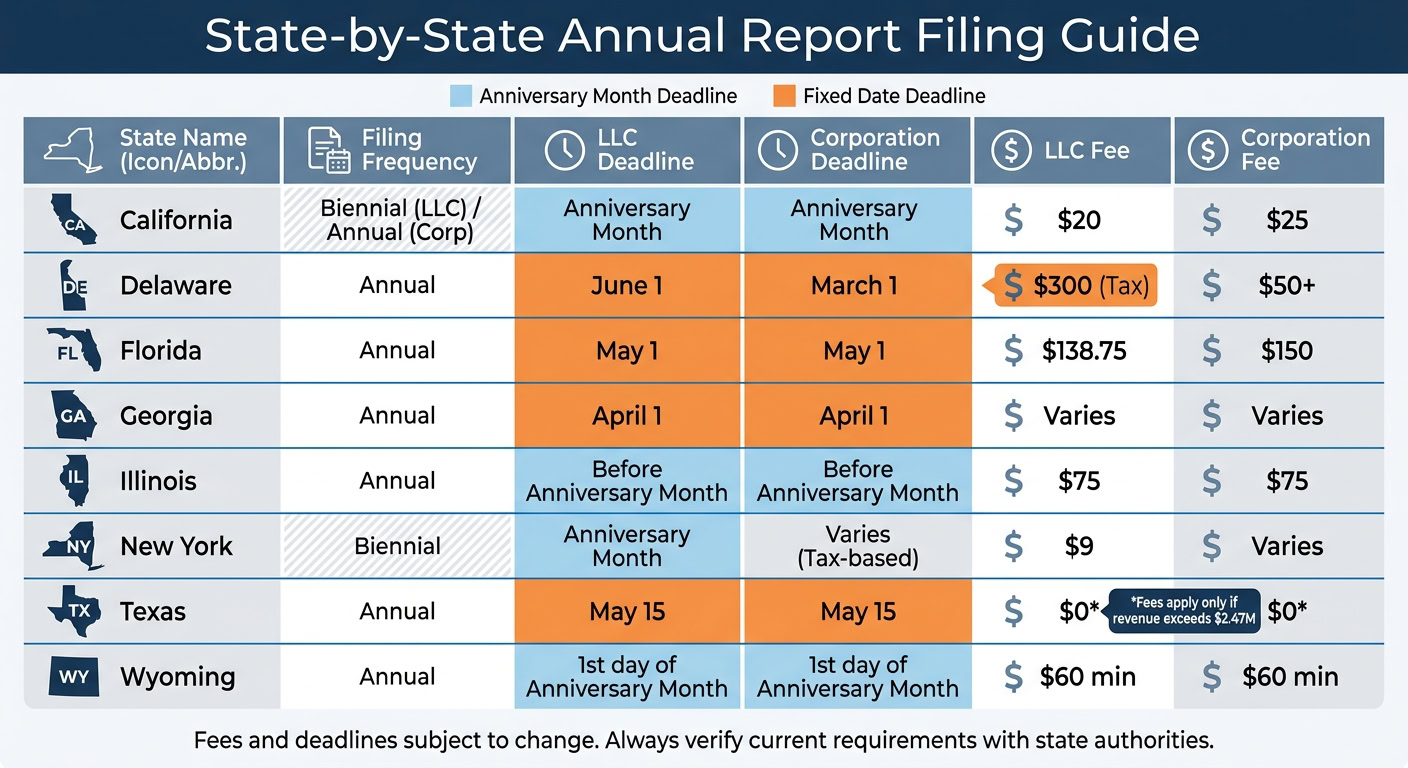
Managing compliance across multiple states means keeping track of a patchwork of deadlines. These deadlines can be tied to fixed dates, anniversary dates, or fiscal years, depending on the state. Understanding these approaches is key to staying on top of your obligations, as filing schedules can vary widely.
Most states require annual filings for businesses, but some follow different timelines. For instance, states like Alaska, California (for LLCs), Indiana, Iowa (for LLCs), Nebraska (for LLCs), and New York mandate biennial reports every two years. Pennsylvania, which previously required decennial reports every 10 years, is shifting to annual filings starting in 2025 with a $7 fee due by September 30 [7]. On the other hand, states like Arizona, Mississippi, Missouri, New Mexico, Ohio, and South Carolina don’t require annual reports for LLCs, although corporations in these states may still have filing requirements [1][7].
How states structure their deadlines also impacts compliance tracking. Fixed calendar dates, such as Florida’s May 1 or Delaware’s March 1 deadlines for corporations, are generally easier to manage when overseeing multiple entities. However, anniversary-based deadlines require businesses to track the specific formation date of each entity. For example, a Wyoming LLC formed on March 15, 2024, would need to file its annual report by March 1, 2025. Foreign entities face additional challenges, as states may impose different deadlines for out-of-state businesses. The table below provides a snapshot of filing schedules across several states.
State-by-State Filing Schedule Comparison
| State Frequency LLC Deadline Corporation Deadline LLC Fee Corp Fee | |||||
|---|---|---|---|---|---|
| California | Biennial (LLC) / Annual (Corp) | Anniversary Month | Anniversary Month | $20 | $25 |
| Delaware | Annual | June 1 | March 1 | $400 (Tax) | $50+ |
| Florida | Annual | May 1 | May 1 | $138.75 | $150 |
| Georgia | Annual | April 1 | April 1 | Varies | Varies |
| Illinois | Annual | Before Anniversary Month | Before Anniversary Month | $75 | $75 |
| New York | Biennial | Anniversary Month | Varies (Tax-based) | $9 | Varies |
| Texas | Annual | May 15 | May 15 | $0* | $0* |
| Wyoming | Annual | 1st day of Anniversary Month | 1st day of Anniversary Month | $60 min | $60 min |
*Texas requires a Franchise Tax/Public Information Report; fees apply only if revenue exceeds $2.47M.
What Happens When You Miss a Deadline
Missing a filing deadline can lead to more than just late fees – it can jeopardize your business’s compliance status. States impose penalties that vary in amount, and interest may accrue over time [7].
The consequences don’t stop there. Failing to file on time can cost your business its “good standing” status, which can block access to financing, government contracts, license renewals, and legal actions. In extreme cases, the state may administratively dissolve your business, removing liability protections and potentially leaving personal assets exposed to business debts. Worse yet, your business name could become available for others to claim.
To regain compliance, you’ll need to file all overdue reports, pay any accumulated fees and penalties, and submit a reinstatement fee, which typically ranges from $50 to $500 [7]. For businesses operating in multiple states, using a compliance calendar with reminders set at 30, 60, and 90 days before deadlines is a smart way to stay organized. Also, ensure your “good standing” status is verified before renewing any business licenses, as many licensing boards require proof of compliance.
Filing Fees and Costs
Running a business across multiple states comes with a range of expenses, including filing fees, franchise taxes, late penalties, and reinstatement fees. These costs can vary significantly depending on each state’s requirements.
State Filing Fees by Entity Type
The fees for annual reports differ by state and entity type, ranging from $0 to $500 [7]. For instance, states like Idaho, Minnesota, and Mississippi don’t charge standard LLCs for annual reports, while Massachusetts has the highest fee at $500 for LLCs. On average, the national LLC annual report fee is about $91 as of 2026 [6].
Interestingly, fees often differ between LLCs and corporations within the same state. In Massachusetts, LLCs pay $500 while corporations are charged $125. In Tennessee, LLCs face a flat $300 fee, yet corporations pay just $20. Similarly, in North Carolina, LLCs pay $200 compared to only $25 for corporations [1][7].
Some states also tack on additional fees beyond the base filing costs. For example:
- California: Requires an $800 minimum annual franchise tax for most entities, plus a $20 biennial Statement of Information fee [7][8].
- Delaware: Charges LLCs a flat $400 annual tax, while corporations pay a franchise tax based on authorized shares, which can exceed $200,000 [7][1].
- Texas: Businesses with revenue under $2.47 million owe no franchise tax but must still file a Public Information Report [7][6][8].
Here’s a quick look at some state-specific fees:
| State | LLC Annual Fee | Corp Annual Fee | Frequency |
|---|---|---|---|
| Idaho | $0 | $0 | Annual |
| Minnesota | $0 | $0 | Annual |
| New York | $9 | Varies | Biennial |
| Kentucky | $15 | $15 | Annual |
| Colorado | $25 (online) | $10 | Annual |
| Georgia | $50 | $50 | Annual |
| Illinois | $75 | $75 | Annual |
| Florida | $138.75 | $150 | Annual |
| North Carolina | $200 | $25 | Annual |
| Delaware | $400 | $50 + Franchise Tax | Annual |
| Tennessee | $300 | $20 | Annual |
| Nevada | $150 + $200 License | $150 + $200 License | Annual |
| Massachusetts | $500 | $125 | Annual |
Costs of Non-Compliance
Staying on top of filing deadlines is crucial because the penalties for missing them can be steep. For example:
- Florida: Late filings incur a $400 penalty – nearly triple the standard $138.75 filing fee [7][1].
- Delaware: Imposes a $200 late fee plus 1.5% monthly interest on overdue amounts [6][1].
- California: Charges a $250 penalty for late filing of its Statement of Information [1][2].
Reinstatement fees can also pile up if a business loses its “Good Standing” status. Beyond financial costs, non-compliance can disrupt operations, making it impossible to open or maintain bank accounts, secure financing, or take part in legal proceedings. Many contracts even include clauses that place businesses in default if they lose their “Good Standing” [2].
For businesses operating in multiple states, keeping track of varying deadlines is critical to avoid these complications and ensure smooth operations.
sbb-itb-ba0a4be
How to Manage Multi-State Compliance
Keeping up with annual report deadlines across several states can feel like a juggling act. Some states, like Delaware, set fixed deadlines – March 1 for corporations – while others tie due dates to the anniversary of the entity’s formation. Without a reliable system, it’s easy to miss a filing, which can result in hefty penalties or even administrative dissolution.
Compliance Tracking Tools and Calendars
Centralizing your entity data is a smart way to stay on top of multi-state deadlines. A master list is essential – it should include details like principal addresses, registered agent information, officer names, and filing deadlines for every state where you’re registered. Don’t forget to include foreign qualifications, which are often overlooked [3].
Set up automated alerts to remind you of upcoming deadlines. These notifications give you time to double-check details, gather necessary documents, and navigate state filing portals without the last-minute scramble. Filing early is always a good idea to avoid technical hiccups [9].
An annual audit of your active entities is another key step. This review ensures your records are up to date and flags any dormant entities that might be better off dissolved or withdrawn. Taking care of these before the next filing cycle can save you from paying unnecessary fees or franchise taxes [9].
Working with Professional Compliance Services
While internal tracking tools are a great starting point, many businesses opt to bring in professional help for added peace of mind. If you’re operating in multiple states, outsourcing compliance tasks can simplify the process. Services like BusinessAnywhere provide a centralized platform to manage all your entity data, filing history, and compliance records in one place [9]. They handle tracking deadlines for each state and send alerts so you never miss a filing.
These services often go a step further by preparing and submitting reports on your behalf. Many platforms also integrate registered agent services, ensuring you receive legal notices and compliance reminders on time [7]. While professional filing services typically charge $50 to $100 per state (plus state fees), the convenience and reliability they offer often make them worth the cost [7].
“Annual report filings are among the simplest – and most easily missed – compliance obligations. A single, overlooked report can jeopardize your entity’s good standing and generate penalties and legal constraints.” – SingleFile [9]
For businesses managing compliance across multiple states, combining automated tracking, centralized record management, and expert filing services can save time and prevent costly mistakes. This proactive approach sets the stage for a closer look at how BusinessAnywhere’s tools can take compliance management to the next level.
How BusinessAnywhere Handles Multi-State Compliance

BusinessAnywhere simplifies the complex process of managing multi-state compliance by offering a centralized online dashboard. Instead of juggling multiple state portals and manually tracking deadlines, the platform streamlines everything with automated alerts, secure document storage, and a managed filing service. It keeps an eye on state-specific deadlines, requirements, and fees across all jurisdictions where your business operates. This all-in-one approach ensures that staying compliant is both efficient and stress-free.
Compliance Features and Tools
The platform is designed to keep you ahead of deadlines with smart compliance alerts sent at 90, 60, and 30 days before due dates [11]. Through the online dashboard, you can access real-time updates on pending obligations and retrieve filed reports whenever needed. When it’s time to file, the process is straightforward: confirm your business details via a quick online form, and BusinessAnywhere takes care of preparing and submitting the necessary paperwork to the state.
A key feature is the integrated registered agent service, which ensures you never miss important state correspondence or legal notices. All official documents are scanned and uploaded directly to your secure cloud dashboard for immediate access [10]. This not only keeps your personal address off public records but also protects you from junk mail and data harvesting. For those on the Complete plan, annual report filing services are included, with only state-imposed fees as an additional cost [11].
Advantages for Multi-State Businesses
For businesses operating across multiple states, BusinessAnywhere offers practical benefits, especially for digital nomads and remote owners. Since a registered agent must be physically present during standard business hours (9 AM to 5 PM), the service allows you to run your business from anywhere [10]. By centralizing compliance management, the platform creates a single, reliable source for tracking state-specific requirements, saving time and reducing administrative headaches.
Transparent pricing ensures you know all costs upfront, including state fees, so there are no surprises when budgeting. The automated tracking and managed filing services help you avoid costly errors, ensuring your business remains in good standing – a critical factor for securing financing or winning government contracts.
Conclusion
State-specific requirements, deadlines, and fees highlight how crucial compliance is to your business’s success. Staying on top of multi-state annual report filings is more than just a legal formality – it’s the backbone of your business’s legal standing and future growth. Missing a filing can lead to serious consequences, such as losing liability protection, restricted access to bank accounts, or even forfeiting your business name. As financial analyst Pavel Konopelko wisely states, “Treat your annual report not as a bureaucratic nuisance, but as the annual premium payment on your business’s liability insurance policy” [2].
For businesses operating in multiple states, the complexity of compliance grows exponentially. Falling out of good standing can lead to reinstatement processes that take anywhere from one to eight weeks. On top of that, you’ll need to pay overdue fees, penalties, and sometimes secure tax clearance [2].
Given these high stakes, a streamlined approach to compliance is a game-changer. BusinessAnywhere simplifies multi-state compliance by automating deadlines, managing state-specific requirements, and ensuring accurate filings – all through a single, user-friendly dashboard. With this system, you can keep your entities in good standing without the stress of juggling multiple state portals.
FAQs
How do I know which states I must file annual reports in?
Filing annual reports is a must for every state where your business is either registered or authorized to operate. Each state has its own set of rules, deadlines, and fees, so it’s crucial to familiarize yourself with the specific requirements for each location. Missing a deadline can result in penalties or, worse, administrative dissolution of your business. Staying on top of these filings helps ensure your business stays in good standing.
What’s the fastest way to find each state’s due date and fee?
The fastest way to check due dates and fees for annual report filings is through trusted online platforms that gather state-specific details for all 50 states. One such option is BusinessAnywhere, which offers compliance assistance to entrepreneurs and remote business owners by providing current and accurate information on deadlines and fees. This method saves time compared to visiting each state’s Secretary of State website individually, especially since these deadlines and fees often change from year to year.
How can I fix it if my company loses good standing?
To get your company back in good standing, start by filing any overdue or missing annual reports. Make sure to update your business information with the state and pay any late fees that apply. If your company has been administratively dissolved, you’ll likely need to file a reinstatement application, pay the required reinstatement fees, and address any compliance issues. Taking prompt action can help you avoid additional penalties or complications.