
Most small businesses should start with 3–5 posts per week on one main platform and stick to that pace for at least 3–6 months. If I post too much and can’t keep it going, results usually drop. If I post too little, my business is easy to miss.
Here’s the short answer:
- Start small: 3–5 posts per week on your main channel
- Pick 2–3 core platforms: not every platform
- Post by platform speed:
- Instagram: 3–5 feed posts/week
- Facebook: 3–5 posts/week
- LinkedIn: 3–5 posts/week for founders, 2–3 for company pages
- TikTok: 1–3 posts/day
- X: 1–3 posts/day, then more only if I can keep it going
- Check results every 4–6 weeks
- Watch the right numbers: reach, engagement, leads, unfollows, and booked calls
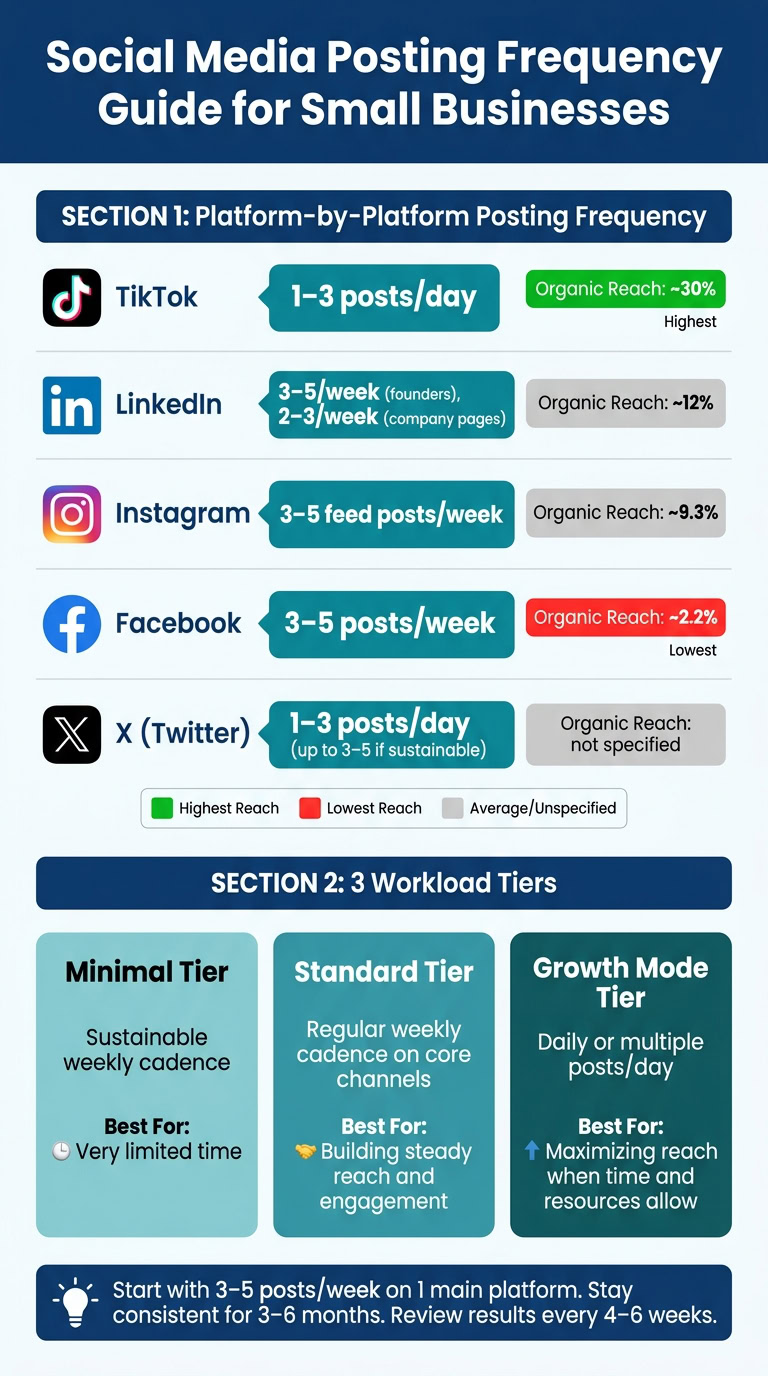
Social media growth is usually slow. Organic reach can be around 30% on TikTok, 12% on LinkedIn, 9.3% on Instagram, and 2.2% on Facebook. That’s why a steady posting rhythm matters more than random bursts.
| Platform | Starting Frequency | Notes |
|---|---|---|
| 3–5 posts/week | Add Stories between feed posts | |
| 3–5 posts/week | Good for local promos and events | |
| 3–5/week or 2–3/week | Founders can post more than company pages | |
| TikTok | 1–3/day | Best fit if I can post often |
| X | 1–3/day | Feed moves fast, so frequency matters |
The main idea is simple: I should choose a posting schedule I can keep up with, batch content, schedule it ahead of time, and make small changes only after the data says I should.
How to Choose a Posting Rhythm Based on Goals and Resources
Match Your Posting Frequency to Your Main Goal
Start with a simple baseline, then line it up with the outcome you want. Your main goal should drive your posting cadence.
If you want brand awareness or authority, steady organic posting is the play. You need to show up on a regular basis so people keep seeing your name, your ideas, and your point of view.
If you want leads or sales, posting alone usually isn’t enough. You also need stronger distribution so your content gets in front of the right people.
For organic growth, consistency matters more than volume. Posting at a pace you can keep up with beats going hard for a week and then disappearing.
3 Workload Tiers: Minimal, Standard, and Growth Mode
Not every small business can post every day. And that’s fine. What matters is picking a pace you can stick with.
| Tier | Weekly Pace | Best For |
|---|---|---|
| Minimal | A sustainable weekly cadence | Staying visible with very limited time |
| Standard | A regular weekly cadence on core channels | Building steady reach and engagement |
| Growth Mode | Daily or multiple posts per day | Maximizing reach when time and resources allow |
Growth Mode works best for businesses that can post daily without letting quality slip. Think of these tiers as a simple way to set your pace. From there, you can adjust for each platform.
Free Up Time by Keeping Business Operations Organized
Here’s the part people often miss: content doesn’t compete only with other marketing work. It also competes with admin.
Formation paperwork, compliance tasks, and mail handling can eat up the time you meant to spend planning posts. When that pile grows, content is usually the first thing to get pushed back.
Using a service like BusinessAnywhere to handle company formation, compliance, and streamlining small business operations with a virtual mailbox takes those tasks off your plate. That time savings makes your posting rhythm easier to sustain. That capacity becomes your platform-by-platform schedule.
sbb-itb-ba0a4be
How Often to Post on Each Platform
Each platform needs its own posting rhythm. Start with your baseline, then adjust based on how quickly content gets buried in the feed.
Instagram and Facebook: Steady Weekly Posting Without Overdoing It
Instagram and Facebook sit in the Standard tier from the workload framework above.
For Instagram, aim for 3–5 feed posts per week. If you have the bandwidth, add Stories between feed posts. That keeps your account active without forcing you to make another full post every time.
Facebook is a good fit for local promotions and events. A practical posting pace is 3–5 posts per week, with short bursts around promotions or local happenings.
If your audience leans more professional than local, put more of that effort into LinkedIn instead.
LinkedIn: Post Less, but Make Each Post Count
LinkedIn falls between the Standard and Growth tiers, depending on what you’re trying to do.
For founders, post 3–5 times per week. For company pages, 2–3 posts per week is a solid target.
Text-first posts and carousels tend to do best here. That makes LinkedIn a strong channel for sharing expertise, client results, and industry insight.
If you’re thinking about posting more, do it only if you can keep the pace going without letting quality slip.
TikTok and X: Higher Frequency Only If You Can Keep It Up
TikTok and X both land in the Growth tier. These platforms lean heavily on frequency, but more posts only help if the quality stays solid.
TikTok: 1–3 posts per day. It rewards volume and has the strongest organic reach among the major platforms, at about 30%.
X: Start with 1–3 posts per day. Move to 3–5 only if you can keep that pace up. The feed moves fast, so posting less often usually makes it harder to stay visible.
Here’s the short version by platform:
| Platform | Suggested Frequency |
|---|---|
| TikTok | 1–3 posts/day |
| 3–5 posts/week (founders); 2–3 posts/week (company pages) | |
| 3–5 feed posts/week | |
| 3–5 posts/week | |
| X | 1–3 posts/day; 3–5 if you can sustain it; fast-moving feed requires frequent posting |
How to Build a Weekly Posting Schedule You Can Stick To
Once you’ve set your posting frequency for each platform, the next step is turning that into a routine you can repeat every week. Frequency gives you a target. A weekly system helps you actually hit it.
Pick 2-3 Core Platforms and Set a Weekly Cadence
Start with two or three channels where your audience spends time and your team can keep up without burning out. More platforms may sound good on paper, but if you can’t keep them active, they become dead weight.
After you choose your core platforms, lock in fixed posting days and times. That removes guesswork and makes the whole process easier to follow. Instead of asking, “What should we post today?” you already know what needs to go out and when.
With your core channels in place, you can build a content system that keeps them moving each week.
Use a Content Calendar and Batch Your Content Creation
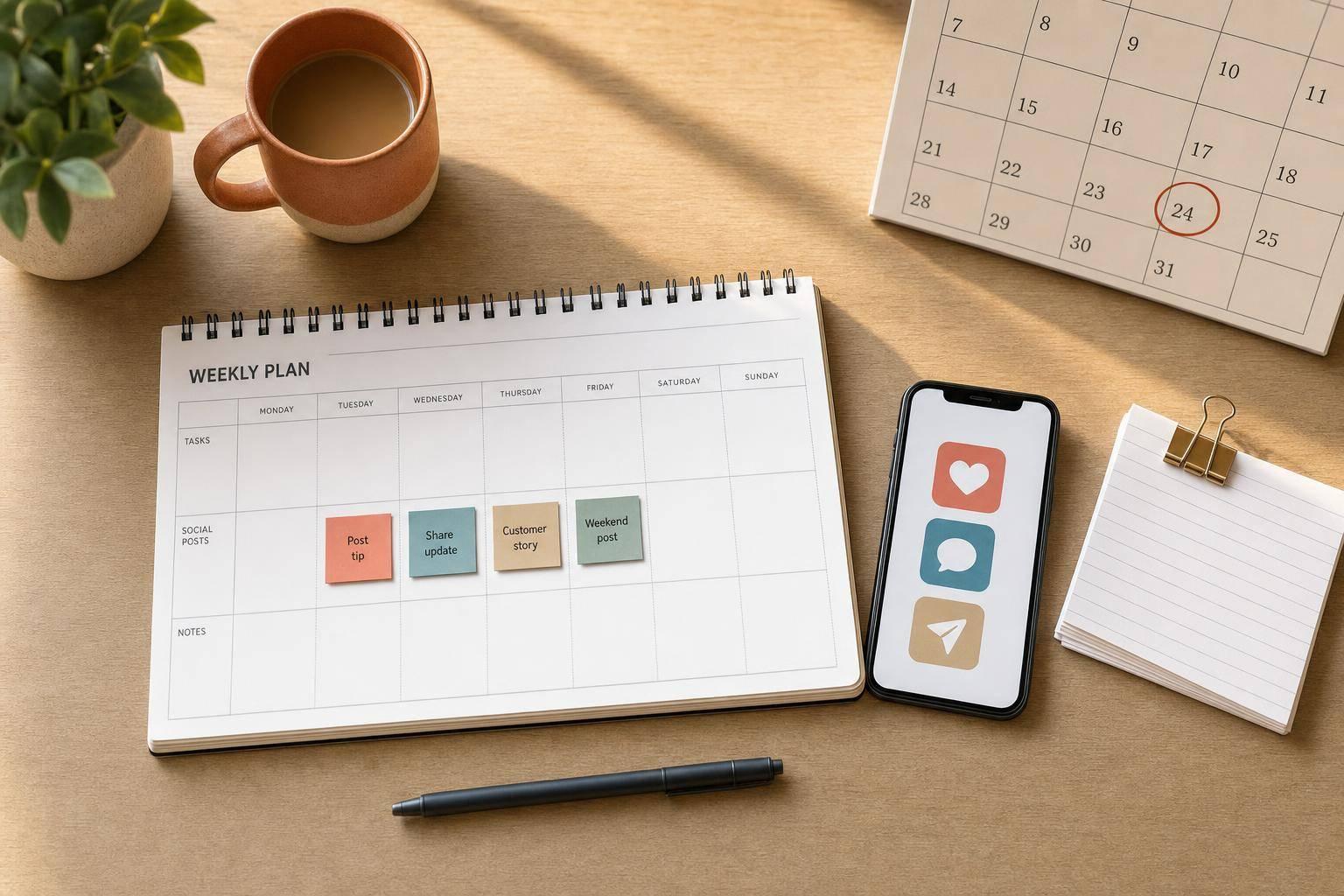
A simple weekly content calendar goes a long way. Use repeatable post types so you’re not starting from zero every time. A small rotation of formats can keep your feed mixed up without making planning feel like a chore.
Batching is where you save time. Set aside one block each week to write captions, pick images, and film short videos in one sitting. It’s a lot easier to stay on track when you’re in “content mode” once, instead of stopping to make posts every day.
You can also stretch one idea across several posts and platforms. One topic might become a short video, a carousel, and a caption-driven post. Same idea, different format.
Schedule Posts in Advance and Keep Your Back Office in Order
After your content is batched, schedule it ahead of time. That way, posting doesn’t depend on memory or whatever chaos shows up during the day. A scheduling tool lets you line up the week’s posts in one session and move on.
It also helps to keep admin tasks from eating into your posting time. A platform like BusinessAnywhere can handle compliance and mail, so those jobs don’t shove your content routine off the calendar.
Then, after a few weeks, check your analytics and adjust your cadence based on what the numbers show.
How to Track Results and Adjust Your Posting Frequency
After you set a posting cadence, check your analytics to see if it’s doing its job. Once your schedule is live, look at whether it’s driving reach, engagement, and leads.
The Metrics That Show Whether Your Cadence Is Working
Watch organic reach and engagement rate. If your goal is lead generation, track cost per lead (CPL) and cost per booked call too.
Some patterns tell you a lot fast. If engagement is dropping while unfollows are climbing, that’s a strong sign you may be posting too often. If reach stays flat, your cadence may be too light. These numbers are best used as reference points, not strict goals.
| Platform | Organic Reach Benchmark |
|---|---|
| TikTok | ~30% |
| ~12% | |
| ~9.3% | |
| ~2.2% |
Review Your Schedule Every 4–6 Weeks and Make Small Changes
Don’t change everything at once. Adjust one variable at a time, then review results after 4–6 weeks. That gives you a cleaner read on what actually moved the needle.
For organic social platforms like TikTok, Instagram, and X, meaningful growth usually takes 3 to 6 months. So if results don’t jump overnight, that’s normal.
If reach is flat, try increasing posting volume little by little. If engagement slips as frequency goes up, pull back and find a level you can keep up with.
Conclusion: Start Small, Stay Consistent, and Scale When Results Support It
The best posting frequency isn’t the highest one. It’s the one you can stick with. Start with a realistic cadence, review performance every 4–6 weeks, and make changes only when the numbers back it up.
FAQs
What if I can only post once or twice a week?
You can still maintain an effective social media presence by focusing on quality over quantity.
For many professional services firms and consultancies, posting high-value insights once or twice a week can be enough to build authority. That might mean a practical checklist, a sharp point of view, or a fix for a common niche problem. You don’t need to post every day to stay visible. You need posts that make people stop and think, this is useful.
To make those posts count, stick to two or three channels where your audience is already active. Then use scheduling tools like Buffer or Hootsuite to keep your posting steady without turning it into a full-time job.
How do I know which social platform to focus on first?
Start by figuring out where your audience already hangs out. Then pick one to three platforms that line up with your audience, your business goals, the kind of content you can actually make, and the time you have.
A simple scorecard can make this easier. Rank each platform based on:
- how active your audience is there
- how well the platform fits your strengths
- how much reach it may give you
In most cases, it’s smarter to go deep on one or two channels your clients use than try to be everywhere at once.
Should I prioritize consistency or posting more often?
Yes – put consistency ahead of posting more often. A steady, realistic schedule plus strong content usually works better than posting all over the place or trying to show up everywhere at once.
Posting too much can weaken engagement and spread your time and energy too thin. It’s usually smarter to stick to a dependable cadence on the platforms where your audience spends time. That helps support visibility, growth, and long-term stability.