
The short answer: if I wanted to start a landscaping business in the U.S. today, I’d do 4 things first: pick services, set a startup budget, form an LLC, and line up licenses, insurance, and pricing before taking jobs.
The market is big – about $176.7 billion in 2026 with roughly 556,000 businesses – so I wouldn’t jump in with tools alone. I’d want a simple plan that covers what I’ll sell, what it will cost, how many jobs I need each week, and how I’ll keep my personal money separate from the business.
Here’s the article in plain English:
- Choose a starting service mix like mowing, cleanups, or mulch work based on local demand and my skill set.
- Map startup costs for equipment, trailer or truck use, software, insurance, filings, and 2–3 months of cash buffer.
- Check break-even math early. For example, if fixed monthly costs are $3,000 and each mowing job leaves $40 after fuel and wear, I’d need about 75 jobs a month.
- Use an LLC if I want liability separation without the extra rules that often come with a corporation.
- Get an EIN from the IRS for $0, open a business bank account, and keep business and personal spending apart.
- Write an operating agreement, even if my state doesn’t ask for one.
- Match each service to permits and insurance. Mowing, pesticide work, irrigation, and hardscaping can all trigger different rules.
- Price jobs with costs in mind and market through Google Business Profile, yard signs, referrals, and local contacts.
Quick comparison
| Topic | What I’d focus on |
|---|---|
| Services | Start narrow and add more later |
| Budget | Equipment, filings, insurance, software, working cash |
| Business structure | LLC for many new landscaping businesses |
| Tax setup | EIN, bank account, bookkeeping |
| Legal paperwork | Articles of Organization, operating agreement, licenses |
| Risk control | General liability, commercial auto, workers’ comp if hiring |
| Early growth | Clear pricing, route planning, local marketing |
Bottom line: this article is about building the business side and the legal side at the same time, so I can start taking clients without making expensive mistakes.
sbb-itb-ba0a4be
Define Your Services, Market, and Startup Budget
Your service list shapes the whole business. It affects the equipment you buy, the licenses you need, and how much money you need on day one. Set that first before you spend anything.
Choose Services That Match Your Skills and Local Demand
Drive through the neighborhoods you want to work in before you decide what to offer. That quick lap can tell you a lot. Are most yards small and simple? Are there larger properties with heavy leaf drop? Do you see HOA communities that may want contract work?
Common starting points include:
- Weekly mowing, edging, and blowing – priced around $35–$55 per visit
- Recurring HOA maintenance – bundled mowing and seasonal cleanups on contract
- Spring and fall cleanups – debris removal, leaf cleanup, bed cleanup, and light pruning; spring bundles typically run $200–$400, fall bundles $200–$500 depending on tree cover and hauling needs
- Mulch-and-bed refreshes – weeding, bed edging, minor shrub trimming, and 2–4 cubic yards of mulch; commonly $300–$800+ per property
Start with one core service. Then layer in higher-ticket seasonal jobs once you have steady work. That keeps your setup simple and your costs under control.
Your service mix also tells you what tools to buy. A mowing-first business needs one setup. Mulch, cleanup, and bed work need another.
List Your Equipment and Software Before You Buy
A solo operator usually needs a commercial walk-behind or stand-on mower that fits local lot sizes, a string trimmer, a backpack or handheld blower, basic hand tools like a rake, shovel, and pruning shears, plus safety gear such as eye and ear protection, gloves, and steel-toe boots. You’ll also need a pickup with ramps or a small utility trailer.
If you plan to offer mulch and bed work, the list grows. You may need wheelbarrows, edging tools, a small tiller, pruning saws, hedge trimmers, tarps for debris, and a larger trailer for bulk materials. If you move into full-service crew work, expect multiple commercial mowers, separate gear for each crew member, and maybe a mini skid-steer for heavier jobs.
Software matters too. Pick your scheduling, estimating, invoicing, and route-planning tools before launch. Good route planning cuts drive time and fuel use, which sounds small at first but adds up fast when you’re running jobs all week.
Estimate Costs and Set Break-Even Targets
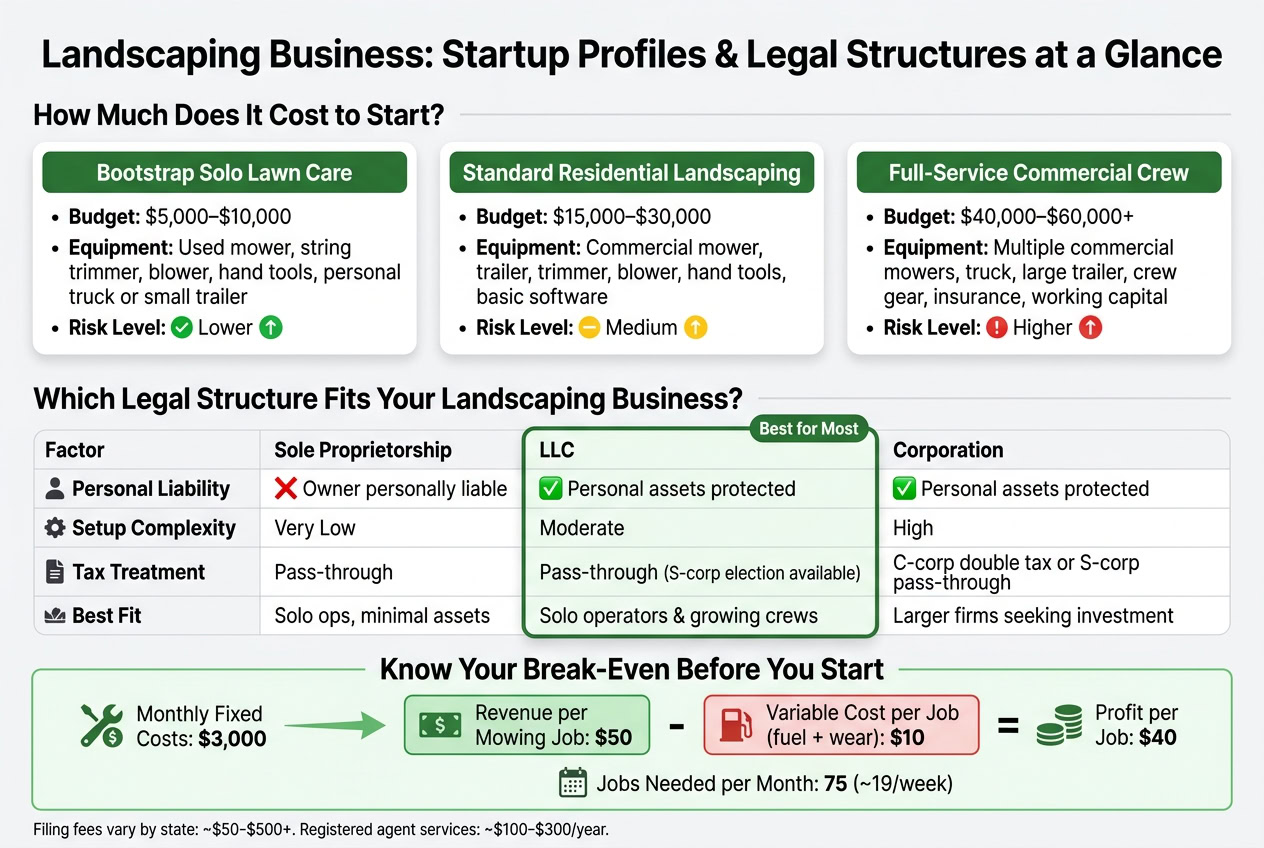
Startup costs can swing a lot depending on how big you want to start. Here’s a realistic look at three common setups:
| Startup Profile | Budget Range | Equipment Set | Risk Level |
|---|---|---|---|
| Bootstrap solo lawn care | $5,000–$10,000 | Used mower, string trimmer, blower, hand tools, personal truck or small trailer | Lower |
| Standard residential landscaping | $15,000–$30,000 | Commercial mower, trailer, trimmer, blower, hand tools, basic software | Medium |
| Full-service commercial crew | $40,000–$60,000+ | Multiple commercial mowers, truck, large trailer, crew gear, insurance, working capital | Higher |
Break your budget into line items before you buy anything. Typical startup costs include LLC filing steps and costs, local licenses, insurance, equipment, vehicle and trailer costs, fuel and maintenance, marketing, software, and 2–3 months of working capital.
For break-even, keep it simple. Add up your fixed monthly costs. Then divide that number by the profit each job leaves after variable costs like fuel and wear.
If your monthly fixed costs total $3,000 and each $50 mowing job costs $10 in fuel and wear, each job contributes $40 – meaning you need about 75 jobs per month, roughly 19 per week, to break even.
Run this math with your own numbers before you file. It’s a lot better to spot a pricing problem on paper than after you’ve bought a trailer and printed yard signs.
Once your service mix and budget are set, choose the legal structure that fits the business. You should compare business structures like LLCs and S-Corps to see which offers the best tax and liability protection for your goals.
Choose a Business Structure and Register the LLC
Once your budget is set, pick a structure that fits how you plan to run the business and how much risk you’re taking on. In landscaping, that matters. Your mix of services, equipment, crew size, and job-site exposure all affect how much protection you may want and how much paperwork you’re willing to deal with.
Compare Sole Proprietorship, LLC, and Corporation
A sole proprietorship is the default if you start taking jobs without filing formation papers. It’s easy to start, but there’s a big downside: there’s no legal separation between you and the business. If a client sues you or there’s property damage on a job site, your personal assets may be on the line.
A corporation also gives you limited liability, but it usually comes with more formal rules than most new landscaping businesses want. A C corporation can also mean double taxation, where the business pays tax on profits and shareholders pay tax again on dividends.
For many landscaping owners, an LLC hits the sweet spot. It gives you liability protection, pass-through taxation, and less paperwork than a corporation. If the business grows, an LLC can also elect S-corp tax treatment later if that fits your tax setup better.
| Factor | Sole Proprietorship | LLC | Corporation |
|---|---|---|---|
| Personal liability | Owner personally liable | Personal assets protected | Personal assets protected |
| Setup complexity | Very low | Moderate; Articles of Organization required | High |
| Tax treatment | Pass-through to personal return | Pass-through by default; S-corp or C-corp election available | C-corp double taxation or S-corp pass-through |
| Fit for landscaping | Solo ops with minimal assets | Solo operators and growing crews | Larger firms seeking outside investment |
File the LLC With the Correct Formation Details
For most landscaping owners, the best state to form in is the state where you do business. Filing in another state can sound smart at first, but it often adds more work. You may still have to register as a foreign LLC where you actually operate, which can mean extra fees and more filings.
Before you submit anything, search your state’s business name database to make sure the name is open. Your LLC name must include "LLC" or "Limited Liability Company" and it has to be different from names already on file. It’s also smart to check trademarks, domain names, and social media handles before you lock it in.
The main filing document is the Articles of Organization. This form usually asks for your LLC name, principal office address, registered agent name and address, and your management structure. For many small landscaping businesses, a member-managed setup works well because the owners handle day-to-day operations. A manager-managed setup makes more sense if you want someone who isn’t an owner to run crews and oversee daily work.
Every state requires a registered agent with a physical street address in the formation state who can be reached during business hours. If you’re out on job sites most of the day, a professional registered agent service can make life easier. That usually costs about $100 to $300 per year.
State filing fees usually run from about $50 to $500+. Check your state’s official business filing site before you send in your paperwork.
With the LLC filed, the next steps are your EIN, operating agreement, and business banking.
Get an EIN, Create an Operating Agreement, and Set Up Business Admin
Your LLC is formed. Now it’s time to make it usable day to day with an EIN, separate banking, clean records, and a proper mail setup. Start with the EIN. It opens the door to banking, payroll, and tax setup.
Apply for an EIN and Separate Your Finances
An Employer Identification Number (EIN) is the federal tax ID for your LLC. You’ll need it to open a business bank account, hire employees and run payroll, and file many federal and state tax returns. The IRS issues EINs for free.
Before you apply, have a few details ready: your LLC’s legal name, formation date, principal business address, and the responsible party’s name and SSN or ITIN. The IRS online application walks you through the SS-4 questions step by step and gives you the EIN as soon as you finish. It’s available Monday through Friday, 7:00 AM to 10:00 PM ET.
| Application Method | Cost | Speed | Best For |
|---|---|---|---|
| IRS Online | $0 | Instant | U.S.-based applicants with a valid SSN or ITIN who need the EIN right away |
| IRS Fax | $0 | About 4 business days | Applicants who want a paper method with a faster turnaround than mail |
| IRS Mail | $0 | About 4–6 weeks | Applicants who prefer paper filing and do not need the EIN quickly |
| Filing Service | $97 flat fee | Varies | Founders who want hands-off help |
Once you have the EIN, open a business bank account and use it only for business income and expenses. Don’t mix it with personal spending. That split makes bookkeeping cleaner and helps protect your LLC’s liability shield.
Once the tax ID is set, put in writing how the LLC will be owned and managed.
Create an Operating Agreement and Organize Your Records
The operating agreement is your LLC’s internal rulebook. It isn’t a public filing, but it’s one of the most important documents you’ll put together. Most states don’t require one, but if you skip it, your state’s default rules run the show.
At a minimum, the agreement should spell out:
- Ownership percentages
- Management authority
- How profits and losses are split
- How voting works
- How new members can join
- What happens if the business is sold or shut down
These points matter more than they may seem at first glance. For a two-member LLC – say, one partner handles sales and scheduling while the other manages crews and equipment – add terms for buyouts, deadlocks, and dispute resolution.
Keep your core documents in one digital folder system: Articles of Organization, EIN confirmation letter, operating agreement, business licenses, insurance certificates, service contracts, invoices, receipts, payroll records, and tax correspondence. When tax season hits or a client asks for paperwork, you’ll be glad everything is in one place.
After governance is set, separate your public mailing address from your registered agent.
Use a Business Address and Mailbox the Right Way
A virtual mailbox gives your landscaping LLC a professional street address for client mail, vendor statements, and bank correspondence. It also helps keep your home address off public records.
But don’t confuse a virtual mailbox with a registered agent. They do different jobs. Your registered agent must have a physical street address in your formation state and must be available in person during normal business hours to receive legal notices and service of process. Use both where needed.
Get Licensed, Insured, and Ready to Win Your First Clients
Now it’s time to make the business legal, insurable, and ready to sell. Once your LLC is set up, the next step is simple: match each service you offer to the licenses, permits, and insurance it may trigger.
Handle Licenses, Permits, and Insurance by Service Type
If you’re offering basic mowing, edging, and blowing, you’ll often need a local business license, any tax registrations your city or state requires, and proof of insurance. But the moment you move into pesticide or herbicide application, the rules usually get tighter. In most states, that means getting a commercial pesticide applicator certification through the state Department of Agriculture. That often includes an exam or approved training. Skip it, and fines can follow.
Bigger jobs can bring another layer of rules. Retaining walls, irrigation, drainage, and hardscaping may trigger contractor licensing, permits, or registration, especially if the work affects utilities or goes above local dollar limits. Before you advertise those services, check with your state’s contractor licensing board.
On the insurance side, most small landscaping LLCs start with four main policy types: general liability, commercial auto, tools and equipment coverage, and workers’ compensation. If you want to keep it lean at first, start with general liability and commercial auto. Then add tools coverage and workers’ compensation as the business grows.
| Service Type | Common Requirements |
|---|---|
| Mowing and basic maintenance | Local business license, any required tax registrations, general liability insurance |
| Pesticide/herbicide application | State pesticide applicator certification, possible commercial applicator certification |
| Irrigation and water system installs | Specialized irrigation or plumbing-related license, backflow permits |
| Hardscaping and larger installs | Contractor registration or license, possible surety bond or permit requirements |
| Employee-based operation | Workers’ compensation insurance |
These costs shouldn’t sit in the background. They need to show up in your pricing from day one.
Price Jobs and Market to Local Customers
Start with your floor rate. Add up your total monthly costs and the pay you want to take home, then divide that by your realistic billable hours. That gives you the minimum rate your jobs need to clear. If a job doesn’t hit that number, it’s costing you money.
For mowing, a simple tiered sheet works well. Price by lot size and how tough the job is. For recurring work, monthly maintenance packages are often easier to sell and easier to manage. Bundle mowing, edging, and blowing into one flat monthly fee based on the number of visits you expect.
Cleanups need a different setup. Charge a minimum fee, then bill extra time by the hour. Add a separate line item for debris haul-off, priced per trailer load. And if the lot looks like it hasn’t seen a mower in months, add a first-cut surcharge for overgrowth.
Once pricing is locked in, shift your attention to getting seen in the neighborhoods you serve.
To land your first clients, mix offline and online moves:
- Put yard signs at active job sites, with permission, and make your phone number easy to read.
- Set up and verify your Google Business Profile so you can show up in "lawn care near me" searches. Add photos of finished work, list your service areas, and ask every happy customer for a review.
- Reach out to property managers and real estate agents with a short intro. Recurring work for multi-unit properties or vacant listings can fill your calendar fast.
- Offer a referral credit so early customers help bring in the next wave of leads.
Conclusion
Right now, the big priorities are compliance, clean pricing, and steady marketing. Build a simple calendar to track every deadline. A spreadsheet is enough. Include your state annual or biennial report, local business license renewal, pesticide applicator certification renewal, insurance policy renewal, and quarterly estimated tax payments. Set reminders 30 to 60 days ahead of each date. Miss one filing, and your LLC can fall out of good standing. That can also create problems with clients who want current certificates of insurance or license verification.
Strong systems from day one make a huge difference. Clean books, written contracts, steady pricing, and a compliance calendar help a landscaping business grow with less chaos. The LLC gives you the base. The systems you build on top of it decide how far the business can go.
FAQs
Should I start with mowing only or offer multiple services?
Start with mowing only if you want a simple, low-cost way to get in the door and you can line up steady residential maintenance jobs.
But don’t stay with one service for too long. Add related work you can price clearly and bundle, like edging, trimming, fertilizing, aeration, and landscaping. That lets you serve more customer needs and smooth out revenue as the seasons shift.
Set your core mowing offer first. Then grow from there based on local demand and what your crew, schedule, and equipment can handle.
How much money do I need to start a landscaping LLC?
You’ll usually need at least $50 to $200 to file your LLC, though state filing fees can run anywhere from $45 to $500+.
It’s smart to set aside money for a few common add-ons too. A registered agent often costs $100 to $300 per year. In some states, you may also face publication fees, which can add up to $750 to $1,750 total. And depending on where you form the LLC, annual or biennial fees or franchise taxes can range from $0 to $800+.
One small win: an EIN costs $0 if you apply for it yourself.
What licenses and insurance do I need before taking jobs?
Before you take on landscaping jobs, make sure you have the state and local licenses or permits needed to run the business legally. That can include a general business license, zoning or home-occupation permits, and a sales tax permit if you sell taxable services or goods.
Planning to use pesticides? You may also need pesticide licensing or certification. On the insurance side, carry general liability coverage and think about adding equipment or vehicle coverage. If you hire employees, you’ll need workers’ compensation too.