
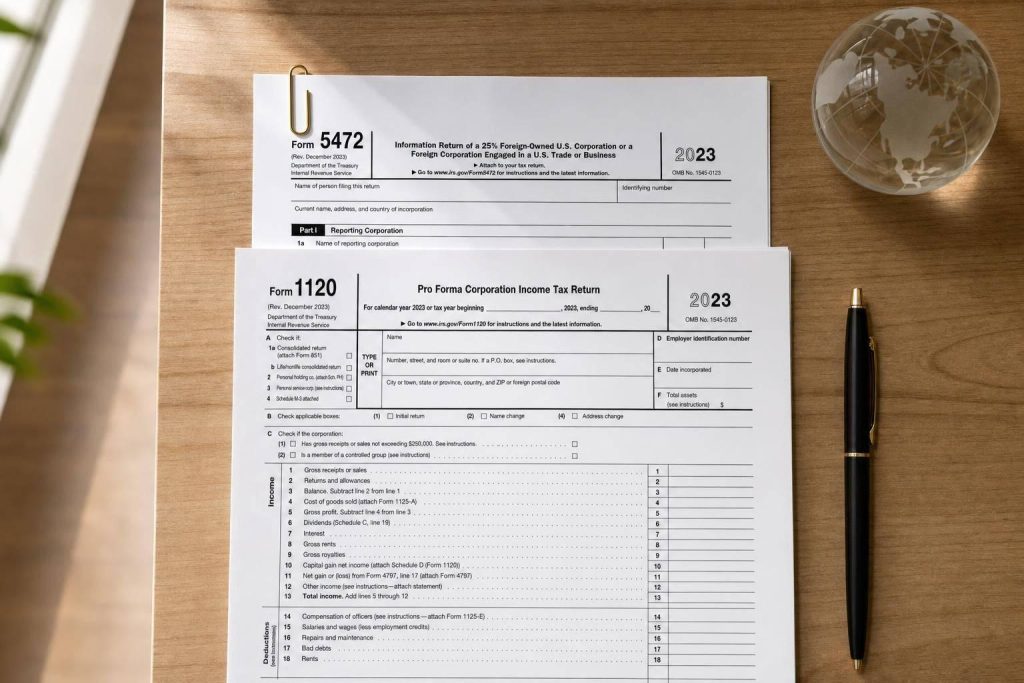
If I own a U.S. single-member LLC through a foreign person, I may need to meet Form 5472 filing requirements even if the LLC made $0 and owes no tax. The rule usually applies when three things are true: the LLC is foreign-owned, it is taxed as a disregarded entity, and it had at least one reportable transaction with the owner or another related party.
Here’s the short version:
- I file Form 5472 for each related party with reportable transactions
- I attach it to a pro forma Form 1120
- I do this even if the LLC had no income
- The due date is often April 15 for calendar-year LLCs
- Late, missing, or wrong filings can trigger a $25,000 penalty, and extra $25,000 penalties can stack after an IRS notice
This rule is about ownership and transactions – not about profit.
What usually counts as a reportable transaction?
- Owner funding
- Reimbursements
- Loans
- Interest payments
- Distributions
- Rent, royalties, and service fees
- Property or noncash transfers
One point matters most: I cannot ignore small or routine transfers. A bank wire to fund the LLC, an owner-paid bill, or a repayment to the owner can all count.
If I had to boil the article down to one checklist, it would be this:
- Confirm the LLC is foreign-owned and disregarded
- Get an EIN
- Review every transfer with the owner or related parties
- Convert all amounts to U.S. dollars
- Prepare one Form 5472 per related party
- Attach the forms to a pro forma Form 1120
- File by the deadline and keep records
| Topic | What I need to know |
|---|---|
| Who files | Foreign-owned U.S. single-member LLCs treated as disregarded entities |
| Trigger | At least one reportable transaction with a foreign owner or related party |
| Main forms | Form 5472 + pro forma Form 1120 |
| Filing method | Mail or fax, not e-file |
| Calendar-year due date | April 15 |
| Extension | Form 7004 can give 6 more months |
| Penalty | Starts at $25,000 per failure |
So if I see “disregarded entity” and think “no filing,” that’s where people get into trouble. This filing sits in the information-reporting bucket, and the IRS can still ask for it even when no income tax return would otherwise be due.
Who Must File and How to Confirm It
Use these three tests to check whether the LLC must attach Form 5472 to a pro forma Form 1120. The form applies only when the LLC is foreign-owned, treated as disregarded, and had at least one reportable transaction during the tax year. If even one of those pieces is missing, the filing duty under the foreign-owned U.S. disregarded entity rules does not apply.
Ownership, tax status, and related-party tests
Start with ownership. Review the LLC’s formation documents, operating agreement, membership ledger, and any changes in membership during the tax year. Then trace direct and indirect ownership through the full ownership chain before deciding whether the LLC is foreign-owned.
Next, check tax status. If the LLC filed Form 8832 to elect corporate status, it is not disregarded and instead follows the corporate Form 5472 rules.
Then look at every transaction during the year involving the foreign owner or any related party. Reportable activity can include owner funding, reimbursements, loans, payments, and other transfers of value.
The LLC must have an EIN, and its legal name, EIN, and principal business address must match IRS records exactly. If the LLC does not yet have an EIN, apply using Form SS-4 and select "Other" on line 9a, entering "Foreign-owned U.S. disregarded entity – Form 5472."
When separate Form 5472 filings are needed
A separate Form 5472 is generally required for each related party with reportable transactions. Put multiple transactions with the same related party on one Form 5472. If the transactions involve different related parties, file separate forms.
Here’s a simple way to think about it: the form tracks the relationship first, then the transactions under that relationship.
For example, if the LLC’s foreign owner transfers funds to the LLC’s U.S. bank account and also pays a vendor invoice on its behalf, both transactions go on one Form 5472. A payment to a separate foreign company controlled by the same owner goes on a second Form 5472.
Comparison table: Which LLC structures may need Form 5472
Use the matrix below to separate foreign-owned disregarded LLCs from other LLC structures.
| LLC Structure | Applies? | Pro Forma Form 1120? |
|---|---|---|
| Foreign-owned single-member LLC treated as a disregarded entity | Yes | Yes |
| U.S.-owned single-member LLC treated as a disregarded entity | Generally no | Generally no |
| LLC taxed as a corporation | Potentially yes | Yes, on the regular corporate Form 1120 |
sbb-itb-ba0a4be
What Counts as a Reportable Transaction
Once filing applies, go through every transfer between the LLC and its foreign owner or another related party before you file IRS Form 5472.
For Form 5472, a reportable transaction includes any transfer of money, property, services, rights, obligations, or other economic value between the LLC and its foreign owner or another related party. Each transfer should be reported separately. Don’t net one transaction against another. Use U.S. dollars and keep records showing the exchange rate you used.
Common transactions owners often overlook
The transactions people miss most often are the everyday ones. This is a common challenge for those learning how non-US citizens can start a US LLC and maintain it.
Initial funding counts. If a foreign owner wires money to open or fund the LLC’s U.S. bank account, or pays formation costs, that transfer needs to be checked for Form 5472 reporting. The same goes for later transfers used to cover payroll, vendor bills, or other operating costs.
Owner-paid LLC expenses also count, and any later reimbursement is its own separate transaction.
Noncash transfers count too. If a foreign owner transfers equipment, inventory, intellectual property, cryptocurrency, or other property to the LLC, or provides services, that is reportable. Write down what was transferred, the date, and its fair market value or another reasonable measure of value.
Transaction table for classifying activity
Use the table below as a quick way to sort common transactions and match them to what must be reported on Form 5472.
| Transaction Type | Typical Payment Direction | Related Party Involved | Form 5472 Reporting Relevance | Supporting Records to Retain |
|---|---|---|---|---|
| Initial owner funding / capital contribution | Foreign owner → LLC | Foreign owner | Reportable | Wire confirmation, bank statement, contribution memo |
| Additional cash transfers | Foreign owner → LLC | Foreign owner or related entity | Reportable | Wire record, bank statement, journal entry |
| Owner-paid LLC expense | Owner → vendor for LLC’s benefit | Foreign owner | Reportable; classify based on how the books recorded it | Vendor invoice, proof of payment |
| Reimbursement to owner | LLC → foreign owner | Foreign owner | Reportable; record separately from the underlying expense | Expense report, receipts, payment confirmation |
| Loan advance to LLC | Foreign owner or related entity → LLC | Foreign owner or related lender | Reportable; distinguish debt from equity | Loan agreement, transfer record, interest terms |
| Loan principal repayment | LLC → foreign owner or related lender | Foreign owner or related lender | Reportable; record separately from interest payments | Amortization schedule, payment confirmation |
| Interest payment | LLC → foreign owner or related lender | Foreign owner or related lender | Reportable | Loan agreement, interest calculation, payment record |
| Distribution or withdrawal | LLC → foreign owner | Foreign owner | Reportable | Distribution ledger, bank statement |
| Service or management fees | Either direction | Foreign owner or commonly controlled entity | Reportable | Contract, invoice, payment proof |
| Rent or lease payment | LLC → owner or related landlord | Foreign owner or related property holder | Reportable | Lease, rent schedule, proof of payment |
| Royalty or license payment | LLC → owner or related rights holder | Foreign owner or related entity | Reportable | License agreement, royalty calculation |
| Property or equipment transfer | Either direction | Foreign owner or related entity | Reportable; document fair market value | Bill of sale, valuation, delivery record |
This table is a screening tool. It does not replace the current Form 5472 instructions. These categories tie straight into the transaction descriptions on Form 5472 and the LLC’s supporting books.
How to Prepare and File Form 5472 With a Pro Forma Form 1120
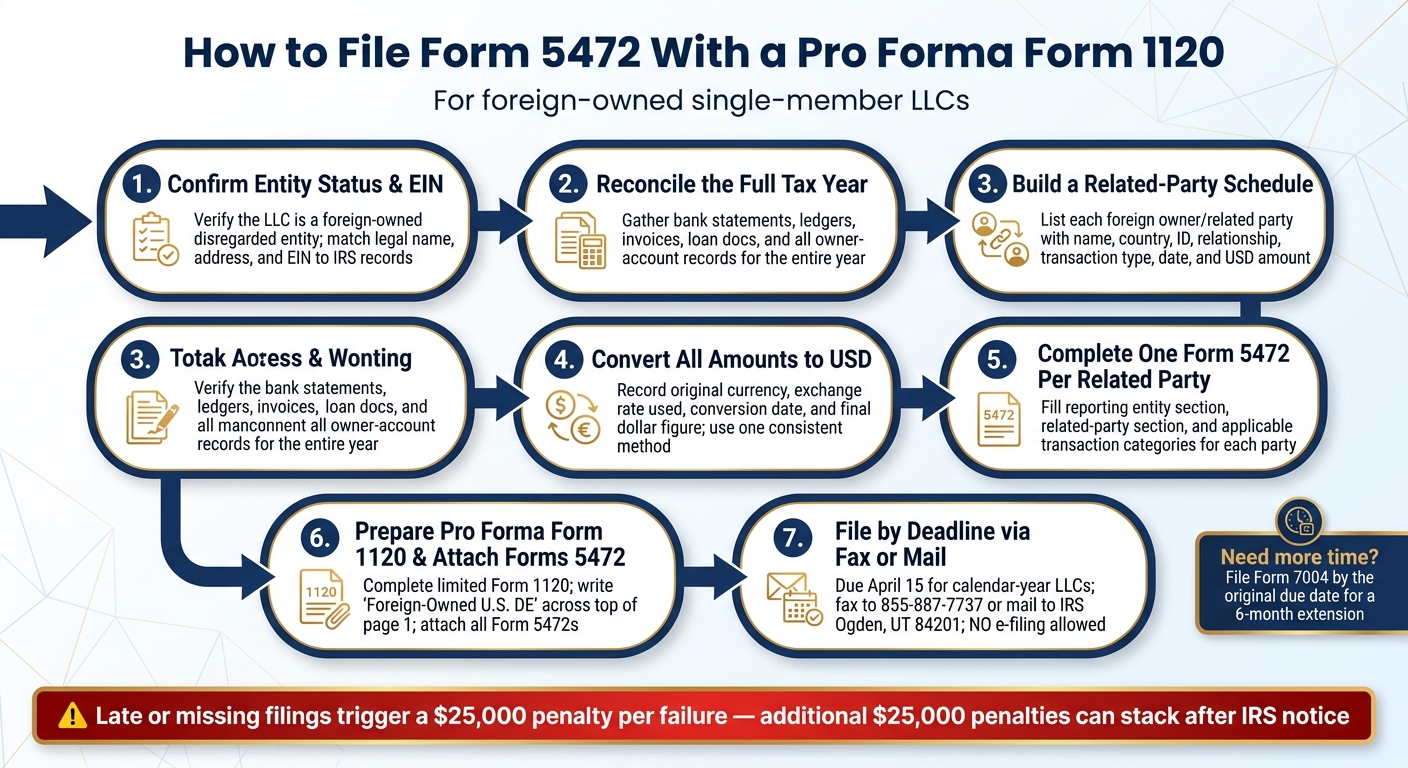
Foreign-Owned Single-Member LLC: Form 5472 Filing Process
Once you’ve pinned down every reportable transaction, it’s time to put the filing package together. The easiest way to avoid mistakes is to handle it in order.
Step-by-step filing checklist
Go step by step before you send anything to the IRS:
- Confirm your entity status and EIN
Make sure the LLC is a foreign-owned disregarded entity. Then match the legal name, address, and EIN to the IRS record. If the LLC still doesn’t have an EIN, obtain an EIN for your non-U.S. LLC before the filing deadline. The owner’s foreign tax ID does not take its place.
- Reconcile the full tax year
Gather the full year’s bank statements, general ledgers or bookkeeping exports, invoices, receipts, loan documents, and owner-account records. Records for capital contributions, distributions, and reimbursements are especially helpful when you review owner activity. And don’t stop at items marked as "income" or "expense." That misses too much.
- Build a related-party schedule
List each foreign owner and related party involved in transactions during the year. For each one, note the name, address, country, ID number, relationship, transaction type, date, and U.S. dollar amount. Keep each related party separate. Do not roll transactions together.
- Convert all amounts to U.S. dollars
Form 5472 must be reported in U.S. dollars. If a transaction was in foreign currency, record the original amount, the exchange rate used, the conversion date, and the final dollar figure. Use one supportable exchange-rate method all the way through, and keep that workpaper with your records.
- Complete a separate Form 5472 for each related party
After the amounts are converted to U.S. dollars, sort them by related party and prepare one Form 5472 for each party. Fill out the reporting entity section, the related-party section, and the transaction categories that apply to that party.
- Prepare the pro forma Form 1120 and attach the Forms 5472
Complete the limited pro forma Form 1120, attach each finished Form 5472, and write "Foreign-Owned U.S. DE" across the top of page 1. Then submit the package using the method below.
What goes on the pro forma Form 1120
For a foreign-owned U.S. disregarded entity, the IRS instructions say the pro forma Form 1120 only needs the LLC’s name and address, plus items B and E on page 1. Item B is the EIN, and item E is the initial-return check box.
Enter the tax-year dates and the other identification details required by the current form. Mark the return "Foreign-Owned U.S. DE." Leave the income, deduction, tax, and balance-sheet schedules blank unless the LLC’s tax classification on its own calls for a full Form 1120.
Filing package table: form, purpose, and submission method
Once the forms are done, package them with the pro forma return and send them using the required method.
| Document | Purpose | Key Information Included |
|---|---|---|
| Pro forma Form 1120 | Cover document for the filing package | LLC legal name, mailing address, EIN, tax-year dates, and "Foreign-Owned U.S. DE" notation |
| Form 5472 (one per related party) | Reports transactions between the LLC and each related party | Reporting entity details, related-party identity, transaction type, and U.S.-dollar amounts |
| Supporting schedules and records | Back up transaction totals, currency conversions, and party classifications | Exchange-rate workpapers, ledger and bank reconciliations |
| Form 7004 (if an extension is needed) | Requests more time to file | LLC identification and the extension request |
File the package by fax or mail. Do not e-file it. The IRS fax number is 855-887-7737. One current IRS instruction source says fax submissions should be sent at 300 DPI or higher. The mailing address is:
Internal Revenue Service 1973 Rulon White Blvd. M/S 6112, Attn: PIN Unit Ogden, UT 84201
Whether you fax or mail, keep a full copy of the signed package, along with the transmission confirmation or mailing receipt. Check the current IRS instructions right before filing. The fax number, mailing address, and form revision can change.
Deadlines, Records, Penalties, and Key Takeaways
Once the filing package is done, the next job is simple: file on time and keep the records that support every number on the return.
For a calendar-year LLC, Form 5472 with the pro forma Form 1120 is due April 15 of the next year. If the LLC uses a fiscal year, the return is due by the 15th day of the 4th month after year-end. If more time is needed, file Form 7004 by the original due date for a six-month extension, and label Form 7004 "Foreign-Owned U.S. DE." The extension moves the due date. It does not remove the filing duty.
What records the LLC should keep
The LLC should keep books and records that support every Form 5472 entry. At a minimum, that means keeping:
- Bank statements
- Owner transfers
- Reimbursement logs
- Loan documents
- Contracts
- Currency workpapers
- Filed forms
- Proof of submission
It also helps to keep a year-round related-party ledger, grouped by related party and transaction type, that matches each Form 5472 entry. Each line should show the transaction date, counterparty name and relationship, transaction category, original amount and currency, U.S. dollar value reported on Form 5472, exchange rate and source, payment method, and the reference document. Before preparing the form, the ledger should reconcile to both the bank statements and the general ledger.
If the IRS questions the return, these records are the proof behind each reported transaction.
Why filing correctly matters
Missed, incomplete, or incorrect filings can trigger a $25,000 penalty per failure. The same $25,000 penalty setup also applies if the LLC fails to keep the required records. And here’s the part many people miss: an incomplete or incorrect filing can still trigger the penalty, so partial disclosure doesn’t remove the risk.
If the failure continues after the IRS gives notice, another $25,000 penalty may apply for each 30-day period, or fraction of a 30-day period, after the 90-day correction period, with no stated maximum. That can snowball fast. In plain English, if the IRS sends a notice, the best move is to respond fast and fix the issue with records that back up the correction.
That’s why timing and accuracy both matter. The filing duty depends on the LLC’s ownership and tax classification, not on whether the LLC made money. No revenue does not remove the filing duty. Clean books are what make the filing easier to support if the IRS ever asks for proof.
FAQs
Do I still need to file if my LLC had no income?
Yes. A foreign-owned single-member LLC will usually still need to file Form 5472 with a pro forma Form 1120 even if it had $0 in income.
Here’s the key point: the filing rule is tied to reportable transactions, not profit.
So even if the business made no money, the filing can still apply when there were transactions such as:
- Capital contributions
- Paid expenses
- Money transfers between the owner and the LLC
Miss the filing, and the penalty can start at $25,000 or more.
What if I had multiple transactions with the same owner?
You need to disclose all of them on Form 5472. The IRS expects you to report every financial exchange between the LLC and its foreign owner, including capital contributions, loans, reimbursements, and payments for services or rent.
Even if the transactions happen often or look similar, each one is still a reportable transaction. Keep detailed records of every transaction for at least seven years to support your filing and stay compliant.
What records should I keep for Form 5472?
Keep detailed records of all reportable transactions between your LLC and its foreign owner for at least seven years.
That means holding on to:
- Bank statements
- Invoices
- Receipts
- Contracts
- Accounting records
- Formation documents
- Records that support capital contributions, loans, distributions, reimbursements, and business expenses
A digital system can make this much easier. It helps you keep records in one place and draws a clear line between personal and business finances.