

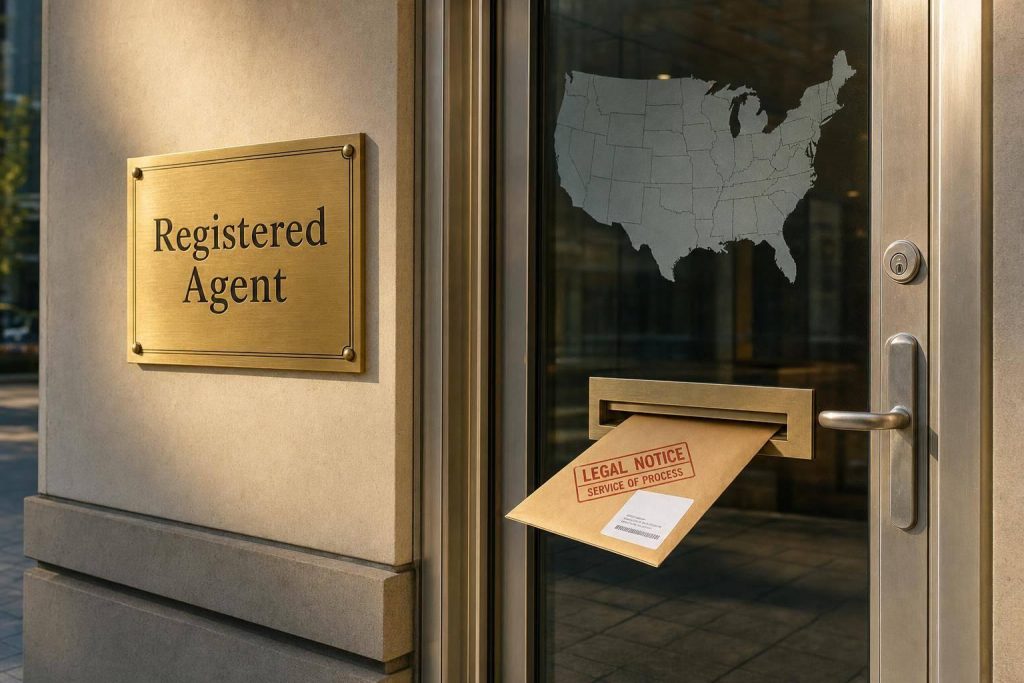
If you form a U.S. LLC or corporation, you usually must keep a registered agent in that state – even if you live outside the United States. You can’t replace that with a P.O. box, email address, or virtual mailbox.
Here’s the short version:
- This rule applies to non-U.S. owners too.
- Your agent must have a physical street address in the state.
- They receive lawsuits, state mail, and compliance notices for your company.
- If your agent is missing or invalid, you can miss deadlines, lose good standing, or face administrative dissolution.
- A registered agent forwards notices – they do not respond, file, pay, or defend your case for you.
- If you register in more than one state, you usually need one in each state.
A few facts stand out. In many states, lawsuit response windows are only 20 to 30 days. And if your company misses service of process, a court can enter a default judgment without hearing your side. States such as Georgia, Wyoming, and Texas also allow penalties like dissolution, termination, or revocation when a business fails to keep a valid agent on file.
If I were running a U.S. company from abroad, I’d treat the registered agent as a basic legal contact point, not a formality. The setup is simple. The risk of ignoring it is not.
A fast way to think about it:
| Issue | What it means for you |
|---|---|
| No registered agent | You may miss lawsuits and state notices |
| Wrong address on file | Deadlines can pass before you know there is a problem |
| Friend or contact as agent | Works only if they stay available and keep records current |
| Commercial agent service | Usually easier for remote owners to monitor |
Bottom line: if you’re a non-U.S. resident with a U.S. entity, keep a valid registered agent in every required state, watch forwarded notices closely, and update the state record right away if anything changes.
What a Registered Agent Does for a Non-US-Owned Business
A registered agent is the person or company listed in your formation documents to receive lawsuits, tax notices, and state compliance mail for your business. If you own the company from outside the United States, this gives the business the in-state contact it must have, even though you aren’t there in person. That matters most when a notice has a short deadline.
The agent must keep a physical street address in the state where the company was formed. That address becomes the company’s registered office. The agent also needs to be available during normal business hours to accept documents. In most cases, the agent scans the document and sends it to you online. From there, the next step is on you.
Documents a Registered Agent Typically Receives
The main documents usually fall into a few groups:
| Document Type | Urgent Action Required? | Typically Forwarded by the Agent? |
|---|---|---|
| Lawsuit, summons, complaint, or subpoena | Yes. Court deadlines are short, and failure to respond can have serious legal consequences. | Yes. This is a core registered-agent function. |
| State annual report reminder | Yes. Missing the deadline can put the business out of good standing. | Often, yes. Confirm your provider’s service terms. |
| Franchise tax notice | Yes. Payment deadlines vary by state and entity type. | Often, yes. Confirm what your provider forwards. |
| State compliance or administrative notice | Usually yes. The notice may require a filing, correction, or payment. | Yes, when sent to the registered office. |
| Federal tax notice | Varies by notice. Prompt action is often required. | Not automatically. Registered-agent service does not replace your IRS address of record. |
Here’s the part many owners miss: forwarding a document is not the same as handling it. The registered agent gets the notice to you. Filing, paying, replying, or hiring a lawyer – that part stays with you.
What a Registered Agent Does Not Do
A registered agent does not run your company, give legal advice, prepare tax returns, or stand in for you in court. If the agent receives a lawsuit, that does not mean they are defending it. They are not a business lawyer, CPA, tax preparer, or company manager.
The registered agent’s address is also meant for official notices only. Regular business mail should go somewhere else, usually through a separate mail-handling service if your provider offers one.
That may sound like a small job, but one missed notice can snowball into a much bigger compliance issue.
sbb-itb-ba0a4be
Why You Cannot Skip a Registered Agent and What Can Go Wrong
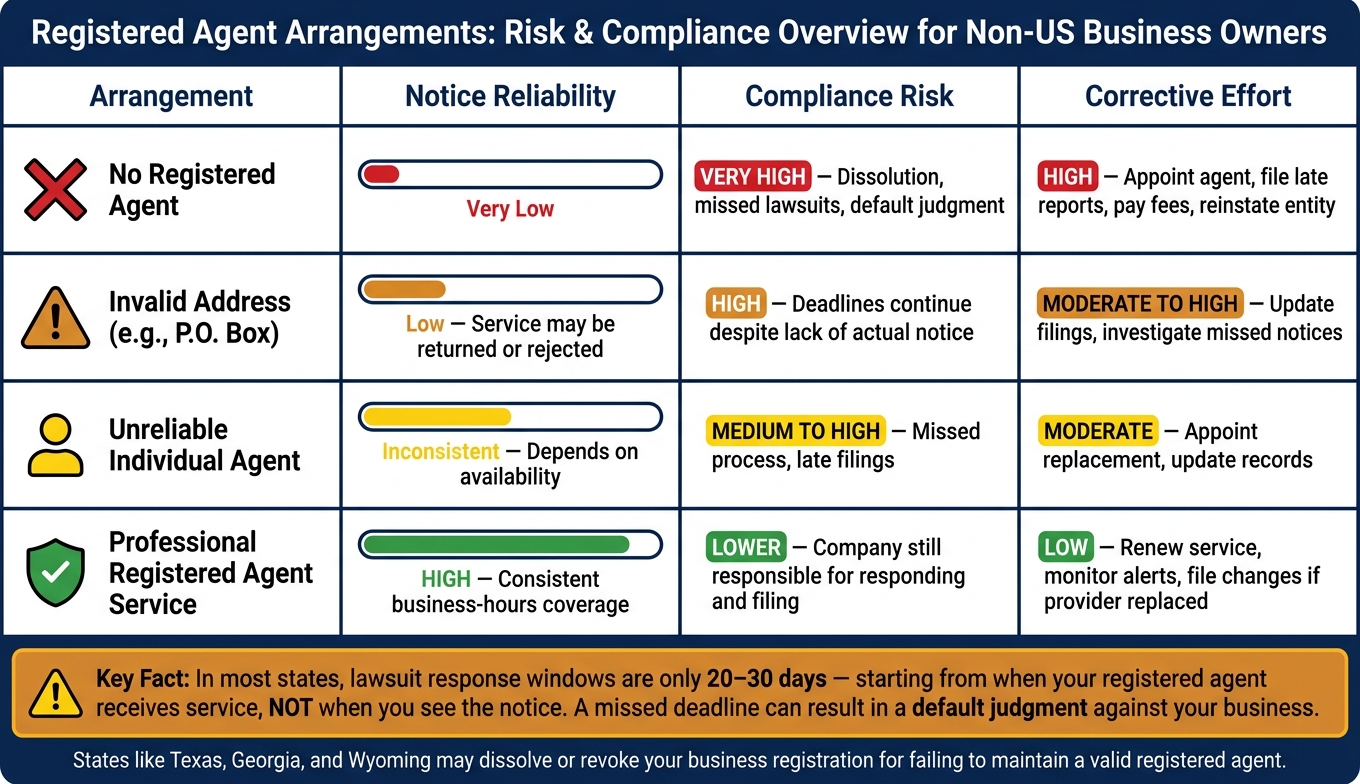
Registered Agent Options for Non-US Residents: Risks & Compliance Compared
A registered agent isn’t a nice-to-have. It’s your business’s official legal contact, and if that contact is missing or wrong, compliance trouble can start fast. Nearly every state requires a registered agent with a real street address in that state. An overseas address, email address, or P.O. box doesn’t count. That detail matters more than many owners think, because once legal papers are served, the clock starts right away.
For lawsuits and other official notices, the response deadline begins when the registered agent receives service, not when you happen to see the message. In many cases, a summons gives you only 20 to 30 days to respond. Those days start from valid delivery.
Common Ways Businesses Fail This Requirement
Most failures don’t look dramatic at first. They’re quiet paperwork problems that snowball.
An owner might name a U.S. friend as the agent, then that friend moves and never shares the new address. A business may switch to a new provider but forget to file the update with the state, so the old address stays on the public record. Another common slip is listing a P.O. box even though the state asks for a physical street address. Some states allow a short cure period after an agent resigns. Others can move straight toward dissolution if no replacement is filed.
Consequences of Not Meeting Registered Agent Requirements
Small record errors can turn into legal and filing problems in a hurry. Miss an annual report notice, and you may face late fees plus delinquent status. Miss a tax notice, and penalties and interest can stack up. Miss a lawsuit, and the court may enter a default judgment against your business without hearing your side at all.
Texas spells this out in plain terms: failing to appoint or maintain a registered agent can lead to involuntary termination of a domestic entity or revocation of a foreign entity’s authority to do business in the state.
| Arrangement | Notice Reliability | Privacy | Compliance Risk | Corrective Effort |
|---|---|---|---|---|
| No registered agent | Very low | Poor; owner’s address may be exposed | Very high; dissolution, missed lawsuits, default judgment | High; appoint agent, file late reports, pay fees, reinstate entity |
| Invalid address (e.g., P.O. box) | Low; service may be returned or rejected | Variable | High; deadlines continue despite lack of actual notice | Moderate to high; update filings, investigate missed notices |
| Unreliable individual agent | Inconsistent; depends on availability | Better than owner’s home address, but varies | Medium to high; missed process, late filings | Moderate; appoint replacement, update records, address missed deadlines |
| Professional registered-agent service | High | Strong; provider’s address is public, not owner’s | Lower; company still responsible for responding and filing | Low; renew service, monitor alerts, file changes if provider is replaced |
How Non-US Residents Can Stay Compliant While Running a US Company Remotely
With the risks out in the open, the path is pretty clear: appoint a qualifying registered agent and keep that information up to date from day one.
Choosing Between an Individual Agent and a Commercial Registered Agent
In practice, the choice usually comes down to one qualified person or a commercial service that handles this full-time.
An individual agent can work if they meet the state’s rules. But for remote owners, the weak spot is reliability. If that person moves, travels, or stops replying, your compliance can slip fast, and you may not get any warning in time.
A commercial registered agent service removes that one-person risk. For a foreign founder running a company from overseas, that setup is often the easier option.
| Factor | Individual Agent | Commercial Registered Agent Service |
|---|---|---|
| Reliability | Depends on one person’s availability | Consistent business-hours coverage |
| Privacy | Personal address appears in public records | Provider’s address is listed instead of yours |
| Document handling | Manual forwarding; speed varies | Digital scanning and online alerts |
| Multi-state coverage | Harder to manage across multiple states | Easier to manage across multiple states |
| Annual cost | Often no direct fee if using a qualified US-based person | Recurring annual fee |
When a Formation Provider With Registered Agent Support Makes Sense
If you want fewer moving parts, it can help to handle formation and registered-agent appointment in the same workflow. A bundled formation-and-registered-agent setup cuts down on coordination for foreign founders. BusinessAnywhere offers this type of setup across all 50 states through one online dashboard.
That said, your business is still responsible for every response, filing, and payment deadline.
A Compliance Checklist for Staying in Good Standing
Once your agent is in place, staying compliant becomes a matter of routine: monitor notices and track deadlines. After formation, check your state’s public business-records database to make sure the agent’s name and registered office address appear exactly as filed. If what the state shows doesn’t match what you submitted, fix it right away.
From there, the ongoing work comes down to a few habits you can’t ignore:
- Monitor forwarded notices actively. Log into your agent’s dashboard on a regular basis. Don’t treat a forwarded legal notice like just another email.
- Keep your contact details current. Your agent needs a working email address, phone number, and mailing address to reach you. Old contact information is a common reason owners miss time-sensitive notices.
- Track deadlines by state. Annual reports, franchise taxes, and biennial statements all have different due dates depending on where your company is registered. Put every deadline on a calendar and set reminders ahead of time.
- Confirm multi-state coverage. If your company owns property, has employees, or must register in other states, you need an active registered agent in each of those states, not only your formation state.
- File changes promptly. If your agent resigns or you switch providers, file the replacement with the state right away.
Keep a digital file with your filings, renewals, payments, and forwarded notices.
Conclusion: Set Up a Registered Agent Before It Becomes a Legal Problem
Most U.S. LLCs and corporations need to keep a registered agent in the state where they were formed. Foreign entities usually need one in each state where they do business. Owning the company from abroad doesn’t erase that rule in most states. If that contact point breaks down, deadlines can slip by fast, and legal rights can slip away with them.
Miss the rule, and the fallout can get ugly: missed lawsuits, missed tax or annual report notices, loss of good standing, penalties, and even administrative dissolution. The good news? The fix is simple. Pick the right agent and keep that appointment active.
Keep the agent’s name and street address up to date. Renew the service on time. And when the agent forwards a notice, treat it like it matters right now.
For most foreign founders, a commercial registered agent service is the simplest path. It gives you a qualifying in-state address, helps keep your personal address off public records, and makes the whole setup easier to manage. No matter which provider you use, check that the address qualifies, keep the appointment active, and handle every forwarded notice with urgency.
FAQs
Can I be my own registered agent from abroad?
No. If you live outside the United States, you usually can’t serve as your own registered agent.
Here’s why: a registered agent needs to have a physical street address in the state where the business is registered. They also need to be available at that address during normal business hours, usually Monday through Friday, 9:00 a.m. to 5:00 p.m.
If you’re abroad, you likely can’t meet those rules on a steady basis. So in most cases, you’ll need to hire a professional commercial registered agent service.
What happens if my registered agent resigns?
If your registered agent resigns, your LLC usually needs to name a new one within about 30 to 60 days, depending on the state.
That window matters more than it might seem. If your business doesn’t keep a registered agent on file and reachable, you could miss:
- lawsuit papers
- state notices
- tax or compliance mail
And that can snowball fast. Penalties may follow, your LLC could lose good standing, or the state could move toward administrative dissolution.
There’s another risk here too. Courts may still treat service through the agent as valid. So if a lawsuit notice goes unanswered because no one received it, your LLC could end up with a default judgment.
Texas adds one more detail. The state may require 10 days’ advance written notice when a registered agent resigns, which can help your business avoid a gap in coverage.
When do I need a registered agent in multiple states?
You need a registered agent in more than one state when your business is officially registered or foreign-qualified in multiple states.
Each state requires its own registered agent with a physical street address in that state to receive legal papers and government notices. An address in one state does not meet another state’s requirement.