
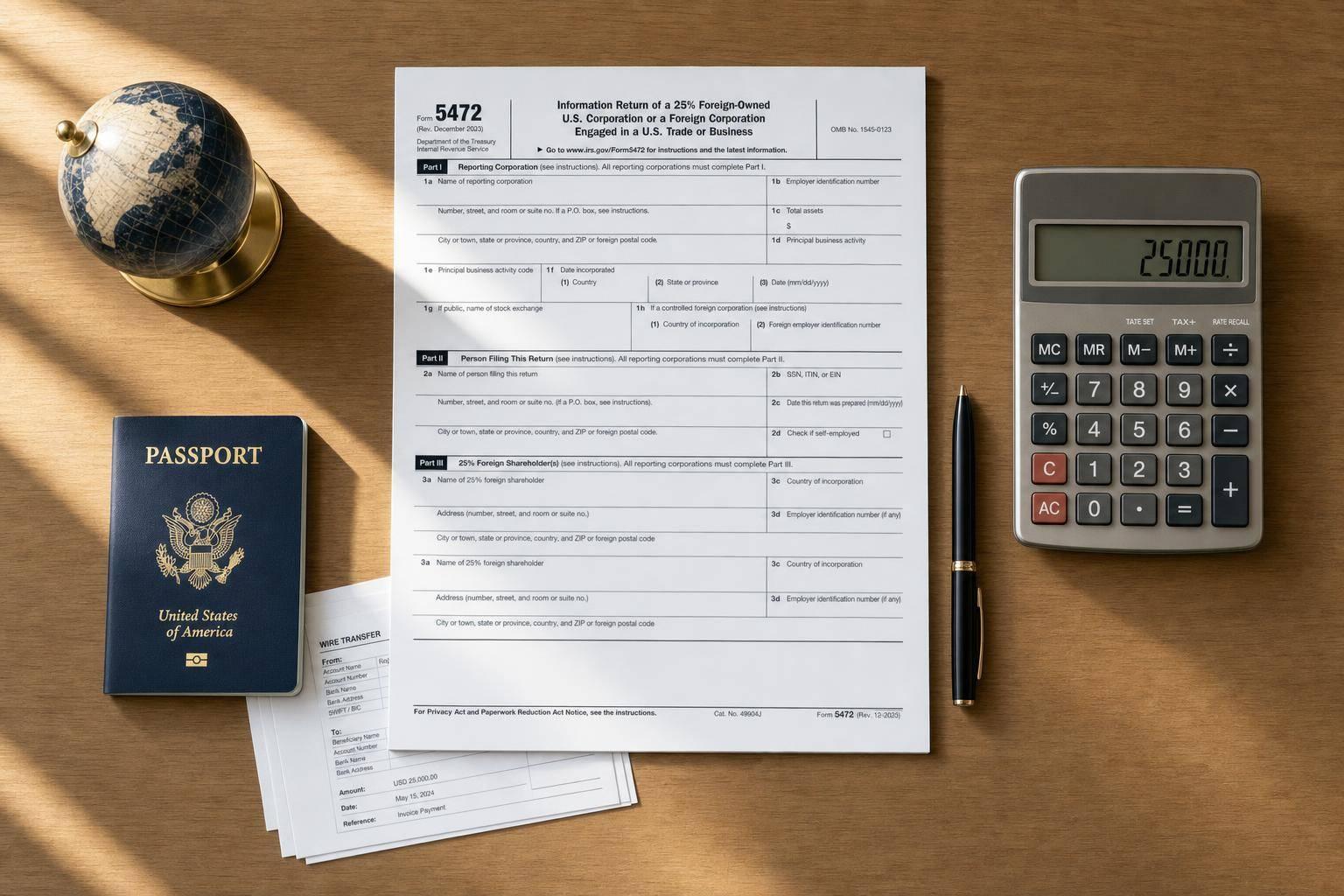
If I am running a U.S. LLC from overseas as a non-U.S. person, I may need to file Form 5472 even when the LLC owes $0 in U.S. income tax. That’s the main point. One owner funding transfer, one reimbursement, or one loan can trigger the filing, and the starting penalty is $25,000 per form, per year.
Here’s the short version:
- Form 5472 is an information return, not an income tax return.
- I file it with a pro forma Form 1120, which works like a cover page.
- A foreign-owned single-member LLC can have a filing duty even with no sales and no tax due.
- Common triggers include capital contributions, loans, repayments, reimbursements, distributions, and service charges.
- For a calendar-year LLC, the due date is usually April 15.
- Filing Form 7004 on time can move the due date to October 15.
- Missing the form – or the records behind it – can lead to $25,000 penalties, with added penalties if the issue continues after IRS notice.
What matters most is simple: Was the LLC foreign-owned, disregarded, and involved in at least one reportable transaction during the year? If yes, I usually need to file.
A few points that trip people up:
- Disregarded for income tax does not mean ignored for Form 5472
- Even small transfers can count
- One Form 5472 may be needed for each related party
- Good records matter just as much as filing on time
This guide boils the rules down to who must file, what gets reported, how Form 5472 fits with Form 1120, which records to keep, and how to stay away from penalties.
Who Must File Form 5472 and When the Requirement Applies
Once you’ve confirmed that the LLC is foreign-owned and disregarded, the next step is simple: did a filing trigger happen?
Under section 6038A, a foreign-owned U.S. disregarded entity, such as a single-member LLC with a foreign owner, is treated as a reporting corporation for Form 5472.
What Counts as a Foreign-Owned Disregarded Entity
A U.S. single-member LLC falls into this category when it has one owner and that owner is a foreign person. Form 5472 applies when foreign persons own at least 25% of the entity. If the LLC has one foreign owner, that test is met automatically.
Ownership doesn’t have to be direct, either. If the LLC is held through a foreign holding company, that can still count under attribution rules.
There’s another point that trips people up: the de minimis and small-corporation exceptions do not apply to domestic disregarded entities that are wholly owned by foreign persons.
When Filing Is Required for a Tax Year
The filing rule kicks in for any tax year in which the LLC has at least one reportable transaction with its foreign owner or another related foreign party. That includes transfers of money, property, or services tied to setting up or running the business.
That means even a brand-new LLC can have a filing duty right away. If the only thing that happened was an initial funding wire from abroad, that still generally triggers Form 5472 for that year.
So while there is a path to no filing, it’s narrow: a foreign-owned single-member LLC generally avoids filing only if no reportable transactions happened during the year. In practice, that’s uncommon.
Common Founder Situations That Trigger the Filing Requirement
Here are some of the founder moves that usually set off the filing requirement:
| Founder Situation | Why It Triggers Form 5472 |
|---|---|
| Wiring startup capital to the LLC | Treated as a capital contribution, which is a reportable transaction |
| Paying for LLC expenses personally, then getting reimbursed | Reimbursements are reportable transactions between the LLC and a related foreign party |
| A foreign parent charging management fees to the LLC | Intercompany service charges and management fees are reportable |
| Lending money to the LLC under a formal or informal loan agreement | Loan principal, repayments, and interest are reportable |
If a reportable transaction took place, the filing package includes Form 5472 and a pro forma Form 1120.
How Form 5472 Connects to Pro Forma Form 1120
Form 5472 has to be filed with a pro forma Form 1120. Sending Form 5472 by itself does not meet the filing rule. So the key point is simple: these two forms go together.
What a Pro Forma Form 1120 Includes
The pro forma Form 1120 identifies the LLC and gives Form 5472 a place to attach. For a foreign-owned single-member LLC, you only fill in the basic items:
- The LLC’s legal name
- U.S. mailing address
- EIN
- Tax year
- Basic entity details on page 1
You leave all income, deduction, and tax calculation lines blank. Across the top of page 1, write "Foreign-Owned U.S. DE" so the IRS can identify the filing.
This package must be filed by mail or fax. The IRS does not accept an e-filed version of it. Save your fax confirmation or certified mail receipt so you have proof that you filed on time. This is a critical step to avoid common EIN and filing mistakes that foreign entrepreneurs often face.
Deadlines, Extensions, and U.S. Filing Dates
For a calendar-year LLC, the filing package is due April 15 of the year after the tax year. That due date still applies even if the LLC owes no U.S. income tax.
If you need extra time, file Form 7004 by April 15. That gives you an automatic six-month extension, which moves the deadline to October 15. One catch: the extension only works if Form 7004 is filed on time.
Form 5472 vs. Pro Forma Form 1120: Side-by-Side Comparison
| Form 5472 | Pro Forma Form 1120 | |
|---|---|---|
| Purpose | Reports transactions between the LLC and its foreign owner or related parties | Acts as the required filing vehicle so the IRS can accept Form 5472 |
| What it contains | Owner details and specific transaction amounts, such as contributions, loans, and reimbursements | LLC name, EIN, U.S. address, tax year, and the "Foreign-Owned U.S. DE" notation |
| Tax due? | No – information reporting only | No – all income and tax lines are left blank for this purpose |
Attach one Form 5472 per related party to the same pro forma Form 1120. The next section gets into which transactions must be reported and which records the IRS expects you to keep.
sbb-itb-ba0a4be
What Transactions Must Be Reported and What Records to Keep
Once a filing trigger exists, the next step is simple: figure out which transactions the IRS expects you to report.
The rule is broad. You must report any transfer of money, property, services, or other value between the LLC and its foreign owner, or another related foreign party. And yes, one single transfer can trigger Form 5472, even if the LLC had no sales or income.
Transactions Commonly Reported on Form 5472
Some of the most common examples are ad spend paid by the owner, owner reimbursements, profit distributions, and non-cash transfers like IP use or loans.
This goes beyond cash. If the foreign owner lets the LLC use a trademark or software license without charging for it, that arrangement still has reportable value. The same idea applies to interest-free loans. No interest charged does not mean no reporting.
For foreign-owned single-member LLCs, every capital contribution and every distribution is reportable, even if the amount seems minor.
Each reportable transaction should have source documents that match the amount and date shown on the form. If the paperwork and the filing don’t line up, that can turn into a problem fast.
Books and Records the IRS Expects
The IRS expects records that show the nature, amount, date, and parties for each transaction. If those records are missing, you can face the same $25,000 penalty that applies to a missed filing.
A good way to handle this is to keep one dedicated folder, either digital or physical, for items like:
- U.S. bank statements
- Wire transfer confirmations
- Invoices
- Signed contracts or service agreements
- Loan agreements with repayment terms
- Reimbursement logs
Track these items during the year. Waiting until filing season to piece everything back together is where things usually fall apart.
Common Reportable Transactions and the Records That Support Them
| Transaction Type | Typical Example | Records to Keep |
|---|---|---|
| Capital contribution | Owner wires $50,000 to fund an e-commerce LLC’s inventory | Bank statements, wire confirmations, capitalization log |
| Owner distribution | Consultant LLC transfers $20,000 to the owner’s foreign bank account | Bank statements, accounting ledger entries, internal resolution |
| Loan from owner to LLC | Owner lends $100,000 to a real estate LLC to finance renovations | Signed loan agreement, repayment schedule, interest calculations |
| Management or consulting fees | LLC pays a foreign related company for marketing management | Service contract, invoices, wire confirmations |
| Expense reimbursements | Owner pays Facebook Ads personally; LLC reimburses quarterly | Receipts, card statements, reimbursement log |
| IP or property transfer | Foreign owner assigns a trademark to the U.S. LLC | Assignment agreement, valuation documentation |
These records back up the filing and help lower penalty risk if the IRS asks you to show proof.
Penalties, Compliance Steps, and Key Takeaways
Penalty Amounts for Late, Missing, or Incomplete Filings
Once you know the rules, the biggest danger is simple: missing the filing or not having the records to back it up.
The IRS can assess a $25,000 penalty for a late, missing, or incorrect Form 5472. If the IRS sends a notice and the issue is not fixed within 90 days, the penalty increases by another $25,000 for each 30-day period, or part of a 30-day period, with no maximum limit. Missing or incomplete books and records can lead to the same penalty exposure.
| Situation | Penalty |
|---|---|
| Late, missing, or incorrect Form 5472 | $25,000 per required form |
| Failure continues after IRS notice and the 90-day period passes | Additional $25,000 per 30-day period |
| Missing or incomplete records | Same $25,000 penalty exposure |
A Simple Annual Compliance Workflow for Remote Owners
The safest move is to make Form 5472 part of your normal bookkeeping process, not a last-minute tax task.
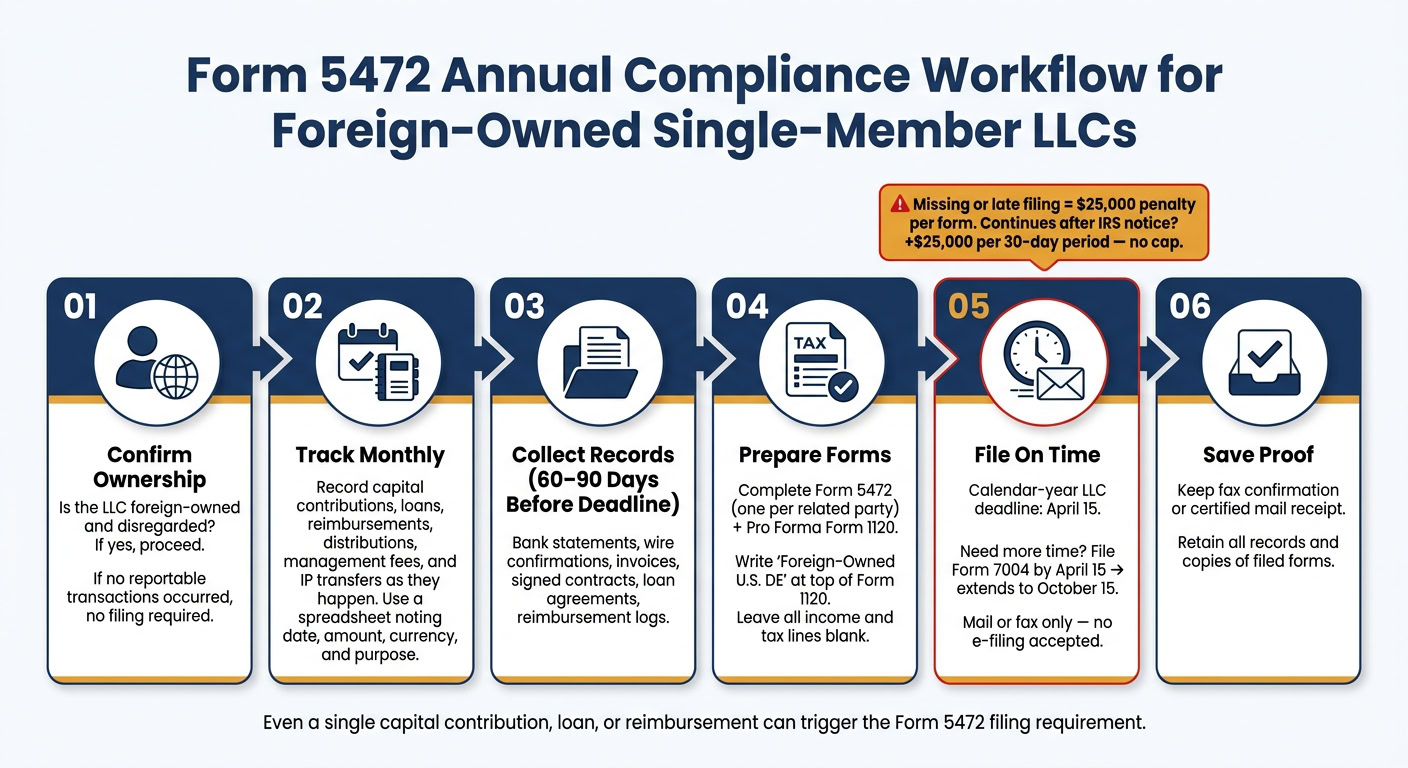
Track Form 5472 items every month instead of waiting until year-end. Reconcile the LLC’s bank account monthly, and record any money moving between the LLC and the foreign owner or related parties as soon as it happens. That includes contributions, loans, reimbursements, and repayments. For a very small LLC, a basic spreadsheet is often enough if it consistently shows the date, amount, currency, and purpose of each transfer.
Get an EIN early because you need it for the pro forma Form 1120 filing. Then, about 60 to 90 days before the deadline, pull together bank statements, wire confirmations, invoices, and other source documents. For a calendar-year LLC, the filing is due April 15. Filing Form 7004 extends the due date to October 15. Keep proof of mailing or a fax confirmation in your records.
What Foreign-Owned LLCs Need to Do Each Year
Think of this as your yearly closeout routine.
Each year, confirm ownership, record reportable transactions, collect records, file on time, and save copies.
Even if activity seems minimal, that does not always mean no filing is due. A single reimbursement, loan repayment, or capital contribution may still trigger Form 5472. The goal is to handle it the same way every year so nothing slips through.
FAQs
Do I need Form 5472 if my LLC had no income?
Yes. Even if your foreign-owned single-member LLC had no income, no sales, or stayed inactive, you still need to file Form 5472 with a pro forma Form 1120.
A lot of owners assume no activity means no filing. That’s where people get tripped up.
This filing rule can still apply with no revenue if you had reportable transactions, such as:
- capital contributions
- startup expenses
- transfers between personal and business accounts
If you don’t file, penalties start at $25,000 per year.
What counts as a reportable transaction?
A reportable transaction covers almost any financial activity between your LLC and its foreign owner.
That includes things like:
- Capital contributions
- Loans and interest
- Distributions
- Service payments
- Money transferred between personal and business accounts
It also covers non-cash events. So if the LLC was formed, acquired, or dissolved, that can still count as reportable even if no money changed hands.
And yes, even small transactions matter. The same goes for activity during periods when the business had no income. If it happened between the LLC and its foreign owner, it likely needs to be reported.
Can I file Form 5472 without Form 1120?
No. Form 5472 can’t be filed by itself. You need to attach it to a pro forma Form 1120.
That rule still applies even if your foreign-owned single-member LLC owes no corporate income tax or had no business activity during the year. Think of Form 1120 as the container and Form 5472 as the document inside it. Without that pro forma Form 1120, Form 5472 isn’t filed the right way.
If you send Form 5472 by itself, the IRS may reject the filing or assess steep penalties.