


- Liability Protection: An LLC separates your personal assets from business liabilities, shielding things like your home or savings from lawsuits or debts. However, mixing personal and business finances can jeopardize this protection.
- Tax Options: LLCs avoid double taxation by default, with profits passing through to your personal tax return. If your business earns over $50,000–$70,000 annually, opting for S-corp taxation could save you thousands in self-employment taxes.
- Flexibility: LLCs allow for custom management structures and profit-sharing agreements, making them ideal for partnerships or businesses with varying contributions.
- Costs and Compliance: Forming and maintaining an LLC involves state fees, annual reports, and taxes, which vary widely by location. For example, California charges an $800 annual franchise tax.
- Funding Challenges: LLCs can’t issue stock, making it harder to attract venture capital compared to corporations.
Quick Takeaway:
An LLC works well for businesses needing liability protection and tax flexibility but may not suit those with low income or plans to raise significant outside investment. Evaluate your earnings, liability risks, and growth plans before deciding.
Key Advantages of Forming an LLC
These benefits address the primary concerns of small business owners, from protecting personal assets to offering operational flexibility.
1. Limited Liability Protection
One of the standout features of an LLC is its ability to separate personal and business assets. If your LLC faces a lawsuit or can’t meet its financial obligations, creditors can only target the business’s assets – not your personal savings, home, or investments. This is a significant difference from a sole proprietorship vs. LLC, where business and personal finances are intertwined.
However, this protection isn’t absolute. Courts can "pierce the corporate veil" if you fail to keep personal and business finances separate. For instance, using your business account to pay personal bills could jeopardize your liability protection. To avoid this, maintain a dedicated business bank account, sign contracts as “Your Name, Member of XYZ LLC,” and create a formal operating agreement – even in states where it’s not required.
"An LLC is a legal container. What goes inside that container – tax classification, liability protection, operating rules – depends on elections you make, how you run the business, and what state you’re in." – Reed Corporation CPA Firm
2. Tax Flexibility
In addition to liability protection, LLCs also stand out for their tax options. By default, the IRS treats a single-member LLC as a disregarded entity, meaning you report business income on your personal tax return using Schedule C – similar to a sole proprietorship, but with added liability protection. For multi-member LLCs, the default tax treatment is as a partnership. In both cases, profits pass directly to members, avoiding the double taxation that C-corporations face.
For businesses earning more than $50,000–$70,000 after paying a reasonable salary, electing S-corp status can provide tax savings. With this election, your income is divided into a W-2 salary (subject to the 15.3% self-employment tax) and shareholder distributions (which are not subject to this tax). For example, a business netting $200,000 with a $90,000 salary could save around $12,000–$15,000 per year in taxes. To take advantage of this, you’ll need to file IRS Form 2553 by March 15 for the calendar year.
3. Management and Ownership Flexibility
LLCs also offer flexibility in how they are managed. You can choose between two management structures: member-managed, where all owners are involved in daily operations, or manager-managed, where a designated manager handles the day-to-day while other members take a more passive role. The manager-managed setup is ideal for businesses with investors who want a stake in the company but prefer to stay out of operational decisions.
Another benefit is the ability to distribute profits flexibly. Unlike corporations, where dividends must align with ownership percentages, LLC members can agree to divide profits based on factors like capital contributions, expertise, or labor – regardless of ownership share. This flexibility makes LLCs particularly appealing for partnerships where contributions vary.
"An LLC lets you customize your management structure around your business, not the other way around." – Corporate Direct
sbb-itb-ba0a4be
Drawbacks and Challenges of an LLC
While LLCs come with certain advantages, they also bring notable costs, tax obligations, and structural limitations that business owners need to consider.
1. Formation Costs and Ongoing Requirements
Setting up and maintaining an LLC can be expensive. States charge a one-time filing fee for the Articles of Organization, which varies significantly – from $35 in Montana to $500 in Massachusetts. Beyond this, most states mandate annual or biennial reports, with fees reaching up to $500. For example, California imposes an $800 minimum annual franchise tax. In New York, a publication notice is required in local newspapers, and if you’re in Manhattan, this can cost $1,500 or more. Missing these deadlines can result in hefty late fees or even administrative dissolution, stripping the LLC of its liability protection.
If your business operates in multiple states, you’ll also need to register as a foreign LLC in each one, incurring fees similar to those for initial registration. These recurring costs, combined with tax implications, can add up quickly for LLC members.
2. Self-Employment Taxes
LLC members face steep self-employment taxes. The rate is 15.3% (12.4% for Social Security and 2.9% for Medicare) on the entire net profit. Since the tax is calculated on 92.35% of net earnings, the effective rate comes out to 14.13%. For instance, if your LLC earns $100,000 in net profits, you’ll owe approximately $14,130 in self-employment taxes – on top of income taxes. High earners face an additional 0.9% Medicare surtax on earnings above $200,000 for single filers.
Some LLCs elect S-corp status to reduce this burden, but this option requires additional administrative work. Generally, it only becomes worthwhile when net profits exceed $50,000–$80,000. Taxes aside, LLCs also face obstacles when it comes to raising external capital.
3. Limited Access to Outside Funding
One of the biggest challenges for LLCs is attracting outside investment. Unlike corporations, LLCs cannot issue stock, which limits their ability to raise venture capital. The WebHR Team highlights this distinction:
"The ease of attracting investors is one of the primary distinctions between corporations and LLCs. Corporations can easily distribute ownership rights in the form of shares… LLCs do not have this option."
When investors join an LLC, they become members, not shareholders, which has tax and governance implications. Members receive a K-1 tax form and are taxed on their share of profits, even if no cash is distributed. This structure often deters venture capitalists and institutional investors, who typically prefer the governance and predictability of C-corporations. C-corporations offer a formal board of directors and the ability to issue preferred shares.
As Amanda Hayes, an attorney at the University of North Carolina School of Law, explains:
"Investors might be looking for a business with more organizational structure and formalities when deciding where to put their money."
If your business plan includes raising venture capital or going public, starting as a C-corporation might be a better option. While converting an LLC into a corporation is possible later, it often comes with legal fees and potential tax consequences.
LLC Advantages vs. Disadvantages: Side-by-Side Comparison
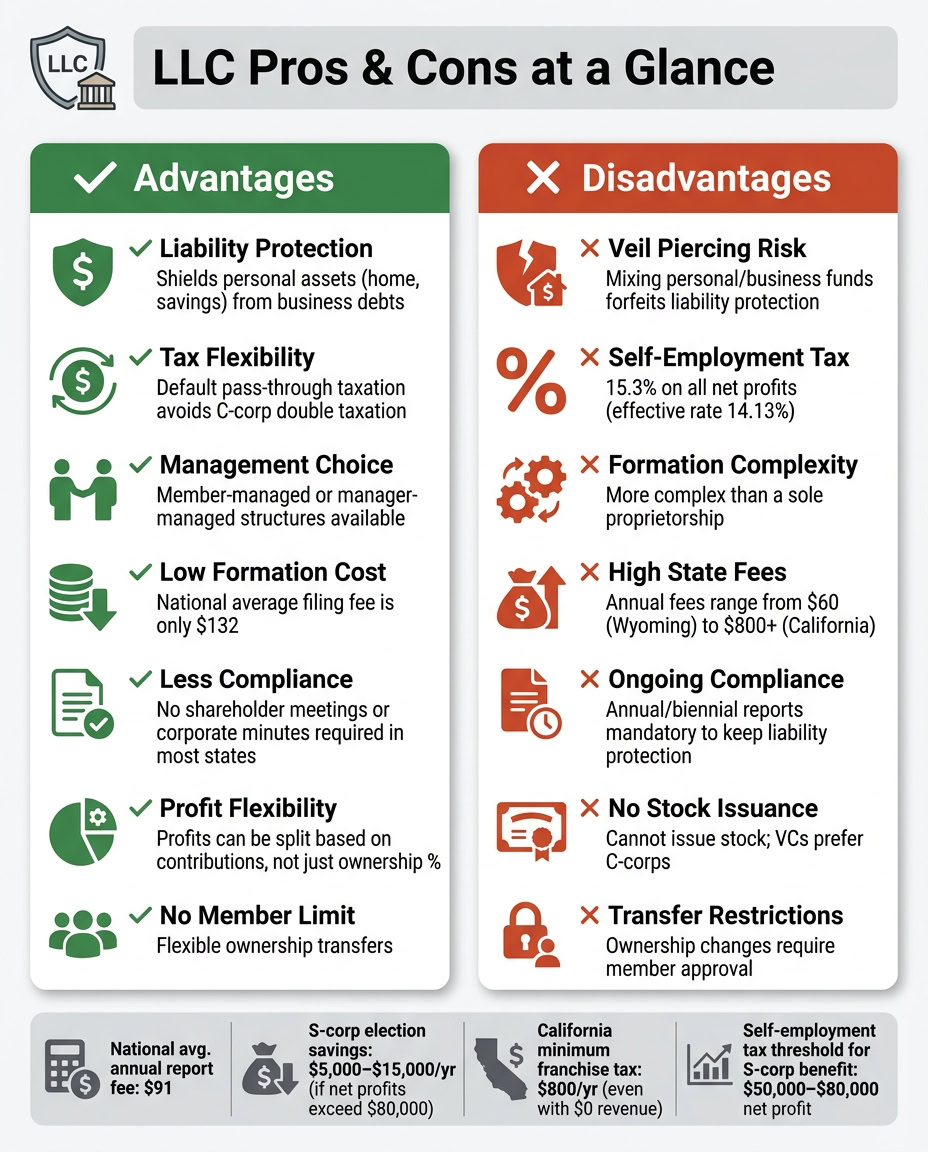
The benefits and drawbacks of an LLC are interconnected, and their relevance often depends on your individual circumstances. This side-by-side breakdown simplifies the comparison to help you weigh your options.
Table: LLC Pros and Cons at a Glance
| Aspect | Advantages | Disadvantages |
|---|---|---|
| Liability Protection | Shields personal assets (like your home or savings) from business debts | Protection can be forfeited if you mix personal and business funds or neglect essential formalities |
| Tax Treatment | Default pass-through taxation avoids double taxation seen with C-corps | All profits face a 15.3% self-employment tax unless S-corp status is chosen |
| Management Flexibility | Option to choose member-managed or manager-managed structures | More complicated to establish compared to an LLC vs sole proprietorship |
| Formation Costs | Average filing fee is only $132 nationwide | Annual fees vary widely, from $60 in Wyoming to over $800 in California |
| Compliance Burden | Most states don’t require shareholder meetings or corporate minutes | Annual or biennial reports are mandatory to maintain liability protection |
| Funding Access | Suitable for self-funded or small businesses | Limited funding options – cannot issue stock, and venture capitalists often prefer C-corps |
| Ownership Transfers | Flexible structure with no member limit | Ownership changes usually need approval from other members |
Here are a few key numbers to keep in mind: the national average annual report fee is $91, and electing S-corp status could save you between $5,000 and $15,000 per year if your net profits exceed $80,000 consistently. However, in states like California, you’ll owe the $800 minimum franchise tax even if your LLC generates no revenue during the year.
As Garrett Sutton, Esq., Principal Partner at Corporate Direct, explains:
"An LLC is not a strategy, it’s a tool. And like any tool, its effectiveness depends on how it’s used."
This perspective underscores the importance of planning. Every advantage has conditions, and every disadvantage can often be managed with proper preparation.
Is an LLC the Right Structure for Your Business?
Choosing the best structure for your business depends on factors like liability risks, potential earnings, and long-term plans. While an LLC works well in many situations, it’s not always the ideal choice. Let’s take a closer look at when an LLC shines and when another structure could be a better fit.
1. Situations Where an LLC Makes Sense
An LLC is a great option if liability protection is a priority. For businesses dealing with physical products, employees, or valuable assets, the legal separation an LLC provides can safeguard personal savings and property from lawsuits or debts. Real estate investors, for instance, often create separate LLCs for each property. This way, if one property faces legal or financial trouble, the others remain unaffected.
If your business is earning $60,000 or more in net income, an LLC can also offer tax advantages. By choosing an LLC tax election like S-corp status, you can potentially cut down on self-employment taxes. For a business netting $150,000 annually, this could mean savings of $8,000 to $12,000. This approach is particularly popular among consulting firms and agencies that consistently hit higher profit levels.
"An LLC doesn’t lock you into one tax structure, it gives you the flexibility to adapt as your business grows." – Corporate Direct
Another benefit of an LLC is its flexibility in profit-sharing for multi-owner businesses. Unlike corporations, LLCs taxed as partnerships allow for "special allocations", meaning profits don’t have to align strictly with ownership percentages. This level of flexibility is rare in other business structures.
2. When a Different Structure May Work Better
A sole proprietorship might be a better fit if your annual net earnings are under $40,000 and your business has minimal liability risk. For example, freelance writers or graphic designers often find sole proprietorships more practical because the costs of maintaining an LLC – like state filing fees and registered agent expenses – can outweigh the benefits at lower income levels.
"The LLC vs. sole proprietorship decision should be driven by liability exposure and business complexity, not by a vague hope of paying less tax." – Reed Corporation CPA Firm
If your business aims to attract venture capital or go public, a C-corporation is usually the better choice. Institutional investors prefer C-corps because they allow for multiple stock classes and follow standardized governance structures. There’s also a significant tax benefit: the Qualified Small Business Stock (QSBS) exclusion lets C-corp shareholders exclude up to $15 million in capital gains from federal taxes – a perk LLC owners don’t get. For startups seeking funding, this advantage can be a game-changer.
| Business Type | Best Fit | Reason |
|---|---|---|
| Real estate investor | LLC | Isolates liability per property; flexible profit distribution |
| Freelance designer | Sole proprietorship | Low liability exposure; no state filing fees required |
| Profitable agency ($150K+) | LLC with S-corp election | Reduces self-employment taxes above a reasonable salary |
| VC-backed tech startup | C-corporation | Required by investors; supports stock classes |
| Multi-owner partnership | LLC (partnership tax) | Allows profit splits unrelated to ownership percentages |
Additionally, having foreign co-owners can complicate things if you’re considering an LLC with S-corp status. U.S. law prohibits non-resident aliens from being S-corp shareholders, limiting your tax flexibility from the start.
Conclusion: How to Weigh the Pros and Cons of an LLC
Looking at the benefits and challenges outlined earlier, an LLC can be a powerful option for small business owners. But as attorney Garrett Sutton wisely notes:
"An LLC is not a strategy, it’s a tool. And like any tool, its effectiveness depends on how it’s used." – Garrett Sutton, Esq., Principal Partner, Corporate Direct
An LLC provides key advantages like liability protection, tax flexibility, and easier management. However, these perks come with trade-offs, such as varying state filing fees and annual compliance costs. For instance, high-cost states like California can make maintaining an LLC more expensive.
Beyond costs, protecting the legal benefits of your LLC is just as important. Mixing personal and business finances or falling behind on state filing requirements can jeopardize your liability protection – something no business owner wants to risk.
Your choice of business structure should also align with your goals and risk tolerance. If attracting major outside investment is part of your plan, a C-corporation or LLC might be a better fit. On the other hand, if your business has low liability risks and you want simplicity, a sole proprietorship could be more practical.
To make the best decision, consider these key questions: How much liability risk does your business face? What are your current and expected income levels? And are you ready to manage the administrative demands of an LLC? These answers will help guide you toward the structure that fits your business best.
FAQs
How do I keep my LLC liability protection from being lost?
To protect your LLC’s liability shield, it’s crucial to treat it as a completely separate entity. This means keeping your personal and business finances separate, maintaining detailed and accurate records, and adhering to all legal formalities. Make sure you comply with state regulations, routinely update your operating agreement, and stay on top of filing deadlines. Ignoring these steps could result in “piercing the corporate veil,” which might put your personal assets at risk for business-related debts or liabilities.
When does an S-corp election start saving me money?
When your net profit consistently surpasses $50,000–$60,000 a year, opting for an S-corp election can lead to significant savings. The key advantage lies in reducing self-employment taxes on distributions. While there are additional compliance costs – typically ranging from $1,500 to $3,000 annually – these expenses are often outweighed by the tax benefits, making the S-corp election a smart financial move for many small business owners.
Should I choose an LLC or a C-corp if I want investors?
If your goal is to attract investors – especially venture capitalists or institutional funding – a C-corporation (C-corp) is generally the go-to choice. Here’s why:
- Standardized Structure: C-corps, particularly those incorporated in Delaware, have a well-established and predictable legal framework. This makes them easier for investors to navigate and trust.
- Multiple Stock Classes: Unlike LLCs, C-corps can issue different classes of stock. This flexibility is crucial for structuring equity deals, offering preferred shares, or accommodating various investor needs.
- Tax Considerations: While LLCs provide tax flexibility, their pass-through taxation model can complicate matters for investors. C-corps, on the other hand, offer certain tax benefits that align better with the goals of venture capitalists.
Although LLCs are known for their operational flexibility, their structure and tax setup often make them less attractive to serious investors. For businesses aiming to raise significant funding, a Delaware C-corp is often the smarter route.