


A benefit corporation lets me build a for-profit company that also puts a public mission into its legal setup. In the U.S., this structure started in Maryland in 2010, has no special federal tax treatment, and often comes with an annual benefit report requirement. The tradeoff is simple: more mission protection, more paperwork.
If I’m comparing options, here’s the short version:
- Benefit corporation: a legal structure under state law
- Standard corporation: mainly centered on shareholder profit
- Certified B Corp: a private certification from B Lab, not a legal structure
- Taxes: usually still C corp or S corp
- Main cost: extra reporting, board process, and state-law compliance
- Main upside: the company’s public mission is written into its charter
| Type | What it is | Main focus | Tax treatment |
|---|---|---|---|
| Standard corporation | State-law corporation | Shareholder returns | C corp or S corp |
| Benefit corporation | State-law corporation with public purpose | Profit + public benefit | C corp or S corp |
| Certified B Corp | Private certification | Impact score and standards | No tax change by itself |
So if I want a simple answer: a benefit corporation can help keep a mission in place as the business grows, but it also adds filing, reporting, and governance work.
How a Benefit Corporation Works Under U.S. Law
A benefit corporation works a lot like a regular corporation. It has shareholders, a board of directors, and officers. Shareholders still get limited liability protection. And there’s no special federal tax status attached to it. For tax purposes, it’s still treated as a C corporation or an S corporation, based on the IRS election.
The big difference is the company’s stated purpose. Its Articles of Incorporation must say that the business exists to pursue general public benefit – a material positive impact on society and the environment, alongside profit. That changes what directors are expected to consider and how they make decisions.
Most states also require an annual Benefit Report that measures progress against a third-party standard. In many states, that report must be shared with shareholders and posted publicly. That’s the main tradeoff in plain English: more protection for the mission, but more scrutiny too.
How It Differs From a Standard Corporation
In a standard corporation, directors usually focus on maximizing shareholder value. If they put social goals ahead of profit, that can create legal risk. In a benefit corporation, directors must weigh the interests of employees, customers, the local community, and the environment along with shareholder returns.
| Feature | Standard Corporation | Benefit Corporation |
|---|---|---|
| Ownership | Shareholders | Shareholders |
| Liability | Limited liability for owners | Limited liability for owners |
| Taxation | C-corp or S-corp | C-corp or S-corp |
| Directors’ Primary Duty | Maximize shareholder profit | Balance profit with public benefit |
| Reporting | Financial statements | Financial statements + annual Benefit Report |
| Legal Basis | State corporate law | State benefit corporation statutes |
That’s an important point: the legal shell is mostly the same, but the directors’ job changes.
Separate from this legal structure, some companies also go after private certification.
Benefit Corporation vs. Certified B Corp: Two Different Things
A benefit corporation is a legal business structure created by state law. A Certified B Corp is a private certification issued by the nonprofit B Lab after a company completes an impact assessment and earns a minimum score of 80 points.
A company can be a benefit corporation without being a Certified B Corp. It can also become a Certified B Corp without adopting the benefit corporation structure. And some companies choose to do both.
If you form a benefit corporation, you’re making a legal choice under your state’s law. If you pursue B Lab certification, you’re entering a separate review process with its own rules. That distinction shapes the pros and cons founders care about most.
sbb-itb-ba0a4be
The Main Advantages of Forming a Benefit Corporation
Those legal rules lead to two practical upsides: mission protection and stronger stakeholder trust.
Mission Protection and Long-Term Decision-Making
A benefit corporation builds the mission into the charter. That gives the company more protection as it grows, changes leaders, brings in funding, or enters sale talks. In a standard corporation, directors are often under more pressure to focus on shareholder returns. In a benefit corporation, the board can also consider the company’s stated social or environmental purpose. That means it can turn down a higher-paid sale if that deal would weaken the mission.
This matters most in moments of pressure. When a company has to explain a tough choice to employees, customers, or investors, the mission isn’t just a slogan. It’s part of the legal structure.
Stakeholder Accountability and Brand Positioning
Public accountability can make the mission more believable. That openness may strengthen trust, help attract employees and customers who share the mission, and appeal to impact investors.
The flip side is pretty clear: more visibility, more reporting, and more scrutiny.
The Main Drawbacks and Compliance Costs
Those mission-driven upsides come with a price: more reporting, more board work, and more legal admin.
Reporting, Governance, and Legal Work
Benefit corporations need to track impact from the start and publish an annual benefit report.
That purpose also has to show up in the company’s governing documents and in how the board operates. Directors and officers don’t just focus on shareholder profit. They also have to weigh employees, the community, and the environment when making decisions. In practice, that usually means getting help from attorneys and accountants who know the filing and reporting rules in your state.
If the company misses required filings or fails to produce the benefit report, it can face penalties or even lose its benefit corporation status.
State Availability, Investor Fit, and No Special Tax Status
This structure isn’t available in every state. Maryland was the first state to pass benefit corporation legislation in April 2010, and adoption has spread bit by bit since then. Founders need to check their state’s rules before they incorporate or convert an existing company. A conversion may require updates to governing documents and, depending on the state, a set level of shareholder approval.
There’s also no federal tax perk here. Benefit corporations do not get special federal tax treatment. They’re taxed as C corps or S corps based on their election.
Investor fit can be another sticking point. Some investors want a simpler setup built around profit. Impact-focused investors, on the other hand, often want clear social results along with financial returns.
| Con | Why It Matters |
|---|---|
| Annual benefit reporting | Requires internal tracking systems and public disclosure. |
| Broader fiduciary duties | Boards must weigh community and environment alongside profit. |
| State-by-state availability | Not available everywhere; conversion may require shareholder approval. |
| No federal tax benefit | Taxed as a C corp or S corp; no special federal treatment. |
| Investor resistance | Some investors prefer simpler, profit-focused structures. |
For founders, this is the tradeoff: more mission protection, but also less speed, less simplicity, and in some cases, less room to maneuver when fundraising.
Who Should Form a Benefit Corporation and What to Do Next
Business Types That Are a Good Fit
Given the reporting and governance costs, this setup makes the most sense for founders who care as much about mission protection as they do about growth. It tends to work well for startups selling eco-friendly consumer goods, health and wellness companies, and other businesses that want public benefit written into the company charter. Examples often linked to this model include Patagonia, Seventh Generation, and Etsy.
Put simply, this is a good fit for founders who want mission protection built into governance, not just used as branding.
It can also make sense for companies that expect outside investors or future ownership changes and want the mission to stay in place as the business grows.
On the flip side, founders who want very light reporting should steer clear of this structure.
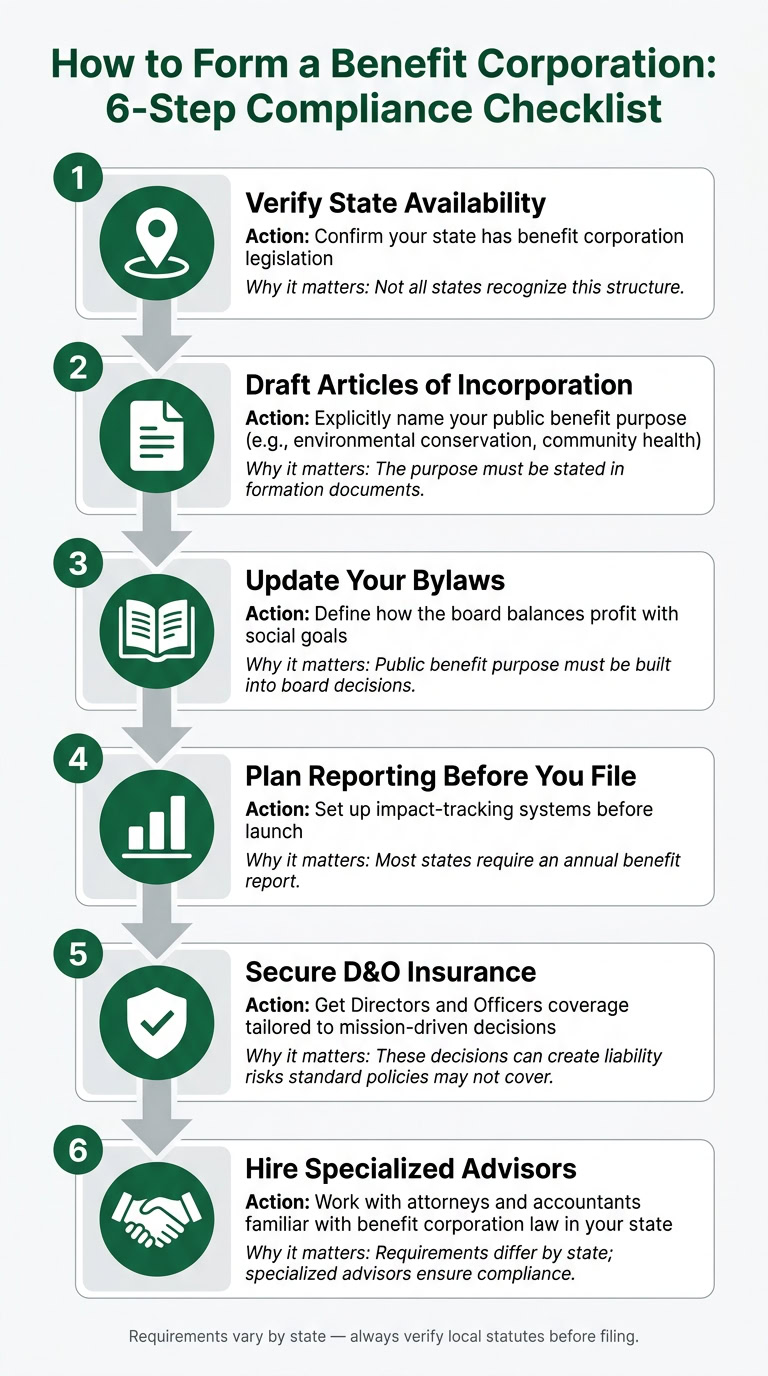
Formation and Compliance Checklist
If this structure lines up with your goals, file in this order:
| Step | Action | Why It Matters |
|---|---|---|
| 1. Verify state availability | Confirm your state has benefit corporation legislation | Not all states recognize this structure |
| 2. Draft your Articles of Incorporation | Explicitly name your public benefit purpose, such as environmental conservation or community health | The purpose must be stated in the formation documents |
| 3. Update your corporate bylaws | Define how the board balances profit with social goals | The public benefit purpose should be built into board decisions |
| 4. Plan reporting before you file | Set up impact-tracking systems before launch | Most states require a benefit report; timing varies by state |
| 5. Secure Directors and Officers (D&O) insurance | Get coverage tailored to mission-driven decisions | These decisions can create liability risks that standard policies may not fully address |
| 6. Hire state-specific attorneys and accountants | Work with advisors familiar with benefit corporation law in your state | Requirements differ by state, so specialized advisors can help you stay compliant |
FAQs
Can I convert an existing corporation into a benefit corporation?
Yes. An existing corporation can convert by amending its Articles of Incorporation to say that it is a benefit corporation.
In most cases, that step requires a formal shareholder vote. Often, approval means a two-thirds majority or a minimum status vote, depending on the state and the company’s governing rules.
For other business types, like LLCs or partnerships, the path is usually different. They often need to complete a formal conversion or merger before they can operate as a benefit corporation.
After the conversion, the work doesn’t stop. The business still has to follow ongoing compliance rules, which usually include:
- Annual benefit reports
- Updated governance procedures
Do all states allow benefit corporations?
No. Not every state allows you to form a benefit corporation.
This business structure exists only where state law allows it. So before you choose it, check whether your state of formation has passed legislation that permits benefit corporations.
Will a benefit corporation affect fundraising?
Yes, it can shape your fundraising strategy, but it doesn’t stop you from raising equity capital. You can still sell shares to current or new investors, much like a traditional corporation.
The main shift is your investor pool. This setup tends to attract impact investors, social venture capital funds, and grant providers. So when you pitch, you’ll want to show both financial strength and social impact.