


Starting a business doesn’t have to cost a fortune. Here’s the bottom line: you can launch a low-risk business with minimal upfront investment – often under $5,000, and sometimes as little as a few hundred dollars. Many of these ideas can be started part-time, right from your home, using tools you already have, like a laptop and an internet connection.
Here’s what you need to know upfront:
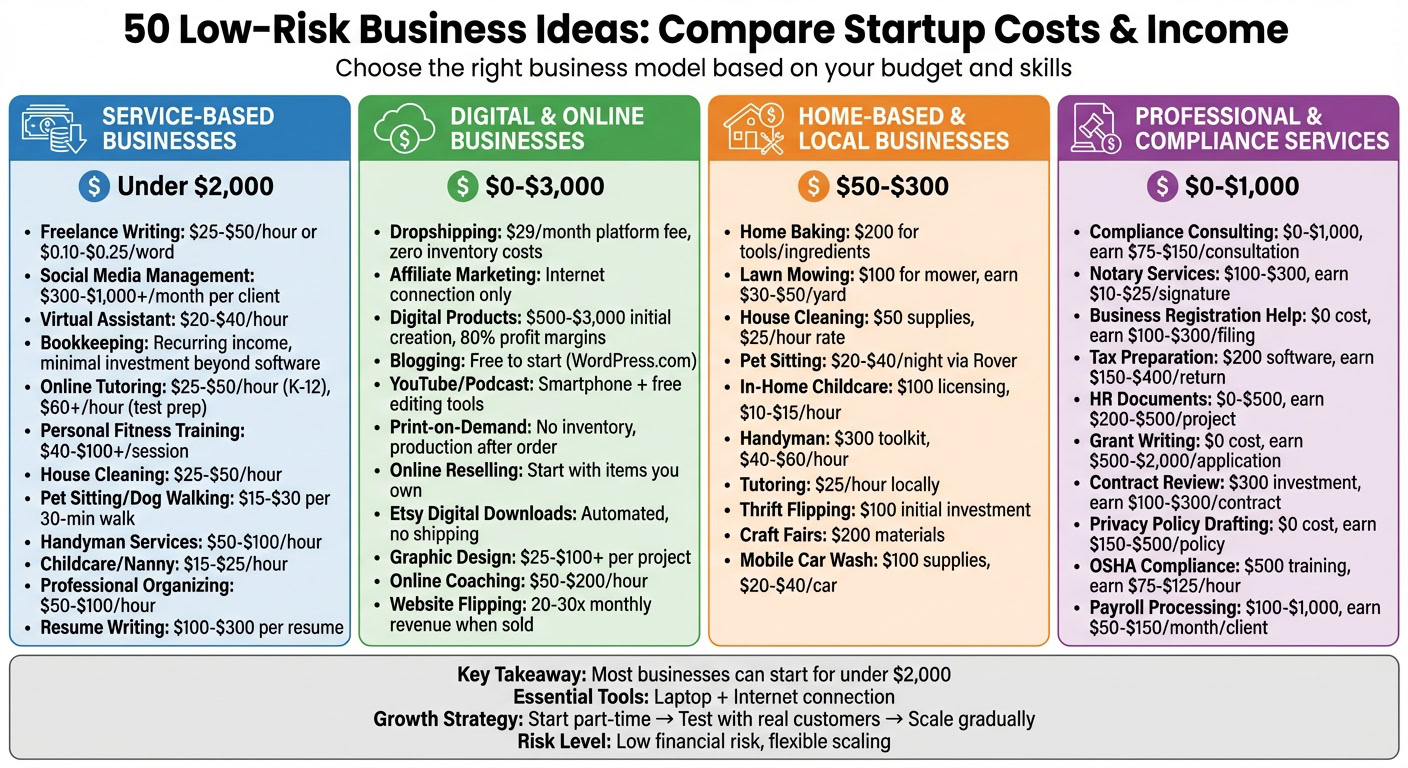
- Service-based businesses (e.g., freelance writing, virtual assistant, or pet sitting) often require less than $2,000 to start and can generate income quickly.
- Digital businesses (e.g., dropshipping, affiliate marketing, or selling digital products) let you work online and scale as demand grows.
- Home-based or local businesses (e.g., baking, lawn care, or house cleaning) cater to community needs and often require small investments in supplies.
- Professional services (e.g., bookkeeping, notary services, or tax preparation) leverage your expertise and start with minimal costs.
The key is to choose a business idea that aligns with your skills and interests, test it with real customers, and grow gradually. This article outlines 50 business ideas grouped into categories, each with low startup costs and simple steps to get started.
1. Service-Based Businesses
Service-based businesses are a fantastic way to start with minimal upfront costs, focusing on your skills rather than physical products. Many of these ideas can be launched for under $2,000, allowing you to test the waters part-time and grow by adding clients or hiring help as demand increases.
Freelance Writing or Copywriting – Use your writing skills to create blog posts, website content, or marketing materials for small businesses and online publications. All you need is a laptop, internet access, and a portfolio of samples. Freelance writers in the U.S. often start at $25–$50 per hour or $0.10–$0.25 per word, with higher rates as you specialize.
Social Media Management – Help businesses manage their presence on platforms like Facebook, Instagram, or LinkedIn by creating content calendars, scheduling posts, and engaging with followers. Using free or affordable scheduling tools, social media managers can earn $300–$1,000+ per month per client.
Virtual Assistant Services – Provide remote administrative support, such as managing emails, calendars, data entry, or customer service. Starting rates for virtual assistants are typically $20–$40 per hour, with specialized skills commanding even higher fees.
Bookkeeping for Small Businesses – Handle bookkeeping tasks like invoicing, expense tracking, and basic financial management using tools like QuickBooks or Wave. Beyond software costs, this service requires little investment and offers steady, recurring income.
Online Tutoring – Teach school subjects, test prep (SAT, ACT, GRE), or specialized skills via platforms like Zoom. Tutors generally charge $25–$50 per hour for K–12 subjects and $60+ per hour for test prep. Startup costs are minimal, requiring only a laptop, webcam, and basic online tools.
Personal Fitness Training (Mobile or Virtual) – Conduct training sessions at clients’ homes, local parks, or online. U.S. personal trainers often charge $40–$100+ per session. While minimal equipment is needed, certifications can enhance your credibility.
House Cleaning Services – Offer residential cleaning services with basic supplies and transportation. Many cleaners charge $25–$50 per hour, providing consistent, recurring income.
Pet Sitting and Dog Walking – Care for pets while their owners are away or at work. Dog walkers in U.S. cities typically charge $15–$30 for a 30-minute walk, with startup costs limited to essentials like leashes and waste bags.
Handyman or Home Maintenance Services – Perform light repairs, furniture assembly, or basic maintenance tasks. Handyman services often charge $50–$100 per hour, with a minimum service fee for each job.
Childcare or Nanny Services – Provide in-home childcare or work at clients’ homes. Rates typically range from $15 to $25 per hour, with specialized care earning higher fees. Be sure to meet local licensing and background check requirements.
Errand Running and Personal Concierge – Help busy clients with errands like grocery shopping, prescription pickups, or dry cleaning. This service requires a reliable vehicle and smartphone, with rates around $25–$50 per hour.
Professional Organizing – Assist clients in decluttering and organizing spaces such as closets, garages, or home offices. Professional organizers in the U.S. charge $50–$100 per hour, with startup costs limited to storage bins and labels.
Resume Writing and Career Coaching – Help job seekers refine their resumes, LinkedIn profiles, and cover letters, or prepare for interviews. This service requires just a laptop and strong writing skills, with rates ranging from $100–$300 per resume or hourly coaching packages.
The key to success in these businesses is building long-term client relationships, which provide steady cash flow as your client base grows. Start by offering your services to friends, neighbors, or local groups and ask for reviews and referrals to build credibility without needing a large marketing budget. These ideas highlight the power of leveraging your skills – an approach we’ll explore further in the next section on digital and home-based businesses.
2. Digital and Online Businesses
Digital and online businesses offer the flexibility to reach a global audience right from your laptop, all while keeping startup costs low. These models eliminate the need for physical inventory or storefronts, making them perfect for testing new ideas and scaling up as demand grows.
Dropshipping Store – Sell products online without managing inventory. Suppliers handle shipping directly to customers. Platforms like Shopify let you start with zero upfront costs (though monthly fees start at $29). You can test a few products using low-cost marketing to find what works.
Affiliate Marketing – Earn commissions by promoting other companies’ products through your website, blog, or social media. All you need is an internet connection, making it one of the simplest and least risky business ideas online.
Digital Product Creation – Develop and sell items like ebooks, online courses, or printable templates through platforms like Gumroad or Teachable. While initial creation costs range from $500 to $3,000, digital products often bring in passive income with profit margins as high as 80%.
Blogging on Niche Topics – Write about specialized subjects like personal finance, travel, or home organization. Monetize your blog with ads and affiliate links. Free platforms like WordPress.com make it easy to get started while you build an audience and grow your revenue.
YouTube or Podcast Content Creation – Create video or audio content and earn income through ads, sponsorships, or affiliate marketing. You can start with just a smartphone and free editing tools, making it an accessible option for beginners.
Print-on-Demand Apparel – Design t-shirts, mugs, or phone cases that are only produced after a customer orders. Suppliers like Printful handle production and shipping, letting you test new designs without worrying about inventory.
Online Reselling – Buy items from thrift stores, garage sales, or clearance racks and resell them on platforms like eBay, Facebook Marketplace, or Poshmark. Many start by selling items they already own and reinvesting profits to grow.
Etsy Digital Downloads Shop – Create and sell digital products like wedding invitations, budget planners, or wall art. Once your designs are uploaded, the process is automated, eliminating the need for shipping or inventory.
Graphic Design Freelancing – Offer services like logo creation, social media graphics, or marketing materials on platforms such as Fiverr or Upwork. Free tools like Canva or GIMP let you start immediately, with freelancers charging anywhere from $25 to $100 (or more) per project.
Online Coaching or Consulting – Share your expertise in areas like fitness, business, or language learning through online sessions. All you need is a webcam and internet access. Many coaches charge between $50 and $200 per hour for their services.
Social Media Content Bundles – Provide local businesses with monthly packages that include content calendars, scheduled posts, and promotional graphics. These bundles create a steady, recurring income stream.
Email Newsletter Publishing – Build a subscriber list around a specific topic and monetize it with sponsorships, affiliate links, or paid subscriptions. Platforms like Substack make it easy to get started for free, only taking a cut when you earn revenue.
Website Flipping – Design simple websites, grow their traffic with content and SEO, and sell them on platforms like Flippa. Profitable sites can sell for 20–30 times their monthly revenue, though building them requires a significant upfront time commitment.
These digital business ideas are cost-effective and can often be launched part-time, giving you the flexibility to experiment without a large financial risk. Up next, we’ll dive into home-based and local business opportunities that build on these strategies.
3. Home-Based and Local Businesses
Starting a home-based or local business allows you to serve your community while keeping costs low. These ideas, much like service-based and digital ventures, require little upfront investment and focus on meeting specific local needs. By tapping into neighborhood connections and maintaining low overhead, you can create a steady income stream.
Home Baking for Local Orders – Whip up cookies, cakes, or specialty treats right from your kitchen and sell them on platforms like Nextdoor or Facebook Marketplace. With about $200 for tools and ingredients, you can test demand through pre-orders.
Neighborhood Lawn Mowing – Offer lawn care services in your area. A basic mower costs around $100, and you can charge $30–$50 per yard to quickly grow a loyal client base.
Reliable Home Cleaning Service – Help busy locals by offering house cleaning services. Start with roughly $50 in supplies and set your rate at $25 per hour.
Community Pet Sitting – Care for pets overnight, either in your home or your clients’. Apps like Rover can help you find customers, with typical earnings of $20–$40 per night.
In-Home Childcare Provider – Provide childcare from your home with an initial licensing investment of about $100. Charge $10–$15 per hour for your services.
Local Handyman Fixes – Handle small home repairs. A $300 toolkit is enough to get started, and you can charge $40–$60 per hour.
Face-to-Face Tutoring Nearby – Offer tutoring services in your area, charging around $25 per hour.
Thrift Flip Local Sales – Find items at thrift stores, garage sales, or clearance racks and resell them locally through Facebook Marketplace or community sales. An initial $100 investment can help you source items to flip and reinvest.
Craft Fairs from Your Garage – Create handmade goods like candles, jewelry, or home decor with about $200 in materials. Sell your creations at local farmers’ markets or craft fairs, and take custom orders to build a steady income.
Errand Runner for Busy Locals – Help neighbors with errands like grocery shopping, prescription pickups, or dry cleaning. Use your car and smartphone to earn about $20 per hour.
Park Personal Training – Offer outdoor personal training sessions. With a $50 investment in basic equipment, you can charge $50 per session.
Mobile Car Wash Service – Start a mobile car wash with $100 in supplies. Charge $20–$40 per car for a convenient service.
Backyard Event Helper – Assist with setting up local events. With just $50 in supplies, you can charge $100 or more per event.
These ideas focus on local needs and flexible services, giving you the chance to start small and grow with minimal financial risk.
sbb-itb-ba0a4be
4. Professional and Compliance Services
Professional and compliance services provide a strong foundation for entrepreneurs looking to leverage their expertise while keeping startup costs low. These services play a crucial role in helping businesses stay compliant, organized, and financially sound. The best part? Many of these services can be launched from home and require minimal investment to get started.
Examples of Professional and Compliance Services
- Virtual Compliance Consulting: Help small businesses navigate regulatory requirements via video calls. With startup costs ranging from $0 to $1,000 for certifications or training, you can charge $75–$150 per consultation, depending on the complexity of the advice.
- Notary Public Services: For $100–$300 in supplies and exam fees, you can become a commissioned notary in your state. Offer mobile or remote notarization services and charge $10–$25 per signature, based on state regulations.
- Business Registration Assistance: Guide new entrepreneurs through filing LLC or corporation paperwork. This service requires no upfront costs beyond your knowledge, and you can charge $100–$300 per filing.
- Tax Preparation Helper: Assist individuals and small businesses with straightforward tax returns during tax season. Invest about $200 in tax software and charge $150–$400 per return, depending on the complexity of the work.
- HR Document Services: Use templates and your expertise to draft employee handbooks, policies, and contracts. With an initial investment of $0–$500 for template libraries, you can earn $200–$500 per project.
- Grant Writing for Small Businesses: Write funding applications for government and private grants. This skill-based service requires no startup costs, and you can charge $500–$2,000 per successful application or $50–$100 per hour.
- Contract Review Assistance: Review business agreements for errors or unfavorable terms. With a $300 investment in legal templates and resources, you can charge $100–$300 per contract.
- Privacy Policy Drafting: Create GDPR- and CCPA-compliant privacy policies for websites and apps. Use free online generators to get started, and charge $150–$500 per policy without any initial investment.
- OSHA Compliance Advising: Help businesses meet workplace safety standards by offering OSHA compliance guidance. With approximately $500 spent on training, you can charge $75–$125 per hour for consulting.
- Remote Payroll Processing: Manage payroll for small businesses using software like Gusto. An investment of $100–$1,000 in software subscriptions allows you to charge $50–$150 per month per client, depending on the size of their workforce.
These services cater to the increasing compliance needs of small businesses. By building strong professional networks and relying on referrals, you can create a steady stream of clients while maintaining a flexible and affordable business model.
Conclusion
The best business idea is one that aligns with your skills, interests, and financial situation. Even straightforward options like freelancing or selling digital products can thrive when they match what you’re good at and genuinely enjoy doing. Starting small, testing your idea with real customers, and making adjustments based on their feedback is a smart and low-risk way to move forward – far better than diving headfirst into something that might not be the right fit.
Many of these ideas come with low startup costs, often ranging between $0 and $2,000. In most cases, all you need is a laptop and an internet connection to get started. These business models are typically flexible, with low overhead, making them ideal for scaling. What begins as a side hustle can grow into a full-time venture by gradually increasing your rates, offering retainers, introducing digital products or courses, or even hiring subcontractors to expand your capacity. This flexibility also allows you to balance your work with family or other commitments while keeping risks – both financial and personal – manageable.
Start by brainstorming a few ideas that fit your skills and interests. Narrow it down to two or three, then test their potential by talking to real customers to gauge demand and pricing. Once you’ve identified the most promising option, use basic tools and modern online services to set up your business quickly and affordably.
Keep in mind that "low risk" doesn’t mean "no risk." Begin small, monitor your expenses closely, and make sure you’re meeting basic U.S. requirements like registering your business, paying taxes, and obtaining any necessary local licenses. Open a separate business bank account, maintain clear records, and check zoning or licensing rules if you’re working from home. By taking gradual steps and using simple professional tools, you can keep both financial and legal risks under control while building a business that works for you.
FAQs
What are the essential steps to start a low-risk business with little money?
Starting a business with minimal risk and investment doesn’t have to be overwhelming. Here’s how you can get started:
- Find the right idea: Pick something that matches your skills and interests while staying within your budget. The more aligned it is with what you enjoy and know, the better your chances of success.
- Lay the groundwork: Draft a straightforward business plan to outline your goals and steps. Register your business name and make sure you’re meeting any legal requirements to operate.
- Set up the basics: Open a business bank account to keep your finances organized. Consider using a virtual mailbox if needed, and ensure you have any permits or licenses required for your industry.
- Get the word out: Start with affordable marketing strategies. Social media, word-of-mouth, and networking can be powerful tools to attract your first customers without breaking the bank.
Begin small, keep your costs in check, and let your business grow steadily over time.
How can I find a business idea that matches my skills and interests?
To discover a business idea that matches your skills and interests, start by reflecting on what you’re naturally good at and the hobbies or activities you genuinely enjoy. What are your strengths? What tasks feel effortless or exciting to you? These can be great starting points for brainstorming potential ideas.
Next, dig a little deeper by researching the skills or resources each idea might require. Think about how these align with your experience and long-term goals. If you’re unsure where to begin, tools like skills assessments or interest quizzes can help narrow down your options.
Ultimately, the goal is to find something you’re passionate about – something you can see yourself staying dedicated to over the long haul. Passion and commitment are key ingredients for success.
What are some common challenges of starting a home-based service business?
Starting a service-based business from home comes with its own set of challenges. For starters, managing client expectations can be tricky, especially when most interactions happen remotely. Clear communication becomes vital to ensure everyone is on the same page.
Another key factor is building a strong online presence. Attracting clients and earning their trust often hinges on how well you showcase your expertise online, which requires consistent effort and time.
Then there are the administrative tasks – things like invoicing, scheduling, and bookkeeping. Without the right tools or systems, these responsibilities can quickly feel overwhelming. On top of that, maintaining a steady income can be tough in the beginning, as the flow of client work may be unpredictable.
Lastly, you’ll need to ensure your business complies with local laws and regulations. This includes understanding zoning rules, tax requirements, and any other legal considerations to avoid running into trouble down the line.