


Starting a business doesn’t have to be expensive or overly risky. Franchises under $20,000 offer an affordable entry point for entrepreneurs, combining proven systems with lower startup costs. These franchises often include training, support, and established brands, reducing the challenges of starting from scratch. Many operate as home-based or mobile models, keeping overhead low while allowing flexibility. Industries like travel, commercial cleaning, fitness, and publishing dominate this space, with options tailored to various interests and skill levels.
Key highlights:
- Affordable Entry: Initial investments range from under $1,000 to $20,000.
- Low Overhead: Many franchises are home-based or mobile, avoiding costly leases.
- Support Included: Training, marketing tools, and operational guidance are standard.
- Quick Start: Some franchises can break even within 6–12 months.
- Flexible Models: Options for part-time or full-time operation.
Examples include Cruise Planners (travel), JAN-PRO (cleaning), Jazzercise (fitness), and Card My Yard (seasonal services). Each franchise offers unique benefits, from tiered investment structures to guaranteed client accounts. Before choosing, review the Franchise Disclosure Document (FDD) and speak with current franchisees to ensure the opportunity aligns with your goals and budget.
What Defines a Low-Risk Franchise Under $20K
Franchises under $20,000 can vary widely in terms of risk, but the best options share certain qualities that help protect your investment and increase your chances of success.
One major factor is the prevalence of home-based and mobile operations. By avoiding costs like commercial rent, utilities, and storefront upkeep, your overhead remains low. This setup often allows you to start small – sometimes even part-time – and expand as your revenue grows. For example, franchises like Cruise Planners operate entirely from home, while mobile franchises deliver services directly to customers, skipping the need for expensive leases right from the start.
Another key element is the operational support provided by franchisors. Many low-cost franchises offer extensive training programs to help you succeed, even in industries where you have no prior experience. In some cases, such as with certain commercial cleaning franchises, franchisors go a step further by offering guaranteed client accounts, making it easier for new owners to secure their first customers without added stress.
Franchises in recession-resistant industries also stand out as safer bets. Services like commercial cleaning and insurance remain in demand regardless of economic shifts. For instance, the global janitorial services market was valued at $324.21 billion in 2023 and is projected to grow to $729.47 billion by 2033. Similarly, the global leisure travel market is forecasted to hit $1.737 billion by 2027, with a compound annual growth rate of 22.6%. These industries aren’t based on fleeting trends – they address ongoing needs that persist through economic ups and downs.
Finally, many franchises offer tiered investment structures, letting you decide how much capital to commit. Take Buildingstars, for example – they provide entry options that cater to both part-time operators and those aiming to scale a larger business. This flexibility allows you to test the waters without overextending financially. Plus, many of these franchises can reach break-even within 6 to 12 months, offering a quicker path to profitability compared to traditional startups.
These characteristics create a strong framework for evaluating low-cost franchise opportunities and identifying those with the best potential for success.
1. Cruise Planners (Travel)

Cruise Planners has consistently held the #1 ranking among travel franchises for 18 straight years. This home-based franchise offers the chance to run a travel agency without the expense of a physical storefront, providing flexibility and keeping startup costs low. Let’s dive into the costs and operational setup for Cruise Planners.
Initial Franchise Fee
The franchise fee varies depending on your background. For most new franchisees, the fee is $10,995. However, if you’re a seasoned travel advisor with an active IATAN card or CLIA certification, the fee drops to just $695. Others, including eligible veterans and first responders, pay $6,995. This tiered pricing makes it accessible whether you’re entering the industry for the first time or already have experience.
Total Startup Investment Range
The total investment required falls between $1,945 and $20,505. This includes the franchise fee, equipment, marketing, training, licenses, and three months of operating funds. The package also features a six-day, in-person training program called "STAR University" in Fort Lauderdale, Florida. Beyond training, franchisees gain access to Cruise Planners’ proprietary tools, like the CP Maxx CRM system and automated marketing resources.
Ongoing Royalty Percentage
Cruise Planners uses a tiered royalty structure: starting at 3%, then dropping to 2%, 1%, and eventually 0% for sales beyond $1 million. This system rewards high-performing franchisees and helps maximize earnings. In contrast, many other travel franchises charge a flat royalty of 1.5% to 3%, regardless of sales. Additionally, franchisees pay about $70 per month for technology and administrative support.
Primary Operational Model (Home-based, Mobile, or Location-based)
Cruise Planners operates as a fully home-based business. You can run your franchise from anywhere with internet access, making it perfect for those looking to start part-time while balancing other commitments, like another job or family. Franchise owner Deborah Banks highlights how this flexibility has been crucial for her military family, allowing them to grow their business while adapting to frequent relocations. Plus, franchisees join a network of over 3,000 others, providing support and collaboration opportunities to combat the isolation that can come with working from home.
2. JAN-PRO Cleaning & Disinfecting (Commercial Cleaning)
Shifting focus from travel to essential services, the commercial cleaning industry offers steady, low-risk franchise opportunities.
JAN-PRO has been the #1 Commercial Cleaning Franchise for 15 consecutive years. With a network of 12,756 units and a 99% retention rate, JAN-PRO operates in a sector that generates over $144 billion annually.
Initial Franchise Fee
The initial franchise fee ranges from $2,520 to $44,000. Entry is made accessible with down payments as low as $950–$1,250, and veterans can take advantage of 24-month interest-free financing for 50% of fees exceeding $8,100. This tiered approach caters to different financial needs and growth aspirations.
Total Startup Investment Range
Starting a JAN-PRO franchise requires a total investment between $4,830 and $58,070. This includes the franchise fee, a starter kit (roughly $900), equipment, initial supplies, uniforms, ID badges, and a set of guaranteed customer accounts. The franchisor also advises having at least $1,000 in emergency savings to handle unforeseen expenses during the startup phase. Unlike many other franchises, JAN-PRO offers in-house financing for both the franchise fee and accounts receivable, making it easier to get started.
Ongoing Royalty Percentage
Franchisees are required to pay a 10% ongoing royalty fee and an additional 1% advertising royalty fee. These fees cover a range of support services, including customer acquisition handled by a regional developer. This setup allows franchisees to focus on providing excellent service instead of worrying about sales and marketing.
Primary Operational Model (Home-based, Mobile, or Location-based)
JAN-PRO’s home-based, mobile business model eliminates the need for a physical storefront, which helps keep overhead costs and risks low. This flexible setup allows franchisees to start part-time, requiring as little as three hours per week, making it possible to maintain a full-time job while building the business. Franchisees Ben and Marissa shared their experience:
"You can work with your family, making JAN-PRO’s potential virtually unlimited."
The business is designed to scale, growing from a small client base to a larger operation by hiring additional team members as demand increases.
3. Farmer’s Insurance (Insurance Services)
Shifting gears from cleaning services to insurance, Farmers Insurance presents a business opportunity rooted in over 90 years of experience. With a portfolio of more than 60 insurance products, it offers a reliable pathway into a critical industry. What’s more, the program includes an appealing fee structure designed to lower entry barriers.
Initial Franchise Fee
Farmers Insurance stands out by charging no franchise or startup fees. As the company explains:
"As a Farmers agency owner, you’ll have support to help you grow your wealth, grow your business, and grow your community with no franchise fee."
By eliminating this fee, Farmers makes it easier for aspiring entrepreneurs to get started, although other financial commitments are required.
Total Startup Investment Range
The total investment needed to launch a Farmers agency is $50,000. This amount covers setting up a fully equipped retail office within 120 days and hiring two licensed staff members. Farmers sweetens the deal with an office startup bonus of up to $10,000 for qualified candidates. Additionally, financial incentives are available for military veterans and bilingual individuals fluent in Spanish, Cantonese, Mandarin, Korean, Vietnamese, Tagalog, or Hindi.
Primary Operational Model
Farmers Insurance operates on a physical retail office model. As an agency owner, you’ll oversee sales, customer service, marketing, and staff development. To support you, Farmers provides resources like the University of Farmers training program and ongoing business coaching.
4. N2 Publishing (Advertising & Publishing)
N2 Publishing, also known as The N2 Company, stands out in the advertising and publishing industry with its low-cost entry model. Specializing in hyper-local print magazines and digital marketing, it operates well-known brands like Stroll, Greet, Real Producers, and BeLocal. With a network of approximately 945 franchises across the U.S., N2 Publishing offers a compelling opportunity for entrepreneurs. Here’s a closer look at its cost structure and business model.
Initial Franchise Fee
Starting with N2 Publishing comes with an initial fee of $570. This fee is notably lower than many other franchise options, making it an attractive choice for those looking to enter the market without a hefty upfront investment.
Total Startup Investment Range
The total investment to launch an N2 Publishing franchise falls between $975 and $9,800. This includes the franchise fee, training costs, and a recommended working capital of $500 to $750. To further ease the burden on franchisees, N2 handles essential back-office operations like graphic design, professional printing, and billing. This streamlined approach helps keep overhead expenses minimal.
Ongoing Royalty Percentage
Franchisees pay a 15% royalty fee on gross sales. Despite this, satisfaction levels among N2 franchisees are reported to be 15–20% higher than industry averages. This suggests that the support and resources provided by the company are well worth the cost.
Primary Operational Model
N2 Publishing’s business model is home-based and mobile, allowing Area Directors to oversee local publications while engaging directly with businesses in their communities. This flexibility is a key draw for many franchisees. Publisher Kelli Heppner shared her experience:
"Not only have I more than tripled what I made at my old job, but I have the freedom to work when it’s convenient for me".
Another publisher, Suzie Chafin, highlighted the work-life balance the model offers:
"For women, we are often forced to pick a career or motherhood. With N2, I didn’t have to pick".
N2 Publishing’s combination of low startup costs, robust support, and flexible operations makes it an appealing option for those seeking a rewarding career path that fits their lifestyle.
5. Jazzercise (Fitness & Dance)
Jazzercise has been franchising since 1982 and boasts over 7,000 units as of 2025. This fitness and dance program offers an accessible way for enthusiasts to turn their love for exercise into a business. With workouts that burn up to 800 calories in just 55 minutes, Jazzercise has become a popular choice for health-focused communities. Here’s a closer look at its fees, investment details, royalties, and operational setup.
Initial Franchise Fee
The franchise fee for Jazzercise is $1,250. This one-time payment provides a low-barrier entry point for aspiring fitness entrepreneurs.
Total Startup Investment Range
Jazzercise offers two franchise options: Associate (instructors teaching for others) and Class/Business Owners (who manage their own classes and may also teach). The initial investment varies:
- Associate Franchise: $2,170 to $2,780
- Class/Business Owner Franchise: $3,935 to $40,745
These costs include essentials like liability insurance ($245–$345 annually), equipment ($500–$700), and other startup expenses. Franchisees also receive around 150 new choreographed routines each year to keep their classes engaging and current.
Ongoing Royalty Percentage
Jazzercise franchisees pay a 20% royalty fee on gross member enrollment, though some programs qualify for a reduced fee of 10%. Monthly royalty minimums vary by franchise type:
- Class Owners: $250 per month
- Business Owners: $500 per month
- Associates: Approximately $130 per year (about $13 per month)
Angela S., a Jazzercise instructor, shared her experience:
"Jazzercise has ignited my passion and boosted my confidence both on and off the stage. It’s brought me lifelong friends, cherished memories, and leadership opportunities."
Primary Operational Model
Jazzercise thrives on in-person connections, with classes held in rented spaces like community centers, gyms, or studios. This approach keeps overhead costs manageable while fostering a strong sense of community. Franchisees are required to teach classes themselves, completing a four- to five-week virtual training and passing an audition to qualify. Once certified, they must teach at least four classes per month.
sbb-itb-ba0a4be
6. Momleta (Fitness for New Mothers)

Momleta has carved out a niche in the fitness world by focusing on the needs of new mothers. Formerly known as Baby Boot Camp, this franchise specializes in pre- and postnatal fitness, offering stroller-based exercise classes that let moms stay active while keeping their little ones close. With locations across the U.S., Canada, and Australia, Momleta provides a flexible, family-oriented business model tailored to fit the lifestyle of new mothers.
Initial Franchise Fee, Total Investment, and Royalty
Starting a Momleta franchise is accessible, with franchise fees ranging from $1,990 to $2,990. The total investment required falls between $3,500 and $8,700, making it an affordable option for many. Instead of traditional percentage-based royalties, Momleta uses a flat monthly fee structure of $100 to $250, which simplifies financial planning. For mothers passionate about wellness and entrepreneurship, these low startup costs and predictable fees make Momleta an appealing choice.
Primary Operational Model
Momleta operates as a mobile and home-based franchise, offering flexibility for owners. Administrative work can be handled from home, while classes are held in accessible community spaces like parks or shopping malls. This setup keeps overhead costs low while fostering connections with local moms, creating a supportive and engaging environment.
7. Card My Yard (Seasonal Greeting Service)
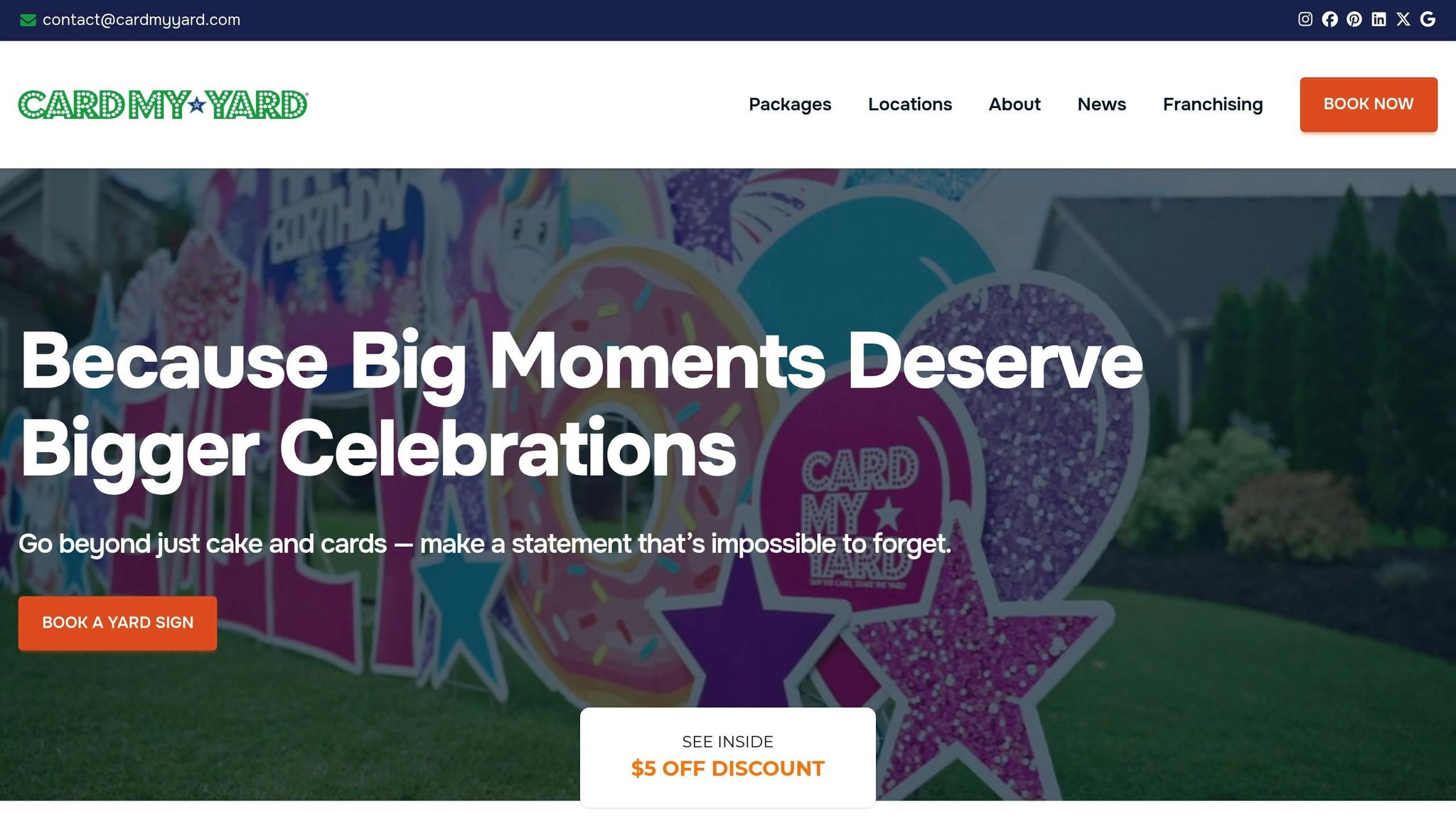
Card My Yard turns ordinary front yards into festive celebrations. This franchise specializes in creating oversized yard signs for special occasions like birthdays, graduations, anniversaries, and more. With 543 franchises spread across 46 states and an impressive 4.93 average customer rating as of 2025, it’s clear that both customers and franchise owners find value in this business model. Here’s a closer look at the investment details for potential franchisees.
Initial Franchise Fee and Total Investment Range
To start a Card My Yard franchise, you’ll need an initial franchise fee of $8,500, with the total investment falling between $10,350 and $18,550. Veterans can take advantage of a $1,000 discount on the franchise fee. This initial cost includes your first set of yard letters and signs, so there’s no need to worry about stocking extra inventory. Most franchisees are fully operational within 30 to 45 days.
Ongoing Royalty Percentage
Franchisees pay a 25% royalty on gross sales, along with a monthly advertising fee ranging from $25 to $65. The average gross revenue per location is $21,957, making this franchise an attractive option for those seeking part-time or supplemental income.
Primary Operational Model
Card My Yard is a home-based, mobile business, which means there’s no need for a storefront or warehouse. Franchisees handle bookings through a custom e-commerce platform and travel to customer locations to set up and later remove the yard displays. Ashley P., a franchisee, shares her perspective:
"I just love that it’s flexible – especially for someone like a mom. It’s a really good franchise that you can really kind of make it work for your family."
The business typically requires only 1 to 2 employees and minimal equipment, such as a vehicle, making it a manageable and family-friendly opportunity.
8. Buildingstars (Commercial Cleaning)

Buildingstars operates within the massive $70 billion commercial cleaning industry, offering a flexible business model to its franchisees. With 1,376 franchise units across the country, the company has established itself by focusing on high-quality office building accounts while steering clear of more demanding sectors like restaurants and health clubs. Its success is reflected in its ranking as #25 on Entrepreneur’s Fastest-Growing Franchise list in 2021, showcasing a consistent track record.
Initial Franchise Fee and Total Investment Range
One of the standout features of Buildingstars is its low barrier to entry. The initial franchise fee starts at just $2,195, making it an affordable option for aspiring entrepreneurs. Depending on the level you choose, the total startup investment ranges from $2,195 to $52,795. For those looking to start even smaller, the entry-level janitorial package begins at $795, which includes equipment and a ready-made customer base generating $1,000 to $5,000 in monthly revenue.
Primary Operational Model
Buildingstars doesn’t just offer competitive fees – it also simplifies operations for its franchisees. As a home-based, mobile franchise, it allows franchise owners to focus entirely on delivering services while regional support centers handle administrative tasks like billing and customer service.
Josh Adams, a franchisee, shares his experience:
"I have been working for Buildingstars for three years now, and I can say that I’m very happy with the company. They are very nice and help to solve any problem you have. They regularly check in to ensure smooth operations."
The franchise structure includes three tiers: Technician (part-time, hands-on work), OnSite Manager (full-time with a small team), and Corporate (overseeing multiple accounts with dedicated teams). Additionally, the "SmartStart™ Program" allows new franchisees to begin part-time without giving up their current job. Plus, when you’re ready to expand, 100% of your initial Technician-level franchise fee can be applied toward upgrading to the OnSite Manager level.
How to Choose the Right Franchise Under $20K
Finding the right franchise starts with understanding your strengths. If you’re skilled in sales and enjoy networking, franchises like Cruise Planners or N2 Publishing might be a great fit since they rely heavily on building relationships and closing deals. On the other hand, if you’d rather focus on managing teams instead of handling every task yourself, a management-oriented option like Buildingstars could be a better choice. For fitness-related franchises, keep in mind that some may require specific certifications before you can get started.
A key step in your decision-making process is reviewing the Franchise Disclosure Document (FDD) thoroughly. This document is packed with essential information. For instance, Item 7 breaks down all the initial costs, while Item 19 shares any earnings projections the franchisor is willing to disclose. Experts often highlight that franchises with proven track records make financing easier. To get a clearer picture, consider speaking with current franchisees to validate the support offered and understand the timeline for getting started.
Another crucial factor is the level of support provided by the franchisor. Some low-cost franchises function more like business opportunities, offering flexibility but limited ongoing guidance. Traditional franchises, however, typically provide structured training, marketing assistance, and operational tools. For example, some may include proprietary software for bookings, standardized customer contracts, or nationally coordinated marketing campaigns. Think about whether these features align with your business goals and personal preferences.
Since many franchises under $20,000 come with low start-up costs, they often allow you to start part-time while keeping your current job. However, double-check this flexibility in the agreement. Also, consider the operational demands. Service-based businesses, such as commercial cleaning, often require working evenings or weekends. Make sure you’re comfortable with any physical requirements and non-traditional hours. Additionally, verify whether the franchise agreement guarantees exclusive territory rights or allows competing units nearby, as this can significantly impact your growth potential.
Lastly, take a close look at the full financial picture. Beyond the initial investment, account for ongoing expenses like royalties and required marketing contributions. Many low-cost franchises aim to help owners break even within 6 to 12 months, but this can depend on factors like your market and effort level. Some franchisors even offer internal financing options for equipment or initial fees, which can ease cash flow challenges. Be sure to weigh these options carefully before making your decision.
Franchise Comparison Table
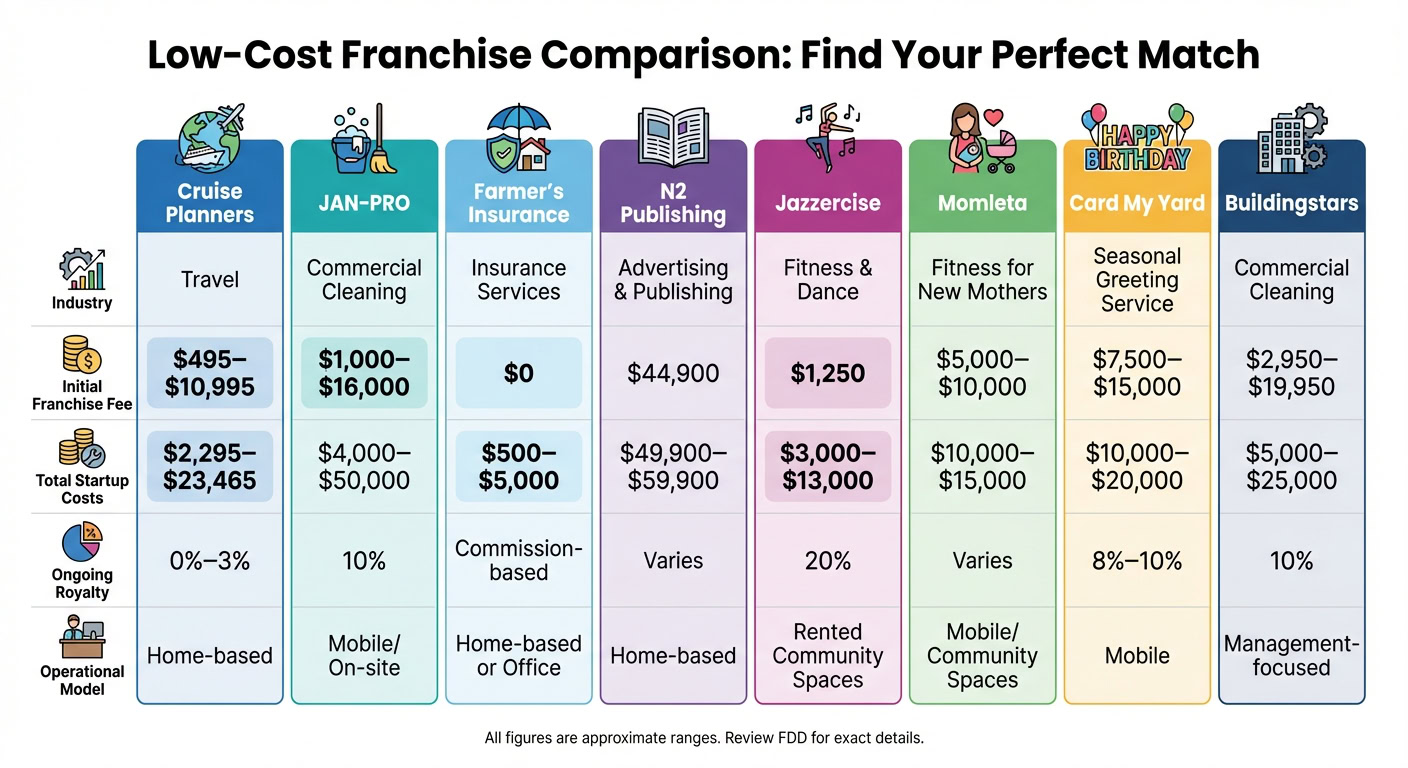
The table below provides a snapshot of essential financial and operational details for various franchises:
| Franchise Name | Industry | Initial Franchise Fee | Total Startup Costs | Ongoing Royalty | Operational Model |
|---|---|---|---|---|---|
| Cruise Planners | Travel | $495–$10,995 | $2,295–$23,465 | 0%–3% | Home-based |
| JAN-PRO | Commercial Cleaning | $1,000–$16,000 | $4,000–$50,000 | 10% | Mobile/On-site |
| Farmer’s Insurance | Insurance Services | $0 | $500–$5,000 | Commission-based | Home-based or Office |
| N2 Publishing | Advertising & Publishing | $44,900 | $49,900–$59,900 | Varies | Home-based |
| Jazzercise | Fitness & Dance | $1,250 | $3,000–$13,000 | 20% | Rented Community Spaces |
| Momleta | Fitness for New Mothers | $5,000–$10,000 | $10,000–$15,000 | Varies | Mobile/Community Spaces |
| Card My Yard | Seasonal Greeting Service | $7,500–$15,000 | $10,000–$20,000 | 8%–10% | Mobile |
| Buildingstars | Commercial Cleaning | $2,950–$19,950 | $5,000–$25,000 | 10% | Management-focused |
This comparison highlights the variety in franchise options, from industries like travel and fitness to commercial cleaning and publishing. Royalty structures differ widely – Cruise Planners, for instance, charges between 0%–3%, while Jazzercise takes 20%. Operational models also range from home-based setups, such as those offered by Cruise Planners and N2 Publishing, to mobile-focused businesses like Card My Yard and JAN-PRO.
For those seeking lower startup costs, franchises like Farmer’s Insurance and Jazzercise might appeal, while others like N2 Publishing cater to higher investment levels. Additionally, some franchises, like Buildingstars, emphasize team management over daily operations, offering flexibility in how you run the business.
This side-by-side breakdown makes it easier to evaluate which franchise aligns best with your financial capabilities and operational preferences.
Conclusion
Franchises under $20,000 offer a great starting point for entrepreneurs working with a smaller budget. They prove that you don’t need a six-figure investment to launch a business with a solid track record and built-in support. From home-based travel agencies to mobile cleaning services, these opportunities cater to a variety of industries, making it easier to find something that fits your interests and lifestyle.
What makes these franchises even more appealing is their flexibility. Many operate as home-based, mobile, or part-time models, and most reach their break-even point within 6 to 12 months, allowing for quicker returns.
Before diving in, take the time to carefully review the Franchise Disclosure Document (FDD). This document spells out key details like fees, obligations, and performance metrics. It’s also helpful to connect with current and former franchisees to get firsthand insights into the level of support, any unexpected costs, and realistic timelines for profitability. Strong franchisor backing and adaptable business models can help reduce risks, but choosing a franchise that aligns with your personal goals and interests is crucial for long-term success.
These opportunities often thrive in industries that are less affected by economic downturns. For example, the travel industry is projected to grow to $1.737 billion by 2027, while janitorial services are expected to reach $729.47 billion by 2033. With the right preparation and research, these franchises could be your stepping stone to business ownership.
FAQs
What should I look for when choosing a low-cost franchise under $20,000?
When exploring a franchise opportunity under $20,000, it’s important to look beyond the initial price tag and evaluate the total investment. This means factoring in the franchise fee, equipment, setup costs (like creating a home office or leasing a space), and the working capital needed to keep things running. Don’t overlook hidden expenses – carefully reviewing the Franchise Disclosure Document can help you spot any surprises that might stretch your budget.
Another key consideration is the support system offered by the franchisor. Comprehensive training programs, hands-on operational guidance, and effective marketing resources can make a world of difference, particularly when you’re working with limited funds. These tools not only ease the learning process but also set you up for a smoother path to success.
Lastly, think about how the franchise aligns with your personal goals and the needs of your local market. Focus on industries with steady demand and ensure there’s a suitable customer base in your area. Don’t forget to account for how royalties and fees might impact your bottom line. By weighing costs, available support, and market compatibility, you can identify a low-risk franchise that delivers strong potential for your investment.
How long does it usually take to break even with a franchise under $20,000?
Franchises with startup costs under $20,000 often reach their break-even point within 6 to 12 months of operation. For some, particularly those backed by a strong brand and minimal overhead expenses, returns can start appearing as early as 3 to 6 months.
How quickly you see profits depends on several factors, including the type of franchise, local market demand, your marketing strategies, and how much you allocate toward essentials like inventory and advertising. Opting for a franchise with recurring income streams – such as subscription-based services – and closely following the franchisor’s training can significantly speed up your path to profitability.
What are the most reliable industries for starting a low-cost franchise under $20,000?
Industries that provide dependable, low-cost franchise options often focus on essential, recurring services that remain steady even during economic shifts. Take commercial cleaning and janitorial services, for example. These businesses frequently secure contracts with offices, schools, and property management companies, offering long-term stability and consistent revenue streams.
Another solid choice is home services and repair businesses, such as painting or garage renovations. These franchises meet ongoing consumer needs, ensuring steady demand regardless of the economy. Similarly, travel planning – like booking cruises or vacations – and tax preparation services capitalize on seasonal demand and benefit from strong brand recognition, making them attractive options for franchise newcomers.
Altogether, sectors like cleaning, home services, travel, and tax preparation shine as some of the most reliable and budget-friendly franchise opportunities available for under $20,000.