


Miss your annual report deadline, and the usual chain is simple: fees start, your good standing can drop, and the state may suspend, revoke, or dissolve your business if you wait too long.
In plain terms, I’d treat a late report like a business fire drill. You should check your state status, file the late report, pay the fees, and, if needed, apply for reinstatement. In Florida alone, an LLC that misses the May 1 deadline can owe $538.75 total – the $138.75 report fee plus a $400 late fee.
Here’s the short version:
- First problem: late fees, often $50 to several hundred dollars
- Next problem: loss of good standing
- After that: trouble with banks, loans, licenses, and contracts
- Worst case: state dissolution or revoked authority to do business
- Best next step: use your Secretary of State site today to confirm status and file what’s missing
If I were reading this because my filing is late, I’d want one answer fast: fix it now before the costs and business limits stack up.
What Happens After You Miss the Deadline
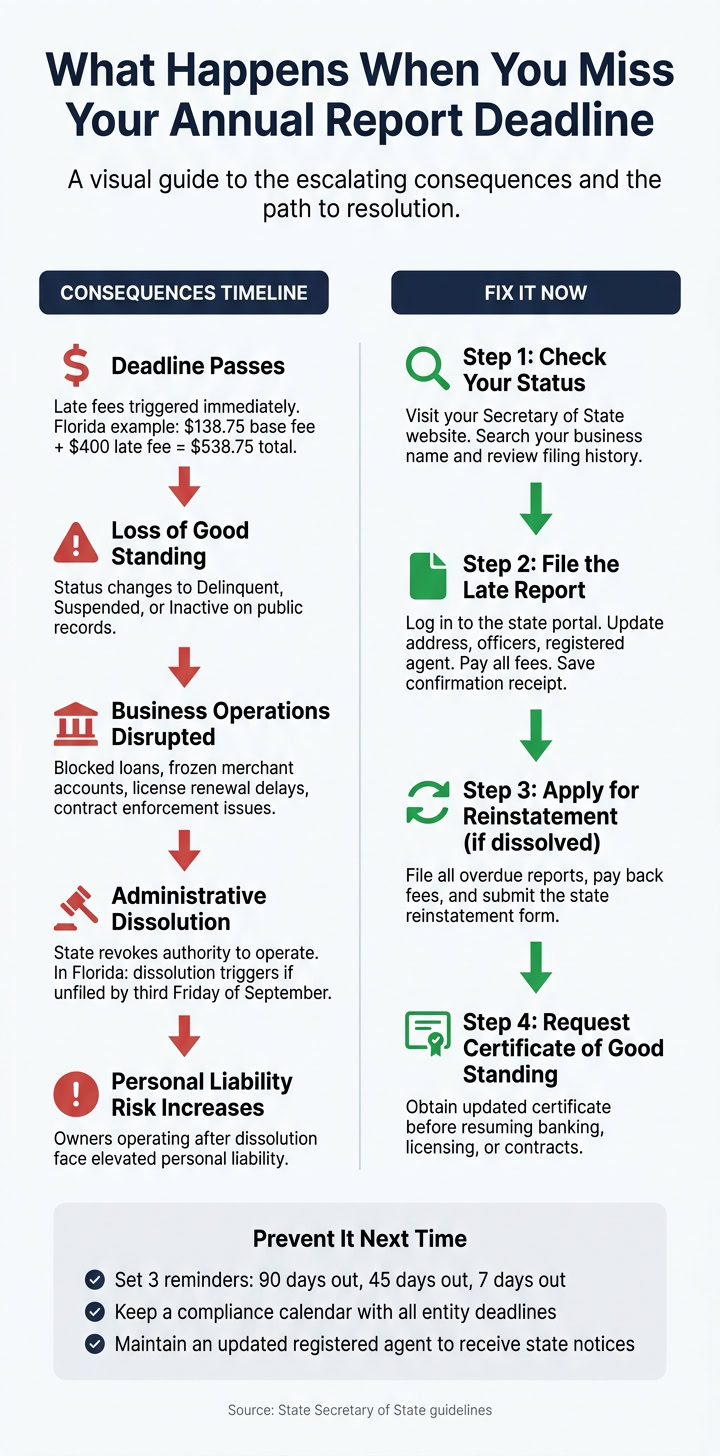
Once the deadline passes, states usually start with fees. Then they move to status changes. If the filing stays overdue, that can lead to dissolution or revoked authority.
Late Fees and Monetary Penalties
The first hit is usually a late fee or penalty. Depending on the state, that can be $50 or several hundred dollars.
Florida shows how fast this can get expensive. The base annual report fee for an LLC is $138.75. Miss the May 1 deadline, and the state adds a $400 late fee. That brings the total to $538.75.
Loss of Good Standing and Public Status Changes
If the report stays unfiled, the business’s public record can change to labels like Delinquent, Suspended, Inactive, or Not in Good Standing.
That status doesn’t just sit in a database. It shows up on state search portals and can stop you from getting a Certificate of Good Standing. At that point, the problem starts moving from paperwork into day-to-day business.
Administrative Dissolution, Revoked Authority, and Operating Risk
If the missed report still isn’t fixed, the state can step in harder. It may administratively dissolve the LLC or corporation, or revoke a foreign entity’s authority to do business in the state.
Florida is a good example of how short the runway can be. If an LLC’s annual report is still unfiled by the third Friday of September, the state administratively dissolves the entity. That can also lead to reinstatement fees and the risk of losing the business name.
After dissolution, the business can no longer carry on normal business. If owners keep operating anyway, their personal liability risk can go up, and the state usually limits the business to winding up its affairs. From there, the trouble can spread into banking, contracts, and licensing.
How a Missed Annual Report Affects Day-to-Day Business
Once the state marks your business delinquent or dissolved, the fallout doesn’t stay on paper. It starts showing up in the parts of the business that need to work every day: banking, contracts, licensing, and basic operations.
Banking, Payment Processing, and Financing Barriers
Missing a filing can do more than trigger state fees. It can interrupt routine financial activity in ways that hit fast.
If your business loses good standing, you may run into trouble getting loans, opening bank accounts, keeping merchant services active, or securing state certifications. In some cases, that can mean frozen merchant accounts, blocked card processing, or financing delays right when cash flow matters most.
Contract Enforcement and License Renewals
A business marked delinquent or not in good standing can hit legal and admin roadblocks too. In some states, that status may stop the company from entering new contracts or enforcing current ones until the business restores its standing.
License renewals can slow down as well. Many state and local agencies ask for proof of good standing before they approve a renewal, so one missed report can turn into a delay that spills into daily operations.
Consequence Snapshot by Problem Type
Here’s the practical impact by problem type.
| Consequence | Operational impact |
|---|---|
| Late Fees & Penalties | Immediate cash drain; fees can range from $50 to several hundred dollars |
| Loss of Good Standing | Harder to open accounts, secure loans, or renew state certifications |
| Administrative Dissolution | Business must reinstate before normal operations resume |
| Banking & Financing Barriers | Loan denials, account freezes, or blocked card processing |
| Licensing & Contract Issues | Blocked license renewals and trouble enforcing agreements |
sbb-itb-ba0a4be
What to Do If Your Annual Report Is Already Late
If your annual report is already late, move fast and handle it in this order: check your status, file the report, then reinstate the business if the state has already suspended or dissolved it.
Check Your Business Status with the State First
Once your status changes, the main job is simple: stop penalties from piling up and get your authority to operate back.
Go to your state’s Secretary of State website and use the business search tool to check your current standing, filing history, and next due date.
Have your exact legal name, state of formation, and foreign registration details ready. The status listed there will show what you need to do next:
| Status | What You Need to Do |
|---|---|
| Active / Good Standing | No immediate action. |
| Delinquent / Not in Good Standing | File the overdue report and pay all fees. |
| Administratively Dissolved / Revoked | File for reinstatement and pay all back fees. |
If you need written proof, request a Certificate of Good Standing from the state.
Once you confirm the status, file the overdue report or go straight to reinstatement.
File the Late Report and Pay All Required Fees
Log in to the state portal and complete the overdue annual report. Check and update your address, managers or officers, and registered agent details if needed.
Pay the filing fee and any late charges shown in the portal. The sooner you act, the sooner you can stop extra penalties from adding up and get back to good standing.
Save the confirmation receipt or stamped copy. That paperwork can help if a bank, lender, or creditor asks you to show proof that you’re back in compliance.
If the state has already dissolved or suspended the entity, filing the late report by itself won’t restore good standing.
Handle Reinstatement If the Business Was Dissolved or Suspended
If the state dissolved or suspended the business, you’ll need to file all overdue reports, pay every past-due fee, and submit the state’s reinstatement form.
After reinstatement, request an updated Certificate of Good Standing before you resume banking, licensing, or contract work.
How to Avoid Missing the Next Deadline
Once you file the overdue report or finish reinstatement, set up a simple system so the next deadline doesn’t sneak past you.
Use State Portals and a Compliance Calendar
Keep every entity in one master list, then add each deadline to a compliance calendar. For every LLC or corporation you own, note the state of formation, the exact filing deadline, whether that deadline is anniversary-based or a fixed date, and the filing fee.
After that, set three reminders for each deadline:
- 90 days out to gather updated information
- 45 days out to log in and submit the filing
- 7 days out for a last review
Google Calendar works well for this. So does any project management tool you already use.
The calendar helps you stay on top of due dates. The state portal helps you confirm what actually happened. After each filing, check your state’s Secretary of State website to make sure the submission was recorded and that the next due date is listed correctly.
For remote owners, this is where things often fall apart. The filing itself may be simple. The missed notice is usually the problem.
Use Registered Agent Reminders and Centralized Tracking with BusinessAnywhere
A registered agent receives official state notices. If that agent information is out of date, it’s easy to miss filings.
BusinessAnywhere keeps renewal dates and registered agent details in one dashboard. For remote owners managing more than one entity, that makes tracking a lot easier.
Key Takeaways
Missing an annual report tends to follow the same chain: late fees, loss of good standing, administrative dissolution, and then trouble with banks and contracts. The fix is usually straightforward. Check your state status, file the overdue report, pay all required fees, and seek reinstatement if the state has already dissolved the entity.
To keep it from happening again, focus on three habits: use a compliance calendar with layered reminders, check the state portal after every filing, and keep the best registered agent service in place so official notices don’t slip through the cracks.
FAQs
Can I still operate if my business is not in good standing?
Maybe. But if your business isn’t in good standing, the risks are serious.
You may not be able to sign contracts, get loans, open bank accounts, renew licenses, or defend your company in court.
If the problem continues, the state may administratively dissolve the business. That means the company can lose its legal right to operate, own property, or keep business accounts.
How long before the state dissolves your business?
There’s no one-size-fits-all timeline for administrative dissolution. Each state has its own rules, deadlines, and grace periods.
In some states, you may get 30 to 60 days to fix missed filings. In others, the state may start moving toward dissolution if the issue isn’t corrected. Check your state’s Secretary of State business database to confirm your status and review any notices. If you miss a deadline, act fast to help avoid permanent dissolution.
Do I need reinstatement or just a late filing?
Usually, reinstatement isn’t needed if you simply filed late. If your business is still active but marked delinquent, you can often fix the issue by submitting the overdue annual report and paying any late fees or penalties to get back into good standing.
Reinstatement usually comes into play only when your company was administratively dissolved or otherwise lost its status. In that case, you’ll generally need to clear missed filings, back fees, and sometimes tax requirements.