If you’re a digital nomad juggling clients across time zones, forming a US LLC can simplify your business operations. Here’s why:
- Access to Payment Platforms: Platforms like Stripe and PayPal often require a legitimate business structure.
- Professional Invoicing: Bill clients in USD and avoid currency conversion fees.
- Asset Protection: Separate personal assets from business liabilities.
- No US Visit Needed: States like Wyoming allow LLC formation without a social security number or physical presence.
Key Benefits
- Tax Efficiency: Non-residents with no US-sourced income may owe no federal taxes.
- Privacy: Use a registered agent to keep personal details private.
- Cost-Effective: Wyoming, for example, charges only $102 to form an LLC and $60 annually.
How It Works
- Registered Agent: Required in the state of formation; costs $50–$300 annually.
- Virtual Mailboxes: Handle mail digitally for $10–$30/month.
- Banking: Use platforms like Mercury or Wise Business to open accounts remotely.
Top State for Nomads: Wyoming
- $102 formation fee, $60 annual fee.
- No state income tax.
- Strong privacy protections.
Forming a US LLC gives you the flexibility to manage your business from anywhere while maintaining a professional presence.
Can You Form a US LLC Without a Fixed Address?
Yes, you can – and it’s not as complicated as it sounds. Every US state requires an LLC to designate a registered agent with a physical street address in the state of incorporation. But here’s the good news: that address doesn’t have to be yours. A registered agent service can provide the required address, sparing you from needing to own property, rent a space, or even set foot in the US.
Professional registered agent services serve as your official point of contact. They supply a valid physical address in your chosen state, handle important legal and government documents on your behalf, and protect your personal details from being listed in public records. These services typically cost between $50 and $300 per year. In certain states, like Wyoming, only the registered agent’s address is listed on the Articles of Organization, which means your name stays completely private. Many digital nomads also pair this with virtual mailboxes to complete their business setup.
"All states require a registered agent with a physical address in the state of incorporation. Professional services cost $50-300 annually and provide privacy benefits plus reliable compliance support." – Rick Mak, Global Entrepreneur and Business Strategist
Virtual mailboxes are another handy tool. They scan and forward mail to you digitally, so you can manage correspondence from anywhere in the world. This setup allows you to establish a legitimate US business presence without needing a permanent residential address. You stay in control of your LLC while traveling, working from coworking spaces, or exploring new destinations. It’s an ideal solution for entrepreneurs embracing a nomadic lifestyle while maintaining compliance with US business laws.
That said, while a registered agent satisfies the legal address requirement, you may encounter additional hurdles when it comes to banking or operational needs. For example, some traditional banks might request a physical “operating” address to open a business account. Digital nomads often address this by using virtual office services that provide necessary documents like lease agreements or utility bills. On the other hand, modern online banking platforms catering to remote businesses often eliminate the need for a physical address altogether, making the process even more seamless.
sbb-itb-ba0a4be
Why Wyoming Works Best for Digital Nomads
Wyoming stands out as a top choice for digital nomads, offering a mix of affordability, privacy, and ease of compliance. With its low fees, no state income tax, and strong legal protections, Wyoming provides a business-friendly environment that’s hard to beat. The state charges only $102 for online LLC formation and a $60 annual report fee – among the lowest in the country. Plus, with no state income tax for individuals or businesses, you get to keep more of your earnings – an essential factor for nomads managing costs while working from anywhere.
Privacy is another major perk. Wyoming doesn’t require member or manager names to appear in public records if you use a registered agent. This keeps your personal information off government databases. Additionally, Wyoming offers robust charging order protection, safeguarding your business assets from personal liabilities – an important feature for entrepreneurs operating in multiple jurisdictions.
"Wyoming invented the LLC structure in 1977 and remains the gold standard for business-friendly policies." – Rick Mak, Global Entrepreneur and Business Strategist
For non-residents, Wyoming’s compliance process is refreshingly simple. You don’t need a U.S. Social Security Number, and the entire setup can be completed online within 1–2 business days. There’s also no minimum capital requirement. This makes Wyoming especially appealing for digital nomads who value speed, simplicity, and strong legal protections. Next, let’s see how Wyoming stacks up against Delaware and New Mexico.
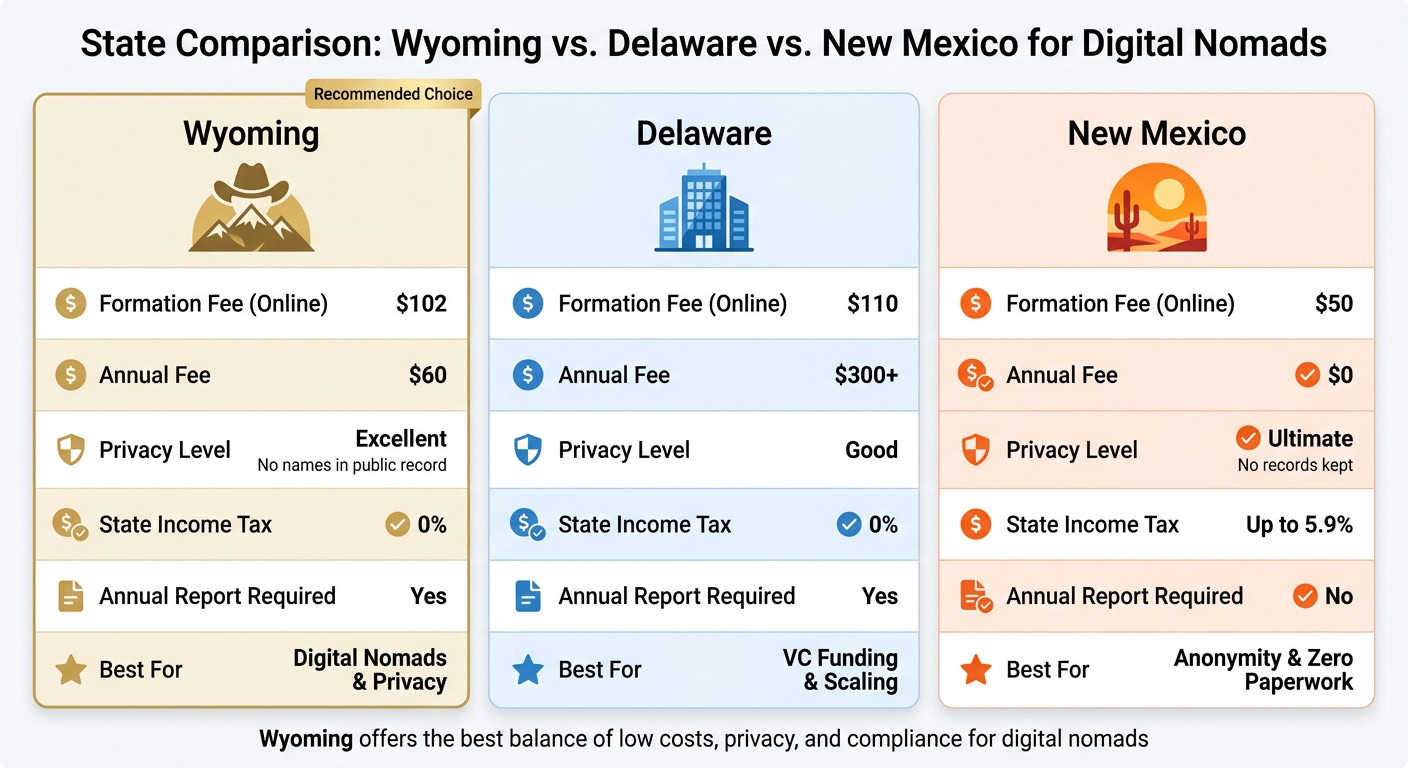
State Comparison: Wyoming vs. Delaware vs. New Mexico
While Wyoming is a favorite for digital nomads, Delaware and New Mexico have their own strengths. Delaware, for example, is a hub for startups, particularly those seeking venture capital. Its specialized Court of Chancery and business-friendly laws make it the choice for over 68% of Fortune 500 companies. However, Delaware’s $400+ annual franchise tax is significantly higher than Wyoming’s $60 fee. For solo entrepreneurs and small remote teams, this added cost often doesn’t justify the benefits unless venture funding is part of the plan.
New Mexico, on the other hand, offers the lowest upfront cost at $50 and doesn’t require an annual report. Its lack of public records for members or managers makes it attractive to those prioritizing anonymity. However, Wyoming’s stronger legal protections and well-established business infrastructure give it the edge for most digital nomads.
Here’s a quick comparison of key features:
| Feature | Wyoming | Delaware | New Mexico |
|---|---|---|---|
| Formation Fee (Online) | $102 | $110 | $50 |
| Annual Fee | $60 | $400+ | $0 |
| Privacy Level | Excellent (No names in public record) | Good | Ultimate (No records kept) |
| State Income Tax | 0% | 0% | Up to 5.9% |
| Annual Report Required | Yes | Yes | No |
| Best For | Digital Nomads & Privacy | VC Funding & Scaling | Anonymity & Zero Paperwork |
Wyoming strikes the perfect balance for most digital nomads. Its combination of low costs, strong privacy protections, and straightforward compliance makes it an ideal choice for solo freelancers, consultants, and small remote teams looking to establish a business in the U.S. Whether you’re working from a beach or a bustling city, Wyoming provides the simplicity and security you need to focus on your work.
How Registered Agents Solve the Address Problem
Every U.S. state requires your LLC to have a physical street address in the state where it’s formed. This is a core requirement for starting a business as a digital nomad. This can’t be a P.O. box or a virtual office, which poses a challenge for digital nomads who are constantly on the move.
This is where a registered agent steps in. A registered agent is an individual or professional service that’s authorized to receive legal documents, service of process, and official government correspondence – like tax notices or annual report reminders – on behalf of your LLC. By appointing a registered agent, you meet the state’s address requirement while also keeping your personal details off public records. States like Wyoming take this a step further by not requiring member names to appear in public filings, offering an extra layer of privacy.
Professional registered agent services typically cost between $50 and $300 annually. Many LLC formation providers, such as BusinessAnywhere, include the first year of registered agent services for free when you set up your LLC. Beyond meeting the address requirement, these services help you stay compliant by tracking deadlines and digitally forwarding important documents. This ensures you never miss critical notices, even while traveling. Missing such notices could result in serious consequences, like default judgments or even the administrative dissolution of your LLC. For instance, if your registered agent resigns and isn’t promptly replaced, your LLC could be dissolved by the state.
Using a professional service formalizes your business presence and is far more dependable than relying on a friend or family member. Unless someone you know can reliably be available at a U.S. address during business hours, it’s better to invest in professional support. These services ensure consistent availability, regardless of your time zone or travel schedule, making them an excellent choice for digital nomads.
With a dependable registered agent handling compliance and privacy, you’ll be ready to move on to the next step: obtaining your EIN while abroad.
Getting Your EIN from Abroad: Step-by-Step Process
Obtaining an Employer Identification Number (EIN) is a crucial step for finalizing your business setup and gaining access to U.S. banking and payment systems. This nine-digit number is necessary for opening U.S. business bank accounts, managing payment processors, and handling tax obligations.
The process varies depending on whether you have a U.S. Social Security Number (SSN) or Individual Taxpayer Identification Number (ITIN). If you do, you can apply online at IRS.gov. This method takes about 10 minutes, and your EIN is issued immediately. For those without an SSN or ITIN – common among non-U.S. entrepreneurs – the process involves submitting Form SS-4 by fax or mail, which takes around 4–6 weeks to process.
Before applying, make sure your Articles of Organization have been approved. This ensures your EIN is linked to the correct entity. You’ll also need a U.S. street address (your registered agent’s address works, but not a P.O. box, as the IRS requires a valid street address) and details like your LLC’s exact legal name, formation date, and accounting year-end (usually December).
For faster results, complete Form SS-4 and fax it to the IRS international fax line, as faxing is quicker than mailing from overseas. Keep in mind, the IRS does not charge a fee for issuing an EIN. However, if you’d rather not handle the paperwork yourself, professional services can assist with the application for $97, ensuring everything is completed correctly and efficiently.
Once you receive your EIN, you must file your Beneficial Ownership Information (BOI) report with FinCEN within 90 days of forming your LLC. Missing this deadline can result in penalties of $500 per day. With your EIN in hand, you’re ready to open international bank accounts and streamline your business operations while traveling.
Banking Options That Work Internationally
Opening a US business bank account from abroad used to mean taking a trip to the States. Not anymore. Thanks to fintech platforms, digital nomads managing US LLCs can now handle their banking needs entirely online. This shift is a game-changer for those running businesses while traveling internationally.
Among the best options for nomads are Mercury, Wise Business, and Revolut Business. Each has its strengths:
- Mercury: Tailored for startups, Mercury offers $0 monthly fees, free domestic and international USD transfers, and no wire fees. It’s a straightforward solution for US-based operations.
- Wise Business: Perfect for handling multiple currencies, Wise supports over 40 currencies at the mid-market exchange rate with no hidden markups. For a one-time $31 setup fee and no monthly costs, it’s ideal if you’re invoicing in euros, receiving pounds, and paying contractors in dollars.
- Revolut Business: A solid choice for managing team expenses, Revolut provides tiered plans ranging from $0 to $149.99 per month. Features include spend limits, approval workflows, and virtual card issuance, making it a flexible tool for teams.
"You can’t open a business bank account remotely in the big brick and mortar banks. However, virtual banks are a reliable alternative." – Vincenzo Villamena, CPA, Entity Inc.
These platforms all provide real US bank details (ACH and wire routing numbers) and integrate with major payment processors like Stripe, PayPal, and Deel. To apply, you’ll need documents like your EIN confirmation letter, Articles of Organization, Operating Agreement, and a valid passport. Mercury, in particular, allows you to apply without ever stepping foot in the US – unlike traditional banks like Chase or Bank of America, which still require in-person visits.
For digital nomads, separating business and personal finances is crucial to maintain the liability protection of an LLC. Many choose Mercury for US client payments and Wise for international transactions, creating a seamless financial workflow.
Nomad Banking Platform Comparison
| Feature | Wise Business | Mercury | Revolut Business |
|---|---|---|---|
| Monthly Fee | $0 | $0 | $0 to $149.99+ |
| FX Rate | Mid-market (no markup) | 1% currency conversion fee | Interbank (1% weekend markup) |
| USD Wire Fees | $4.14 to receive | $0 to send/receive | $10 flat rate (or plan allowance) |
| Local Account Details | Supports multiple currencies | USD only | USD, GBP, EUR |
| Best For | Frequent international payouts | US-focused startups | Effective team spend management |
Platforms like BusinessAnywhere can assist in setting up your bank account as part of their LLC formation services. They’ll guide you through gathering the right documents and selecting the platform that aligns with your business needs.
Once your banking is sorted, you’re ready to tackle tax rules for digital nomads tax residency and manage your LLC remotely.
Tax Residency vs LLC Residency: What’s the Difference?
Setting up a US LLC doesn’t automatically make you a US taxpayer. The concepts of LLC residency and personal tax residency are entirely separate. Here’s what that means:
LLC residency refers to the state where your LLC is registered. This determines filing fees, privacy regulations, and the legal framework your business operates under. Personal tax residency, however, is based on where you physically live and work. For digital nomads, this often depends on factors like nexus rules and the number of days spent in a particular location.
If you own a single-member LLC, the IRS considers your business a "disregarded entity." This means the LLC itself doesn’t pay federal income taxes. Instead, profits and losses are reported on your personal tax return. For non-US citizens without US-sourced income or a physical presence in the US, this generally means no US federal income tax is owed. However, you’ll still need to file Form 5472 and Form 1120 annually for reporting purposes. Keep in mind, though, that filing these forms is about compliance, not taxation. This distinction between business and personal tax obligations becomes especially important when dealing with international tax systems.
"A single-member LLC owned by a non-resident is considered a ‘disregarded entity’ for US tax purposes. This means the LLC itself doesn’t pay taxes in the US but the owner may have to." – Vincenzo Villamena, CPA and CEO of Entity Inc.
It’s also crucial to remember that forming an LLC in a state like Wyoming doesn’t exempt you from tax obligations in your country of residence or wherever you’re working. For example, spending significant time in Portugal, Thailand, or any other country could trigger personal tax residency there. Carefully tracking your physical presence is essential, as spending too many days in one jurisdiction may lead to tax liabilities, regardless of where your LLC is registered. Understanding this separation is a key part of managing your global tax strategy effectively.
Tools for Managing Your LLC Remotely
Once your LLC is formed and your banking is in place, having the right digital tools can make managing everything remotely much easier. Whether you’re operating your US LLC from Bali, Buenos Aires, or bouncing between temporary addresses, you’ll need a flexible tech setup. Key tools can help you digitize mail, stay on top of compliance deadlines, and keep your finances organized.
Virtual mailboxes are a must-have for digital nomads. Since your LLC requires a physical address to receive legal notices, a commercial mail receiving agency (CMRA) can solve this problem. These services provide a legitimate street address, scan your mail, and upload it to an online dashboard. Most virtual mailbox services cost between $10 and $30 per month. For instance, BusinessAnywhere offers a virtual mailbox with unlimited scanning and global forwarding, starting at $20 per month when billed annually. This means you could be sipping coffee in Lisbon while reviewing a scanned IRS tax notice, deciding whether to forward the original document to your accountant or handle it yourself.
Compliance tracking is another critical piece. Missing state annual reports or BOI filings could result in penalties of up to $500 per day. Many online platforms that assist with LLC formation also offer automated compliance calendars, sending reminders for state-specific deadlines. BusinessAnywhere, for example, includes built-in compliance alerts to ensure you stay on track, even if you’re constantly on the move.
For bookkeeping and document management, it’s crucial to keep your business and personal finances separate to maintain liability protection. Look for banking solutions designed for nomads that integrate seamlessly with accounting software. Alternatively, tools like Beancount.io can help with straightforward, cross-border recordkeeping. From invoicing a client in euros to paying a contractor in Thai baht, tracking every transaction from the start will save you headaches down the line.
Some registered agent services go a step further by bundling features like compliance calendars and mail forwarding, creating a virtual office presence for your LLC. These services typically charge between $125 and $250 per year. For digital nomads juggling multiple time zones and currencies, this added convenience can make managing your LLC a lot smoother.
Conclusion: Your Path to Forming a Nomad-Friendly LLC
Setting up a US LLC gives digital nomads the tools they need to run their businesses with ease and legitimacy. The steps are straightforward: pick a state that suits your needs, designate a registered agent, file your Articles of Organization, secure an EIN, and open a business bank account designed for remote access.
The real benefit? The ability to manage your business from anywhere. With a dependable registered agent to handle official mail, a virtual mailbox for scanning correspondence, and online banking for managing finances, your US LLC becomes a reliable base for your global operations. States like Wyoming stand out with their low fees and zero state income tax, helping to keep costs low. Plus, compliance reminders ensure you stay on top of important deadlines.
For digital nomads, a US LLC offers the structure, financial setup, and professional image needed to work across borders seamlessly. Whether you’re billing clients in euros, paying contractors in baht, or building a business that moves with you, this setup provides the support you need. The formation process is quick, and with the right tools, managing your LLC takes minimal effort.
If you’re ready to take the next step, BusinessAnywhere simplifies the process with free LLC formation (state fees apply), virtual mailbox services, registered agent options, and compliance tools – all in one easy-to-use platform. Take the leap and let a US LLC be the foundation for your global business journey.
FAQs
What countries will tax me if I run a US LLC while traveling?
Your tax responsibilities hinge on your residency and where your income is generated. US citizens and residents are required to report their worldwide income, which includes any earnings from a US LLC, no matter where it’s earned. On the other hand, non-residents are taxed based on income sourced from the US or the specific classification of the LLC. Globally, most countries tax their residents on worldwide income as well. To avoid paying taxes twice, it’s crucial to review local laws and any applicable tax treaties. For accurate compliance and tailored advice, consider consulting a cross-border tax expert.
Will payment platforms freeze my account if I use a virtual address?
Using a virtual address, like one from a registered agent for your US LLC, usually doesn’t result in account freezes – as long as you stick to the platform’s rules. Payment platforms such as Wise and Revolut Business are accustomed to remote entrepreneurs relying on virtual addresses. To stay on the safe side, make sure to provide accurate details, complete all verification steps, and adhere to their policies.
Do I need to charge sales tax or VAT to international clients?
Forming a US LLC doesn’t mean you’ll automatically need to charge US sales tax or VAT to clients abroad. Whether you’re responsible for these taxes depends on where your clients are located and the nature of what you’re selling. For digital products or services sold internationally, many US states don’t impose sales tax. However, some countries might require you to register for VAT if your sales surpass their local thresholds. It’s always a good idea to consult a tax professional to make sure you’re following the rules.