
A shareholder agreement is a private, legally binding document that outlines the rules, rights, and responsibilities of a company’s shareholders. Unlike public documents like bylaws, it focuses specifically on shareholder relationships and governance.
Key Highlights:
- Purpose: Protects shareholder interests, clarifies ownership, and defines decision-making processes.
- Who Needs It: Companies with multiple shareholders, startups, family businesses, or those with minority investors.
- Core Elements:
- Ownership rights and share distribution (e.g., pre-emptive rights, share classes).
- Share transfer rules (e.g., Right of First Refusal, tag-along, drag-along rights).
- Dispute resolution methods (e.g., arbitration, deadlock provisions).
- Exit strategies (e.g., buyout terms, valuation formulas).
- Timing: Best created during company formation or initial share issuance.
For remote businesses, it also addresses jurisdiction, digital compliance, and virtual shareholder participation. A well-drafted agreement ensures smoother operations and protects all parties involved.
What to Include in a Shareholder Agreement
Ownership Rights and Share Distribution
Start with a capitalization table – a detailed breakdown of each shareholder’s ownership percentage. This document is key to avoiding misunderstandings and provides a clear foundation for future decisions. Beyond the initial share allocation, the agreement should also address how ownership might evolve over time.
One important element to include is pre-emptive rights, which protect existing shareholders from ownership dilution. These rights give current shareholders the first chance to buy new shares before they’re offered to external parties, allowing them to maintain their ownership stakes. Additionally, define share classes to distinguish between voting and non-voting shares. This distinction is particularly relevant when bringing in investors who may want financial returns without participating in decision-making.
Finally, align ownership with governance by outlining clear decision-making processes.
Decision-Making and Governance
Set specific voting thresholds for different types of decisions. For example, routine matters might require a simple majority (51%), while significant actions, like mergers or selling major assets, may need a supermajority of 75% or even unanimous consent.
The agreement should also detail board appointments, especially if certain shareholders, such as founders or venture capitalists, have the right to appoint directors. To protect minority shareholders, include veto rights, which allow them to block major corporate actions even if they own less than 50% of the company. Unlike amending articles of incorporation – which often requires a 75% vote – changing a shareholder agreement generally requires unanimous approval from all signatories.
Once governance is addressed, move on to rules for managing share transfers.
Share Transfer Rules and Restrictions
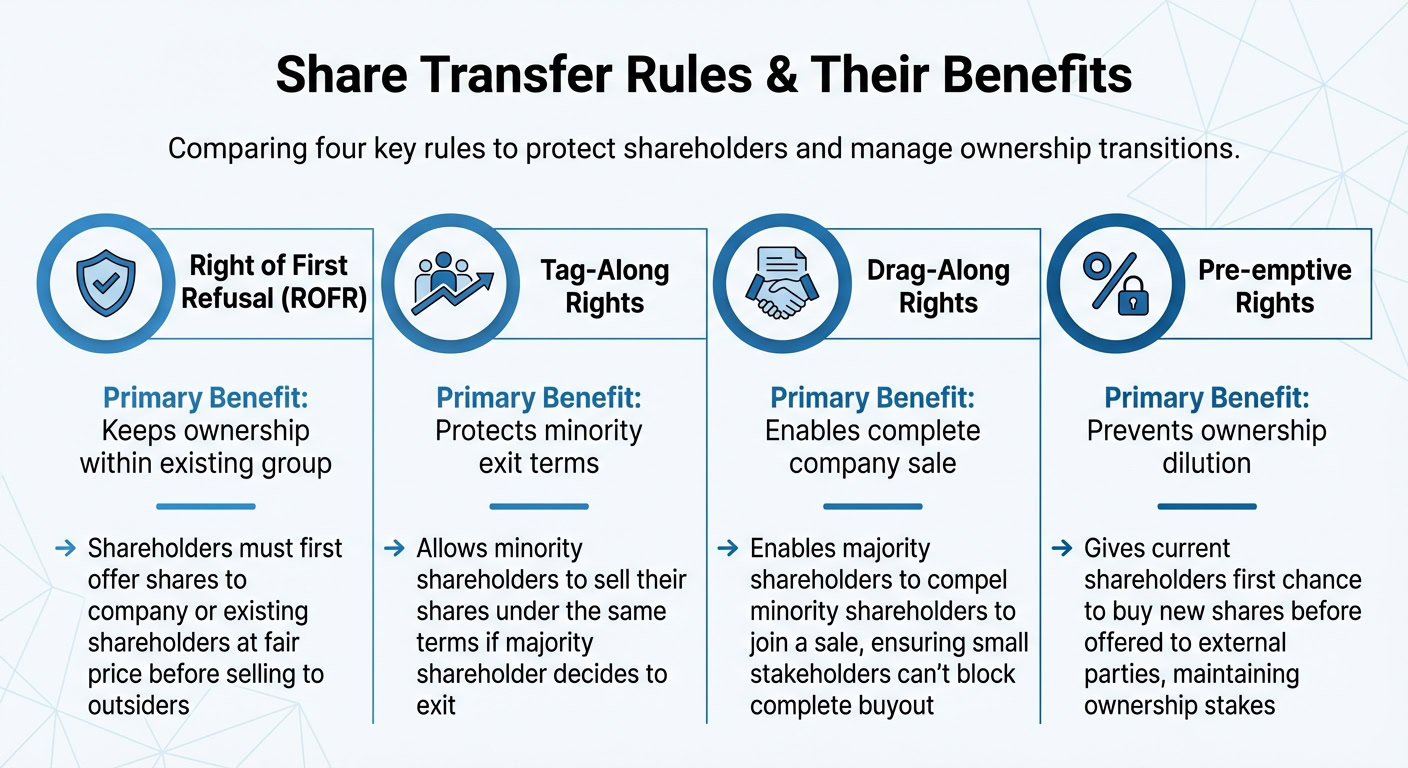
Establish clear rules for share transfers to maintain stability in company ownership. For instance, a Right of First Refusal (ROFR) ensures that shareholders must first offer their shares to the company or existing shareholders at a fair price before selling to outsiders. Tag-along rights protect minority shareholders by allowing them to sell their shares under the same terms if a majority shareholder decides to exit. On the flip side, drag-along rights enable majority shareholders to compel minority shareholders to join a sale, ensuring that small stakeholders can’t block a complete buyout.
The agreement should also address permitted transfers, allowing shareholders to transfer shares to family members or spouses for estate planning purposes.
| Rule Type | Primary Benefit |
|---|---|
| Right of First Refusal | Keeps ownership within existing group |
| Tag-Along Rights | Protects minority exit terms |
| Drag-Along Rights | Enables complete company sale |
| Pre-emptive Rights | Prevents ownership dilution |
How to Resolve Disputes
After ownership and transfer rules are set, the agreement should include steps for resolving conflicts. Alternative Dispute Resolution (ADR) clauses, such as mediation or binding arbitration, are a great way to handle disputes privately and efficiently, avoiding the expense and publicity of litigation. These measures not only save time but also help keep internal matters confidential.
Deadlock scenarios – where shareholders are evenly divided on a decision – should also be addressed. Include deadlock provisions that outline solutions, such as appointing a neutral third party or implementing a predetermined tiebreaker mechanism to avoid operational standstills.
Exit Strategies and Buyout Terms
Finally, plan for orderly shareholder exits. The agreement should define valuation formulas to determine the fair price of shares during a buyout. This avoids disputes over pricing when shareholders leave.
Include mandatory buy-back triggers that specify when the company must or can repurchase shares, such as in cases of death, disability, bankruptcy, or a shareholder leaving the company. These rules protect the remaining shareholders from being forced into partnerships with heirs or creditors. Additionally, outline dissolution procedures to guide the process of winding down the business, including how assets will be distributed among shareholders.
Shareholder Agreements for US Businesses
Meeting US Legal Requirements
A shareholder agreement is a legally binding contract shaped by both state and federal laws. While not mandatory, it complements essential business formation documents by outlining specific rights and duties of shareholders. As Ijeoma S. Nwatu, a Digital Strategy Consultant at the U.S. Small Business Administration, explains:
"The purpose of the document is to govern the internal operations of the business in a way that suits the specific needs of the business owners".
You don’t need to file this agreement with state agencies, such as the Secretary of State, but it should be stored with your essential business records. Without such an agreement, your company will default to general state laws, which might not align with your business’s unique needs. This document not only strengthens operational clarity but also ensures fair treatment for all shareholders.
Protecting All Shareholders
A well-crafted shareholder agreement establishes a fair structure that safeguards the interests of both minority and majority shareholders. For minority shareholders – those owning less than half of the company – such agreements can require unanimous consent for major decisions, granting them veto power even with limited ownership. It also sets clear rules for board elections, officer appointments, and removals, reducing the risk of internal conflicts.
In cases where shares might need to be transferred involuntarily – like during a shareholder’s death, divorce, or bankruptcy – the agreement can mandate the company to repurchase those shares, keeping ownership within the intended group. This ensures that control of the business stays aligned with the original vision.
Reducing Risks for Small Businesses
For small businesses, shareholder agreements offer vital protections against potential risks. By including pre-determined valuation formulas, businesses can prevent costly disputes when a shareholder decides to exit. Additionally, these agreements often include mandatory dispute resolution methods, like mediation or arbitration, which help resolve conflicts efficiently while keeping matters private.
To safeguard sensitive information, confidentiality and non-compete clauses can stop departing shareholders from misusing trade secrets or launching competing businesses. For companies with an even number of directors, the agreement should include a mechanism to resolve tie votes, ensuring smooth operations. Attorney Daniel T. Janis emphasizes the importance of foresight when drafting these agreements:
"Lawyers should… force their clients to slow down and think about how restrictive shareholder agreement covenants will feel during the lean times, even when the lush times are close at hand".
Given the complexity of state and federal regulations, it’s essential to have a qualified attorney draft or review your shareholder agreement to ensure it meets legal standards and remains enforceable.
Shareholder Agreements for Remote Businesses
Managing Shareholders Across Different Locations
Running a remote business comes with its own set of challenges, especially when doing business in multiple states or even different countries where shareholders are spread out. A well-drafted shareholder agreement should clearly state which jurisdiction’s laws will apply and where any disputes will be resolved. Without this clarity, businesses risk expensive legal battles over jurisdiction.
The agreement should also address how official communications, like quarterly reports or meeting invitations, will be handled digitally. It’s wise to include provisions allowing for electronic approval of share transfers and amendments. As of 2020, 33 U.S. states, including Delaware, allow companies to hold virtual-only shareholder meetings, while 45 states and Washington, D.C., permit hybrid meetings.
For non-compete clauses, traditional geographic restrictions often don’t fit the borderless nature of remote work. Instead, these clauses should be carefully crafted to protect the business while remaining enforceable in a virtual environment. To ensure remote shareholders can fully participate, the agreement should define how digital voting will work and specify whether major decisions require a simple majority or a supermajority. These steps pave the way for incorporating digital compliance tools effectively.
Using Digital Tools for Compliance
Digital tools can make compliance easier for remote businesses. Shareholder agreements, as private contracts, don’t need to be publicly filed. Platforms can securely store these agreements and maintain a real-time capitalization table that tracks ownership percentages.
Services like BusinessAnywhere offer tools tailored for remote entrepreneurs, including registered agent services, compliance support, and virtual mailboxes. Their centralized digital dashboard allows shareholders to access meeting agendas, rules of order, and proxy materials. For financial matters like dividend payouts or shareholder loan repayments, automated payment systems ensure transparency and timely distribution.
When drafting agreements, it’s essential to include provisions for electronic signatures and virtual identity verification. This ensures that only authorized shareholders can vote and participate in decision-making.
Real Examples for Remote Businesses
Real-world cases highlight the importance of customized legal and digital strategies for remote businesses. Take the example of Ulmart, an online retailer caught in a cross-border shareholder dispute starting in 2016. The conflict involved majority owners with 61.5% of shares and a minority partner holding 38.5%, regarding additional investments. In 2018, a London court ruled that the majority shareholders had to buy out the minority stake for $67.16 million. This case underscores how tailored shareholder agreements can help resolve deadlocks across jurisdictions. As Valeriy Stalirov of Stalirov&Co explains:
"The SHA helps business owners to disperse on equal, balanced and fair terms if a conflict arises".
For virtual meetings, it’s essential to provide clear instructions for remote access, allow attendees to test their connections 15 minutes before the meeting, and have technical support available during the session. Douglas K. Chia and Ann S. Lee from the Rutgers Center for Corporate Law and Governance emphasize:
"Shareholders must be able to exercise their rights to attend and vote at shareholder meetings on an equal basis to maintain the integrity of corporate governance".
To protect minority shareholders in a remote setup, businesses should consider including tag-along rights and unanimous approval requirements for major decisions. These measures ensure that a localized majority doesn’t sideline remote minority shareholders. Additionally, clear buy-sell provisions and "Right of First Refusal" (ROFR) clauses can help manage share transfers, preventing unwanted third parties from entering the ownership group if a shareholder decides to exit.
sbb-itb-ba0a4be
How BusinessAnywhere Helps with Shareholder Agreements
BusinessAnywhere provides businesses with tools to manage shareholder agreements effectively, especially for remote teams. From ensuring compliance to offering secure document storage, the platform addresses the challenges of coordinating shareholders across different locations.
Registered Agent and Compliance Support
One of BusinessAnywhere’s key features is its registered agent service, which helps businesses stay compliant with state regulations. In the U.S., every company must appoint a registered agent to handle legal documents, including shareholder communications. BusinessAnywhere handles this requirement across all states where your business operates. This includes managing annual report filings, regulatory obligations, and share registry updates – essential tasks since shareholder agreements often depend on state-specific laws like the Delaware General Corporation Law. These services provide a solid framework for securely managing shareholder agreements.
Virtual Mailbox and Document Storage
Shareholder agreements are private and sensitive documents, so secure storage is crucial. BusinessAnywhere’s virtual mailbox service offers a centralized, secure location to store and access these agreements. The platform includes client portals with controlled access, allowing shareholders to view relevant documents while protecting confidential information. This ensures that all stakeholders have access to the most up-to-date materials without compromising security.
Services for Remote Entrepreneurs
BusinessAnywhere also simplifies document management and signing for remote businesses. Designed with digital nomads and remote entrepreneurs in mind, the platform enables the electronic execution of documents, making it easy for shareholders to sign agreements no matter where they are in the world. Its Digital Nomad Kit includes LLC registration, EIN application, registered agent services, a virtual mailbox, and compliance tools – everything needed to set up a U.S. business remotely. For shareholder agreements, the platform’s document management system helps track deadlines and monitor corporate services through a secure portal.
As Shriya Sahni from Startup Movers explains:
"A Shareholders’ Agreement is not just paperwork – it’s business insurance. It safeguards investments, clarifies governance, and ensures long-term stability".
With BusinessAnywhere, businesses can manage these critical agreements confidently and efficiently, no matter where they operate.
Conclusion
A shareholder agreement is more than just a formality – it’s a critical tool for protecting investments, ensuring smooth governance, and fostering long-term stability. Whether you’re launching a new venture or managing an established company, this document provides the clarity needed to prevent disputes, safeguard minority shareholders, and control the transfer of ownership within your business.
For remote businesses, it plays an even more crucial role by aligning governance across different jurisdictions, keeping stakeholders on the same page no matter where they are. Additionally, its confidential nature allows you to structure business relationships privately, without the need for public disclosure.
It’s wise to draft your shareholder agreement early – ideally during the company’s formation or when shares are first issued. As attorneys J. Gerard Legagneur and Amanda Hayes point out:
"Putting a shareholders’ agreement in place at the beginning can make expansion easier as your company changes and grows".
Key provisions to include are restrictions on share transfers, methods for resolving disputes, and clearly defined exit strategies. These elements help protect all parties and set the stage for effective management.
Digital tools like BusinessAnywhere make managing these agreements easier. With services like registered agent support, secure virtual mailboxes, and compliance tools, remote entrepreneurs can efficiently handle U.S. business operations while navigating shareholder relationships across borders. This kind of technology ensures that managing a remote business remains seamless and stress-free.
FAQs
Why do remote businesses need a shareholder agreement?
A shareholder agreement plays a key role in the success of remote businesses by setting clear guidelines for ownership, decision-making, and resolving disputes. For companies where founders and investors are scattered across different locations and rely on virtual communication, having this formal agreement helps avoid reliance on casual conversations and ensures everyone is aligned.
It includes critical details like ownership rights, voting processes, and exit strategies to minimize confusion and protect everyone involved. For instance, provisions such as right-of-first-refusal, tag-along rights, or drag-along rights make it easier to handle transitions when a shareholder decides to sell their stake. The agreement can also cover essential aspects like conducting virtual board meetings and protecting sensitive information – both of which are particularly important for teams operating remotely.
Ultimately, a well-thought-out shareholder agreement provides the structure remote businesses need to run efficiently and focus on growth, even when team members and stakeholders are working from different corners of the world.
What should be included in a shareholder agreement?
A shareholder agreement sets the ground rules for how shareholders work together and how the business is run. It typically covers ownership and voting rights, detailing who owns shares and how decisions are made. It also includes restrictions on transferring shares, such as buy-sell provisions or rights of first refusal, and defines the governance structures, like how the board is composed and how meetings are conducted.
The agreement often addresses financial matters, including dividend distribution policies and the issuance of new shares. It outlines dispute resolution methods, such as mediation or arbitration, and defines exit strategies, like buy-out terms or procedures for a shareholder leaving the company. Other important sections may deal with confidentiality, non-compete agreements, and the process for making amendments to the agreement. Together, these elements provide a framework to safeguard the business and its shareholders while preparing for potential challenges ahead.
How can digital tools help simplify shareholder agreements?
Digital tools have transformed how businesses handle shareholder agreements, making the process faster and far more streamlined. Instead of starting from scratch, these tools let you create tailored agreements by simply entering key details like ownership percentages and share classes. They also simplify teamwork by automating workflows, tracking revisions, and collecting e-signatures in line with U.S. ESIGN laws.
Once the agreement is finalized, these platforms boost transparency and minimize risks. With real-time cloud storage, all shareholders can access the latest version anytime, while built-in notifications keep everyone informed about deadlines, vesting schedules, or necessary approvals. Plus, many of these tools integrate seamlessly with cap-table management systems, allowing businesses to easily monitor share transfers, dilution events, or exit plans. This ensures agreements stay relevant and actionable – especially for companies operating remotely or in virtual environments.