


If you’re trying to protect your business’s ideas, brand, or content, you need to understand the difference between patents, trademarks, and copyrights. Here’s a quick breakdown:
- Patents: Protect inventions and processes. They require formal application and grant exclusive rights for 20 years (utility patents) or 15 years (design patents). Costs start at $1,600 but can climb significantly.
- Trademarks: Protect brand identifiers like names, logos, and slogans. Registration isn’t required but offers stronger, nationwide protection. Trademarks can last indefinitely with renewals every 10 years. Costs start at $250–$350 per class.
- Copyrights: Protect original works like books, music, software, and art. Protection is automatic upon creation and lasts for the author’s life plus 70 years. Registration costs $45–$65 and is recommended for legal enforcement.
Each serves a unique purpose: patents focus on functionality, trademarks safeguard brand identity, and copyrights protect creative expressions. Many businesses use a combination of these protections to secure their assets.
Quick Comparison
| Feature | Patent | Trademark | Copyright |
|---|---|---|---|
| What is Protected | Inventions, processes, designs | Brand names, logos, slogans | Original works (books, software, art) |
| Duration | 20 years (utility); 15 years (design) | Indefinite with renewals | Life of author + 70 years |
| Cost | $1,600+ | $250–$350 per class | $45–$65 |
| Registration | Required | Optional but recommended | Automatic but registration advised |
Whether you’re launching a product, building a brand, or creating content, choosing the right protection early can save you time and money in the long run.
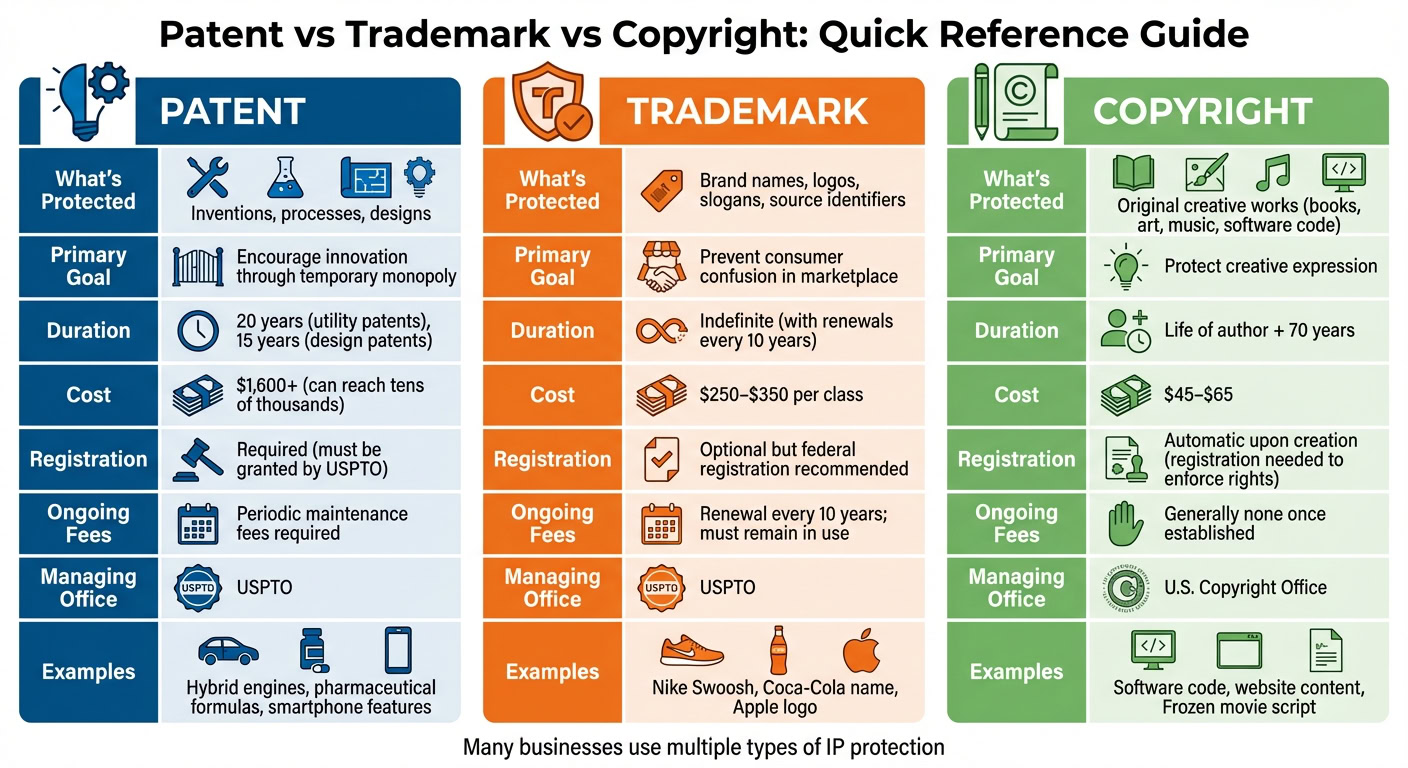
Patent vs Trademark vs Copyright Comparison Chart
What is a Patent?
A patent is a legal right granted by the USPTO (United States Patent and Trademark Office) that gives inventors exclusive control over their inventions for a set period. This right prevents others from copying, using, selling, or importing the invention without permission. In return for this exclusivity, inventors are required to publicly share the technical details of their creation. As attorney David H. Siegel from Norris McLaughlin P.A. puts it:
"Basically, a patent is a trade; you make your knowledge public in exchange for a monopoly on a certain use of that knowledge".
Not every idea qualifies for a patent. For an invention to be eligible, it must meet three key criteria: it has to be novel, non-obvious, and serve a useful purpose in an industry. Patents focus on protecting the functional application of ideas rather than the ideas themselves.
Now, let’s break down the main types of patents and how they differ.
Types of Patents
The USPTO issues several kinds of patents, but two types dominate the field:
- Utility patents: These cover how an invention works, protecting new products, machines, processes, or chemical compositions. Utility patents make up about 90% of all patents issued in the U.S.. They are valid for 20 years from the filing date and require periodic maintenance fees to stay active.
- Design patents: These protect the ornamental design or appearance of a manufactured item. For design patents filed after May 13, 2015, the protection lasts 15 years from the grant date, and no maintenance fees are required. In some cases, a product can qualify for both types – for example, a chair with a distinctive look and an innovative folding mechanism could be covered by separate design and utility patents.
Requirements and Costs
Securing a patent isn’t cheap. The process starts at a minimum of $1,600 and includes scheduled maintenance fees during the patent’s lifespan – 20 years for utility patents and 15 years for design patents. Acting quickly is essential. Delaying your application could put your rights at risk, so consulting a patent attorney early in the process is highly recommended.
Examples of Patent Protections
Patents cover a wide range of innovations, and examples help illustrate their scope. Pharmaceutical companies often patent new drug formulations, while tech companies secure patents for software methods that produce concrete results. Manufacturers protect machinery improvements. For instance:
- A hybrid engine with a unique power distribution system
- A smartphone feature designed to extend battery life
- A chemical process for creating biodegradable plastics
Each of these examples demonstrates how patents safeguard inventions that meet the criteria for novelty and industrial usefulness. The scale of patenting activity is immense – just in 2022, inventors and businesses worldwide were granted 3.5 million patents.
These details about patents provide the foundation for understanding how they compare to trademarks and copyrights.
sbb-itb-ba0a4be
What is a Trademark?
A trademark is a word, phrase, symbol, or design that identifies and distinguishes your goods or services from others in the market. Think of it as your business’s signature – something that customers associate directly with your brand. The United States Patent and Trademark Office (USPTO) defines it like this:
"A trademark can be any word, phrase, symbol, design, or a combination of these things that identifies your goods or services. It’s how customers recognize you in the marketplace and distinguish you from your competitors."
Trademarks are crucial for protecting your brand’s identity. They prevent consumer confusion by stopping others from using similar marks that could mislead customers into buying a competitor’s product instead of yours. While your brand represents the emotional connection and reputation you build with customers, a trademark legally protects the specific names, logos, and slogans tied to that brand.
Interestingly, trademarks can also extend to non-traditional elements like sounds, colors, product shapes, and even packaging designs.
Now, let’s dive into how registering a trademark strengthens these protections.
Trademark Registration and Costs
You don’t need to register a trademark to have rights – those rights begin the moment you use the mark in commerce. These are called common law rights, but they’re limited to the geographic area where your business operates.
Federal registration with the USPTO, while not mandatory, offers clear advantages. It grants nationwide rights and establishes a legal presumption of ownership, making it much easier to defend your mark against imitators. The cost for federal registration starts at $350 per class of goods or services.
Before registration, you can use the ™ symbol for goods or the ℠ symbol for services to signal your claim. However, the ® symbol is reserved for trademarks officially registered with the USPTO.
Duration and Maintenance
Unlike patents or copyrights, trademarks can last indefinitely – as long as you keep using them in commerce and meet maintenance requirements. Federal registrations are valid for 10 years but can be renewed every 10 years without limit. To maintain your trademark, you’ll need to file specific documents between the 5th and 6th years, again between the 9th and 10th years, and every 10 years after that.
This indefinite protection aligns well with long-term business strategies, allowing trademarks to evolve alongside your brand.
Examples of Trademark Protections
Trademarks cover a wide range of identifiers that businesses rely on daily. For example, Apple’s logo, Nike’s swoosh, and the "Just Do It" slogan are all trademarks. Even product shapes can be trademarked – Goldfish crackers protect their signature fish shape, and Coca-Cola has trademarked its iconic contoured bottle.
These protections ensure customers can trust the quality and authenticity of a product when they see a familiar trademark. For businesses, this trust is a cornerstone of building a strong, lasting brand identity.
What is a Copyright?
A copyright safeguards original works of authorship that are fixed in a tangible medium. This protection kicks in the moment your work is captured in a physical or digital form – whether it’s written, recorded, or saved.
The U.S. Copyright Office explains it like this:
"Copyright is a type of intellectual property that protects original works of authorship as soon as an author fixes the work in a tangible form of expression."
Works that qualify for copyright include books, songs, movies, paintings, software code, photographs, and even architectural designs. However, copyright doesn’t cover ideas, methods, systems, or principles – it only applies to the specific way those ideas are expressed. For instance, the concept of a detective solving crimes isn’t copyrightable, but your specific novel about a detective with unique dialogue and plotlines is.
Additionally, titles, names, short phrases, and slogans don’t usually qualify for copyright protection. Instead, they might be eligible for trademark protection.
Copyright Registration and Costs
Copyright protection happens automatically as soon as your work is fixed in a tangible form. You don’t need to register it for the protection to exist. However, registering your work with the U.S. Copyright Office offers key legal benefits that automatic protection doesn’t.
For example, U.S. law requires copyright registration before you can file a lawsuit for infringement. Registration also allows you to pursue statutory damages and attorney’s fees in court – advantages that can be a game-changer if someone uses your work without permission. If you register within five years of publication, your copyright is presumed valid in court, which can simplify legal proceedings.
The registration process is simple and affordable. You’ll need to complete an application, pay a filing fee, and submit a copy of your work. The Electronic Copyright Office (eCO) provides the quickest and least expensive option, with fees starting at $45 for a single application (one work, one author, sole owner) and $65 for a standard online application. Paper applications cost $125.
Duration of Copyright Protections
Copyright protection lasts much longer than patent protection. For works created on or after January 1, 1978, the protection lasts for the author’s lifetime plus 70 years. In the case of joint works, the copyright extends 70 years after the last surviving author’s death.
For works made for hire – such as those created by employees as part of their job or certain commissioned works – copyright lasts for 95 years from publication or 120 years from creation, whichever comes first. This is especially important for businesses since they own the copyright to works created by their employees during the course of employment.
As of now, all U.S. works published before 1926 are in the public domain.
Examples of Copyright Protections
Copyright law plays a vital role in protecting creative works for businesses. For example:
- Software code: Companies can copyright proprietary applications and platforms.
- Marketing materials: Blog posts, website copy, and video content are protected as soon as they’re created.
- Training resources: Manuals, product photography, and architectural plans also fall under copyright protection.
These protections ensure businesses can secure the creative elements that drive their operations.
The U.S. Supreme Court highlighted the purpose of copyright in Twentieth Century Music Corp. v. Aiken:
"The immediate effect of our copyright law is to secure a fair return for an ‘author’s’ creative labor. But the ultimate aim is, by this incentive, to stimulate artistic creativity for the general public good."
Interestingly, some works can benefit from overlapping protections. For instance, a business logo might be copyrighted for its artistic design and trademarked as a brand identifier. This dual coverage helps protect both its creative expression and its commercial identity.
Patents vs Trademarks vs Copyrights: Side-by-Side Comparison
This breakdown highlights the distinct purposes and features of patents, trademarks, and copyrights. Each serves a unique role in protecting intellectual property (IP), with specific rules, coverage, and costs.
Patents and trademarks fall under the jurisdiction of the USPTO, while copyrights are managed by the U.S. Copyright Office, part of the Library of Congress. They are governed by different laws: the Lanham Act for trademarks, the U.S. Copyright Act for copyrights, and the Patent Act for patents.
A major difference lies in how protection starts. Copyrights are automatic as soon as an original work is fixed in a tangible form. Trademarks can arise from common law use in commerce, but federal registration provides stronger, nationwide protection. Patents, on the other hand, require a formal application, examination, and approval from the USPTO – they are never automatic.
Here’s a quick-reference guide to help you understand how each type of protection works and decide which suits your needs.
Comparison Table
| Feature | Patent | Trademark | Copyright |
|---|---|---|---|
| What is Protected | Inventions, processes, and ornamental designs | Brand names, logos, slogans, and source identifiers | Original creative works (books, art, music, software code) |
| Primary Goal | Encourage innovation through temporary monopoly | Prevent consumer confusion in the marketplace | Protect creative expression |
| Managing Office | USPTO | USPTO | U.S. Copyright Office |
| Registration Requirement | Mandatory – must be granted | Optional, but federal registration recommended | Automatic upon creation (registration needed to enforce rights) |
| Duration | 20 years (utility/plant); 15 years (design) | Indefinite (with use and 10-year renewals) | Life of author + 70 years |
| Typical U.S. Cost | Tens of thousands of dollars | $250–$350 per class | $45–$65 |
| Ongoing Fees | Periodic fees required | Renewal every 10 years; must remain in use | Generally none once established |
| Examples | Hybrid engines, pharmaceutical formulas | Nike "Swoosh", Coca-Cola name | "Frozen" movie script, website content |
Some assets can qualify for more than one type of IP protection. For example, a software application might have its source code copyrighted, its name and logo trademarked, and its innovative technical methods patented. Similarly, a distinctive bottle design could be covered by both a design patent and a trademark (as trade dress).
How to Choose the Right Protection for Your Business
The first step in safeguarding your business is understanding what exactly needs protection. For example, a new technical process or product feature typically requires a patent. If you’re focused on establishing brand recognition through a name, logo, or slogan, then a trademark is the way to go. Meanwhile, original content like software code, written material, or visual art falls under copyright. Many businesses eventually need a combination of these protections as they grow and diversify. Once you’ve identified what you’re protecting, consider which type of protection aligns best with your business goals.
Timing and budget play a big role in making the right choice. Copyright protection is automatic once a work is created, but registering it (for $45–$65) is recommended to ensure enforceability. Trademarks should ideally be filed before or at launch to lock in your priority date and prevent others from using similar names. Patents, on the other hand, demand a significant financial and time investment – they typically take 2–4 years to secure. Only pursue a patent if your invention offers clear novelty and strong commercial potential. For more details on costs and specific requirements, refer to earlier sections.
Scenarios for Small Businesses
Let’s look at a few examples to clarify how these protections apply in real-world situations:
- A tech startup creating a new app should copyright the source code, trademark the app name and logo early, and consider patenting any innovative technical methods if they provide distinct technical advantages worth the cost.
- A skincare brand launching a new product line would need trademark protection for its brand identity, copyright for packaging designs and website visuals, and possibly a patent for any groundbreaking formulas.
- Content creators who use their channel names as part of their commercial brand (e.g., for ad revenue or merchandise sales) should trademark those names to protect their business.
- Freelancers designing logos or writing code for clients should always use written IP assignments to transfer copyright ownership to the client. Without such agreements, the creator legally retains ownership of the work.
Considerations for Remote Businesses
Remote businesses face distinct challenges when it comes to intellectual property. For companies operating across state lines or internationally, federal registration is crucial. This creates a public record of ownership and strengthens your legal standing in multiple jurisdictions. Before finalizing a brand name, it’s smart to spend 30–60 minutes conducting a trademark clearance search using the USPTO TESS tool. Skipping this step could lead to costly rebranding down the line.
For remote enterprises, filing trademarks early is especially important. Additionally, don’t forget to comply with renewal requirements every 10 years to keep your protection active. Services like Business Anywhere can simplify the trademark filing process and assist with ongoing compliance, making it easier for remote entrepreneurs to manage their IP as they expand into new markets. For most startups, trademarking a brand name should be a top priority, while patents are best pursued later – once the business model is proven and the invention justifies the legal costs.
Conclusion
Grasping the distinctions between patents, trademarks, and copyrights is crucial for safeguarding your business assets and setting the stage for growth. Patents protect functional inventions and processes, offering a temporary 20-year exclusivity in exchange for public disclosure. Trademarks secure brand elements like names, logos, and slogans, helping to prevent consumer confusion and build trust. With proper use and 10-year renewals, they can last indefinitely. Meanwhile, copyrights automatically shield original creative works – such as software code, written content, and visual art – from the moment they’re created, lasting for the author’s lifetime plus 70 years. Together, these protections serve different purposes, and many companies find value in combining them as they scale.
Choosing the right intellectual property (IP) strategy depends on what you need to protect and your business objectives. For example, copyright registration costs just $45–$65, while trademarks typically range from $250–$350 per class. On the other hand, patents involve a much larger investment – usually between $6,000 and $25,000 – making them best suited for inventions with clear commercial potential. These costs, while significant, directly contribute to enhancing your company’s valuation and laying a foundation for sustained growth.
Intellectual property often ranks among a business’s most valuable assets. Formal registration not only establishes a public record of ownership but also deters competitors and boosts your company’s worth during negotiations or acquisitions. Whether you’re launching a tech startup, developing a consumer brand, or managing a remote business, securing the right protections now can shield you from expensive legal disputes and rebranding headaches later. By prioritizing IP, you’re investing in your company’s future.
FAQs
Can I use more than one type of IP protection for the same asset?
Yes, it’s possible to safeguard the same asset using multiple forms of intellectual property (IP) protection. For instance, you could combine a patent with a copyright or pair a trademark with a copyright. The decision largely depends on the asset’s characteristics and the type of protection you’re seeking. For example, you might patent an invention while also copyrighting its design or securing its branding with a trademark.
What should I protect first if I’m on a tight budget?
If you’re working with a tight budget, focus on safeguarding your most important and at-risk assets – typically your trademarks. Trademarks protect key elements of your brand identity, such as your name, logo, or tagline. These are essential for customer recognition and are relatively inexpensive to register compared to other forms of protection.
Patents, on the other hand, tend to be more expensive and involve a more complicated process. Copyrights are designed to protect creative works, but unless those works are at the core of your business, they might not require immediate attention. Prioritizing trademarks ensures your brand is protected without stretching your budget too thin.
When should I talk to an IP attorney?
If you’re looking to protect your intellectual property, like filing patents, trademarks, or copyrights, it’s wise to consult an IP attorney. They can also provide valuable guidance if you’re facing infringement issues or disputes tied to your intellectual property. An attorney will help you navigate the legal processes to secure your business assets and stay aligned with intellectual property laws.