


Estonia e-Residency and US LLCs are two popular options for entrepreneurs running location-independent businesses. Here’s a quick breakdown to help you decide:
- Estonia e-Residency: Ideal for EU-focused businesses. Offers 0% tax on retained profits, access to the EU market, and a fully digital setup. However, it requires monthly bookkeeping, a local contact, and has higher compliance costs.
- US LLC: Best for global or US-focused businesses. Provides 0% US federal tax for foreign-sourced income, minimal compliance, and easy access to US payment platforms. However, penalties for missed filings are steep, and traditional banking can be challenging.
Quick Comparison
| Feature | Estonia e-Residency (OÜ) | US LLC (Wyoming) |
|---|---|---|
| Setup Time | 4–6 weeks | 2–4 weeks |
| Initial Costs | ~$450 | $102–$402 |
| Tax on Retained Profits | 0% | 0% |
| Tax on Distributions | 22% corporate tax | 0% (if foreign-sourced) |
| Compliance | Monthly bookkeeping | Annual filings only |
| Banking | EU-focused fintechs | US neobanks |
| Best For | EU clients, reinvestment | Global/US clients |
Your choice depends on your target market, income source, and ability to manage compliance. Both options serve different business needs effectively.
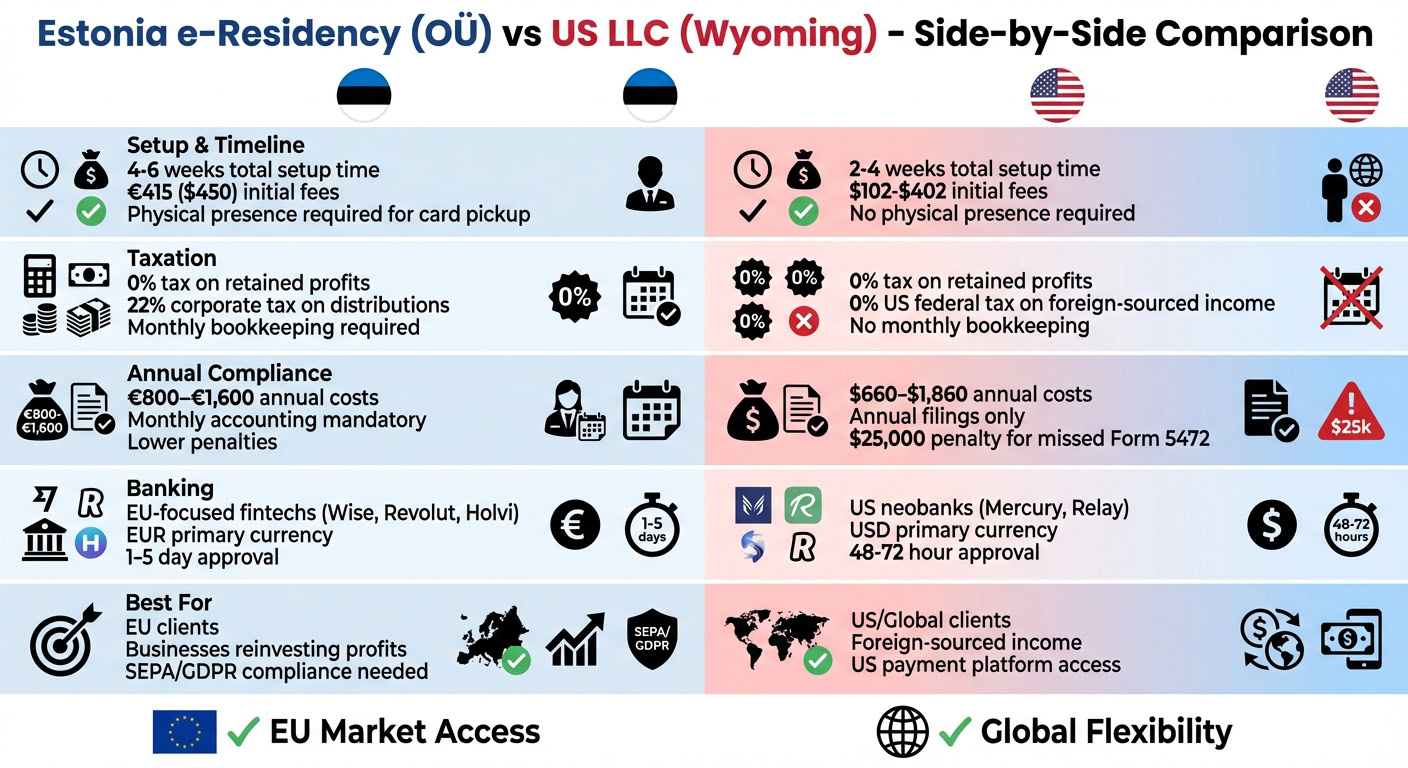
Estonia e-Residency vs US LLC: Complete Comparison for Digital Entrepreneurs
Setup Process and Requirements
Estonia e-Residency Setup
To establish an Estonian OÜ, the first step is obtaining a digital ID through the e-Residency program. This application costs around €150 (roughly $165) and requires a passport copy, a photo, and a motivation statement, all submitted online. Once approved, you’ll need to collect the physical ID card in person at an Estonian embassy or designated pickup center, where fingerprinting and identity verification are conducted. This process typically takes 2–5 weeks.
After receiving your digital ID, the actual company registration is quick and efficient, often completed within 2 hours using Estonia’s digital infrastructure. This step requires a state fee of approximately €265. For non-resident board members, Estonia mandates a local contact and registered address, which are usually provided by licensed service providers at an annual cost of €100–€200.
As of July 2025, over 126,000 individuals from more than 175 countries have become e-residents, collectively founding more than 36,000 companies. The program boasts a high approval rate of 94%.
Unlike the Estonian process, forming a US LLC does not require in-person verification, offering a fully digital alternative.
US LLC Setup
Creating a US LLC is also a straightforward process that can be completed entirely online, even for non-residents. It begins with selecting a state, with Wyoming, Delaware, and New Mexico often chosen for their business-friendly regulations and privacy protections. Wyoming, which pioneered the LLC structure in 1977, remains a popular choice. Filing fees in Wyoming are about $102, with an annual report fee of roughly $60.
The next step involves filing the Articles of Organization with the Secretary of State and appointing a registered agent, who must have a physical address in the chosen state to handle legal correspondence. Registered agent services typically cost between $50 and $300 annually. Starting in 2024, all US LLCs must maintain a US business address, which can be a physical office, virtual office, or even the registered agent’s address.
Additionally, you’ll need to apply for an Employer Identification Number (EIN) through the IRS. This step is free and doesn’t require a Social Security Number for non-residents. Many banks also require an Operating Agreement, which outlines ownership and operational guidelines. The formation process usually takes 1–2 business days, though setting up a bank account may add another 1–2 weeks.
Rick Mak, a global entrepreneur and business strategist, highlights Wyoming’s role in shaping the LLC model:
"Wyoming invented the LLC structure in 1977 and remains the gold standard for business-friendly policies."
Setup Costs and Time Comparison
| Feature | Estonia e-Residency (OÜ) | US LLC (Wyoming) |
|---|---|---|
| Total Setup Time | 4–6 weeks | 2–4 weeks |
| Initial Fees | ~€415 ($450 approx.) | $102–$402 |
| Physical Presence | Required for card pickup | Not required |
| Local Representative | Mandatory (~€100–€200/year) | Registered Agent ($50–$300/year) |
| Registration Speed | 2 hours (with digital ID) | 1–2 business days |
These differences in setup time, costs, and physical requirements are key factors to consider when deciding which structure best suits your global business needs. Each option offers distinct advantages, influencing both the initial setup process and long-term operational flexibility.
Tax Structures and Obligations
Estonia e-Residency Taxation
Once you’ve set up your Estonian company, understanding how its tax structure works is essential. Estonia uses a deferred corporate tax model, meaning your Estonian OÜ pays 0% tax on profits that are retained or reinvested. Taxes only come into play when profits are distributed as dividends, at which point a 22% corporate income tax applies (up from 20% in 2025).
Running an Estonian company requires monthly bookkeeping to record all transactions, even if no profits are distributed. However, digital nomads need to be cautious of the permanent establishment (PE) rule. If you’re managing your Estonian business while living in a high-tax country – like Germany or France – that country might claim the right to tax your business as if it were locally based.
Oliver Eidel, Founder of Eidel.io, explained this challenge:
"Estonia’s 0% profit tax is huge for startups which want to grow… but it sucks because Estonia can’t change the international tax system regarding permanent establishment."
Another important detail: Estonia’s dividend tax is classified as a delayed corporate tax, not a capital gains tax. This distinction means your home country might not recognize it as a tax credit against personal income tax, potentially leading to double taxation. While Estonia has over 60 double taxation agreements to address this issue, nomads without a stable tax residency might still face complications. That said, this model works well for businesses focused on reinvesting profits within the EU market.
US LLC Taxation
A US LLC owned by a non-resident operates as a pass-through entity, so the business itself doesn’t pay federal income tax. Instead, profits are taxed at the owner level. If you’re a digital nomad with no physical presence or US-source income, this structure often results in 0% US federal tax on both retained earnings and distributions.
The key is ensuring your income isn’t classified as "Effectively Connected Income" (ECI) or tied to "Engaged in a US Trade or Business" (ETBUS). For example, remote consulting, SaaS products, and services for global clients generally qualify as foreign-sourced income, keeping you outside US tax obligations.
However, compliance is still necessary. You’ll need to file Form 5472 and a Pro-Forma Form 1120 annually to report capital transactions. Missing Form 5472 can result in a steep $25,000 penalty, regardless of whether any tax is due. Tax consultant David Stancel underscores this point:
"The US LLC for non-residents is not a no-filing structure. It’s a no-or-low-tax structure with mandatory information reporting."
Take Maria, for example. In March 2026, she – a Spanish UX designer – set up a Wyoming Single-Member LLC. She deposited $3,000 in initial capital and earned $92,000 in revenue from global clients, taking $65,000 in distributions. Since all her income was foreign-sourced and she had no US physical presence, she owed $0 in US federal tax. Still, she filed Form 5472 to report her $3,000 contribution and $65,000 distribution. Her total compliance cost for the year, including CPA and registered agent fees, was about $1,009, or 1.1% of her revenue. This setup is ideal for entrepreneurs seeking tax neutrality without a US presence.
Tax Scenarios Comparison
Here’s a quick breakdown of the differences between these two tax structures:
| Feature | Estonia e-Residency (OÜ) | US LLC (Non-Resident) |
|---|---|---|
| Tax on Retained Profits | 0% (deferred until distribution) | 0% at the entity level (pass-through) |
| Tax on Distributions | 22% corporate income tax | 0% US federal tax (if income is foreign-sourced and non-ETBUS) |
| Monthly Bookkeeping | Required | Not required |
| Federal Filing | Annual report + monthly VAT (if applicable) | Form 5472 + Pro-Forma Form 1120 |
| Late Filing Penalty | Varies by jurisdiction | Minimum penalty of $25,000 |
| PE Risk | High (if managing from a high-tax country) | Low (no physical presence required) |
Both options cater to different business needs. Estonia’s model is great for reinvesting profits and operating within the EU, while a US LLC offers tax neutrality for global entrepreneurs without US ties. Your decision should factor in your country of residence, how you plan to use your profits, and your ability to handle the compliance requirements.
Compliance Requirements and Annual Costs
Estonia e-Residency Compliance
Once you’ve navigated the initial setup, the next hurdle is understanding the ongoing compliance obligations tied to an Estonian OÜ. A key requirement is monthly bookkeeping, even if no profits are being distributed. This is because corporate tax in Estonia is only triggered when profits are distributed. To handle this, many e-residents turn to local accounting services, which typically cost between €50 and €100 per month, translating to €600–€1,200 annually.
Additionally, you’ll need a local contact with a legal address in Estonia, which adds €200–€400 per year to your expenses. Filing an annual report with the Business Register is non-negotiable, and many founders rely on digital services or Estonian accountants to simplify the process. As Wise Business points out:
"Even small or inactive companies must file an annual report with the Business Register. Many founders use Estonian accountants or digital services that specialize in supporting e-Residents."
If your annual turnover exceeds €40,000, you are required to register for VAT, which adds another layer of monthly reporting. While Estonia’s system is fully digital and paperless, these administrative tasks mean compliance becomes a monthly affair. On average, annual compliance costs for an Estonian OÜ range between €800 and €1,600. The country’s transparent public registry enhances credibility but comes at the cost of reduced privacy.
US LLC Compliance
For a single-member US LLC (SMLLC), compliance is much less frequent. There is no legal requirement for monthly bookkeeping, allowing for flexible accounting as long as you meet annual filing deadlines. Compliance primarily involves filing a state annual report and federal tax forms. However, missing Form 5472 can result in a hefty $25,000 penalty.
State compliance costs vary. Wyoming, for instance, charges about $60 annually for its report, while Delaware’s franchise tax starts at $400. A registered agent service is also mandatory, costing between $100 and $300 annually. On the federal side, non-resident owners of an SMLLC must file Form 5472 alongside a Pro-Forma Form 1120. These filings report details like capital contributions and distributions, even if no US taxes are owed. CPA fees for this service typically range from $500 to $1,500 annually. Tax consultant David Stancel cautions:
"The US LLC is not a loophole. It’s a legitimate structure with legitimate compliance requirements that most foreign founders don’t discover until they’re staring at a penalty notice."
For a Wyoming SMLLC, total annual compliance costs usually fall between $660 and $1,860. While the administrative burden is lighter compared to Estonia, staying compliant is critical to avoid those severe penalties.
Compliance Requirements Comparison
| Feature | Estonia e-Residency (OÜ) | US LLC (Wyoming SMLLC) |
|---|---|---|
| Accounting Frequency | Monthly (required for tax and VAT) | Annual (no monthly requirement) |
| Annual Reporting | Mandatory (in Estonian) | Mandatory (state and federal filings) |
| Typical Annual Cost | ~€800–€1,600 | ~$660–$1,860 |
| Late Filing Penalty | Generally lower and more forgiving | $25,000 per missing Form 5472 |
| Local Presence | Contact person required | Registered agent required |
| Public Transparency | High (public registry) | Low (enhanced privacy for members) |
Estonia’s system demands more frequent interaction with compliance tasks but offers a more forgiving penalty framework. On the other hand, US LLCs have a more relaxed annual schedule but come with steep penalties for overlooked federal filings.
sbb-itb-ba0a4be
Banking and Payment Processing
Estonia e-Residency Banking
Setting up a bank account for your Estonian OÜ can be tricky. Traditional Estonian banks like LHV and Swedbank often require a "strong connection to Estonia", which could mean having local employees, suppliers, or physical property. On top of that, many still insist on an in-person visit to a branch in Tallinn. For example, LHV charges a €200 non-resident review fee just to process your application.
To avoid these challenges, many e-residents turn to EU-regulated fintech solutions like Wise, Revolut Business, or Holvi, which offer fully remote account setup and management. Wise Business stands out with its ability to handle over 50 currencies and transparent conversion fees ranging from 0.41% to 2.85%. It’s also highly rated, boasting a 4.3-star Trustpilot score based on more than 230,000 reviews. Additionally, Estonian companies can connect effortlessly with payment processors like Stripe and PayPal, making transactions smoother.
Meanwhile, US LLC owners encounter a different set of hurdles and advantages when it comes to banking.
US LLC Banking
Traditional US banks, such as Chase and Bank of America, are known for rejecting over 95% of non-resident applications. Because of this, many US LLC owners opt for neobanks like Mercury and Relay, which cater specifically to remote onboarding and don’t require a Social Security Number (SSN). Mercury, for instance, typically approves accounts within 48–72 hours and has an estimated 78% success rate for non-residents with a valid US entity.
Vincenzo Villamena, CEO of Entity Inc., captures the sentiment well:
"The most frustrating part isn’t forming the company, it’s opening a US business bank account… but it’s still very doable, even remotely."
Mercury charges no monthly fees, provides free ACH transfers and domestic wires, and applies a $15–$30 fee for international wires with a 1% foreign exchange markup. For businesses needing multi-currency functionality, Wise Business remains a strong alternative, with a 92% acceptance rate. US LLCs also benefit from direct integration with major payment platforms like Amazon and Shopify, which can be a big plus for those targeting the US market.
These varying banking landscapes make for an interesting comparison.
Banking and Payment Solutions Comparison
Here’s a side-by-side look at how Estonia’s e-Residency banking stacks up against US LLC banking:
| Feature | Estonia e-Residency (OÜ) | US LLC (Wyoming SMLLC) |
|---|---|---|
| Traditional Bank Access | Challenging – often requires in-person visit | Extremely challenging – over 95% rejection rate |
| Fintech/Neobank Access | Fully remote (Wise, Revolut, Holvi) | Fully remote (Mercury, Relay, Wise) |
| Approval Speed | 1–5 business days | 48–72 hours |
| Primary Currency | EUR (Euro) | USD (US Dollar) |
| Multi-Currency Support | Strong (Wise/Revolut) | Limited (Mercury focuses on USD) |
| Stripe Transaction Fee | 2.9% + $0.30 plus 1% currency conversion | 2.9% + $0.30 plus 1% currency conversion |
| PayPal Currency Conversion | Around 3–4% | Around 3–4% |
| Monthly Banking Fees | $0 (fintech) or €200+ (traditional) | $0 (neobanks) or $15–$50 (traditional) |
For businesses focused on the Eurozone, Estonia’s fintech options offer simplicity and cost savings. On the other hand, if your revenue is in US dollars or you need seamless access to US-based payment platforms, forming a US LLC and using neobanks like Mercury or Relay might be the better route.
Which Option Is Right for Your Business?
Taking into account the comparisons of setup, tax, compliance, and banking mentioned earlier, let’s break down which choice aligns best with your business needs.
Estonia e-Residency: For EU-Focused Businesses
Estonia e-Residency is ideal for businesses targeting the European Union. It offers access to SEPA transfers, Euro-based invoicing, and built-in GDPR compliance – key factors for building trust with European clients who prefer working with EU-registered companies. Additionally, Estonia’s 0% tax on retained profits is a major advantage for reinvesting in your business.
Georg Klausner, from Mansiontech OÜ, shared his experience:
"E-Residency is the best option to set up a company for multiple founders without bureaucracy: our business was up and running cheaply within days."
That said, Estonia might not be the best fit for solo freelancers earning less than $40,000 annually, as the yearly maintenance costs, which range from $900 to $3,900, could outweigh the tax savings. Furthermore, starting in August 2025, Estonia will require an "economic connection" to issue a VAT number. This could pose challenges for digital nomads without direct ties to the country.
US LLC: For Global and US-Focused Entrepreneurs
A US LLC is a great choice for entrepreneurs targeting the United States or running global e-commerce operations. US customers often prefer working with domestic entities, and payment processors are tailored for local transactions. The pass-through taxation structure also benefits non-residents with foreign-sourced income.
US LLCs offer additional banking flexibility, with neobanks like Mercury and Relay often approving accounts remotely. If you need access to US-based infrastructure and want to avoid EU compliance requirements, forming a US LLC is a straightforward and practical solution.
These unique benefits make the US LLC a strong contender depending on your business goals.
Decision Factors
Your choice ultimately depends on your customer base, profit strategy, and how comfortable you are with compliance requirements. Opt for Estonia if you’re focused on EU markets, reinvestment opportunities, and maintaining economic ties. On the other hand, go with a US LLC if you’re targeting US customers, need pass-through taxation benefits, or require quick and easy access to banking.
Some businesses even combine both structures to maximize trust and gain regional advantages.
FAQs
Will my home country still tax my Estonia e-Residency or US LLC income?
Understanding how your home country taxes income from an Estonia e-Residency company or a US LLC depends on your tax residency and local laws.
Estonia, for example, only taxes distributed profits, meaning reinvested earnings are not subject to tax. However, your personal tax obligations will still depend on the rules of the country where you’re a tax resident. On the other hand, US LLCs typically don’t tax non-residents unless the income is sourced from the United States.
To ensure you’re meeting all legal requirements, it’s crucial to consult a local tax expert who can guide you based on your specific situation.
Can I open a business bank account remotely with either option?
Yes, both Estonia’s e-Residency and a US LLC offer the possibility of setting up a business bank account remotely, but the processes vary. Estonia’s e-Residency often relies on fintech platforms within the European Economic Area (EEA), providing fully online account access. On the other hand, for a US LLC, non-residents can open accounts remotely by providing an EIN, a US business address, and a registered agent. Both options are designed to cater to digital entrepreneurs, provided the necessary documentation and services are in place.
Which structure is cheaper to maintain each year for a solo business?
Establishing and maintaining a company through Estonia’s e-Residency program is often less expensive annually compared to a US LLC. The main recurring costs include a contact person fee, which typically ranges from $200 to $400, and accounting fees starting at around $50 per month. Altogether, this adds up to about $600 to $1,300 per year.
On the other hand, US LLCs usually come with higher annual expenses. These can include franchise taxes and registered agent fees, which vary by state but tend to be pricier, especially for solo entrepreneurs.